Month: August 2024

US Tornado Review 2023

From NOT A LOT OF PEOPLE KNOW THAT

By Paul Homewood

It’s time to unpack the annual tornado fraud from NOAA:

https://www.ncei.noaa.gov/access/monitoring/monthly-report/tornadoes/202313

According to NOAA’s latest annual report,  the frequency of US tornadoes has been steadily rising since the 1950s. To the average reader, this is obviously down to global warming, which we all know makes weather more extreme!

Nowhere does their report mention that we are observing more tornadoes nowadays because of better technology and reporting procedures, not because more are actually occurring. Here is the guidance that NOAA published a few years ago, something that has mysteriously disappeared from their website now. Thanks to Wayback, we can still view it.

One of the main difficulties with tornado records is that a tornado, or evidence of a tornado must have been observed. Unlike rainfall or temperature, which may be measured by a fixed instrument, tornadoes are short-lived and very unpredictable. If a tornado occurs in a place with few or no people, it is not likely to be documented. Many significant tornadoes may not make it into the historical record since Tornado Alley was very sparsely populated during the 20th century.

Much early work on tornado climatology in the United States was done by John Park Finley in his book Tornadoes, published in 1887. While some of Finley’s safety guidelines have since been refuted as dangerous practices, the book remains a seminal work in tornado research. The University of Oklahoma created a PDF copy of the book and made it accessible at John Finley’s Tornadoes.

Today, nearly all of the United States is reasonably well populated, or at least covered by NOAA’s Doppler weather radars. Even if a tornado is not actually observed, modern damage assessments by National Weather Service personnel can discern if a tornado caused the damage, and if so, how strong the tornado may have been. This disparity between tornado records of the past and current records contributes a great deal of uncertainty regarding questions about the long-term behavior or patterns of tornado occurrence. Improved tornado observation practices have led to an increase in the number of reported weaker tornadoes, and in recent years EF-0 tornadoes have become more prevelant in the total number of reported tornadoes. In addition, even today many smaller tornadoes still may go undocumented in places with low populations or inconsistent communication facilities.

With increased National Doppler radar coverage, increasing population, and greater attention to tornado reporting, there has been an increase in the number of tornado reports over the past several decades. This can create a misleading appearance of an increasing trend in tornado frequency. To better understand the variability and trend in tornado frequency in the United States, the total number of EF-1 and stronger, as well as strong to violent tornadoes (EF-3 to EF-5 category on the Enhanced Fujita scale) can be analyzed. These tornadoes would have likely been reported even during the decades before Doppler radar use became widespread and practices resulted in increasing tornado reports. The bar charts below indicate there has been little trend in the frequency of the stronger tornadoes over the past 55 years.

http://web.archive.org/web/20200410134618/https://www.ncdc.noaa.gov/climate-information/extreme-events/us-tornado-climatology/trends

.

In fact, there was a definite decline in the number of strong tornadoes up to 2014, rather than the “little trend” noted by NOAA.

We now have full data for 2023, so I can extend the above two graphs:

https://www.spc.noaa.gov/wcm/#data

The picture has changed little since 2014. There is still little long term trend in EF-1s and over, but the number of EF-3s has remained at a much lower level than pre-2000. The latest data confirms NOAA’s conclusions from 2015.

There was no EF-5 last year, nor any so far this year. The last was the Moore tornado in 2013. On average there are two EF-5s every year three years. The longest previous absence of EF-5s was between 1999 and 2007.

Moreover with only two EF-4s last year. only 2005 and 2018 had fewer.

The evidence clearly shows that tornadoes have become less intense since reliable records began in 1970, but NOAA would like you to believe otherwise.

It is hard to describe NOAA’s reporting of tornadoes as anything other than fraudulent.

via Watts Up With That?

https://ift.tt/CpFHg6B

August 5, 2024 at 04:12PM

Renewable Hell: Electricity price spikes hit $16,000 morning and night in our two largest states

By Jo Nova

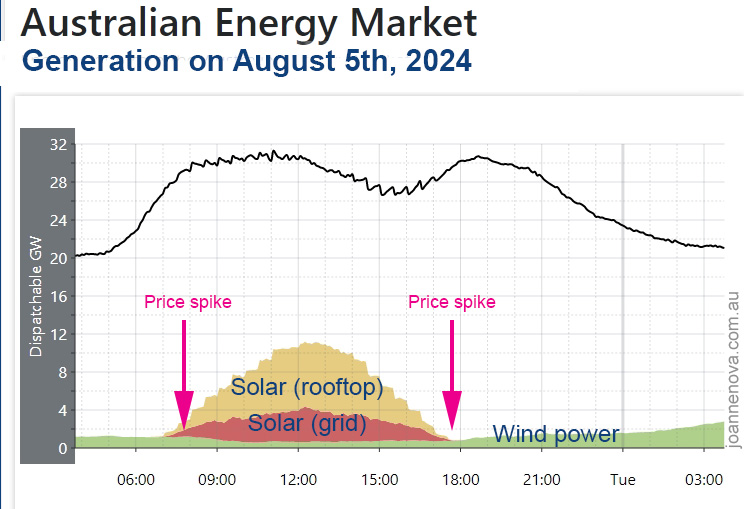
And you thought last week was bad. While the single spike at $17,000 a megawatt hour in five states simultaneously was a record, just a week later we have the double spike bonfire — peaking at breakfast and dinner on the same day in our two largest states. That’s a high degree-of-difficulty (to pay the bill). This was not just a 5-minute bid rocket — it was 90 full minutes of blitzkreig twice in a day for both NSW and Victoria. With admirable supporting efforts in burning money in Tasmania and South Australia for breakfast, and then in Queensland, which joined the financial bonfire for dinner.

The average price for the whole 24 hour period of August 5th was eye-watering. Last week the spike flattened out to about $300 per megawatt hour across the day. But yesterday in NSW and Victoria, the average price was $2,150 across both states for 24 hours in a row.

Welcome to renewable hell

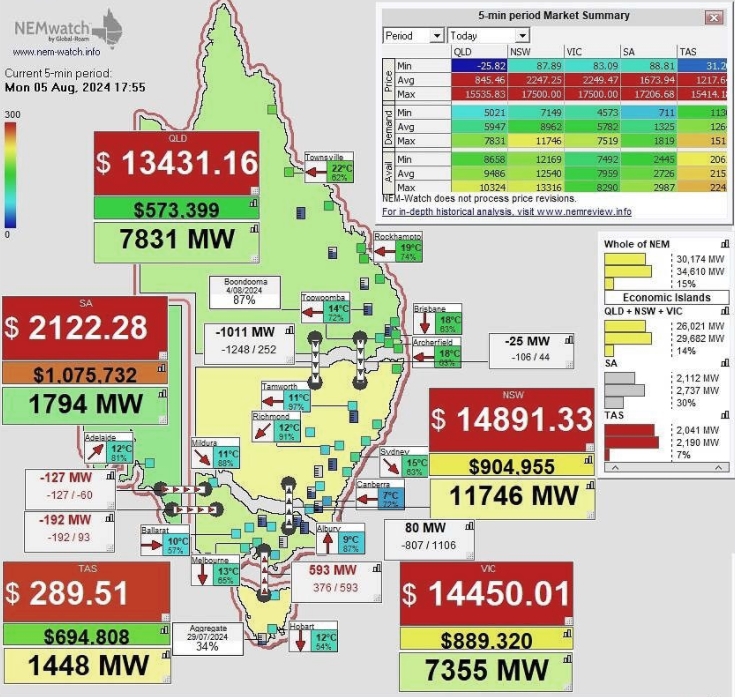
At both peaks Victoria was burning 7.5GW of power at $17,000 a megawatt hour.

In NSW the breakfast peak was 10GW and the dinner peak was 12GW. Count the money… theoretically this is $17 million per gigawatt hour. While the retailers have some hedging to avoid the carnage on the spot market, each spike is sending a price signal that’s about $200 million dollars. We could have built a gas plant….

It would be cruel to say these price spikes correlated with wind and solar failures, but I’ll say it anyway:

Renewable Generation and price spikes.

ANERO.id


Paul McArdle of WattClarity points out demand was 30GW in the evening — which is moderately high, but not a record. Wind was low, clouds rolled in sapping, and seven out of 44 coal plants were out of action (partly by design and partly by accident).

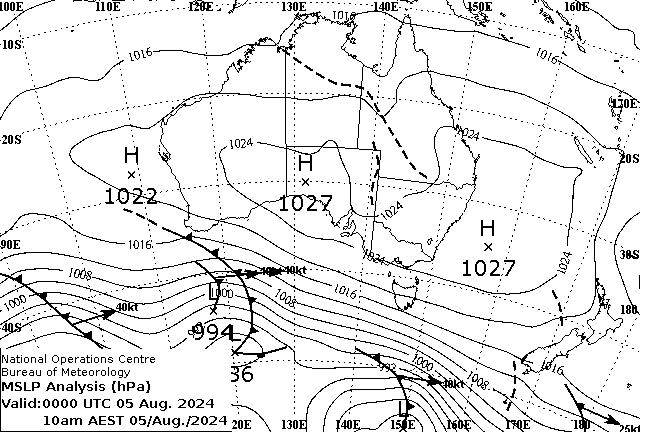
It was, of course, another hostile high pressure cell — 5,000 miles wide and here to becalm the entire continental wind power industry.

What happens if “Climate change” causes High Pressure Cells over Australia?


Synoptic chart. Australia. Wind power

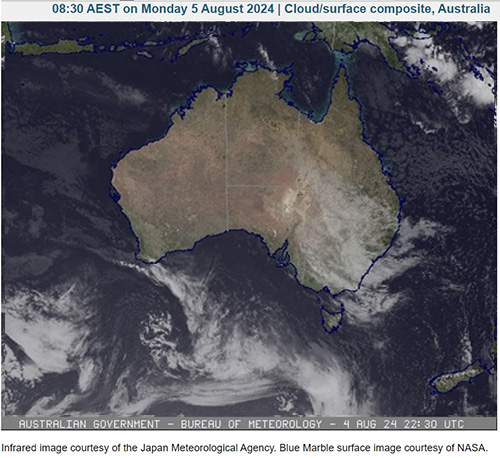
And the clouds rolled over

At 8am the grand total of wind and solar power yesterday was only 4 gigawatts. Just a few days ago, at 8am, the same equipment was providing 6.6 gigawatts. So it’s just an “unplanned” outage of 2.5 gigawatts.

From the BOM Satellite page
Clouds over Australia. BOM. Satellite image.Thanks to WattClarity for the snapshot

August 5, 2024 Price Spike, AEMO. Australia.

Even though the biggest bonfires were in NSW and Victoria, things were bad on the whole National Grid — for the 24 hour period Queensland also averaged $1,040 per megawatt hour, South Australia: $1,600 and Tasmania $943.

And let’s not forget if we’d made different choices that a good old brown coal plant could have made all this electricity for $8 a megawatt hour.


0 out of 10 based on 0 rating

via JoNova

https://ift.tt/vamVruM

August 5, 2024 at 03:25PM

The Real Threat to Democracy

With street riots seemingly breaking out in just about every one of our cities, it is easy to understand why journalists and politicians are currently in agreement that right-wing thuggery is one of the greatest threats to our democracy. And since this all started out following the spread of a factually incorrect rumour that the Southport assailant had been an illegal refugee from Syria, one can also understand why the rise of fake news, spread by bad actors, has also been resurrected as a primary threat. These are well-established narratives that our society has come to hold dear. So it is no wonder that bringing the ‘scum’ to justice and clamping down on online misinformation have featured so prominently in the approved response. After all, whenever democracy itself is under threat, the authorities cannot afford to appear weak. So just lock them all up, they say. Throw away the key and fine the internet platforms as heavily as you can. That’ll sort it out.

I don’t wish to play down the importance of the societal unrest we are currently experiencing, and I certainly am not condoning the criminal behaviour we are witnessing. But I would like to offer an alternative perspective on where the real threat lies here. And bear with me, because it is a threat that has much wider ramifications than the excesses of the extreme right-wing or the threat of online misinformation. Furthermore, it is particularly important when reflecting upon Net Zero and the prospect of a peaceful challenge.

To put it simply, democracy is never under greater threat than when journalists and politicians are seemingly in lockstep. For example, both Kier Starmer and Yvette Cooper have been at pains to point out that what we are seeing is not legitimate protest but mindless and opportunistic thuggery. And, apart from a few mutterings, so say all the newspapers. There is very little evidence that journalists are in much of a mood to question what Starmer and Cooper are saying. Nobody, for example, seems to be headlining with the claim that recent events are primarily the inevitable result of years of political failure. Nobody seems to be pointing out that these ‘thugs’ are nevertheless sincere in stating their grievances; that they just happen to prefer to express themselves through the magic of mindless violence. Yes, they are being outrageously non-democratic in their approach, but that does not mean that they have no point to make, no matter how knuckle-scraping they may be. Nor does it excuse a failure to analyse the path of political failure that has led to this horrific situation. Surely, to say that the rioters are just hooligans looking for any excuse to destroy is both simplistic and unhelpful. And yet that is what most of our journalists are letting our politicians get away with.

As a completely different example, what are we to make of the 20 billion pound ‘black hole’ that the incoming government ‘discovered’ when they opened up the spreadsheets on the shiny new PCs presented to them as they entered office? The best we have had from the journalists is a straightforward reporting of the inter-party squabbling that this ‘discovery’ has led to. And yet this is what Paul Johnson, Head of the Institute for Fiscal Studies had to say, four weeks prior to the general election, when he referred to a 20 billion pound financial hole revealed by the Office of Budgetary Responsibility (OBR):

We will be very rude if the new government comes in and says ‘oh look, this is a terrible shock. We’ve opened the books. The OBR have told us something we never expected and that’s why we didn’t tell you about all these tax rises we are going to introduce, or why we didn’t tell you we are going to have an entirely different set of fiscal rules. Or that’s why we didn’t tell you about spending cuts’. I think that would be fundamentally dishonest of them.

So why are not all of the papers now running with the headline ‘Reeves you are a blatant liar’, or ‘Oh how little time we had to wait before the Labour government’s duplicity was exposed’? More to the point, why had the journalists not called out both main parties for completely failing to address this black hole during their election campaigning? There were some, such as Owen Jones, who tried to raise this issue whenever they had the chance, but they tended to be voices in the wilderness. It is almost as if the press had been complicit in the silence back then. If so, that explains why even now they can’t bring themselves to call a lying cheating spade a lying cheating spade.

Whatever the case, this complicity has serious consequences for democracy. In the first example, politicians are being allowed to focus upon the need for an iron-fist approach to policing, rather than conceding that their previous political position had a role in increasing the likelihood of societal unrest. In addition, by framing the problem as a straightforward issue of law and order, they escape any discussion that perhaps their political position needs to change if we are to address the root causes. In the second example, a massive and profound deceit of the electorate is aided and abetted, and subsequently passed off as little more than a bit of creative accountancy that has raised some eyebrows. With such levels of journalistic delinquency the democratic process becomes worthless.

So why is our journalistic profession sleeping on the job? Why are they not prepared to challenge our politicians when it matters? And, most importantly as far as my current readership is concerned, what does this say for our chances of Net Zero being adequately challenged before rioting breaks out on the streets?

One of the problems seems to be the way in which our journalists and politicians interact. Too much of the mainstream political journalism now seems to operate through the auspices of so-called client journalists. It’s the journalism made famous in Yes Prime Minister, in which cosy relationships are established in Westminster watering holes, and where privileged access is courted and protected in quid pro quo relationships. The brutal fact is that most journalists are too interested in the next scoop that would enable them to win an award, and so dare not alienate the political benefactors who can service their needs (albeit for a little bit of tenderness in return). No one dared call out the Labour Party politicians during the election campaign because everyone was too busy fostering healthy client relationships that would see them through the next five years. No one who covets continued access to the corridors of power is now going to jeopardize any of that by calling out Reeves as being the bare-faced liar that she clearly is.

One can assume that similar thinking was behind the strange reluctance of the average hack to force the Labour Party into detailing just what David Milliband had in store for the hapless electorate. During the campaign, no one in the party seemed keen to push him forward, and no one seemed to find that strange. Furthermore, claims that fuel bills will go down, that Great British Energy would save the world, and that everything was fully funded were errant nonsense. Yet, weirdly, no one with a microphone seemed to know what questions to ask.

In fact, as far as Net Zero is concerned, the problem is so much more deep-rooted than that. Not only does your average journalist share Milliband’s delusion’s and failure to grasp basic principles of engineering and economics, there isn’t a great deal they can now do about it anyway because the irreversible damage was actually done during 14 years of client journalism supporting the Conservatives.

No doubt as reality dawns on the great British public, and the laws of physics catch up with Milliband, there will be an increasing level of challenge in the press, particularly the sector that leans to the right. But it is unlikely that journalists will force a U-turn in time to avoid the ‘mindless thuggery’ that will break out in the communities feeling the Net Zero pain first and hardest. No doubt, at that point, pledges to clamp down and restore law and order will feature prominently in the speeches of politicians and the reporting of journalists. After all, there will be democracy at stake. It’s just a shame that, before it got to that stage, the same journalists hadn’t thought to better protect democracy’s integrity by doing their job properly and demanding that politicians face reality.

via Climate Scepticism

https://ift.tt/nd81xBV

August 5, 2024 at 03:02PM

Ruinous Folly of CO2 Pricing

Dr. Lars Schernikau is an energy economist explaining why CO2 pricing (also falsely called “carbon pricing”) is a terrible idea fit only for discarding.  His blog article is The Dilemma of Pricing CO2.  Excerpts below in italics with my bolds and added images.

1.Understanding CO₂ pricing
2.Economic and environmental impact
3.Global economic impact
4.Alternative solutions
5.Conclusion
6.Additional comments and notes
7.References

Introduction

As an energy economist I am confronted daily with questions about the “energy transition” away from conventional fuels. As we know, the discussion about the “energy transition” stems from concerns about climatic changes.

The source of climatic changes is a widely discussed issue, with numerous policies and measures proposed to mitigate its impact. One such measure is the current and future pricing of carbon dioxide (CO₂) emissions. The logic followed is that if human CO₂ emissions are reduced, future global temperatures will be measurably lower, extreme weather events will be reduced, and sea-levels will rise less or stop rising all together.

Although intended to reduce greenhouse gases, this approach has sparked considerable debate. In this blog post I discuss the controversial topic of CO₂ pricing, examining its economic and environmental ramifications.

However, this article is not about the causes of climatic changes, nor is it about the negative or positive effects of a warming planet and higher atmospheric CO₂ concentrations. It is also not about the scientifically undisputed fact that we don’t know how much warming CO₂ causes (a list of recent academic research on CO₂’s climate sensitivity can be found at the end of this blog).

Nor do I unpack the undisputed and IPCC confirmed fact that each additional ton of CO₂ in the atmosphere has less warming effect than the previous ton as the climate sensitivity of CO₂ is a logarithmic function irrespective of us not knowing what that climate sensitivity is. I also don’t discuss the NASA satellite confirmed greening of the world over the past decades partially driven by higher atmopheric CO₂ concentrations (see sources inc Chen et al. 2024).

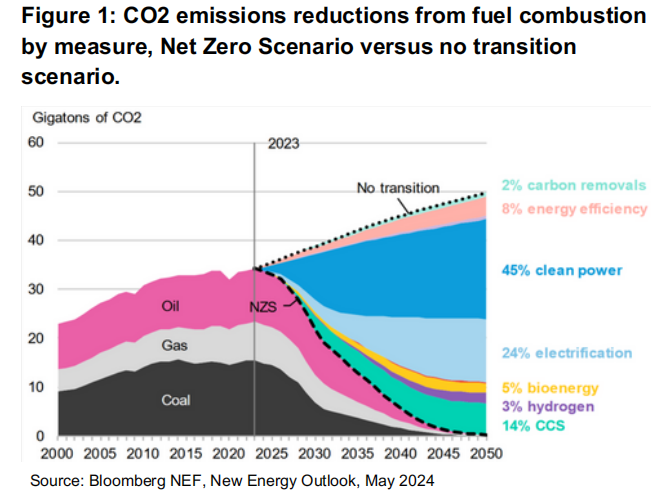
Instead, this blog post is about the environmental and economic “sense”, or lack thereof, of pricing CO₂ emissions as currently practiced in most OECD countries and increasingly seen in developing nations. It is about the “none-sense” of measuring practically all human activity with a “CO₂ footprint”, often mistakenly called “carbon footprint”, and having nearly every organization set claims for current or future “Net-Zero” (Figure 1).
1.Understanding CO₂ Pricing

CO₂ pricing aims to internalize the external costs of CO₂ emissions, thereby encouraging businesses and individuals to reduce their “carbon footprint”. The concept is straightforward: by assigning a cost to CO₂ emissions, it becomes financially advantageous to emit less CO₂.

However, this simplistic view overlooks
significant complexities and unintended consequences.

Our entire existence is based on drawing from nature (“renewable” or not), so the “Net-Zero” discussion ignores a fundamental requirement for our survival. I agree that it should be our aim to reduce the environmental footprint as much as possible but only if our lives, health, and wealth don’t deteriorate as a result.

Now, I am sure, some readers and many “activists” may disagree, which I respect but, at a global level, find unrealistic. However, I would assume that most agree that no-one’s life ought to be harmed or shortened for the sake of reducing the environmental impact made. Otherwise, there is little room for a conversation.

BloombergNEFs “New Energy Outlook” from May 2024 should possibly be called “CO₂ Outlook”, as there is little to be found about energy and its economics but rather all about CO₂ emissions and the so called “Net-Zero” (Figure 1), which is in line with media, government, and educational focus on primarily carbon dioxide emissions.

2.Economic and Environmental Impacts

One of the primary criticisms of CO₂ pricing is that it addresses only one environmental externality while ignoring others. This narrow focus can lead to economic distortions, as it fails to account for the full spectrum of environmental and social impacts. For instance, while CO₂ pricing might reduce emissions, it can also drive-up energy costs, disproportionately affecting lower-income populations and hindering economic development in lesser developed countries.

It is by now undisputed amongst energy economists that, large-scale “Net-Zero” intermittent and unpredictable wind and solar power generation increases the total or “full” cost of electricity, primarily because of their low energy density, intermittency, inherent net energy and raw material inefficiency, mounting integration costs for power grids, and the need for a drastic overbuild installation system plus an overbuild backup/storage system because of their intermittency.

CO₂ pricing can also result in environmental trade-offs. For example, the shift towards “renewable” energy sources like wind and solar, incentivized by CO₂ pricing, has its own set of environmental impacts, including land use, resource extraction, energy footprint, and energy storage challenges.

When BloombergNEF (Figure 1) displays
how clean power and electrification
will directly reduce CO₂ emissions to zero,
then they are clearly mistaken.

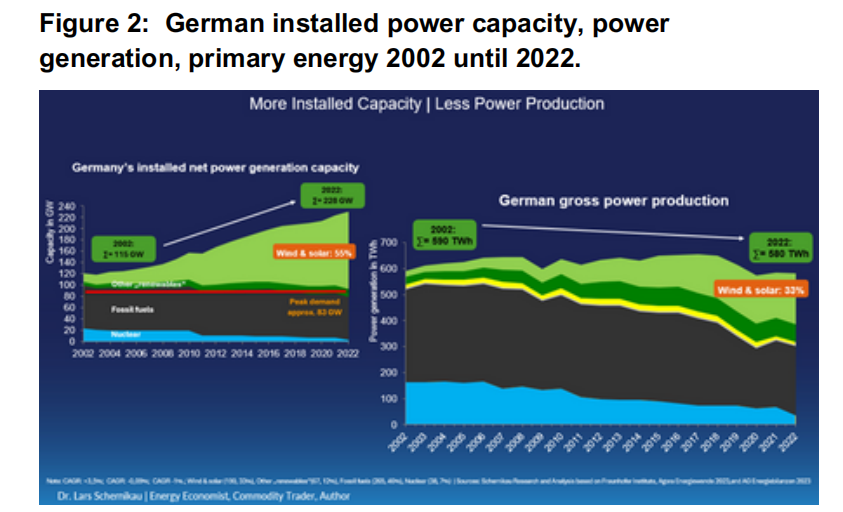
My native country Germany provides a notable example of the complexities involved in transitioning to “renewable” energy. The country has invested heavily in wind and solar power, leading to the highest electricity costs among larger nations. Germany’s installed wind and solar capacity is now twice the total peak power demand. This variable “renewable” wind and solar power capacity now produces about a third of the country’s electricity and contributes about 6% to Germany’s primary energy supply (Figure 2).

Sources: Schernikau based on Fraunhofer, Agora, AG Energiebilanzen. See also www.unpopular-truth.com/graphs.

3.Global Economic Implications

Higher energy costs, obviously and undisputedly, hurt less affluent people and stifles the development of poorer nations (Figure 3). Thus, a move to more expensive wind and solar energy has “human externalities”. The less fortunate will be “starved of” energy as they wouldn’t be able to afford it, leading to literal reduction in life expectancy.
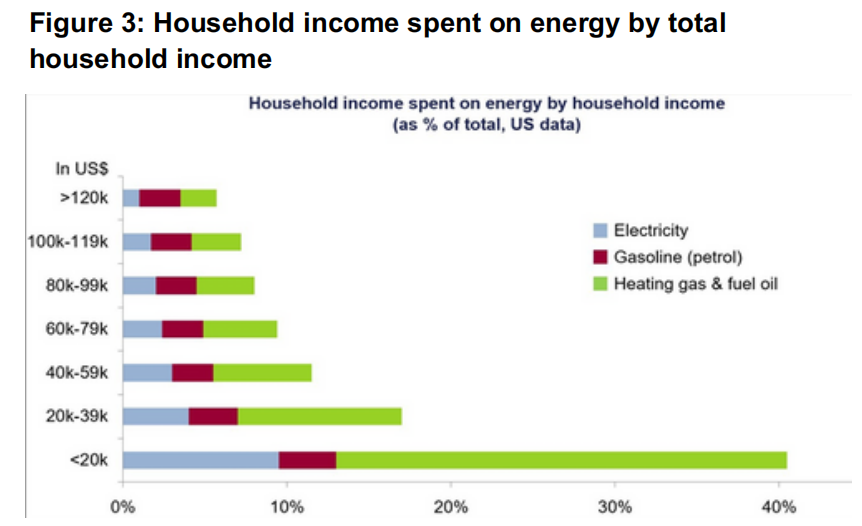
Source: Eschenbach 2017; Figure 38 in Book “The Unpopular Truth… about Electricity and the Future of Energy”

CO₂ pricing typically focuses only on emissions during operation,
neglecting significant environmental and economic costs
incurred during other stages or by the entire system.

For instance, the production of solar panels involves substantial energy and raw material inputs. Today there is not one single solar panel that is produced without coal. Similarly, the manufacturing and transportation processes of wind turbines and electric vehicles are energy-intensive and environmentally impactful. These stages are rarely accounted for in CO₂ pricing schemes, leading to a distorted view of their true environmental footprint. Also not accounted for are:

a) the required overbuild,
b) short and long duration energy storage,
c) backup facilities, or
d) larger network integration and transmission infrastructure.
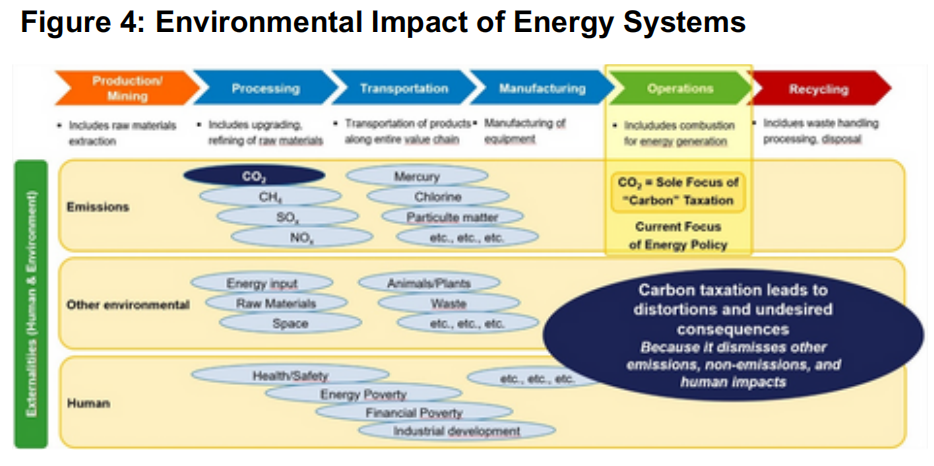
Source: Schernikau, adapted from Figure 39 in Book “The Unpopular Truth… about Electricity and the Future of Energy“

Figure 4 illustrates how virtually all CO₂ pricing or taxation happens only at the stage of “operation” or combustion. How else could a “Net-Zero” label be assigned to a solar panel produced from coal and minerals extracted in Africa with diesel-run equipment, transported to China on a vessel powered by fuel-oil, and processed with heat and electricity from coal- or gas-fired power partially using forced labour? All this energy-intensive activity and not a single kilogram of CO₂ is taxed (see my recent article on this subject here) The same applies to wind turbines, hydro power, biofuel, or electric vehicles.

It turns out, CO₂ tax is basically just a means to redistribute wealth, with the collecting agency (government) deciding where the funds go. Yes, a CO₂ tax does incentivize industry to reduce CO₂ emissions at their taxed operations only, but this comes at a cost to economies, the environment, and often people. . . Any economist will confirm that pricing one externality but not others leads to economic distortions and, many would say, worse environmental impacts.

4.Alternative Approaches

Distortion, in this case, is just another word for unintended consequences to the environment, our economies, and the people. Pricing CO₂ only during combustion but failing to price methane, raw material and recycling, inefficiency, or embodied energy, or energy shortages, or land requirement, or greening from CO₂… will cause undesirable outcomes. The world will be worse off economically and environmentally.

Protest if you must, but let me offer a simple example. The leaders of the Western world seem to have united around abandoning coal immediately, because it is the highest CO₂ emitter during combustion (UN 2019). Instead, demanding reliable and affordable energy, Bangladesh, Pakistan, Germany, and so many more nations have embraced liquified natural gas (LNG) as a “bridge” fuel to replace coal. This “switch” is taking place despite questions about LNG’s impact on the environment, including the “climate”. This policy, supported by almost all large consultancies, indirectly caused blackouts affecting over 150 million people in Bangladesh in October 2022 (Reuters and Bloomberg).

So, the world is embarking on an expensive venture
to replace as much coal as possible with
more expensive liquified natural gas LNG.

On top of that, wind and solar are given preference. For example, the IEA recently confirmed that 2024 sparks the first year where investments in solar outstrip the combined investments in all other power generation technologies. As a result, energy costs go up, dependencies increase, lights go off, and, as per the UN’s IPCC, the “climate gets worse.”

Now imagine what would happen if we would truly take into account all environmental and human impacts, both negative and positive, along the entire value chain of energy production, transportation, processing, generation, consumption, and disposal… we would all be surprised! You would look at fossil fuels and certainly nuclear through different eyes. Instead we should simply incentivize resource and energy efficiency which will truly make a positive difference!

5.Conclusion

No matter what your view on climate change is, pricing CO₂ is harmful… why?
Answer: … because pricing one externality but not others leads to economic and environmental distortions…causing human suffering.

That is why, even considering the entire value chain, I do not support any CO₂ pricing.. That is why I fight for environmental and economic justice so we can, by avoiding energy starvation and resulting poverty, make a truly positive difference not only for ourselves but also for future generations to come.. . We need INvestment in, not DIvestment from 80% of our energy supply to rationalize our energy systems and to allow people and the planet to flourish.

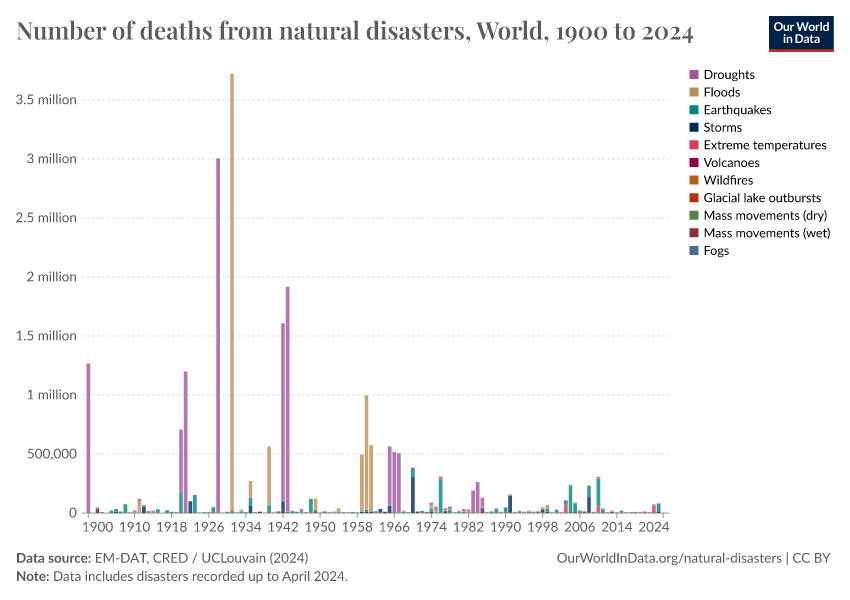
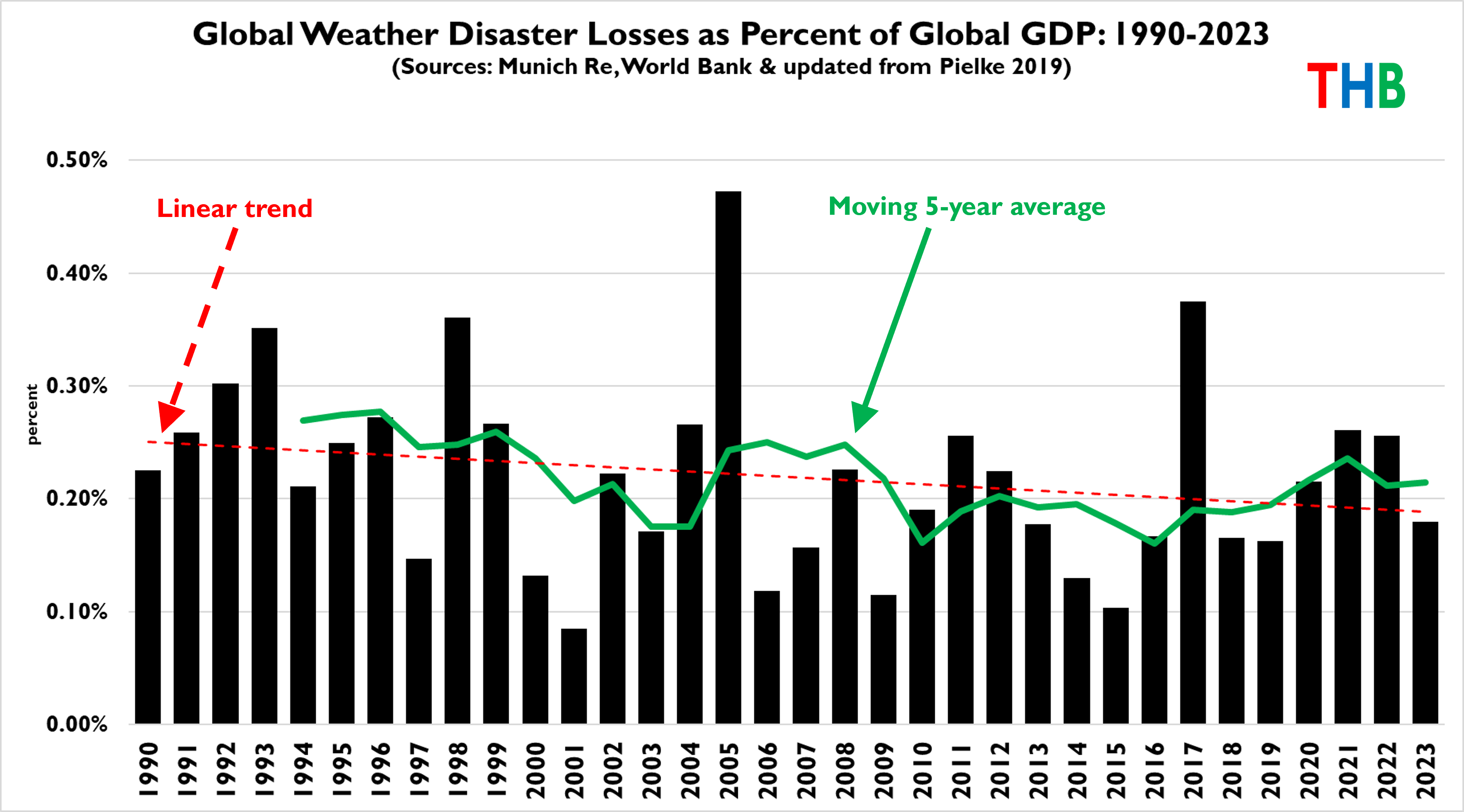
I strongly support increasing adaptation efforts, which have already been successful in drastically reducing the death rate and GDP adjusted financial damage from natural disasters during the past
100 years (OurWorldInData, Pielke 2022, Economist).


via Science Matters

https://ift.tt/WMRwZiQ

August 5, 2024 at 01:54PM