
Month: August 2024

New Zealand’s Net Zero green energy disaster is a terrible warning

By Paul Homewood


h/t Ian Magness

A glimpse of our future!


image

New Zealand has serious problems with its power supply. There are three underlying reasons: the weather, a flawed electricity market and a drive for ‘net zero’.

Sixty-five per cent of New Zealand’s electricity is provided by hydropower, and the remainder by geothermal, gas, coal, wind and some solar. Though hydropower is often seen as the one form of renewable energy which is not plagued by intermittency of supply, it sadly isn’t true. In a dry year, hydro’s ability to deliver falls away, and we lose about 10 per cent of our generation. In the past, we always tried to have the hydro reservoirs and coal stockpile full by the end of summer to guard against this possibility. When we switched to an electricity market, this was forgotten.

This year, we failed to refill the reservoirs, and levels are now unusually low. We are muddling along for the moment, but this is a difficult position from which to recover and there are likely to be blackouts at some point in the future.

The ability of our fossil fuel power stations to step into the gap has been severely restricted. We used to get 20 per cent of our electricity from gas-fired power stations, but six years ago, as part of their decarbonisation policy, the previous government banned further gas exploration, and we are now desperately short of gas. The new government is encouraging new exploration but we won’t see the results for several years.

We also have a single coal fired station with insufficient coal in its stockpile because our electricity market does not pay for the cost of maintaining an adequate stockpile.

Full story here.

via NOT A LOT OF PEOPLE KNOW THAT

https://ift.tt/6H5cp9d

August 29, 2024 at 03:44AM

Electric car boss quits after sales plunge 40pc

By Paul Homewood


 image

The chief executive and founder of European Tesla rival Polestar has quit after seven years at the helm.

Polestar, which is controlled by Sweden’s Volvo and China’s Geely, confirmed on Wednesday the resignation of long-time boss and founder Thomas Ingenlath. He will be replaced from Oct 1.

His resignation comes after sales of the Swedish company’s upmarket electric cars slumped. Global volumes fell 40pc in the first quarter of 2024 to 7,221, down from 12,076 the previous year.

Once valued at more than $20bn (£15bn), Polestar’s valuation has plummeted to around $2bn since it went public in 2022. Its shares, listed in New York, are down 41pc this year alone.

The carmaker, headquartered in Gothenburg in Sweden, lost close to $1.5bn over the course of 2023.

Originally starting life as a prototyping division of Volvo, developing concept models and touring car racers, Polestar was launched as a standalone marque in 2017. It was billed as Europe’s answer to Tesla.

Vehicles such as the Polestar 2 electric hatchback received a positive reception from critics.

However, Matthias Schmidt, an analyst at Schmidt Automotive Research, said Polestar had struggled to turn its critical acclaim into mass sales.

In February, Volvo announced it would no longer be providing financial support to Polestar, offloading part of its 48pc stake to Geely, its Chinese parent company.

https://www.telegraph.co.uk/business/2024/08/28/boss-electric-carmaker-polestar-cut-off-volvo-quits/

via NOT A LOT OF PEOPLE KNOW THAT

https://ift.tt/XiDsQJv

August 29, 2024 at 03:36AM

Running on “100% Renewables” Claims = 100% Pure & Unadulterated Bunkum

Corporates claiming to run on nothing but sunshine and breezes is just another form of greenwashing. Whether it’s tales about producing ‘green’ iron or ‘green’ hydrogen, the truth never gets a look in. And it’s the same when major energy users claim to be exclusively powered by wind and/or solar.

In every case these operators ensure that they remain connected to the same grid that powers everybody else; the same grid that runs on coal, gas or nuclear. Such that reliable power is never far away.

Even where the green-washer purports to disconnect, there will be a bank of diesel generators or gas turbines close and handy when the sun sets, the wind stops blowing or the battery runs flat.

Any business worth running requires power as and when it needs it; not when the sun’s up or the wind is blowing.

And that very much includes data centres that sit at the heart of the Internet.

Knowing that their staggering and constant power use has capacity to generate poor corporate ‘optics’, electronic data handling outfits – like America’s Switch – pitch up stories about using 100% ‘renewable’ energy, 100% of the time.

As Francis Menton reports below, it’s a claim that is 100% pure and unadulterated bunkum.

Zero Emissions Grid Demonstration Project Follies: No Fraudulent Demonstration Projects Allowed!
Manhattan Contrarian
Francis Menton
13 August 2024

Even as I regularly repeat my calls for a Zero Emissions Grid Demonstration Project, I’m ready for the next move in the back and forth.

Suppose someone claims that a steady zero emissions electricity supply has been achieved? How can we determine and verify whether that is true? The facts can be sufficiently complex, and the incentives sufficiently perverse, that fraudulent claims are to be expected.

Consider the simple case of El Hierro Island. They set out in 2008 with the objective of building a wind/storage electricity system that would provide the island with zero-emissions electricity.

To this day, the website of the wind/storage electricity company, Gorona del Viento, proclaims on its opening page “An island 100% renewable energy.” Proceed through the website, and you will find lots of happy talk about tons of carbon emissions saved, and about hours of 100% renewable generation. But if you are persistent, and finally get to the detailed charts of the latest statistics, you find that the percent of electricity from the wind/storage system for the most recent full year (2023) was only 35%.

Because El Hierro is an island, it lacks the ability to cheat by sneaking in some electricity from gas or coal from a neighboring state or country and not counting it.

But now consider the case Switch Inc., which is one of the largest (maybe the very largest) companies that specialize in operating data centers.

Like its colleagues in Big Tech, Switch is obsessed with the desire to show its virtue by claiming to have “emissions” as low as possible, preferably zero.

As I discussed previously in posts here and here, the likes of Google, Microsoft, Meta, Apple and Amazon all have the same obsession, and they all put out annual “sustainability” reports that loudly proclaim their virtue in the headlines and introductions; but then, all of them ultimately admit in the fine print that their emissions are actually increasing with the voracious energy demands of data centers and AI.

Well, such honesty is not good enough for Switch. Go to their website here and you will find this unequivocal statement: “All Switch data centers have run on 100% renewable energy since 2016.”

Really? How have they accomplished that? Of course, you will not find sufficient detail in their own statements to check the veracity of their claim. However, Bill Ponton has done an excellent analysis at RealClearEnergy on August 6 definitively proving that their claim is fraudulent.

The title is “Tech Titan’s Quest for Net Zero.” [See below]

Although Switch has supposedly contracted for sufficient solar power and backup storage to supply the steady electricity requirements of its facilities, in fact basic math shows that they have not purchased nearly sufficient quantities of either to accomplish the job. Despite their claims to the contrary, they are thus sneaking undisclosed amounts of power from reliable hydrocarbon sources to keep their centers operational 24/7.

Checking into Switch’s claim of “100% renewable” energy for its data centers, Ponton focuses on a particular center (Citadel) outside Reno, Nevada. He goes to Switch’s 10K for 2021, where Switch discloses that it has contracted for 130MW of renewable (in this case, solar) power to run the facility. But is that enough?

To figure that out, you would need to know what is the baseload power requirement of the facility, and also how much storage is available to turn the intermittent solar power into a continuous baseload supply.

Switch omits that information from its 10K, but Ponton tracks it down in an article about the facility in Greentech Media for July 2020: the baseload power requirement of the facility is 30MW, and the available battery is a 60MW/240MWh Tesla Megapack.

So is 130 MW of solar arrays plus 240 MWh of storage sufficient to provide 30 MW of firm baseload power? Ponton goes through the calculations, and here is the conclusion:

For more than half of the year from September through March, solar generation is not enough to handle both daytime and nighttime demand of 720 MWh. Increasing battery storage from 240 MWh to 330 MWh will have some effect in reducing the system’s dependence on gas power backup, but above 330 MWh of battery capacity, the system is limited by its solar capacity. 

Switch has the option of increasing both its solar and battery capacity to reduce the percentage of gas generation required to back up the system. However, even with 200 MW of solar capacity and 420 MWh of battery capacity, gas will need to generate 1% of the total energy required to provide steady-state baseload of 30 MW both day and night.

So they would need to nearly double the storage capacity (240 MWh to 420 MWh) and multiply the solar generation capacity by more than 1.5 (130 MW to 200 MW), and still that would leave them needing to draw their supply 1% of the time from backup natural gas.

Now 1% of the time may not seem like very much. But 1% of a year is 87 hours, which is close to 4 days. And for those four days, you need the whole 30 MW of gas power that you would need to run the data center the whole time with no solar power at all. You need to keep the gas plant fully maintained and ready to step in at all times. And you need to pay the gas plant’s full cost of capital even though it may be idle 99% of the time.

If I am reading Mr. Ponton’s piece correctly, even to get to the figures of 200 MW of solar arrays and 420 MWh of storage to provide 30 MW of baseload power, he is assuming (1) zero turnaround losses on stored energy, and (2) no such thing as a cloudy day reducing solar irradiance.

I’ll let Mr. Ponton run the numbers on his spreadsheet, but I’ll bet that one good fully-overcast week in December or January could send the storage need from 420 MWh to a multiple of that.

Ponton provides this as a link to all of his calculations.

So the mighty Switch Inc. is exposed as no more honest about its assertions of zero emissions than our friend gkam.

The moral is that we should accept no claim of achievement of zero emissions electricity from anyone who maintains a continuing connection to a grid with hydrocarbon generation on it. Otherwise, there is way to much potential for cheating.
Manhattan Contrarian

Tech Titan’s Quest for Net Zero
Real Clear Energy
Bill Ponton
6 August 2024

All technology titans aspire to the goal of operating with 100% renewable energy. In reality, few, if any, have reached that goal. Their annual reports are laced with incessant net zero happy talk, but buried deep in those same pages is the admission that they are not even close to attaining their goals.

However, there are some companies that state that they have reached their goal of running on 100% renewable energy. Switch Inc. is one of those companies.

Switch is the brainchild of Rob Roy, Switch’s Founder and CEO, who in 2002 acquired a former Enron data center in Nevada and parlayed it into a formidable company. Switch states on its website that since January 2016, all Switch data centers have been powered by 100% renewable energy.

In its 2021 10-K form filed with the SEC, Switch states that its Citadel Campus near Reno, Nevada, designed to be the world’s largest data center, has up to 130 MW of 100% renewable power available to the facility. However, the report is conspicuously missing any reference to the baseload power requirement of the facility. Data centers have a relatively flat demand profile so it would be quite a trick to convert 130 MW of solar generation into something that a data center could utilize to run 24/7.

An article in Greentech Media provides a clue. It states that with the addition of a 60 MW/240-MWh Tesla Megapack installation, Switch turns 130 MW of solar capacity into 30 MW of “quasi-baseload” renewables. The battery converts daytime bell-shaped solar generation into nighttime dispatchable power.

For most readers this explanation would be suffice. However, for the inquisitive, there is an easy way to calculate whether 130 MW of solar capacity would provide 30 MW of steady baseload with the assistance of 60 MW/240 MWh Tesla Megapack.

The first step is to determine the daily solar irradiance (kWh/m2/day) received during each month at the solar facility near Las Vegas from which Switch purchases its renewable energy (see Table 1).
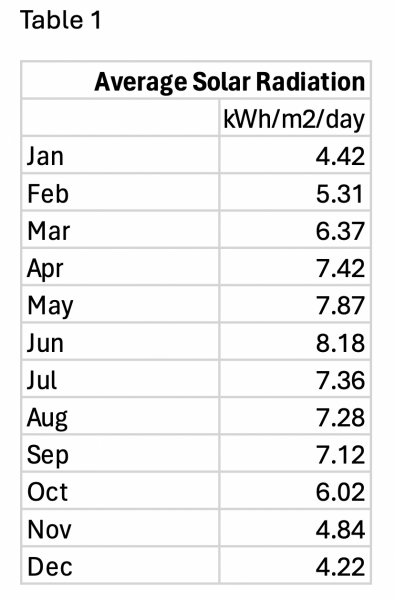
The NREL PV Calculator is a useful tool for computing the solar irradiance at a specific location and the solar power generation for a particular nameplate solar power capacity at that location. Assuming, 30 MW of steady-state power consumption and 130 MW of solar power capacity (as the GTM article concludes), solar generation, daytime demand and nighttime demand are as follows (see Table 2).
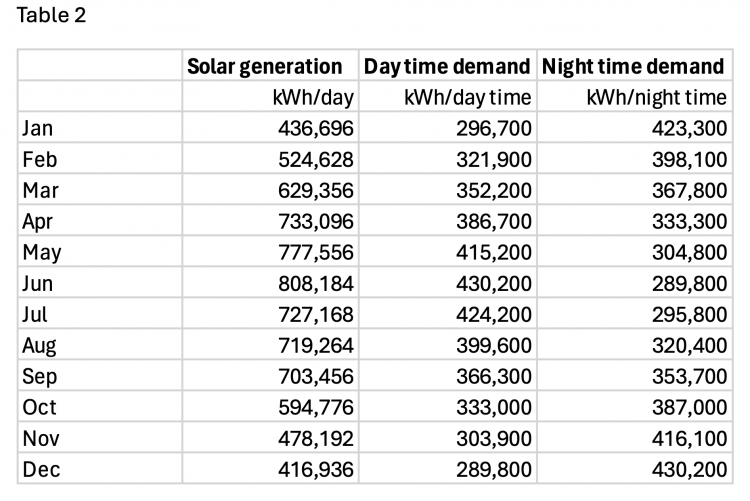
For more than half of the year from September through March, solar generation is not enough to handle both daytime and nighttime demand of 720 MWh.

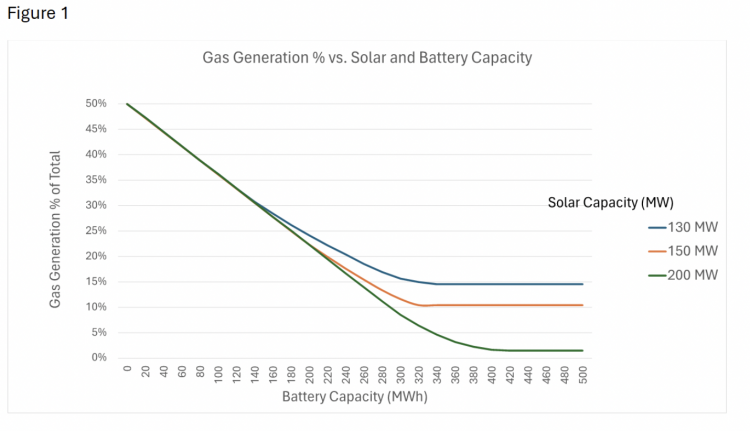
Increasing battery storage from 240 MWh to 330 MWh will have some effect in reducing the system’s dependence on gas power backup, but above 330 MWh of battery capacity, the system is limited by its solar capacity.

Switch has the option of increasing both its solar and battery capacity to reduce the percentage of gas generation required to back up the system. However, even with 200 MW of solar capacity and 420 MWh of battery capacity, gas will need to generate 1% of the total energy required to provide steady-state baseload of 30 MW both day and night (see Figure 1).
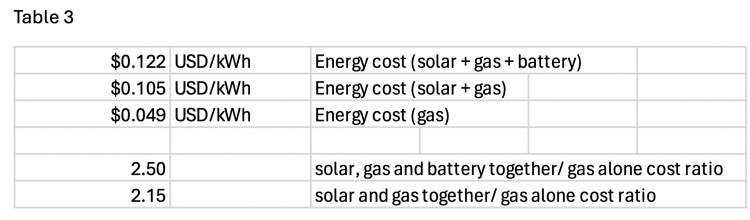
Switch pays a premium for its solar/battery scheme. Assuming EIA capital cost estimates and the 25-year average price for natural gas, energy cost would be over twice as much with solar power capacity of 130 MW and battery energy capacity of 240 MWh versus natural gas power of 30 MW. (See Table 3).
To keep gas generation at 1% of total with 200 MW of solar capacity and 420 MWh of battery capacity, Switch will need to pay 3.6 times more than it would cost with gas alone. (see Figure 2).
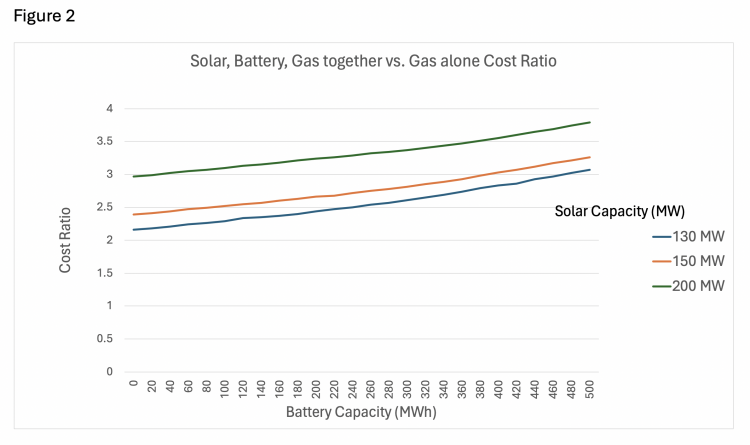
An observant reader will note that my analysis only takes into consideration diurnal patterns and 20% of the time the solar array is obscured by at least 80% cloud cover.

Both solar and  battery capacity would need to scale considerably to sustain steady-state output power throughout the overcast period. For those readers interested in reviewing my calculations, I provide a link to them here.
Real Clear Energy

via STOP THESE THINGS

https://ift.tt/wFKIdvl

August 29, 2024 at 02:33AM

Energy & Creative Destruction: Fossil Fuels Triumphant

“Creative destruction results from verdicts at the intersection of supply and demand. Outside of the free market, energy elitism has created a political market, a sub-industry whose activity results from special tax favors, government grants, and/or mandates.”

Creative destruction, a term popularized by Joseph Schumpeter, is the market process whereby bad is eliminated, the better replaces the good, and past performance gives way to new strategies and victors. No firm is forever, and financial loss is a characteristic of capitalism, as is the more used term profit.

Energy is the story of creative destruction. Coal gas and later coal oil replaced a variety of animal and vegetable oils, including whale oil, camphene oil, and stearin oil. Crude (mineral) oil then displaced manufactured (coal) oil, just as later natural gas would displace manufactured (coal) gas.

Coal itself displaced primitive biomass (burned plants and wood) and other forms of renewable energy, such as falling water and wind. Fossil fuel was a concentrated, continuous-burn industrial-grade energy.

The intensity of fossil energy can be understood as a stock of the sun’s work over the ages, not a dilute flow from the sun (solar, wind)–or a low-density mass from limited years of sunshine (biomass). “The ancient resource pattern depends primarily on animate energy and hence on current solar radiation,” Erich Zimmermann explained. “The modern resource pattern is built around stored-up solar radiation.”

Beginning with Jevons (1865)

W. S. Jevons explained how coal (and by implication, gas and oil) were uniquely suited for—and indeed, prerequisites for—the machine age. “[T]he economy of power … consists in withdrawing and using our small fraction of force in a happy mode and moment,” said Jevons, the father of modern energy thought.

Given fossil fuels, the unreliability of wind power and water flow were overcome. “The first great requisite of motive power is, that it shall be wholly at our command, to be exerted when, and where, and in what degree we desire,” Jevons explained. “The wind, for instance, as a direct motive power, is wholly inapplicable to a system of machine labour, for during a calm season the whole business of the country would be thrown out of gear.”

But even if wind were consistent and storable, it was still too little from too much. Jevons explained:

No possible concentration of windmills … would supply the force required in large factories or iron works. An ordinary windmill has the power of about thirty-four men, or at most seven horses. Many ordinary factories would therefore require ten windmills to drive them, and the great Dowlais Ironworks, employing a total engine power of 7,308 horses, would require no less than 1,000 large windmills!

Biomass was no escape. “We cannot revert to timber fuel, for ‘nearly the entire surface of our island would be required to grow timber sufficient for the consumption of the iron manufacture alone.’” And on geothermal: “The internal heat of the earth … presents an immense store of force, but, being manifested only in the hot-spring, the volcano, or the warm mine, it is evidently not available.”

Water power had reliability problems compared to coal and locational issues as well. Explained Jevons:

When an abundant natural fall of water is at hand, nothing can be cheaper or better than water power. But everything depends upon local circumstances. The occasional mountain torrent is simply destructive. Many streams and rivers only contain sufficient water half the year round and costly reservoirs alone could keep up the summer supply. In flat countries no engineering art could procure any considerable supply of natural water power, and in very few places do we find water power free from occasional failure by drought.

Furthermore,

The necessity … of carrying the work to the power, not the power to the work, is a disadvantage in water power, and wholly prevents that concentration of works in one neighbourhood which is highly advantageous to the perfection of our mechanical system. Even the cost of conveying materials often overbalances the cheapness of water power.

Dense Energy, Real Energy

In reference to California’s energy in the 1920s, the father of the modern electricity industry, Samuel Insull, explained how so-called white coal (hydroelectricity) required steam-plant backup for reliability.  And so it came to be in 2000/2001 when a bad water year in California triggered an electricity crisis in light of government retail price ceilings.

Steam plants, Insull added, could be situated near the load, unlike hydro production, which was at the river.

Jevons’s energy-by-energy analysis is as true today as it was when penned in 1865. Coal could be burned continuously and evenly, avoiding the intermittency of wind or sunshine. Coal did not depend on the season or on a weather condition, as did water flow. Coal was storable and transportable. Coal production and combustion needed far less surface area than would a similar amount of renewables.

In short, there could not be a return to the chancy, inflexible, dilute energies of the past—which were, ironically, all renewable from a physical viewpoint. [1] Seizing upon this point, Jevons was the first intellectual to question the ability of renewables to serve as primary energies for industrial society.

Coal as Wonder Fuel

“Coal, in truth, stands not beside but entirely above all other commodities,” Jevons concluded. “It is the material energy of the country—the universal aid—the factor in everything we do. With coal almost any feat is possible or easy; without it we are thrown back in the laborious poverty of early times.” As the “source of fire … of mechanical motion and of chemical change,” coal was “the Mainspring of Modern Material Civilization.”

This wonder fuel, Jevons added, was “the chief agent in almost every improvement or discovery in the arts which the present age brings forth.” The iron age was really the age of coal, since “coal alone can command in sufficient abundance either the iron or the steam.” Substitute carbon-based energy for coal—add oil and gas to coal—and Jevons’s conclusion is clear and correct for today.

Coal creatively destroyed renewables as primary energy. The carbon-based energy era introduced creative destruction between coal, manufactured gas (coal gas), manufactured oil (coal oil), crude oil, and natural gas.

Other Creative Energy Destruction

Thomas Edison’s electricity rocked the manufactured-gas industry across an ocean, as witnessed in London by a young Samuel Insull. It was coal versus coal once removed, with gas distilled from coal competing against coal-generated electricity. Later, natural gas would go head to head with coal to generate steam for producing electricity.

In transportation, creative destruction encompassed the gasoline-powered internal-combustion engine, which knocked electricity off its perch. Try as they might, Edison, Insull, and even Henry Ford could not make electric vehicles viable against petroleum-powered cars and trucks. Batteries were heavy, costly, and slow to recharge compared to the energy from on-board motors.

Neither could electricity break into the railroad market, despite the entreaties of Samuel Insull. Wood, then coal, then diesel burned on board was simply too economical for rural locomotion, as opposed to urban street locomotion.

Samuel Insull’s standards of excellence made him an agent of creative destruction. The “creative rearranger” improved his industry over multiple decades. Early in his Chicago career, Insull persuaded manufacturers, retailers, traction companies, and farm villages to stop generating their own power and to buy instead his cheaper, more reliable supply. Insull’s new-and-improved electricity reached across the energy market, pressuring both kerosene and coal gas in the illumination market to improve or perish.

But Insull’s best efforts could not make electricity competitive for transportation outside of streetcars, and his battery packs at power plants proved to be a very expensive, limited option to serve peak demand. Electricity had to be consumed the moment it was produced, creating a different set of economics that über-entrepreneur Insull addressed via two-part rates and other strategies.

Conclusion

Creative destruction results from market verdicts at the intersection of supply and demand. Innovation and expected profit drive supply; price, availability, and quality (including reliability) attract demand.

Outside of the free market, energy elitism and legislative votes have created a political market, a sub-industry whose activity results from special tax favors, government grants, and/or mandates. Uneconomic energies are a form of postmodernism under which market-rejected, politically correct offerings spring to life—liabilities parading as assets.


[1] Also see Robert Bradley, Capitalism at Work: Business, Government, and Energy (2009), pp. 194–98.

The post Energy & Creative Destruction: Fossil Fuels Triumphant appeared first on Master Resource.

via Master Resource

https://ift.tt/iCoEhNg

August 29, 2024 at 01:04AM