Month: August 2024

New research may lead to more accurate forecasting of active hurricane periods

More accurately predicting periods of increased hurricane activity weeks in advance may become possible due to new research published this month.

The study, led by the U.S. National Science Foundation National Center for Atmospheric Research (NSF NCAR), shows that twice as many hurricanes form two days after the passing of large-scale atmospheric waves called Kelvin waves than in the days before. This finding may enable forecasters and emergency managers to anticipate clusters of hurricanes days to weeks in advance. 

The research team used an innovative computer modeling approach to tease out the influence of Kelvin waves, which are large-scale atmospheric waves that can extend more than 1,000 miles in the atmosphere and shape global weather patterns. 

“If weather forecasters can detect a Kelvin wave over the Pacific Ocean, for example, then they can anticipate that a few days after the wave there will be an uptick in hurricanes forming over the Atlantic,” said NSF NCAR scientist Rosimar Rios-Berrios, the lead author of the paper. “This would help them communicate with emergency managers and local governments who could prepare for the likelihood of an active hurricane period and alert the public. This research has the potential to save many lives.” 

The study was published in Monthly Weather Review

Aquaplanet 

For decades, scientists have noticed that hurricanes form in clusters followed by several weeks of little to no hurricane activity. Several studies have suggested that Kelvin waves could be responsible for the surge in hurricanes, but scientists were unable to separate out other potential factors and prove Kelvin waves were responsible. To overcome this, Rios-Berrios and her colleagues used a novel combination of computer modeling tools to confirm that Kelvin waves do indeed boost hurricane formation. 

The research team used a simulation called aquaplanet that was run on NSF NCAR’s Model for Prediction Across Scales (MPAS), which is a next-generation computer model that can capture fine-scale weather phenomena and global-scale atmospheric patterns simultaneously.  Aquaplanet is a configuration that simulates a hypothetical world that behaves like Earth, but doesn’t have land or seasons. The simplified world acts like a lab and makes it easier to isolate the effects of Kelvin waves on hurricane formation. 

The scientists ran the simulations on the Cheyenne supercomputer at the NCAR-Wyoming Supercomputing Center.

To investigate the connection between Kelvin waves and hurricanes, the research team measured the number of days between hurricane formation and Kelvin wave crests. The measurements showed a significant peak after two days, with hurricane development being twice as likely. Because the aquaplanet simulations capture the physical process of hurricane formation, the results go beyond correlation and suggest that Kelvin waves are actually impacting hurricane formation.

The new study also emphasizes the importance of recent research that Rios-Berrios co-authored with NSF NCAR postdoc Quinton Lawton about the need to improve the ability of weather forecast models to simulate Kelvin waves.

“I started this research on Kelvin waves in 2017. It was a big project that took years to go from an idea to scientific results and really highlights why this type of research is so valuable,” said Rios-Berrios. “There are still a lot of gaps in scientific knowledge about how hurricanes form and research like this helps us narrow where scientists should focus to better understand these powerful storms.” 

The paper: 

Title: Modulation of tropical cyclogenesis by convectively coupled Kelvin waves
Authors: Rosimar Rios-Berrios, Brian Tang, Christopher Davis, and Jonathan Martinez
Journal: Monthly Weather Review

via Watts Up With That?

https://ift.tt/wgWc3fy

August 29, 2024 at 12:07AM

No, New York Times, Maine Lobsters Aren’t Dwindling Due to Climate Change

By Anthony Watts and H. Sterling Burnett

An August 25th article in the New York Times (NYT), titled “What the Lobstermen of Maine Tell Us About the Election claims “…as far as climate change goes, Maine’s lobster fishing community may well be America’s own canary in the coal mine,” implying that harm to Maine’s lobster fishing industry is an early indicator of the dangers from climate change. This is false. Multiple lines of data show that the Maine lobster industry is doing well. Amid a mild warming over the past century, record lobster hauls have been recorded in the last 10 years even as the number of licensed lobstermen has fallen significantly.

Climate Realism discussed the fortunes of the lobster fishery in the face of climate change previously in an October 2020 Climate Realism story.

“The Maine Department of Marine Resouces (DMR) reports that each of the 10 highest annual lobster catches occurred during the past 10 years,” reported the 2020 Climate Realism post. “Lobster catches in Maine are presently double what they were just 20 years ago.”

With two additional years of data, the story is still the same, recent years catches remain among the highest ever recorded.

In fact, DMR data show that amid historically normal year to year variations in catch totals, over the past 34 year period of modest warming, Maine’s lobster catch has increased by approximately 288 percent since 1990, even as the number of licensed lobster fishers declined by almost 13 percent, largely due to stricter regulations raising the cost to operators. (See the table, below)

The NYT says in their article, “In part because of climate change, Ms. Guenther believes, the number of full-time lobster fishermen in Maine may decline by as much as one-half during the next decade.” If so that will likely be because of federal regulations limiting lobster operations ostensibly to protect endangered North Atlantic right whales even as the government promotes massive offshore wind complexes in lobster and whale habitat. Climate rules, not modestly warmer waters, are the biggest threat to the lobster industry.

A 2023 masonslobster.com article discussing the state of the industry, also directly refutes the NYT’s analysis:

Last year, Maine fishermen hauled ashore 124 million pounds of lobsters, six times more than what they’d caught in 1984. The $456 million in value those landings totaled was nearly 20% higher than any other year in history, in real terms. These days, around 85% of American lobster caught in the US is landed in Maine—more than ever before.

Even more remarkable than sheer volume, though, is that this sudden sixfold surge has no clear explanation. A rise in sea temperatures, which has sped up lobster growth and opened up new coastal habitats for baby lobsters, is one likely reason.

The National Oceanic and Atmospheric Administration (NOAA) has this to say about the state of Maine’s lobster fishery:

Maine’s economy has reaped the benefits of the lobsters’ move. In 2014, New England’s lobster industry was worth $564 million. Maine alone reported $459.6 million—81% of the total. The arrival of the lobster seems like a boon for Mainers, but the thing that pushed them north hasn’t gone away: warming ocean temperatures.

Clearly, warmer ocean temperatures, a common claim from climate change advocates, have, if anything, had the effect of increasing lobster hauls in Maine, rather than causing a significant decline. (see the graphic, below)

In 2021, the value of the Maine lobster catch skyrocketed:

Lobster landings in Maine from 1950 to 2021. (Courtesy Maine Department Of Marine Resources)

NewsCenter Maine recently cited DMR preliminary data for 2023 which suggests that the lobster haul fell in 2023 to 93,734,116 pounds of lobster, but that figure is in line with the historical interannual changes in the haul. It is still higher than every year prior 2010, even with a decline in licensed lobster fishers.

Despite the lower catch, the value of the lobster haul increased by $72 million from 2022 to 2023, reaching $461,371,720. This was due to a significant increase in the price paid to fishermen, from $3.97 per pound in 2022 to $4.95 per pound in 2023.

Rather than climate change, in fact, the NYT reports that invasive species are a likely reason for recent declines:

To begin, sea squirts are suddenly everywhere. Translucent, water-filled organisms known as tunicates and about the size of a golf ball, they can spread rapidly across the ocean floor, fouling oyster beds and leeching oxygen from the seawater. “After they die off,” Mr. Black said, “the bottom is dead.” Sea squirts were most likely imported in the bilge water of a foreign ship, and they can now thrive in the Gulf of Maine, whose water has warmed.

Sea squirts, brought in by a ship in bilgewater, have nothing to do with climate change.

Also, since climate change operates on long time scales, of 30 years or more, claims by the NYT of a climate connection to reducing catches in any single year are simply rank speculation with nothing to back it up. That’s probably why the NYT article was in the opinion section of the newspaper.

Contrary to the impression given by the NYT promoting the prescribed climate crisis narrative that climate change causes nearly every bad thing that happens, data show that Maine’s lobster fishery is doing well. It is profitable and the catch remains abundant. NYT’s story is shoddy journalism at best.

via Watts Up With That?

https://ift.tt/nAhCWEM

August 28, 2024 at 08:05PM

Cold showers coming, as largest exporter of LNG runs out of gas due to red tape and green fantasies

By Jo Nova

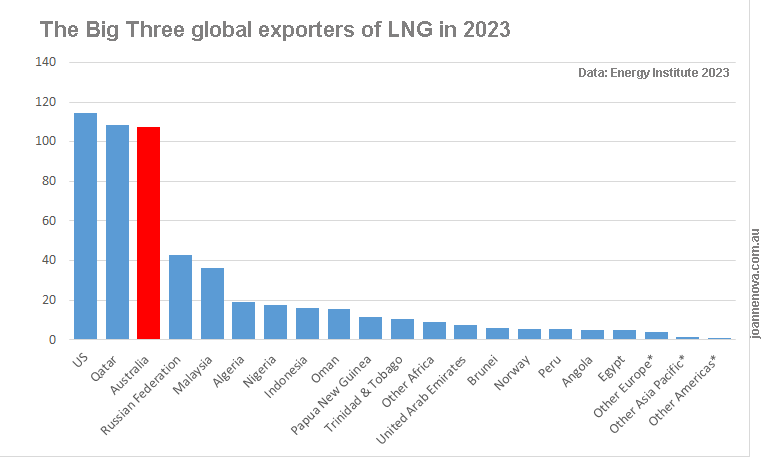
In Great Achievements of Government mismanagement, there is a $1 trillion dollar boom in LNG infrastructure around the world. Australia is one of the top three exporters of LNG, far ahead of the rest, and we’re about to run out of gas to keep the lights on. It’s so bad we probably have to import gas.

As if anyone needed another example of how small-minded dictocrat decrees can screw up a free market and achieve the exact opposite to what they tried to arrange, feast your eyes on Australia.

It takes real planning to start this far ahead and still bollix this up:

Australia was literally the worlds largest LNG exporter in 2020

Top three exporters of LNG in the world. Graph

One of our large energy companies APA Group says a vital Queensland gas pipeline was already running at capacity this winter, and things are so bad, gas power stations here may have to run off diesel, which is stupid on many levels at once. Not only does it lose triple points in Climate-Scrabble, being a dirty high emissions fuel, it’s one of the only fossil fuels we aren’t swimming in. We have 300 years in proven reserves of coal and if we’re lucky, just 32 days of diesel.

The Australian

Australian households could be hit with “cold showers” due to ­energy shortages, with the nation’s largest gas pipeline operator warning expensive gas will have to be imported into the country to fill the gap if pending projects are not approved.

New modelling by APA Group shows Australia’s east coast is ­facing a prolonged period of gas shortfalls, with a vital Queensland pipeline running at capacity over this winter amid ongoing renewable droughts and production disruptions in Victoria.

Officials this winter said the country’s fleet of gas power stations could be forced to run off diesel next year as traditional ­supplies run dry.

APA Group was all set to start a major expansion of its gas pipeline in 2024 when one of the octopus arms of the government decided it might change the rules. The Australian Energy Regulator (AER) is suddenly saying it might shift from the current light regulation market to a full price management scheme, upon which all the investor-wallets at APA solidified with permafrost. The boss at APA, Adam Watson, said no one could figure out what the return on investment would be, so they suspended the expansion in May. For some reason, the Labor Party couldn’t see this coming.

The Labor government aimed to reduce emissions, cut coal, and make electricity cheaper, instead as Watson says, we’re headed for a market that is less reliable, less affordable and has higher emissions.  “Put another way – cold showers, higher energy bills and coal generating our electricity for longer.”

Australia’s biggest gas deposits are 5,000 km (3,000 miles) from most of the people, and only connected by a small pipe or no pipe at all. The Bass Basin deposit is expected to run out around 2027 just when things get hairy on the electricity grid.

There is gas to spare, but Victoria banned Fracking “Forever” in 2017, and even put it in the State Constitution, just in case the voters changed their minds. Though apparently this was largely a marketing ploy in Greener fashion stakes, and legal eagles argued this was probably meaningless. Victoria did quietly allow some gas exploration after a few years, when they had scared all the investors off.

Poetically, just a few months ago NSW banned offshore mining and exploration for gas and oil. Even though exploration is harmless, you never know what people might find. If people knew there was cheap gas nearby they might want to use it.

Meanwhile Snowy Hydro has built a whole new peaking gas plant which was supposed to run on 30% Green Hydrogen (that was why the Labor Government supported it). The gas pipeline is not finished yet either, so when it starts, for the first two months it will run on pure diesel. Another green win for Australia!

0 out of 10 based on 0 rating

via JoNova

https://ift.tt/GL6Vcb2

August 28, 2024 at 05:31PM

UN Urges Western Nations to phase Out Fossil Fuel

Essay by Eric Worrall

UN Secretary General António Gutteres is doubling down on his shrill climate demands, as he approaches the final stretch of his zero achievement term of office.

Pacific in peril: UN urges Australia to block new coal and gas projects

By Bianca Hall
August 27, 2024 — 11.25am

Wealthy countries like Australia must immediately phase out fossil fuels and block new coal projects and oil and gas expansion to drastically reduce greenhouse emissions, United Nations Secretary-General António Guterres said in Tonga on Tuesday.

The UN issued a global SOS – what Guterres described as a “save our seas”, releasing new data from NASA and the World Meteorological Organisation that showed sea-level rises had doubled since the 1990s.

“Without drastic cuts to emissions, the Pacific islands can expect at least 15 centimetres of additional sea-level rise by mid-century, and more than 30 days per year of coastal flooding in some places,” Guterres told reporters at the forum.

Read more: https://www.smh.com.au/environment/climate-change/pacific-in-peril-un-urges-australia-to-block-new-coal-and-gas-projects-20240823-p5k4ue.html

The demand is especially funny because fossil fuel is a key component of solar and wind power. Coal is an essential ingredient of solar panels, while oil and gas are essential components of the epoxy or polyester plastic used to form wind turbine blades. An end to coal, oil and gas projects, especially metallurgical coal, would also spell the end of the renewable revolution.

But I guess you’d need to know something about science and engineering to understand the relationship between fossil fuel and “green” energy.

As the forgettable Gutteres approaches his final stretch, an interesting question is who will replace him.

Former New Zealand Prime Minister Jacinda Ardern, who is currently a player in the global censorship push, is a long shot possibility. She seems a very random kind of person, she made a speech in 2023 equating climate skepticism with gun violence. If she serves the UN as well as she served the people of New Zealand, with any luck the United Nations would suffer total dissolution by the end of a Jacinta term as UN Secretary General.

via Watts Up With That?

https://ift.tt/Nr7goFc

August 28, 2024 at 04:04PM