Month: August 2024

Jem Bendell – The Best Selling Climate Doomer Who is Wrecking the Alarmist Movement

Michael Mann – “Doom-mongering has overtaken denial as a threat and as a tactic. … they are led down a path of disengagement. They unwittingly do the bidding of fossil fuel interests by giving up.”

Doomist or realist? Meet the scientist who says the climate collapse has already begun

By Nick O’Malley August 23, 2024 — 5.00am

Just shy of 40 years old he was made a full professor.  He was publishing papers in prominent journals and his two books had been well received.     

“I was living in a beautiful part of the world, the Lake District in the UK,” he recalls, speaking from his new home in Bali as he prepares to travel to Sydney for this weekend’s Festival of Dangerous Ideas.  Then, while preparing for his inaugural professorial speech, Bendell dived back into the scientific literature to check in on how quickly the climate was heating, and how well our efforts were going at cutting emissions to slow the process on rates of habitat and biodiversity loss. 

What he read shattered him.  “I’d always thought, you know, we had the rest of the century to change, otherwise we would be in a pickle.”  He began to tuck the scientific papers and new stories that bothered him most into a folder. These were the sorts of stories many will remember. Stories about ancient frozen gasses burping from the Arctic tundra decades before scientists predicted such a thing might happen, weird heat spikes in Pacific. They were stories about events he had read about, but not expected the world to see during his lifetime.

He came to believe that the scientific data was being downplayed, minimised or misunderstood.

Read more (paywalled): https://www.smh.com.au/environment/climate-change/doomist-or-realist-meet-the-scientist-who-says-the-climate-collapse-has-already-begun-20240820-p5k3wj.html

A fascinating narrative battle appears to be heating up between people who think climate doomsday is unstoppable, and those who want governments to stop the climate apocalypse.

Michael Mann has doomers firmly in his sights. From 2021;

Another new front in the new climate war is what you call “doomism”. What do you mean by that?
Doom-mongering has overtaken denial as a threat and as a tactic. Inactivists know that if people believe there is nothing you can do, they are led down a path of disengagement. They unwittingly do the bidding of fossil fuel interests by giving up.

What is so pernicious about this is that it seeks to weaponise environmental progressives who would otherwise be on the frontline demanding change. These are folk of good intentions and good will, but they become disillusioned or depressed and they fall into despair. But “too late” narratives are invariably based on a misunderstanding of science. Many of the prominent doomist narratives – [Jonathan] FranzenDavid Wallace-Wells, the Deep Adaptation movement – can be traced back to a false notion that an Arctic methane bomb will cause runaway warming and extinguish all life on earth within 10 years. This is completely wrong. There is no science to support that. …

Read more: https://www.theguardian.com/environment/2021/feb/27/climatologist-michael-e-mann-doomism-climate-crisis-interview

Jem may have made millions of dollars from climate doomsday book sales, though to his credit he offers a free ebook version of his latest work, so its difficult to tell how many of the sales or downloads registered on Amazon were the free version. His current efforts appear to be focussed on translating his climate doomsday book into as many European languages as possible.

Jem Bendell currently lives in the tropical island tourist paradise of Bali according to his Wikipedia article, which strikes me as a strange place to ride out the global warming apocalypse. One of my favourite books, “Snowing in Bali”, details how South American cocaine traffickers turned Bali into a drug crazed party town and a drug transhipment point for imports into Australia and the rest of Asia, kind of an Acapulco in the West Pacific.

Jem’s Wiki entry claims he is in Bali trying to establish a school for regenerative farmers, so perhaps he sees his new life in Bali as a way of helping the most vulnerable people in the world survive on the front lines of the climate apocalypse.

via Watts Up With That?

https://ift.tt/n64CT2D

August 22, 2024 at 08:01PM

Scientists: 100% Of 2000-2023 Warming Explained By Solar Forcing…Human Climate Forcing ‘Does Not Exist In Reality’

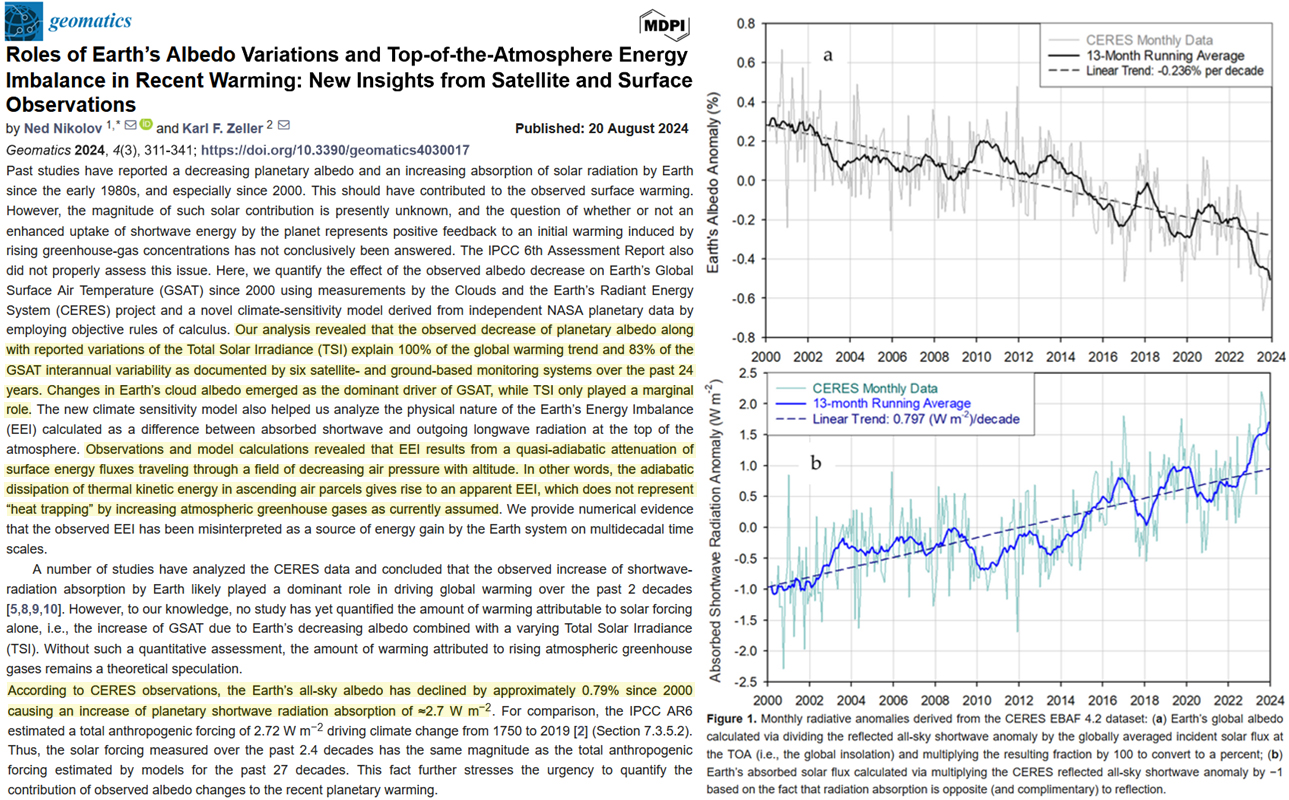
“Our analysis revealed that the observed decrease of planetary albedo along with reported variations of the Total Solar Irradiance (TSI) explain 100% of the global warming trend and 83% of the GSAT interannual variability as documented by six satellite- and ground-based monitoring systems over the past 24 years.”  – Nikolov and Zeller, 2024

A new, observation-based study makes extensive use of satellite data (CERES) to quantify the driving mechanism behind the global surface air temperature (GSAT) warming throughout the first 24 years of the 21st century.

Instead of agreeing with the prevailing narrative, the authors reject the hypothesis that accumulated “heat trapping” from rising greenhouse gas (GHG) concentrations in recent decades is the driver of global warming. Instead, satellite observations clearly indicate “100% of the global warming trend and 83% of the GSAT interannual variability” is explained by the increasing trend in absorbed shortwave radiation due to the downward trend in planetary primarily induced by changes in cloud cover.

“According to CERES observations, the Earth’s all-sky albedo has declined by approximately 0.79% since 2000 causing an increase of planetary shortwave radiation absorption of ≈2.7 W/m².”

Image Source: Nikolov and Zeller, 2024

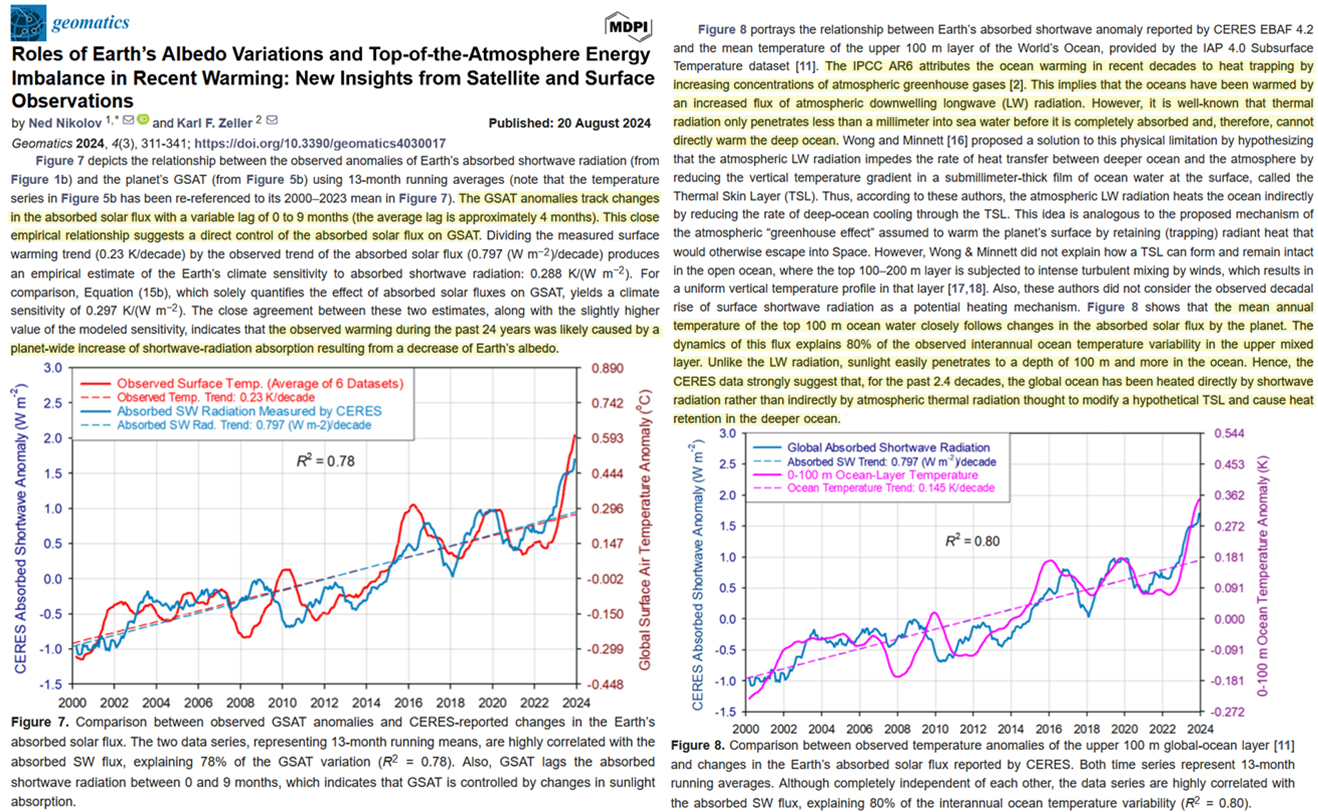
The authors point out that the prevailing narrative that says increases in downwelling longwave radiation from GHGs drive warming in the top 100 meters of the ocean is rooted in assumption. The proposed-but-never-observed (using GHGs as the causal variable) mechanism involves a hypothetical “thermal skin layer” temperature-gradient explanation for how GHG-induced water-warming might possibly work (see Wong and Minnett, 2018). In reality, thermal radiation penetrates less than one-thousandth of a meter and “cannot directly warm the deep ocean.”.

In contrast, satellite-observed increases in absorbed solar radiation – which penetrates 100 m and indeed directly warms the ocean water – explains not only the 0-100 m ocean-warming trend since 2000, but also 80% of the interannual temperature variability.

“CERES data do not support the hypothesis that the observed EEI [Earth’s Energy Imbalance] is a result of heat trapping by increasing atmospheric greenhouse gases. Instead, these data indicate that the Earth system has gained energy through an increased absorption of solar radiation…”

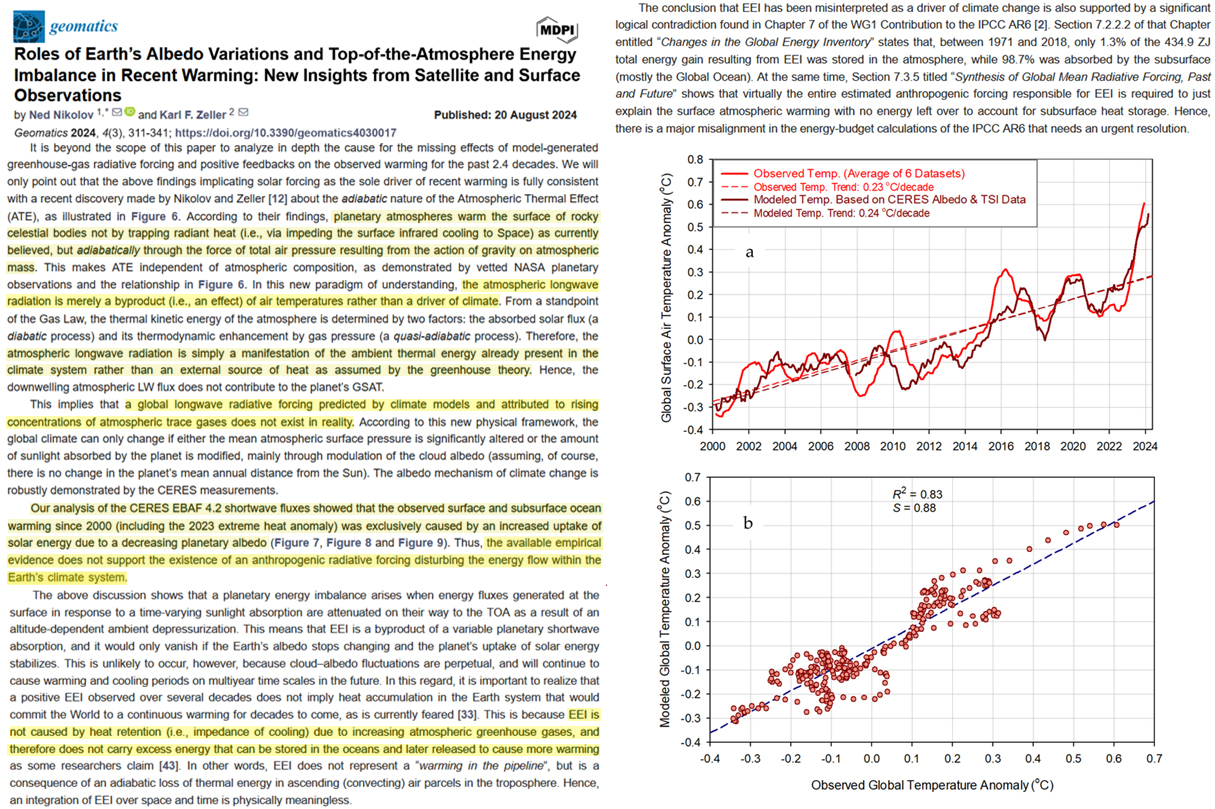
“Our analysis of the CERES EBAF 4.2 shortwave fluxes showed that the observed surface and subsurface ocean warming since 2000 (including the 2023 extreme heat anomaly) was exclusively caused by an increased uptake of solar energy due to a decreasing planetary albedo…”

Image Source: Nikolov and Zeller, 2024

Drs. Nikolov and Zeller further explain “the atmospheric longwave radiation is merely a byproduct (i.e., an effect) of the air temperatures rather than a driver of climate.”

This is because Earth’s Energy Imbalance (EEI) – the energy budget presumed to be the determinant of atmospheric and ocean warming (positive imbalance) or cooling (negative) – “is not caused by heat retention (i.e., impedance of cooling) due to increasing atmospheric greenhouse gases, and therefore does not carry excess energy that can be stored in the oceans and later released to cause more warming.”

In other words, the anthropogenic global warming conceptualization is not a real-world phenomenon. It does not exist.

“[A] global longwave radiative forcing predicted by climate models and attributed to rising concentrations of atmospheric trace gases does not exist in reality.”

“Thus, the available empirical evidence does not support the existence of an anthropogenic radiative forcing disturbing the energy flow within the Earth’s climate system.”

Image Source: Nikolov and Zeller, 2024

via NoTricksZone

https://ift.tt/KcUwfxt

August 22, 2024 at 06:35PM

Transition hell: Solar plants sit idle for 4 years in NT because the “grid wasn’t ready”

By Jo Nova

The Northern Territory is a test case for renewable energy and it’s a bonfire

In 2016, the new Labor Government waved a magic wand and commanded they would be 50% renewable by 2030. The experts said it was doable and would save $30 million a year. They gave out the permits for large solar installations, which began construction in 2019, but then changed the rules, and wouldn’t let the solar plants connect to the Darwin-Katherine grid in 2020. Thus 64 megawatts of solar panels that cost $40 million dollars have sat, doing nothing, for four long years.

“It’s just reflecting back into space, not being used to power the grid and to substitute for diesel and gas turbine production,” said local vet Peter Trembath, who leased his land to energy company Eni Australia for the solar project.

“It’ll be some technical issue, but you’d reckon they would have sorted that out before Eni spent $40 million to erect it.”  — Max Rowley,  ABC News June 2022

It’s always the Grids fault…

The reason they couldn’t be connected was that the Territory government suddenly rewrote the rules in February 2020 and insisted the solar generators had to operate like fully scheduled generators, not semi-scheduled ones. They would have to make accurate predictions of what they could supply 30 minutes ahead on a rolling 5 minute basis. This meant they would need their own battery backup with the equivalent of 80% of their capacity and storage that lasted 30 minutes. They’d also need “weather forecasting” ability to predict cloud cover.

The solar owners, Eni, protested that this would cost them $20 million or more “making the project unviable”. And to make things even worse, the government was saying they had to build the battery at the solar plant, and reserve it to back up their own panels, so they wouldn’t be able to build the battery in Darwin, and use it to help the grid at other times, which would defray the costs. It all seems quite bizarre.

Why didn’t the renewables industry protest these belated draconian conditions louder? Probably because they didn’t want to highlight the reason for the Territory government’s sudden flip.

The panic-attack about connecting solar power came just after the Alice Springs black start

The NT government didn’t appear to realize that there were risks in adding 64MW of solar power to a grid that was roughly 250MW in size until 13th October 2019 when the whole Alice Springs network serving 29,000 people collapsed due to a cloud. It was the third blackout in four years, and it must have terrified the management in Darwin, because Alice Springs didn’t have much solar, yet the system was so unstable. Only 13% of the towns total electricity comes from solar panels, but one cloud was enough to knock that little grid over and it took over nine hours to get it restored. By December 2019, an inquiry was set up and both CEO’s of the Power and Water Corp and the Territory Generation lost their jobs.

Presumably the new CEO’s were not going to risk the collapse of the larger Darwin-Katherine Grid, hence the sudden rule change in February 2020 which left the solar operators high and dry.

The ABC and others insist the blackout had nothing to do with solar power, and was just due to incompetence, but all the new grid managers grabbed their electrical garlic and acted exactly like solar power was the vampire. How else do we explain that these perfect solar plants have been sitting there doing nothing for four years?

When 64MW is too much for Darwin, lets build 4,000?

Clearly grids need their armour before anything so risky as a large solar plant can be connected, which is all the more poignant considering the Australian government just approved (again) the humongous SunCable plant, what will be the “largest plant in the world”, at 4GW, and it’s going to be in the Northern Territory. It’s 60 times bigger than the 4 Eni plants, but is supposedly going to send most of the green electrons to Singapore, a mere 5,000 kilometers away, which is lucky, because the whole Darwin-Katherine grid only uses 250MW at peak, so SunCable would eat it alive.

The people will pay for the solar debacle

The new NT Generator Performance Standards were trying to make sure that the Territory’s consumers wouldn’t end up footing the bill for the backup and wouldn’t suffer a blackout. But the Territory Government has paid $45 million to build a battery in Darwin anyway, and looks like it will try to buy out the four idle solar plants from Eni. So the citizens will be whacked for the cost one way or the other for the magical wish-fairy thinking that renewables would be easy and cheap.

As it happens the people of the NT get to vote tomorrow in the Territory elections. Lets hope there is some salvation. Though on Channel Nine apparently the major issue is not about keeping the lights on, but whether people can keep crocodiles as pets. No, seriously.

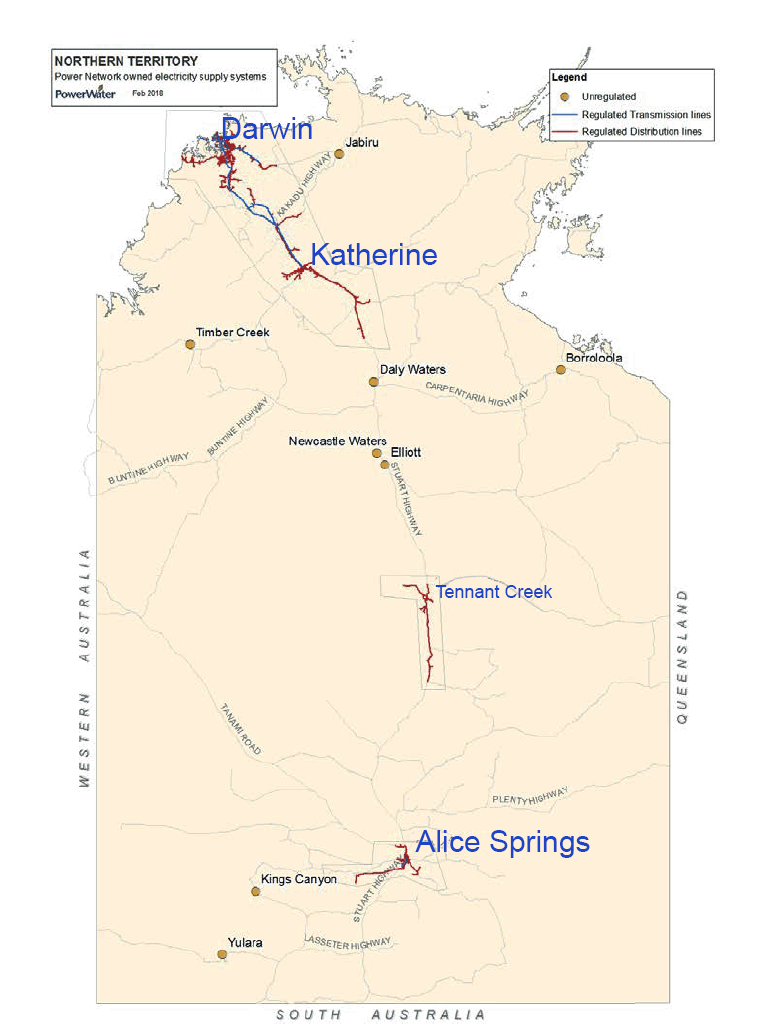
Map of NT electricity Grids, Darwin, Katherine, Alice Springs

There are only about 250,000 people living in the Northern Territory. There are two separate grids and several microgrids.  All of these are perfect test cases to showcase renewable energy, as I keep saying, and none of them are managing to do it.

When will we get the message? If a town of 30,000 can’t live off the sun and wind, why would anyone bet the whole nation on it?

h/t CO2 Lover


10 out of 10 based on 1 rating

via JoNova

https://ift.tt/lP2Oysd

August 22, 2024 at 04:10PM

Tangled Comparisons: Renewables Versus Fossil Fuels

By Norman Rogers

We are often told that wind and solar, if not cheaper, are at least cost competitive with fossil fuels. Dead wrong! Wind or solar costs around five times more per megawatt hour compared to, for example, natural gas.

We are told that wind and solar will save us from a climate catastrophe. If there is a looming climate catastrophe, the only thing that will save us is nuclear power. Wind and solar are incredibly expensive methods of reducing CO2 emissions. The more wind and solar you build, the cost of removing CO2 increases disproportionately.

The U.S. has wasted $1.5 trillion on wind and solar and for that money only a little more than 10% of our electricity comes from wind and solar.

Fossil fuels are not dirty. Modern natural gas or coal plants are environmentally pristine. CO2 is not a pollutant, but an aerial plant food that is greening the Earth. CO2 makes plants grow faster with less water.

Wind or solar electricity is not worth what it costs to create it. It is worth what someone is willing to pay for it. That is a generally accepted economic principle.

If the government requires a utility to purchase some amount of electricity at some price, that is not a free market.  That is central planning. Central planning has a role, but it rarely works as well as the voluntary exchange of goods and services. Central planning creates unexpected twists and turns and often results in low productivity.

I will first discuss the value of wind and solar electricity in a free market and then discuss the effect of extensive government interventions via subsidies and mandates.

Everywhere when commentators compare the cost of wind or solar electricity with the cost of fossil fuel electricity, they use LCOE, the levelized cost of electricity. It is a logical error to compare LCOE of natural gas with LCOE of wind or solar. The correct comparison is to compare the marginal cost of natural gas with the LCOE of wind or solar. The marginal cost of natural gas electricity is about $20 per megawatt hour in the U.S. The LCOE of wind or solar hovers around $100 per megawatt hour, or about five times more.

LCOE includes amortization of the cost of building the generating plant. The marginal cost is essentially the cost of the fuel to generate the electricity.

Under what circumstances will a utility or grid operator be willing to purchase wind or solar electricity?  For the sake of the discussion, we postulate that the utility is going to replace some of its natural gas electricity with wind or solar electricity. The argument would be the same if coal electricity is being replaced and different if hydroelectricity is being replaced. No one would replace nuclear electricity with wind or solar because nuclear fuel is too cheap.

The utility cannot make a complete replacement, scrapping a natural gas generating plant and replacing it with a wind or solar farm. That is impossible because wind and solar are erratic, providing power subject to the weather and the daily solar cycle. Their erratic nature cannot be fixed at a remotely reasonable cost with batteries or pumped storage.

The utility will be open to reducing output from a gas plant and replacing that electricity with wind or solar electricity, when the sun is shining or the wind is blowing, only If the wind or solar electricity is less expensive then the marginal cost of generating the electricity with the gas plant. Notice that I said marginal cost, not LCOE.

Marginal cost for a gas plant is almost entirely the cost of the fuel. If gas is $3 per MMBtu and the gas plant is a combined cycle plant, the marginal cost of generating electricity is about $20 per megawatt hour. In countries that do not enjoy cheap natural gas the marginal cost will be higher.

If the cost of the wind or solar electricity is greater than $20 it will be a money losing proposition to substitute wind or solar electricity for gas electricity. If it is less, then it will be a profitable endeavor. The value of wind or solar is $20 per megawatt hour under these conditions.

LCOE for a natural gas plant includes an allowance for the amortization of the initial investment. It also depends on the utilization or capacity factor of the plant. The capacity factor is not very relevant to the properties of natural gas generation because real utilities over-provision their generator capacity to account for peak demand and the possibility of plants being under repair.

LCOE for a wind or solar farm is almost entirely capital cost spread over the number of megawatt hours generated with due consideration for the time value of money. The marginal cost is near zero because it costs nothing extra to generate an additional megawatt hour and nothing is saved if fewer megawatt hours are generated. If plant output is curtailed because the grid cannot accept all the wind or solar power available, the cost per megawatt hour is proportionally increased. Overwhelming the grid with wind or solar is an increasingly serious problem.

The Departure From a Free Market

The most important government intervention is state renewable portfolio laws. These laws define renewable energy and set quotas for what proportion of the electricity in the state must be from renewable sources.

Without getting too complicated, renewable energy is usually defined as anything that is not fossil fuel, nuclear energy or hydroelectricity involving dams. Most of the energy that passes that test is too expensive or not scalable. Wind and solar are too expensive and handicapped by intermittency, but they are scalable. The result is that renewable energy is almost always wind or solar. A few states allow hydroelectricity with dams to be considered renewable. Hydro has limited scalability due to the best sites being already developed.

Renewable portfolio laws mandate the purchase of an increasing proportion of renewable electricity. For example, California requires that 60% of the electricity be from renewable sources by 2030.

The second most important government intervention are federal subsidies, tax credits and complicated tax provisions called tax equity financing, that subsidize about 50% of the cost of building a wind or solar farm.

Mandating the purchase of renewable electricity changes the nature of the market for renewable electricity. Without the mandates the owner of a wind or solar farm is doomed to beg utilities to purchase electricity for far less than it costs to generate. The farm would soon be bankrupt. But with mandates the utilities are knocking on his door begging for renewable power that they are mandated to purchase, without regard to the price. Renewable portfolio laws change the market from a buyers’ market to a sellers’ market.

There are a handful of companies with the expertise and financial resources to construct billion-dollar, utility-scale, wind or solar farms. Although they nominally compete by bidding for the sale of electricity, they constitute an oligopoly.  That is to say that the competition will not be as vigorous as it would be if more players were in the market.

The most common deal structure is that the developer constructs a wind farm and sells the electricity to the utility. Because the market is tipped in favor of the big companies, they are able to require a long-term contract, called a power purchase agreement or PPA, usually 20 for years, guaranteeing a market at a set price for all the electricity that the project can produce. That long-term market and price guarantee has tremendous value.

The PPA is a subsidy because by removing market risk, the farm becomes less like a business and more like a treasury bond. The price per megawatt hour can be less because a lower rate of return is viable. Risk has been removed. With the guaranteed market, the farm becomes marketable to conservative investors like infrastructure funds or pension funds. I estimate that the PPA reduces the rate of return needed from 12% to 8% and thus subsidizes the cost of renewable electricity by a third.

That subsidy is not cost free. The utility is assuming massive debt and risk by signing the PPA. There are plenty of possible reasons why utilities might want to get out of PPA’s in five or ten years. For example, lower cost nuclear electricity.

Between renewable portfolio laws and federal subsidies, the wind or solar farm is about 66% subsidized. For example, if the LCOE of the wind or solar electricity is $100 per megawatt hour, after the subsidies are applied it is $33 per megawatt hour. This is still more than the $20 that the electricity is worth. To close the gap the utility must raise its rates to pay for the extra $13 per megawatt hour. The final subsidy comes from the electricity customers.

Justifications for Massive Subsidies

The first justification is that reducing CO2 emissions will prevent a climate catastrophe. This justification fails for several reasons. Reducing American CO2 emissions will have little effect because the emissions problem is in Asia where emissions not only dwarf ours but are skyrocketing due to development of coal powered generation.

The cost of reducing CO2 emissions by wind or solar is very high, more than $300 per metric ton of CO2 removed. The subsidy is the cost of removing CO2. It becomes increasingly difficult to augment the amount of wind or solar above 50% due to their intermittent nature. Carbon offsets can be purchased for as little as $10 per ton, although not enough would be available to neutralize CO2 emissions from the entire power system. Serious reduction of emissions at reasonable cost requires adopting nuclear power, generally prohibited by renewable portfolio laws.

The second justification is that fossil fuel or nuclear fuel will run out. Within the borders of the U.S. is enough fossil fuel for hundreds of years and nuclear fuel for thousands of years. It is not sensible to turn the economy upside down in anticipation of a theoretical event centuries in the future.

A third justification is that fossil fuel plants cause air pollution, and nuclear plants may release harmful radiation. Modern coal or natural gas plants are environmentally clean. Nuclear plants are proven by hundreds of plants running for decades. The worst accidents were easily contained.

Finally, the increase in CO2 in the atmosphere has greened the Earth and substantially increased agricultural production. CO2 is aerial plant food.

When will the nation wake up and stop the bleeding?

Norman Rogers writes about energy and is the author of the book Dumb Energy. More detailed discussion and computational details is at https://windsolarcon.org.

This article was originally published by RealClearEnergy and made available via RealClearWire.

via Watts Up With That?

https://ift.tt/ecMd5k7

August 22, 2024 at 04:02PM