Month: August 2024

Australia is running out of electricity to charge electric cars, and they’re only 0.9% of cars on the road

EV fast charging is not so fast.

By Jo Nova

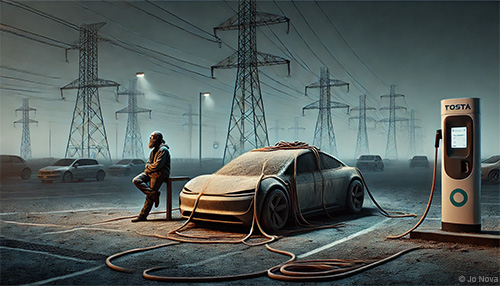
No one saw this car crash coming?

EV’s represent just 0.9% of all cars on the road in Australia but plans to install fast chargers are already grinding to a crawl. Last year, Ampol was planning to build 180 EV charging bays by the end of the year. Instead it’s proved difficult to even reach half that target. Eight months after they were supposed to have 180 in action they’ve reached 92.

Just throw money…

A mere 3 weeks ago Ampol announced that thanks to a $100 million dollar grant from the Australian government they would install more than 200 new fast chargers at Ampols national network of petrol stations this year. But presumably after making a few phone calls they’ve realized it’s not going to happen. (You’d think they might have made the calls before putting out the press release, and the Minister might have phoned a friend before tossing $100 million out?)

Ben Potter and Simon Evans, Australian Financial Review

Ampol, one of the country’s largest petrol retailers, has dialled back plans to triple the number of electric vehicle chargers because of power grid limitations in a blow to government hopes of pushing motorists towards cleaner cars in big numbers by 2030.

The company’s chief executive, Matt Halliday, said it would not be possible to expand the number of charging bays from 92 to 300 by the end of this year because of difficulties connecting chargers to the grid which is already struggling to cope with an influx of renewable energy generation.

In March, Energy Minister Chris Bowen said the government would spend $60 million helping car dealerships install chargers on sales lots.

[As] much as we spend a lot of time talking about generation, firming and transmission infrastructure, the last mile distribution grid is not really built for large-scale electrification, despite the best will that the players have to try and make it happen,” Mr Halliday added. “There are a lot of constraints that need to be worked through.”

These people are just not good with numbers. A fast charger needs 300 kilowatts, and if there are three car charging spaces in a row, that’s a major load that our low voltage lines simply can’t bear. In order to get the local distribution networks upgraded the wait times to connect the chargers can be as long as two years.

Not to mention that we’re supposedly aiming to transform the car market so most new cars sold will be electric in a mere five years or so, while we supposedly try to shut down some cheap reliable coal plants.

At the moment most EVs charging overnight are probably burning more fossil fuels than petrol cars do. The EV revolution in Australia (should it happen) would rampantly increase our carbon dioxide emissions. But who cares, right? It was never about CO2.

ht Dave of Cooyal in Oz, and CO2 Lover


0 out of 10 based on 0 rating

via JoNova

https://ift.tt/ZA8C3sT

August 21, 2024 at 03:36PM

Climate Claim: The UN “… need to resist the assertion that mining is always beneficial …”

Essay by Eric Worrall

All that separates us from a Venezuelan style economy where ordinary people search the trash for food is politicians listening to the wrong advice.

The UN can set a new course on “critical” transition minerals   

Published on 20/08/2024, 4:51pm

Comment: A high-level panel is working to define principles for responsible mining, which will be presented to the UN General Assembly in September

By Claudia VelardeStephanie Weiss and Jessica Solórzano

Claudia Velarde is Co-director of the Ecosystems Program at the Interamerican Association for Environmental Defense (AIDA), Stephanie Weiss is a Project Coordinator at AIDA, and Jessica Solórzano is an Economic Specialist at AIDA. 

The global push toward renewable energy, intended to reduce climate-aggravating emissions, has revealed how the environmental and social costs of extracting the minerals it requires fall disproportionately on local communities and ecosystems.  

Many argue that electromobility and renewable energy technologies will help mitigate climate change – but adopting them on a large scale would require a massive increase in the mining of minerals such as lithium, which are key to their development.  

Our reflection on what the Panel cannot ignore points to three elements: a status quo approach to “development”; a high level of technological optimism concerning mining; and a lack of urgency regarding ecosystem limits and communities’ rights.  

First, we acknowledge that the Panel is under pressure from powerful actors, but it will need to resist the assertion that mining is always beneficial to the economic growth and prosperity of nations. This status-quo perspective reinforces the notion of unlimited natural resources for human consumption, mirroring the economic development promises of the early 20th century, which contributed to the current climate crisis.   

The Panel must not fail to consider the possibility of degrowth or the imposition of limits on mining activities that could lead to reduced material and energy consumption. Nor should it neglect other forms of traditional and local knowledge that may offer possibilities for alternative development. 

Then, on the impacts, pollution and other ecosystem disruptions caused by mining, it is consistently stated that assessments and evaluations are necessary – and that these can preserve ecosystem integrity.  

Read more: https://www.climatechangenews.com/2024/08/20/the-un-can-set-a-new-course-on-critical-transition-minerals/

I don’t think we should ignore these glimpses into what I believe it the true agenda of the green movement – the dismantling of the industrial revolution, and a return to a medieval peasant economy.

Did you know Venezuela was per capita the 4th wealthiest nation on Earth in the 1950s? There is no path to reduced consumption which does not include immense suffering and economic dislocation. Whether the reduced consumption is due to economic imbalances, price controls or government imposed sanctions on critical economic activities like mining, the result is always an economic recession or a new great depression, or in extreme cases total collapse.

via Watts Up With That?

https://ift.tt/J9Lbv6O

August 21, 2024 at 12:00PM

Alarmist Predictions False! Not A Single Heat Wave This Summer At Cologne-Bonn

An analysis of data show that the Cologne-Bonn airport hasn’t had a single real heat wave so far this summer, as was the case in most places in Germany.

“Experts” predicting a “summer of hell” are proven wrong.

Hat-tip: Snowfan

Firstly, there is no standardized international definition of the term heatwave. Definitions are often based on a combination of percentile-based threshold values.

For example, the World Meteorological Organization (WMO) defines a heat wave as a period during which the daily maximum temperature exceeds for more than five consecutive days the maximum normal temperature by 5 degrees Celsius.

At the start of summer, climate alarmists predicted Germany would likely see a “summer of hell” with extreme heat waves and misery for Germans. Today we look back at this prediction, using data from the Cologne-Bonn airport weather station.

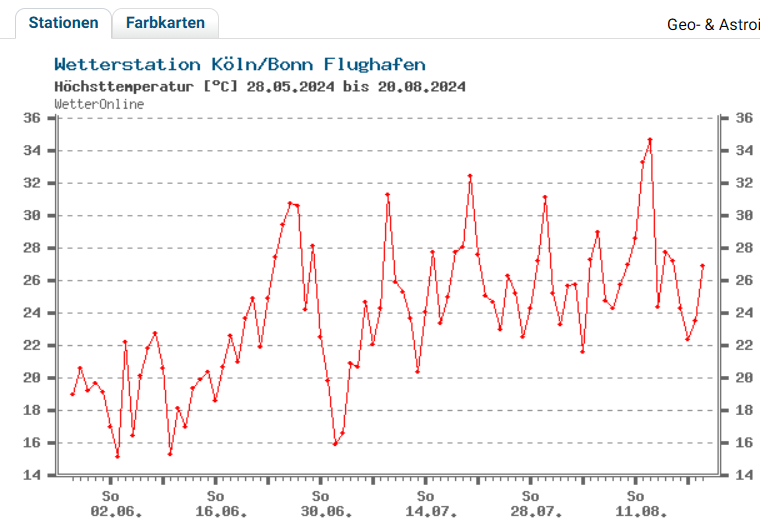
The Cologne-Bonn airport is located right smack in the middle of Europe, and the following chart depicts the daily high temperatures recorded there this summer:

Chart: WetterOnline.

Though the temperature very briefly peaked over 30°C a few times this summer, there was never a protracted period of heat extending over days.

After having hit 33°C and 29°C on August 11 and 12 respectively, the temperature peaked at a balmy high of 34°C on August 13th. But then the temperature rapidly cooled off the next day, reaching a high of just over 24°C.

In summary: the summer of 2024 in Cologne didn’t see a single extended period of extreme heat, unless. that is, you call 3 days above 28°C a heat wave.

This was the case across much of Germany. Granted, some German cities perhaps experienced warmer periods.

One thing is sure: the “summer of hell” in Germany predicted earlier by Marc Benecke has now been exposed as just a plain-stupid climate horror story, probably intended to scare the FridaysForFuture kids.

Donate – choose an amount

via NoTricksZone

https://ift.tt/rFhCk7H

August 21, 2024 at 11:44AM

We teach kids only half the scientific method

From CFACT

By David Wojick

The vigilant folks at the CO2 Coalition have been saying we are no longer teaching the scientific method in public school science education classes. This puzzled me because the new rules for science education claim to teach kids to think like scientists. I figured the kids would be awash with scientific method.

I was wrong. With the help of some Coalition experts, I investigated this strange situation and here are my basic findings.

In a nutshell, which is explained more fully below, only the happy half of the scientific method is being taught. This is the fun formulation of possible hypotheses and models that might explain what we observe. The hard half, where these tentative explanations get evaluated and likely fail, is not taught.

Now, let’s look at it in some detail. It is all about what are called “standards” which are actually State regulations saying what topics will be taught at each grade level. About two decades ago, there began a push for national standards because while most states taught the same topics, they were often in different grades, which created problems –textbooks, for example.

The Feds paid the States to adopt Common Core standards in math and English, but they punted science to the National Academy of Sciences. Agencies often did this with science issues.

In 2012, the NAS produced its blueprint for science standards — “A Framework for K-12 Science Education: Practices, Crosscutting Concepts, and Core Ideas”, which is often simply called the Framework.

A bunch of State people then formed a huge working group that wrote standards to fit the Framework. These are called the “Next Generation Science Standards,” or NGSS for short. Today, 20 States have officially adopted the NGSS, while another 29 are reported to have standards that are based on the Framework. (The sole holdout is Florida.)

The Framework and NGSS are very different from the pre-existing State science standards. These older standards taught scientific knowledge, basically the fundamental facts that underlie each of the primary scientific areas. Electricity, cell structure, the solar system, and stuff like that.

Some of this is still taught as the Core Ideas, plus there are Crosscutting Concepts like causality. But the method is what is called Practices. These are supposed to be how scientists work, plus they have added engineering. Students do projects instead of learning facts.

Here are the listed practices from the Framework (and the NGSS):

1. Asking questions (for science) and defining problems (for engineering)

2. Developing and using models

3. Planning and carrying out investigations

4. Analyzing and interpreting data

5. Using mathematics and computational thinking

6. Constructing explanations (for science) and designing solutions (for engineering)

7. Engaging in argument from evidence

8. Obtaining, evaluating, and communicating information

Note that the list basically is sequential. It ends with formulating, arguing for, and communicating explanations.

There is nothing about testing, evaluating, or criticizing these explanations. But this sort of critical evaluation is the essence of science. It sets science apart from unconstrained belief. This is the very heart of the scientific method, so the CO2 Coalition is dead right.

Then, it gets very puzzling because the Framework actually presents evaluation as a central activity. The Practices list is Box 3.1 in the Framework. Just three pages later, we find Figure 3.1 which looks to be a diagram version and is labeled “The three spheres of activity for scientists and engineers.”

The central sphere is labeled “Evaluating” and lists “ARGUE, CRITIQUE, and ANALYZE” as its activities. There is an arrow pointing directly to “FORMULATE HYPOTHESES” under the heading “Developing Explanations.”

I have no idea why evaluating proposed explanations (and models) was not included in the list of practices. Perhaps they simply wanted to make science fun by avoiding the unpleasant part. After all, progressives are often against grading students and especially against failing them.

But whatever the reason, the Framework and NGSS only teach the happy half of the scientific method. The crucial part where hypothesis meets reality is not there. So, they are actually failing to teach how scientists think and work.

I propose a simple fix taken right from the Framework. The NGSS and the States should simply add this activity to the list:

“Activity 9: Proposed models and explanations will be evaluated using analysis, critique, and argument from evidence.”

Now we just have to get this out to the 49 States.

via Watts Up With That?

https://ift.tt/O73sKwM

August 21, 2024 at 11:15AM