Month: August 2024

‘Shoehorning’ a fire into the climate narrative 

Note: This is a reprint of my op-ed “Editor for a Day” in the Chico Enterprise-Record, complete with links and graphs to factual references for the benefit of readers there who were directed to WUWT. The photo of the Park Fire pyrocumulus cloud above was taken by me as I observed the fire’s progress – Anthony


On July 30, The New York Times (NYT) ran an article titled “How Did the Park Fire Get So Big, So Fast?”that claims, “Heat has been breaking records all summer, and … records will probably continue to fall over the next several years as the burning of fossil fuels continues to add greenhouse gases to the atmosphere.”

The article provides no data or citations supporting this claim but relies on opinions from so-called climate experts who have no connection to the fire. Last week, Professor Mark Stemen wrote in an op-ed “…it was climate change that pushed that fire to Tehama County overnight.” How absurd; climate doesn’t act on short time scales or local venues.

This sort of “causality shoehorning” (to coin a phrase) is becoming increasingly common among journalists and climate advocates as they strain to fit any weather event or catastrophe into the climate change narrative.

Like Stemen’s claim, NYT’s claim of “a very clear fingerprint of climate change” on dry vegetation that fueled the Park fire is little more than personal opinion, offering no scientific citation or basis for the claims.

While there was a heat wave prior to the Park fire, that had no bearing on the fire. The area where the fire spread, Butte and Tehama Counties, were not in drought conditions according to the U.S. Drought Monitor for July 23 – the day before the Park fire was ignited by a criminal arsonist.

So, “climate change caused drought” creating abnormally dry conditions didn’t figure into the Park fire at all. The fire wouldn’t exist without the act of arson.

The ignition point was in Bidwell Park. Just north of that point, huge acreages of grassland and scrub brush exist. Combine that ignition with the sustained southerly winds that day of 20-25 mph, and it is no surprise that the fire rapidly spread north. Rick Carhart, the Public Information Officer for CalFire in Butte County, confirmed in a telephone interview that the area “had not naturally burned in several decades, and had no control burns to reduce fuel loads.” He added that these “high fuel loads, combined with the wind that day made a very aggressive fire.”

If the fire happened now during below-normal temperatures (in California), would its slower spread be due to climate change too?

Climate change contributed nothing to ignition or rapid spread of the fire – local weather and a criminal act was at fault. The drying of grasses (which happens every spring) and the heat wave (which happens every summer) are both weather patterns that operate on short-term time scales as opposed to long-term climate change.

The Intergovernmental Panel on Climate Change finds no climate signal, nor increasing trend, behind thunderstorms, or lightning occurrences spark fires. Also, NASA satellites have documented a global long-term decline in wildfires. NASA reports satellites have measured a 25-percent decrease in global lands burned since 2003.

Source: https://earthobservatory.nasa.gov/images/145421/building-a-long-term-record-of-fire

A 2007 paper in the journal Forest Ecology and Management reported that prior to European colonization in the 1800s, more than 4.4 million acres of California forest and shrub-land burned annually. As compared to the 4.4 million California acres that burned each year prior to European colonization, only 90,000 acres to 1.6 million California acres burn in a typical year now.

Clearly, there is no climate change component to California wildfires. If there were, fires in the present would be consuming much more than 4.4 million acres annually – but this isn’t happening. The simple fact is: arsonists and lightning are responsible for most wildfires.

Source: https://www.visualcapitalist.com/cp/comparing-lightning-caused-and-human-caused-u-s-wildfires/

The intensity and coverage of wildfire varies greatly from year to year, as evidenced by the 2022 NYT story: Why California’s 2022 Wildfire Season Was Unexpectedly Quiet. A map of fires from year to year in the article demonstrates this well. Curiously, a data correlation between the Spotted Owl ruling and an increase in acreage burned from lack of forest management since 1990 exists.

Graph combining data for Federal lands showing acres harvested vs. acres burned, in millions of acres. Data from U.S. Forest Service and the National Interagency Fire Center. Graph by Anthony Watts using that data.

The NYT believes that they can divine climate connections to the fire from offices in New York. At least Stemen was local, but still wrong.

It seems that climate activists and journalists care more about furthering their misguided climate agenda than they do about reporting the facts.

Factual references are published here: https://wattsupwiththat.com/newspaper-letter-references/

Anthony Watts is a former meteorologist at KHSL TV/ Action News Now. He does daily forecasts for KPAY Radio and is also a Senior Fellow for Climate and Environment at the Heartland Institute in Chicago. He also operates the most viewed climate related website in the world, wattsupwiththat.com

via Watts Up With That?

https://ift.tt/S4vGFx0

August 21, 2024 at 11:15AM

The Short Lives of Wind Turbines

In a recent short video (below) John Burgess summarizes why wind farms become unviable long before promoters promised. He explains that after about 15 years wind farms are uneconomic to keep going. Also the far more reliable older smaller under 2 MW turbines have a longer life. All based on the work of one professor – Gordon Hughes.who did some brilliant work on wind farm costs some three years ago. For those preferring to read, I provide a transcript lightly edited from closed captions in italics with my bolds, key exhibits and added images.

Paul Burgess Basics 2 The Lifespan of Wind Turbines

This video is on the lifespan of wind turbines. In this video and quite a few others actually, I’m going to be relying on the work of Professor Gordon Hughes and a document you should all read is this one The link to Hughes’ study is in the title in red below. That video was produced three years ago but had very few views less than a thousand. My job is to bring these stories to the public and his work is extremely valuable, so this video is based on that.

Wind Power Economics – Rhetoric and Reality

Here we go the lifespan of turbines shock horror. Wind turbines gradually wear out and they do
it faster than you think. As I have explained, the load factor for a wind farm is the percentage of the actual electricity you get out of it in the real world compared to a purely theoretical maximum, the maximum being every second of the Year it blows perfectly and everything you get 100%. What percentage of that do we actually get, that’s the load factor.

Typically for onshore wind farms in the UK Island Etc it’s 26 to 30%, in that sort of range. The bigger ones, the higher ones may get into the low30s. So that’s the load Factor but that doesn’t stay the same. It actually deteriorates. These things wear out as they go, and they actually deteriorate at quite a rate, around about 3% per year. And so what matters with load factors– no excuses. If it has to be stopped for maintenance that reduces a load Factor, because it’s a real world measurement of what you produce.

Now Denmark kept really good records of their turbines. And here is a diagram that explains a few things about them. The results are quite remarkable. This graph looks complicated, but it’s a graph to show basically the failure rate over time for wind turbines. And it’s constructed from a large number of wind turbines in Denmark. On this vertical axis is how much of the energy is lost, which affects the load factors. We start off with almost zero so nothing is lost. We’re getting the expected performance, and that seems to be the case here for almost two years. But as you go up that axis and you go to the very top, there’s nothing left at all, There’s no energy output.

Now there are four colors of Curves, The higher two are for offshore, showing Old Generation and New Generation offshore. The lower two are for onshore, again Old Generation and New Generation. The new generation have higher turbine values and this comprises turbines up to 8 megawatts. They’re much worse than the older generation; they deteriorate much faster, and you can see that from the curves. Reading a curve is quite amazing. Let’s look at what point you’ve lost 60% of the energy coming out the wind farm. For Offshore New Generation the answer there is just 60 months or 5 years.

So 60% of those offshore modern turbines have failed within 5 years. Obviously they have to repair them all the time and therefore there’s a big rising cost to all this. But looking quickly at what we get from onshore modern ones which is the orange curve here. Let’s check when 20% of the turbines are failed, that’s one out of five turbines, and that is at about 68 months or about 5 to six years.

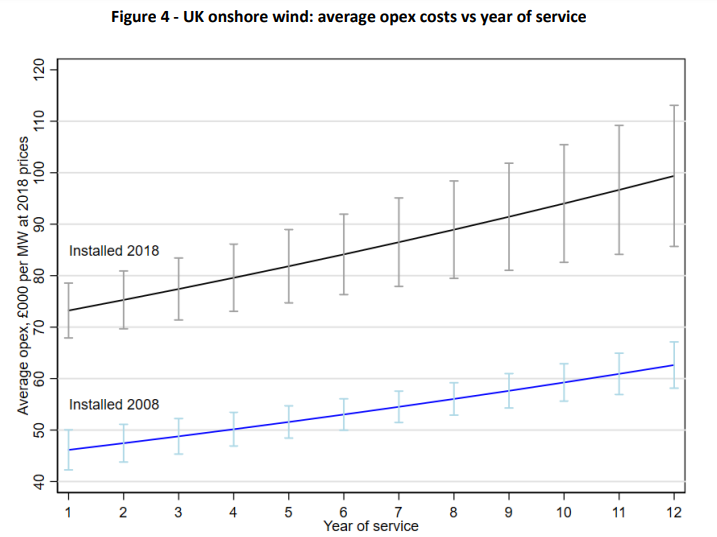
You can expect failures so these things they had to be repaired, which puts the costs up. So what are the running costs of these turbines? This graph of one axis shows how many thousands of pounds per megawatt of installed capacity you actually pay out per year. And the bottom scale is the length of time, how much those costs rise over time. And as you can see the lower line is the older generation and the Top Line the newer generation, such as they are putting into the Isle of Man

So let’s take Isle of Man as an example. They’re going to install 20 megawatts worth, so let’s look at the running cost and these are in 2018 prices, so the costs have risen since then. You can see taking the Isle of Man modern turbines we start off at £74,000 a year per megawatt, and we end at about £100,000 a year after 12 years per megawatt of installed capacity. So we start off with 74 times in this case for 20 megawatts for the Isle of Man which is 1.48 million a year and we end up at a neat 2 million a year in running costs. And that keeps rising.

This basically shows that after about 15 years
it’s no longer worth maintaining the wind Farm.

Offshore wind of course is much more expensive starting off at around about £200,000 a year and ending up at £400,000 a year per megawatt, three to four times the price of onshore.

I am aware that that raises lots of questions and they will be answered in following videos. Why is it if it’s about 15 years that you’ve had some forms carry on Beyond? And so on. The whole thing seems to me to be a Ponzi scheme, it really does. And that will be explained in following videos.

via Science Matters

https://ift.tt/M8RKUjI

August 21, 2024 at 10:16AM

Thursday

0 out of 10 based on 0 rating

via JoNova

https://ift.tt/w8lRNqG

August 21, 2024 at 09:45AM

Hottest Evah Pulled Out Of Thin Air!

By Paul Homewood

Hottest evah!

image

https://www.ncei.noaa.gov/access/monitoring/climate-at-a-glance/global/time-series/globe/land_ocean/1/7/1850-2024

.

According to NOAA, there was record warmth in much of the world last month, including Greenland and Africa:

.

image

.

The reality is somewhat more mundane, as NOAA has no temperature data at all in much of Greenland and Africa.

.

image

.

Much of the world was also much colder than usual.

NOAA also  say they know what the global temperature was in July 1881:


image

.

Which is quite miraculous given that they only had a handful of stations in North America and Europe:

.

image

GHCN Station Network

https://journals.ametsoc.org/view/journals/atot/29/7/jtech-d-11-00103_1.xml

Still, at least they did not site their weather stations next to airport runways and electricity sub-stations in those days!

via NOT A LOT OF PEOPLE KNOW THAT

https://ift.tt/L4hXFiW

August 21, 2024 at 09:30AM