Month: August 2024

Repeating climate denial claims makes them seem more credible

By Jo Nova

A group of arty psychologists has accidentally shown how much skeptics can achieve it they just speak up.

The small, poorly worded study, done by people who have little understanding of the climate debate, or even of the scientific method, doesn’t prove much at all. But if you start with 170 people who have been fed propaganda for years and then ask some random questions, whatever you repeat seems more believable. We could have learnt so much more if these psychologists did not start so confused themselves.

Their big “discovery” was that hearing something skeptical a second time gave it a significant boost in believability, even when the audience were 90% believers.  Their big conclusion was the advice to essentially never utter a skeptical word, just repeat the propaganda:

“Do not repeat false information. Instead, repeat what is true and enhance its familiarity.”

They appear to be oblivious that their advice essentially kills the idea of open public debate. They don’t mention public debate or free speech. Possibly, since they are at an Australian university, they’ve never come across it.

But the core message comes through at The Guardian — they are scared skeptics might be heard:

Our new research has produced worrying findings. Climate misinformation may be more effective than we’d like to think because of a phenomenon called the illusory truth effect In short, we are more likely to believe a lie if we encounter it repeatedly. Worse, the effect works immediately – a lie seems to be more true even after just one repetition.

Repetition, boys and girls, is “insidious”:

The study’s lead author, Mary Jiang, from the Australian National University, said: “The findings show how powerful and insidious repetition is and how it can influence people’s assessment of truth.”

But it is only “insidious” when skeptics repeat things, not when the State says the same thing a thousand times, and starts the repetition at kindergarten. These researchers live in an academic fishbowl.

The survey was  swamp of  irrelevant questions on boring things skeptics hardly ever say like “Global warming will not increase skin cancer”. But one question they designated as misinformation may have gone off like a bomb in the survey:

“Emails seized from prominent climate scientists suggest conspiracy and data manipulation.”

Clearly these researchers have never read the ClimateGate emails where esteemed professors admitted in writing that they use “Mikes Nature trick” to “hide the decline”. However, as is their way, they suggest conspiracies themselves based on nothing but their avid imagination. At the Conversion (that academic site that banned skeptics) they let their hair down —  seemingly afraid skeptics might use AI bots to wipe out their “public support” (that was created through decades of mindless repetition).

As our social media feeds fill up with AI-driven bots, sheer repetition of lies may erode the most essential resource for action on climate change – public support. Traditional media has a different problem – in their commitment to presenting both sides, journalists often platform climate sceptics whose untrue claims add to the repetition of misinformation.

Somehow they lie to themselves that “journalists” are committed to presenting both sides and often platform climate skeptics. Where have they been for the last 10 years — not apparently doing any background research for their paper. If they spent half an hour reading skeptical blogs they’d know that belief in climate change levitates on billion dollar propaganda campaigns, a million lines of “carbon is pollution” and mass censorship. The academic world has trained a generation to hate the sixth element of the periodic table, and these psychologists would probably think that’s a good communication strategy.

Their Holy Arc is “the consensus” — that quintessentially unscientific philosophy of polling the scientists you haven’t sacked yet

Australian universities are nothing if not hotbeds of GroupThink.

What can we do to protect ourselves, they ask, and the answer is to chant the permitted litany. In an immature science it’s absurd that 999 climate scientists out of 1,000 say the exact same thing, but this is their garlic to ward off the vampires:

Researchers have found one reliable solution – come back to the scientific consensus. For decades, scientists have researched the question of whether our activities are the main cause of rising global temperatures. Many different lines of evidence from rates of ice melt to sea temperatures to satellite measurements have now answered this conclusively. The scientific consensus is now 99.9% certain, a figure which has only grown over time. Drawing on this consensus may work to protect us from accepting sceptic arguments by reminding us of the very large areas of agreement.

They write as though they are children afraid of catching of catching typhoid: “Drawing on the consensus may work to protect us from accepting skeptic arguments”. Lord help us all, in case we find a skeptic persuasive!

It’s so pathetically intellectually feeble. And indeed, their conspiratorial minds are unleashed, they see “actors” with “an agenda” and never for a moment guess that they are the actors and their agenda is to protect the establishment that pays them:

There’s a systemic problem here. Never before in history have we been able to access so much information. But our information environments are not benign. Actors with an agenda are at work in many areas of public life, trying to shape what we do or do not do. We need to learn more about how we can battle the power of lies on repeat.

These poor psychologists are so badly trained in the philosophy and methods of science, they have no idea that open public debate is an essential part of science. If the man-made catastrophe was overwhelmingly true, it would survive public open debate. There wouldn’t be a gap where 50% of the population disagree with 99.9% of the experts. Nor would the experts struggle to convince half the meteorologists and two thirds of engineers and geologists.

They only need to worry about maintaining belief in climate change because it is a manufactured falsity which billions of dollars depends on.

As I’ve said for years: there’s a reason we don’t ask scientists if they believe in gravity.

Other Polls

REFERENCE

Jiang Y, Schwarz N, Reynolds KJ, Newman EJ (2024) Repetition increases belief in climate-skeptical claims, even for climate science endorsers. PLoS ONE 19(8): e0307294. https://ift.tt/QBRezrF

Experiment 1: N = 47 (Judging by the dated questions this was done about ten years ago).

Experiment 2: N= 120 participants (including 5 uncategorized). 36 participants were Alarmed (31%), 35 Concerned (29.2%), 27 Cautious (22.5%), 0 Disengaged (0%), 8 Dismissive (7%), and 14 Doubtful (11.7%).


0 out of 10 based on 0 rating

via JoNova

https://ift.tt/1w53zFf

August 12, 2024 at 03:48PM

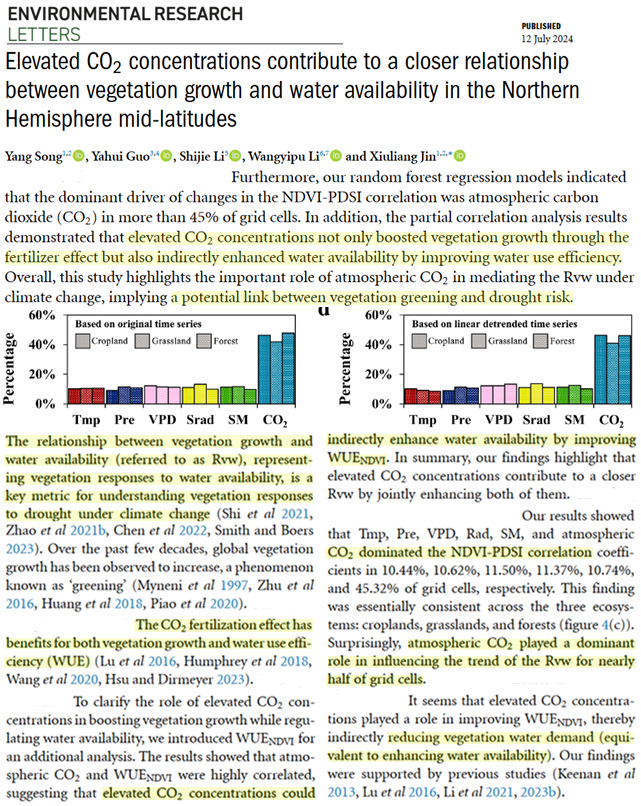
Another New Study Finds Rising CO2 Enhances Planetary Greening And Reduces Drought Risk

“…elevated CO2 concentrations not only boosted vegetation growth through the fertilizer effect but also indirectly enhanced water availability [reducing drought risk] by improving water use efficiency.” – Song et al., 2024

One of the more commonly-stated concerns linked to “global warming” is that sweltering heat will parch the terrestrial landscape (browning), limit vegetation growth, and foment water shortages – even widespread drought.

However, a new study suggests the Earth’s rising CO2 concentration has the exact opposite effect in the real world.

In their extensive trend analysis spanning the last few decades, the scientists determined elevated CO2 was the single most “dominant driver” (accounting for 45% of the correlation) when assessing the link between reducing vegetation water demand and improved water use efficiency.

Compared to CO2, temperature and precipitation, for example, play a far less significant role (10-11% of the correlation) in influencing the trend in improved vegetation growth and water use efficiency.

“The CO2 fertilization effect has benefits for both vegetation growth and water use efficiency (WUE).”

“…elevated CO2 concentrations could indirectly enhance water availability by improving [water use efficiency]…reducing vegetation water demand.”


Image Source: Song et al., 2024

via NoTricksZone

https://ift.tt/NzM27HV

August 12, 2024 at 01:35PM

Pubpeer Comment on our recent paper by the anonymous “Phoma destructiva”

By Andy May & Marcel Crok

An anonymous reviewer has written a critique of our recent paper “Carbon Dioxide and a Warming Climate are not problems,” published online May 29, 2024, in The American Journal of Economics and Sociology.

In the introduction to his critique, Phoma destructiva writes: “the authors and their cited sources likely underestimated anthropogenic global warming.” We provide no estimate of the anthropogenic component of global warming. All we do is point out that if some of the observed warming is natural, the IPCC AR6 estimate of anthropogenic global warming will be too high. This is trivially true.

The first part of the main critique, is actually a lengthy critique of Javier Vinós’ book Climate of Past, Present and Future, that has nothing to do with our paper. His critique compares Vinós’ projections into the future to those made by the IPCC, our paper makes no projections. We simply discuss the climate of today and the recent past (back to 1750), so this section of the critique is irrelevant to our paper and should be directed to Dr. Vinós.

While we cite some published projections in our conclusions, we deliberately avoided making any projections ourselves, our paper only considers past and present observations. The critique disputes Vinós’ predictions of the future by claiming that the IPCC predictions, based on the impact of CO2 emissions, are more accurate. We currently have no idea whether Vinós’ or the IPCC predictions are correct or not, as the time period discussed is not over yet. Our paper discusses the state of the climate today and in the past, predictions of the future are not observations and should not be confused with them.

The next section attempts to dispute the existence of all multidecadal ocean oscillations based on two papers by Michael Mann and co-authors, Mann, et al. (2020) and Mann et al. (2021). Mann’s 2020 paper attempts to show that the most cited ocean climate oscillations, the AMO and the PDO, are not statistically significant because their signal is not sufficiently above red noise. However, he acknowledges that the historical observations of the AMO are statistically significant, and it is only climate model results that are not statistically significant. Since all models are wrong (Box, 1976), this argument is quite weak.

The PDO is usually interpreted as a long-term variation in the La Niña/El Niño ratio, and (Mann, Steinman, & Miller, 2020) do acknowledge that the ratio varies in a statistically significant fashion on a 40–50-year timescale. He just disputes the predictability of the traditional PDO.

We acknowledge that the longer-term ocean oscillations are poorly understood and poorly described. However, Mann et al. (2020) provides no valid evidence that they do not exist or that they have no natural component. In fact, he admits:

“Based on the available observational and modelling evidence, the most plausible explanation for the multidecadal peak seen in modern climate observations is that it reflects the response to a combination of natural and anthropogenic forcing during the historical era.” (Mann, Steinman, & Miller, 2020)

We agree with this sentence, and it is consistent with our paper.

Mann, et al. (2021) attempts to explain multidecadal ocean oscillations (specifically the AMO and the PDO) as an artefact of volcanic activity and anthropogenic greenhouse gases and aerosols. Again, as also noted in Mann (2020), Mann (2021) notes the absence of a multidecadal signal in climate model simulations but acknowledge that the signal can be seen in observations (Mann M. , Steinman, Brouillette, & Miller, 2021). We would argue that if the signal is seen in observations and in paleoclimate proxy data, but not in climate models, that is a reason not to trust the climate models, not a reason to reject the proposed natural oscillation.

We do believe that anthropogenic greenhouse gases and aerosols, and volcanic activity have some influence on climate, but we believe that current warming has been “juiced” by natural ocean oscillations. These oscillations are observed in nature and have been traced back as far as 1567AD, well before anthropogenic greenhouse gases and aerosols could have been a factor in climate change (Gray, Graumlich, Betancourt, & Pederson, 2004).

The evidence presented by Mann (2021) that volcanic activity has caused the “apparent” ocean oscillations is model based, and not based on observations. This is problematic for many reasons, not the least of which is that the IPCC AR6 models cannot reproduce the critical tropical sea surface temperatures (SSTs) very well, even though sea surface temperatures are a key component of most of the ocean oscillations. From AR6:

“We assess with medium confidence that CMIP5 and CMIP6 models continue to overestimate observed warming in the upper tropical troposphere over the 1979–2014 period by at least 0.1°C per decade, in part because of an overestimate of the tropical SST trend pattern over this period.” AR6, p 444

“… despite decades of model development, increases in model resolution, and advances in parametrization schemes, there has been no systematic convergence in model estimates of ECS. In fact, the overall inter-model spread in ECS for CMIP6 is larger than for CMIP5; …”AR6, WGI, page 1008.

In other words, both the AR5 and AR6 climate models overestimate sea surface temperatures in the tropics, which is nearly half of the planet’s surface. In addition, the model estimates of ECS (Equilibrium Climate Sensitivity to a doubling of CO2) are worse in AR6 than in AR5, suggesting that the models are getting worse with time, not better, relative to observations (also see here). Other studies have also shown that the climate models are invalidated when compared to observations (McKitrick & Christy, 2020) and (McKitrick & Christy, 2018). Model evidence cannot be used to show observational evidence is incorrect.

Then the anonymous critique of our paper again resorts to comparing predictions by Vinós, (Wyatt & Curry, 2014), and others to the IPCC predictions. We made no predictions, we only cited observations. The end of the time period for the various predictions they criticize has not been reached, thus which, if any, of the predictions turn out to be correct is unknown and will not be known for decades to come. Arguing which prediction is correct at this point is a fruitless exercise. Predictions are a critical part of science, but one should wait until the prediction period is over before criticizing them.

Discussion

This critique is a poster child for all that is wrong with modern climate science. Phoma destructiva sets up obvious strawmen from articles we cite, that are unrelated to our argument that observations show no dangers or net harm from climate change today, and then attacks his own strawmen, rather than our paper. This sort of irrelevant strawman fallacy is unfortunately very common in climate science and is never credible.

Far too often even trained climate scientists mix climate model results with observations as if they were of equal importance or significance, they are not. Statements like the following from Mann et al., 2021 are clearly incorrect:

“Our analysis reveals a robust multidecadal, narrowband (50- to 70-year) oscillatory “AMO-like” signal in simulations of the past millennium; the oscillation is driven by episodes of high amplitude explosive volcanism that happen, in past centuries, to display a multidecadal pacing. We find no evidence for an internally generated 50- to 70-year multidecadal oscillatory signal despite continued claims that proxy data reveal such a signal.” (Mann M. , Steinman, Brouillette, & Miller, 2021)

Translation, our simulations show that volcanism caused the oscillation and proxy evidence that the oscillation is natural is wrong, because our models say so. This is clearly flawed logic; however we do agree that the current ocean oscillations probably have both forced (CO2 and volcanism) and unforced (natural) components. But as stated in Mann (2020), objectively separating these two components is problematic.

Climate models, like all models, are always wrong (Box, 1976). Properly done, observations are always right, within measurement accuracy. Ocean oscillations, such as the AMO, PDO, and many others, are observed climate features, they are real, and cannot be disproven with climate model results.

Note: Neither Marcel nor Andy have a PhD, thus Phoma destructiva used the title “Dr.” incorrectly.

Works Cited

Box, G. E. (1976). Science and Statistics. Journal of the American Statistical Association, 71(356), 791-799. Retrieved from https://ift.tt/v3qwU1P

Gray, S. T., Graumlich, L. J., Betancourt, J. L., & Pederson, G. T. (2004). A tree-ring based reconstruction of the Atlantic Multidecadal Oscillation since 1567 A.D. Geophys. Res. Lett., 31. doi:10.1029/2004GL019932

IPCC. (2021). Climate Change 2021: The Physical Science Basis. In V. Masson-Delmotte, P. Zhai, A. Pirani, S. L. Connors, C. Péan, S. Berger, . . . B. Zhou (Ed.)., WG1. Retrieved from https://ift.tt/ZrpbGaP

Mann, M., Steinman, B., & Miller, S. (2020). Absence of internal multidecadal and interdecadal oscillations in climate model simulations. Nature Communications, 11. doi:10.1038/s41467-019-13823-w

Mann, M., Steinman, B., Brouillette, D., & Miller, S. (2021). Multidecadal climate oscillations during the past millennium driven by volcanic forcing. Science, 317, 1014-1019. doi:10.1126/science.abc5810

McKitrick, R., & Christy, J. (2018, July 6). A Test of the Tropical 200- to 300-hPa Warming Rate in Climate Models, Earth and Space Science. Earth and Space Science, 5(9), 529-536. doi:10.1029/2018EA000401

McKitrick, R., & Christy, J. (2020). Pervasive Warming Bias in CMIP6 Tropospheric Layers. Earth and Space Science, 7. doi:10.1029/2020EA001281

Wyatt, M., & Curry, J. (2014, May). Role for Eurasian Arctic shelf sea ice in a secularly varying hemispheric climate signal during the 20th century. Climate Dynamics, 42(9-10), 2763-2782. Retrieved from https://ift.tt/adWxyC8

via Watts Up With That?

https://ift.tt/AKUI8b0

August 12, 2024 at 12:06PM

Tuesday

0 out of 10 based on 0 rating

via JoNova

https://ift.tt/aQFeNT3

August 12, 2024 at 09:56AM