Mid and late tropical weather season should be active and perhaps hyperactive.
via CFACT
September 4, 2024 at 11:32PM
Mid and late tropical weather season should be active and perhaps hyperactive.
via CFACT
September 4, 2024 at 11:32PM
“In autumn 2014, large pieces of trees were discovered for the first time from glacial slope sediments in the foreland of the Pasterze glacier. These are far larger than previous finds and are impressive evidence of the former tree population. The tree trunk, several metres long and broken into two pieces, was discovered in September 2014 by two employees of the Grossglockner mountain railway/glacier railway. Initial analyses by Andreas Kellerer-Pirklbauer (University of Graz) and Kurt Nicolussi (University of Innsbruck) show that it is around 6,000 years old.”


Pasterze releases a meter-long tree trunk after thousands of years – Spittal
Just having fun
This entry was posted in Uncategorized. Bookmark the permalink.
via Real Climate Science
September 4, 2024 at 08:55PM
Owen Klinsky
Contributor
Swedish automaker Volvo Cars said on Wednesday that it is scrapping its goal of going fully electric by 2030 as the electric vehicle (EV) market continues to struggle.
The company announced it now aims for between 90% and 100% of its cars to be fully electric or plug-in hybrids by the end of the decade, with the remainder being “mild,” non-plug-in hybrids, a company press release stated. Volvo’s backpedaling comes amid lower-than-expected consumer demand for EVs and a recent industry shift away from electrification. (RELATED: REPORT: $84 Billion Worth Of Biden-Subsidized Manufacturing Projects Floundering)
“While Volvo Cars will retain its position as an industry leader in electrification, it has now decided to adjust its electrification ambitions due to changing market conditions and customer demands,” the company wrote. “The strategic adjustments to its electrification ambitions ensure that Volvo Cars has a flexible plan that meets customer preferences and enables value creation as a business.”
Volvo has ditched plans to sell only electric cars by 2030 amid waning demand for battery powered vehicles.
Another big manufacturer ditching EV plans. #CostOfNetZero
👉https://t.co/i7qPgRbjLx pic.twitter.com/AMlxhyAKwv
— Net Zero Watch (@NetZeroWatch) September 4, 2024
“We are and will remain an industry leader in electrification and nearly half of our global sales are either fully electric or plug-in hybrids,” a Volvo spokesman told the DCNF.
The company’s shift in strategy comes amid broader challenges in the EV market, with consumer demand coming in lower than proponents hoped, according to Fortune, and automakers like Rivian, Ford and General Motors hemorrhaging cash on their EV initiatives.
Ford scrapped plans to manufacture a three-row electric SUV in August, while Mercedez-Benz dropped its goal of an all-electric line-up by 2030 in February. Luxury EV maker Lucid laid off 6% of its workforce in May, equating to roughly 400 employees.
Volvo’s Wednesday announcement is the latest setback for President Joe Biden’s goal of having 50% of new U.S. car sales be EVs by 2030.
All content created by the Daily Caller News Foundation, an independent and nonpartisan newswire service, is available without charge to any legitimate news publisher that can provide a large audience. All republished articles must include our logo, our reporter’s byline and their DCNF affiliation. For any questions about our guidelines or partnering with us, please contact licensing@dailycallernewsfoundation.org.
via Watts Up With That?
September 4, 2024 at 08:04PM

By Jo Nova
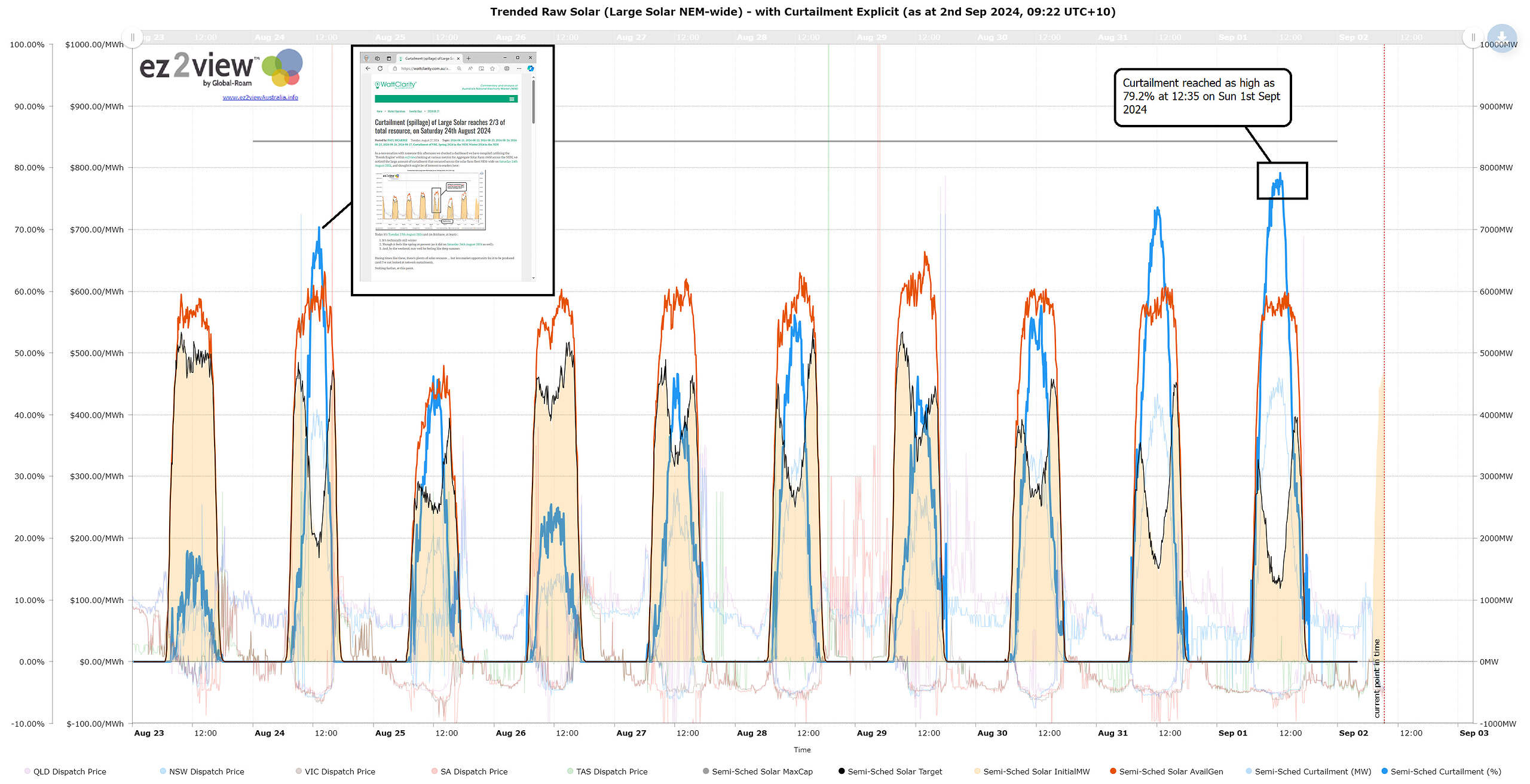
It’s winter in Australia and already we’re reaching the point where there’s too much solar. There’s such an excess of useless energy, prices are negative, meaning the hapless generators have to pay people to take the poison power away. And on Sunday, at a time when investors ought be making their peak profit for the day, they were rushing to turn 80% of their panels off.
Feel the pain — the stunted curve of the solar plants (below) is supposed to be the same shape as the rooftop PV.
In reality, this is how we make the parabolic curve of orbital solar physics fit a rectangular box — by building five times as much as we need and wasting most of it.
Bear in mind, this is just the start of a the lumpy road to nowhere. Even though we already have more solar panels than we can use, we’re supposed to be installing 22,000 more panels every day in Australia to reach our mystical NetZero target.
Paul McArdle of WattClarity noticed the dire situation. As he says “rooftop PV is killing it’s big brother!”
He has calculated the curtailment levels were often around 40 to 50% for large solar plants this week.
Who would want to invest in a solar plant?
And at the moment, there’s a bite out of the daily peak, every day.
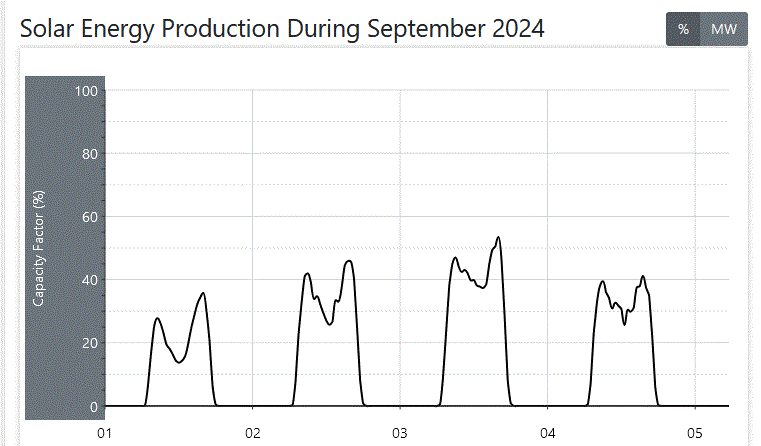
We’re reached this surreal point because there is more wind power than usual and it’s spring. The weather is mild, so householders don’t need as much electricity thus the minimum demand on the grid is falling dangerously low. That’s a problem because the giant coal plants and other reliable generators need to keep running, to supply the frequency stabilization and so they can ramp up to fill the gaps.
Angela Macdonald-Smith, Australian Financial Review
[Josh Stabler, managing director at adviser Energy Edge] …said the available wind and solar resource almost exceeded total demand, but noted that renewable “spillage” – where renewable output is not made use of – was also at a record high.
“Spillage and abundance will be continuous features of the electricity market into the future and will become more common, especially during spring,” Mr Stabler said.
It’s mayhem on the market:
The 24-hour average wholesale price was negative for Victoria, South Australia and Tasmania, according to National Electricity Market data, with NSW only just in positive territory at $16.81 a megawatt-hour for the 24 hours to 3am on Monday. That compares with the four-week average price in NSW of $206.23/MWh.
So wholesale electricity prices are six times higher than they used to be, and we have an overdesigned grid with twice as much infrastructure as we need and most of the time, a lot of the capital assets are sitting around doing nothing.
And people think if we just do more it will “be cheaper”.
10 out of 10 based on 1 rating
via JoNova
September 4, 2024 at 04:54PM