Month: September 2024

UAH August 2024: Most Regions Cooler, Offset by SH Land Spike

The post below updates the UAH record of air temperatures over land and ocean. Each month and year exposes again the growing disconnect between the real world and the Zero Carbon zealots.  It is as though the anti-hydrocarbon band wagon hopes to drown out the data contradicting their justification for the Great Energy Transition.  Yes, there has been warming from an El Nino buildup coincidental with North Atlantic warming, but no basis to blame it on CO2.  

As an overview consider how recent rapid cooling  completely overcame the warming from the last 3 El Ninos (1998, 2010 and 2016).  The UAH record shows that the effects of the last one were gone as of April 2021, again in November 2021, and in February and June 2022  At year end 2022 and continuing into 2023 global temp anomaly matched or went lower than average since 1995, an ENSO neutral year. (UAH baseline is now 1991-2020). Now we have an usual El Nino warming spike of uncertain cause, unrelated to steadily rising CO2 and now moderating.
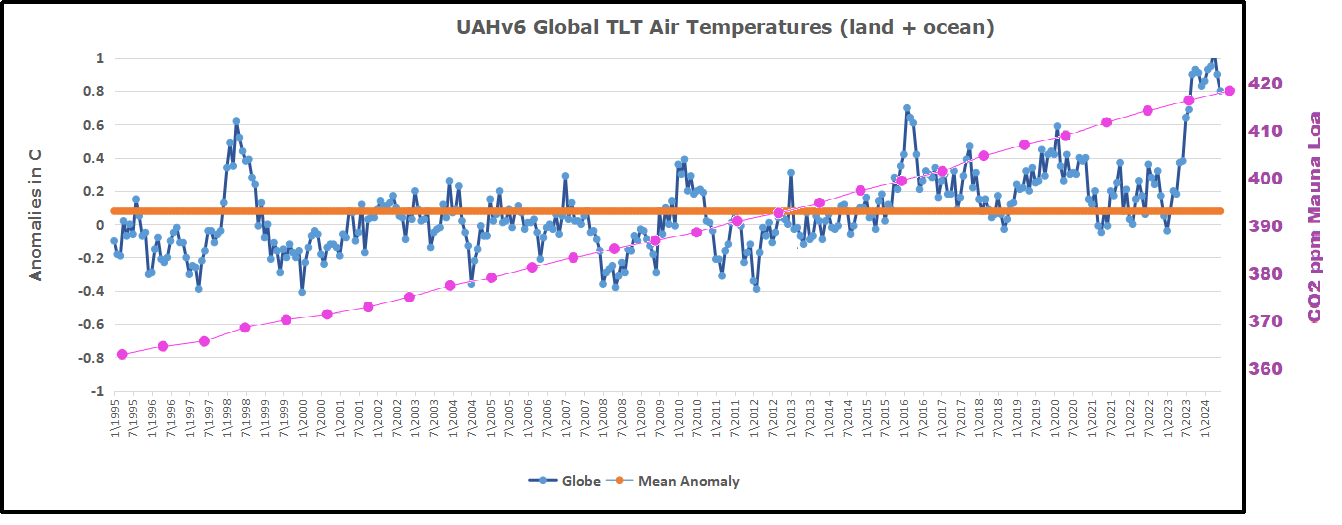
For reference I added an overlay of CO2 annual concentrations as measured at Mauna Loa.  While temperatures fluctuated up and down ending flat, CO2 went up steadily by ~60 ppm, a 15% increase.

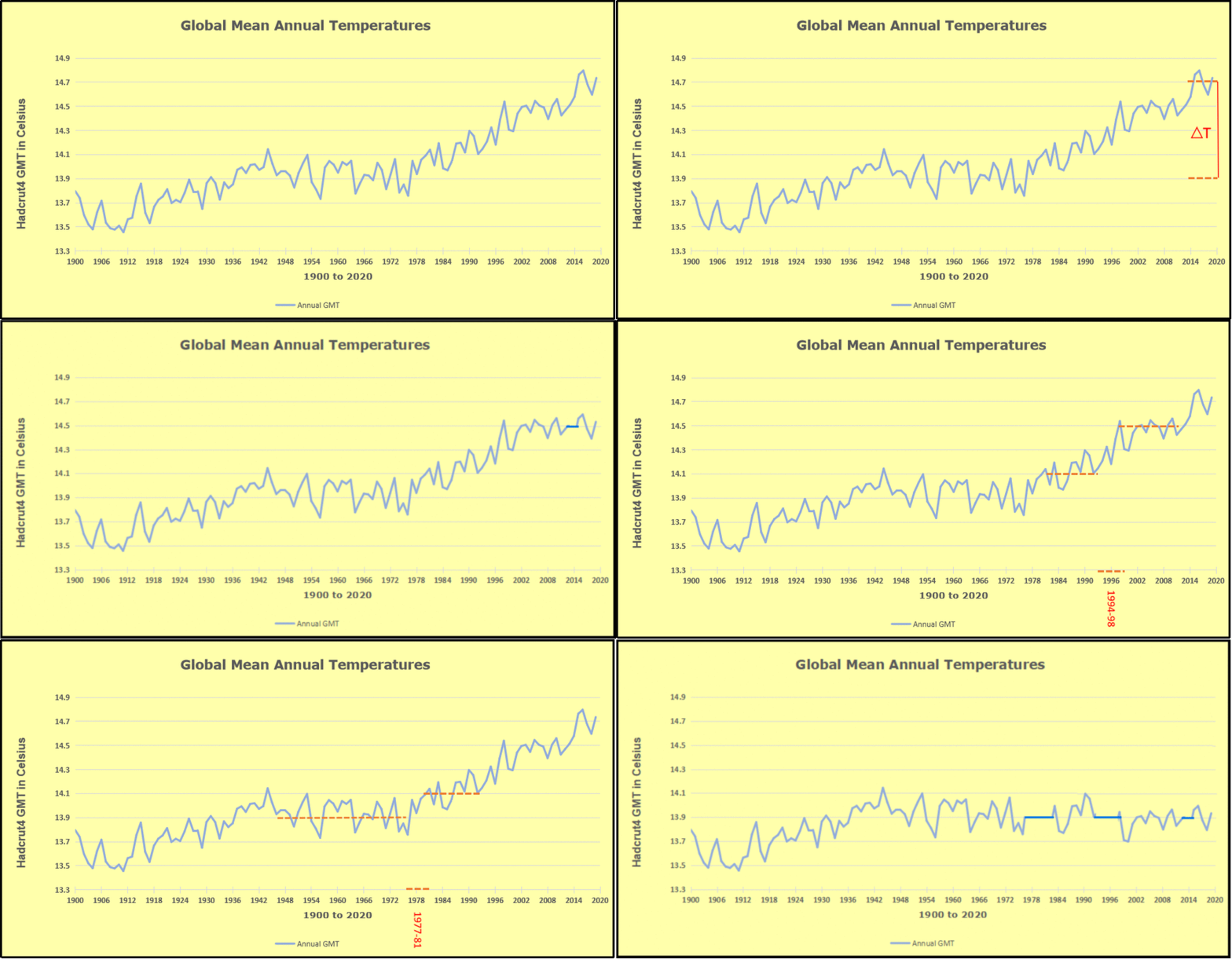
Furthermore, going back to previous warmings prior to the satellite record shows that the entire rise of 0.8C since 1947 is due to oceanic, not human activity.
gmt-warming-events

The animation is an update of a previous analysis from Dr. Murry Salby.  These graphs use Hadcrut4 and include the 2016 El Nino warming event.  The exhibit shows since 1947 GMT warmed by 0.8 C, from 13.9 to 14.7, as estimated by Hadcrut4.  This resulted from three natural warming events involving ocean cycles. The most recent rise 2013-16 lifted temperatures by 0.2C.  Previously the 1997-98 El Nino produced a plateau increase of 0.4C.  Before that, a rise from 1977-81 added 0.2C to start the warming since 1947.

Importantly, the theory of human-caused global warming asserts that increasing CO2 in the atmosphere changes the baseline and causes systemic warming in our climate.  On the contrary, all of the warming since 1947 was episodic, coming from three brief events associated with oceanic cycles. And now in 2024 we have seen an amazing episode with a temperature spike driven by ocean air warming in all regions, along with rising NH land temperatures, now receding from its peak.

Chris Schoeneveld has produced a similar graph to the animation above, with a temperature series combining HadCRUT4 and UAH6. H/T WUWT
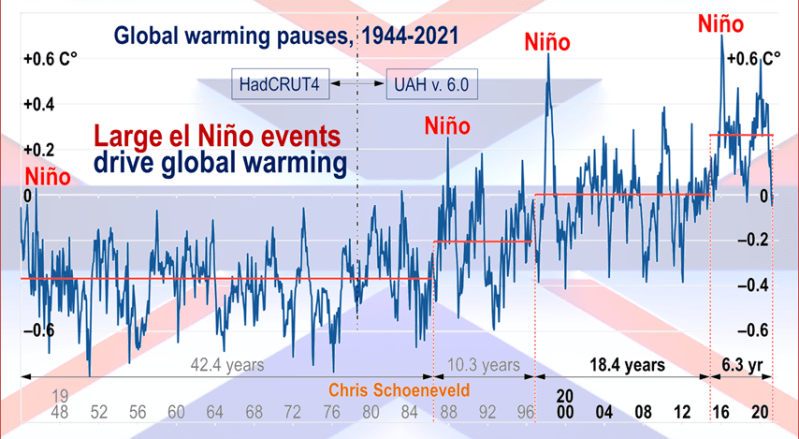
image-8


mc_wh_gas_web20210423124932

See Also Worst Threat: Greenhouse Gas or Quiet Sun?

August 2024 Most Regions Cooler Offset by SH Land Spike

 banner-blog

With apologies to Paul Revere, this post is on the lookout for cooler weather with an eye on both the Land and the Sea.  While you heard a lot about 2020-21 temperatures matching 2016 as the highest ever, that spin ignores how fast the cooling set in.  The UAH data analyzed below shows that warming from the last El Nino had fully dissipated with chilly temperatures in all regions. After a warming blip in 2022, land and ocean temps dropped again with 2023 starting below the mean since 1995.  Spring and Summer 2023 saw a series of warmings, continuing into October, followed by cooling. 

UAH has updated their tlt (temperatures in lower troposphere) dataset for August 2024. Posts on their reading of ocean air temps this month are ahead of the update from HadSST4.  I posted last month on SSTs using HadSST4 Oceans Warming Uptick July 2024. These posts have a separate graph of land air temps because the comparisons and contrasts are interesting as we contemplate possible cooling in coming months and years.

Sometimes air temps over land diverge from ocean air changes. Last February 2024, both ocean and land air temps went higher driven by SH, while NH and the Tropics cooled slightly, resulting in Global anomaly matching October 2023 peak. Then in March Ocean anomalies cooled while Land anomalies rose everywhere. After a mixed pattern in April, the May anomalies were back down led by a large drop in NH land, and a smaller ocean decline in all regions. In June all Ocean regions dropped down, as well as dips in SH and Tropical land temps. In July all Oceans were unchanged except for Tropical warming, while all land regions rose slightly. Now in August we see a warming leap in SH land, slight Land cooling elsewhere, a dip in Tropical Ocean temp and slightly elswhere. End result is a small upward bump.

Note:  UAH has shifted their baseline from 1981-2010 to 1991-2020 beginning with January 2021.  In the charts below, the trends and fluctuations remain the same but the anomaly values changed with the baseline reference shift.

Presently sea surface temperatures (SST) are the best available indicator of heat content gained or lost from earth’s climate system.  Enthalpy is the thermodynamic term for total heat content in a system, and humidity differences in air parcels affect enthalpy.  Measuring water temperature directly avoids distorted impressions from air measurements.  In addition, ocean covers 71% of the planet surface and thus dominates surface temperature estimates.  Eventually we will likely have reliable means of recording water temperatures at depth.

Recently, Dr. Ole Humlum reported from his research that air temperatures lag 2-3 months behind changes in SST.  Thus cooling oceans portend cooling land air temperatures to follow.  He also observed that changes in CO2 atmospheric concentrations lag behind SST by 11-12 months.  This latter point is addressed in a previous post Who to Blame for Rising CO2?

After a change in priorities, updates are now exclusive to HadSST4.  For comparison we can also look at lower troposphere temperatures (TLT) from UAHv6 which are now posted for August.  The temperature record is derived from microwave sounding units (MSU) on board satellites like the one pictured above. Recently there was a change in UAH processing of satellite drift corrections, including dropping one platform which can no longer be corrected. The graphs below are taken from the revised and current dataset.

The UAH dataset includes temperature results for air above the oceans, and thus should be most comparable to the SSTs. There is the additional feature that ocean air temps avoid Urban Heat Islands (UHI).  The graph below shows monthly anomalies for ocean air temps since January 2015.
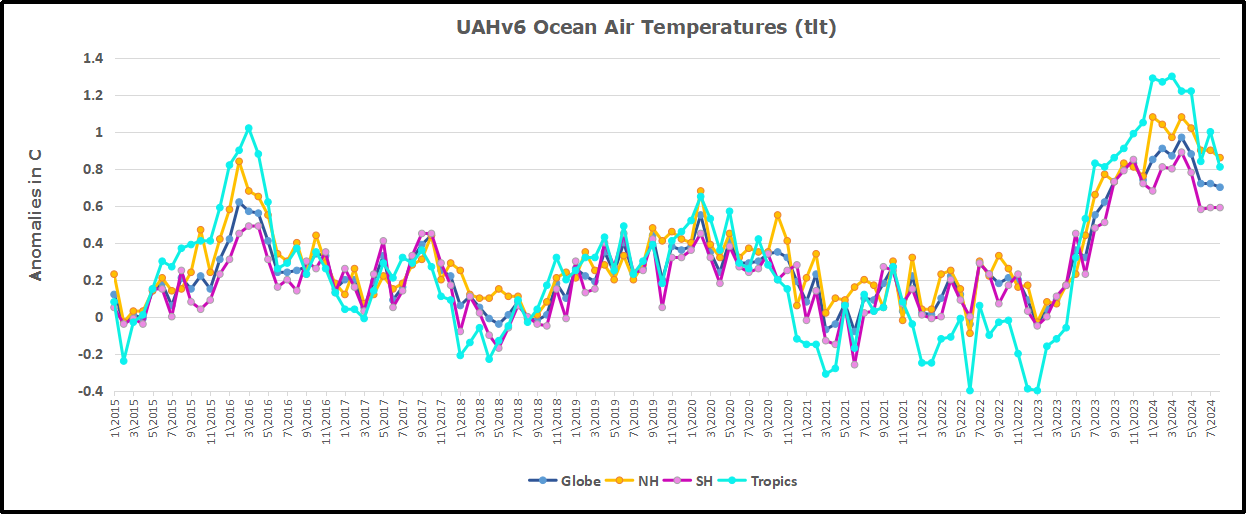
 

Note 2020 was warmed mainly by a spike in February in all regions, and secondarily by an October spike in NH alone. In 2021, SH and the Tropics both pulled the Global anomaly down to a new low in April. Then SH and Tropics upward spikes, along with NH warming brought Global temps to a peak in October.  That warmth was gone as November 2021 ocean temps plummeted everywhere. After an upward bump 01/2022 temps reversed and plunged downward in June.  After an upward spike in July, ocean air everywhere cooled in August and also in September.   

After sharp cooling everywhere in January 2023, all regions were into negative territory. Note the Tropics matched the lowest value, but since have spiked sharply upward +1.7C, with the largest increases in April to July, and continuing through adding to a new high of 1.3C January to March 2024.  In April and May that started dropping in all regions.   June showed a sharp decline everywhere, led by the Tropics down 0.5C. The Global anomaly fell to nearly match the September 2023 value. In July, the Tropics rose slightly while SH, NH and the Global Anomaly were unchanged. Now in August a drop in the Tropics, with little NH cooling and Global Ocean anomaly slightly lower.

Land Air Temperatures Tracking in Seesaw Pattern

We sometimes overlook that in climate temperature records, while the oceans are measured directly with SSTs, land temps are measured only indirectly.  The land temperature records at surface stations sample air temps at 2 meters above ground.  UAH gives tlt anomalies for air over land separately from ocean air temps.  The graph updated for August is below.
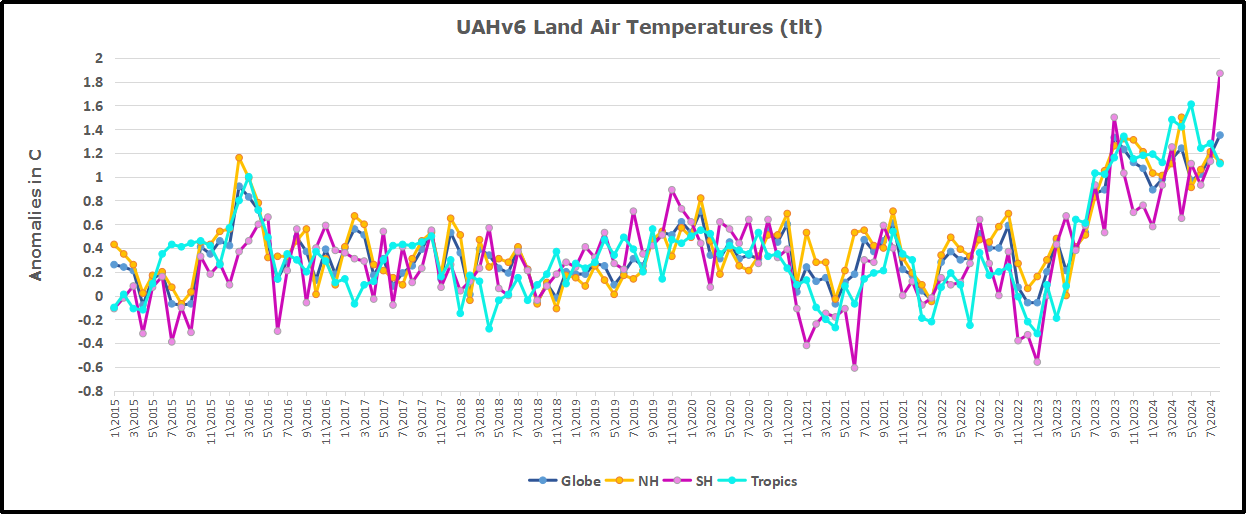
 

Here we have fresh evidence of the greater volatility of the Land temperatures, along with extraordinary departures by SH land.  Land temps are dominated by NH with a 2021 spike in January,  then dropping before rising in the summer to peak in October 2021. As with the ocean air temps, all that was erased in November with a sharp cooling everywhere.  After a summer 2022 NH spike, land temps dropped everywhere, and in January, further cooling in SH and Tropics offset by an uptick in NH. 

Remarkably, in 2023, SH land air anomaly shot up 2.1C, from  -0.6C in January to +1.5 in September, then dropped sharply to 0.6 in January 2024, matching the SH peak in 2016. Then in February and March SH anomaly jumped up nearly 0.7C, and Tropics went up to a new high of 1.5C, pulling up the Global land anomaly to match 10/2023. In April SH dropped sharply back to 0.6C, Tropics cooled very slightly, but NH land jumped up to a new high of 1.5C, pulling up Global land anomaly to its new high of 1.24C.

In May that NH spike started to reverse.  Despite warming in Tropics and SH, the much larger NH land mass pulled the Global land anomaly back down to the February value. In June, sharp drops in SH and Tropics land temps overcame an upward bump in NH, pulling Global land anomaly down to match last December. In July, all land regions rose slightly, and now in August a record spike up to 1.87 and pulling the Global land anomaly up by 0.17°C. Despite this land warming, the Global land and ocean combined anomaly rose only 0.03°C.

The Bigger Picture UAH Global Since 1980
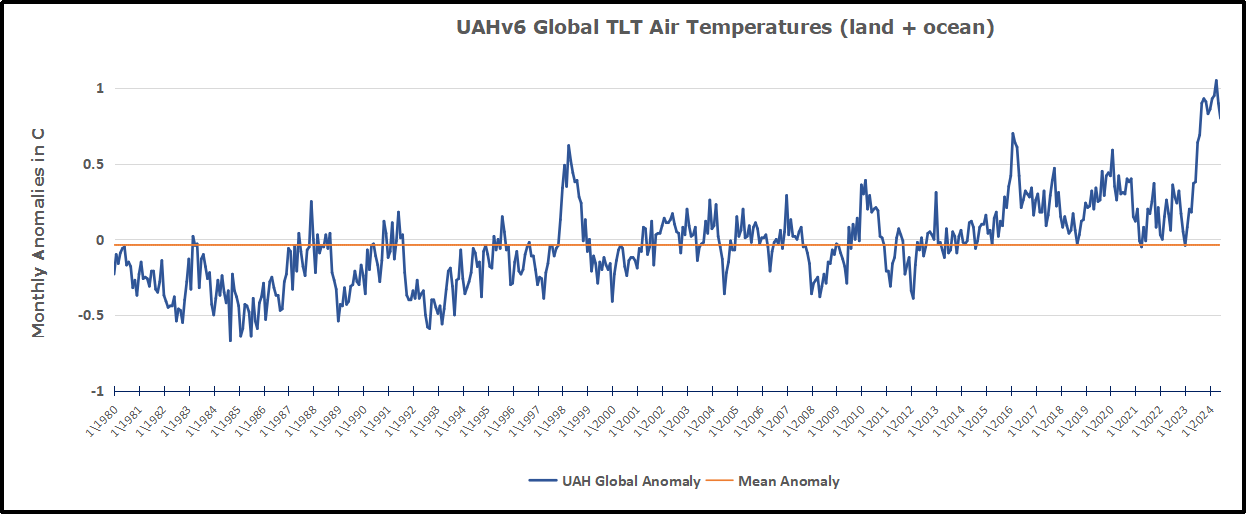
The chart shows monthly Global anomalies starting 01/1980 to present.  The average monthly anomaly is -0.04, for this period of more than four decades.  The graph shows the 1998 El Nino after which the mean resumed, and again after the smaller 2010 event. The 2016 El Nino matched 1998 peak and in addition NH after effects lasted longer, followed by the NH warming 2019-20.   An upward bump in 2021 was reversed with temps having returned close to the mean as of 2/2022.  March and April brought warmer Global temps, later reversed

With the sharp drops in Nov., Dec. and January 2023 temps, there was no increase over 1980. Then in 2023 the buildup to the October/November peak exceeded the sharp April peak of the El Nino 1998 event. It also surpassed the February peak in 2016. After March and April took the Global anomaly to a new peak of 1.05C.  The cool down started with May dropping to 0.90C, and in June a further decline to 0.80C.  Despite an uptick to 0.85 in July,   it remains to be seen whether El Nino will weaken or gain strength, and it whether we are past the recent peak.

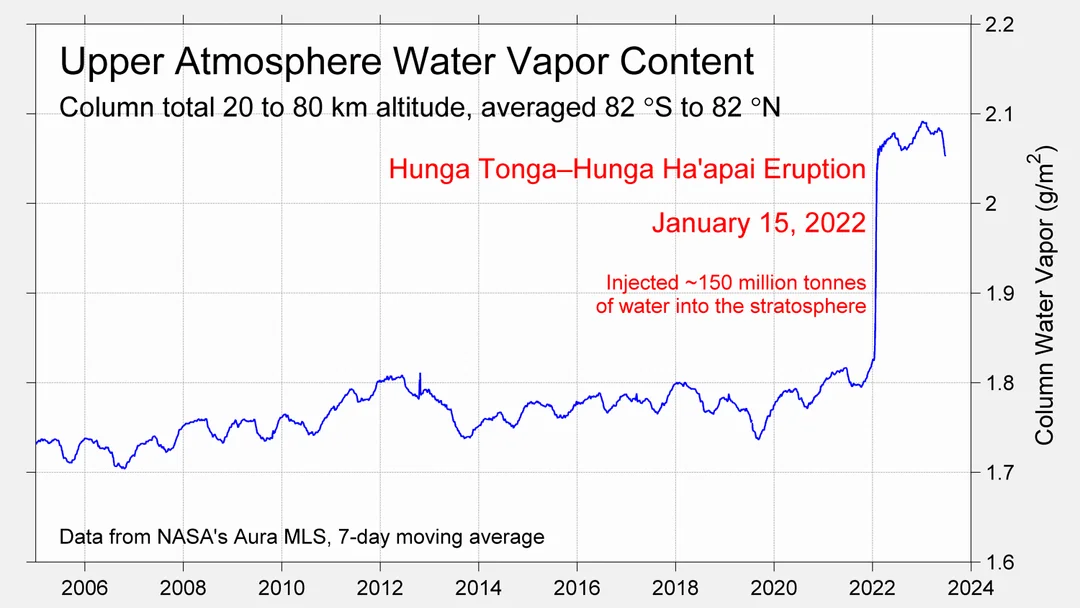
The graph reminds of another chart showing the abrupt ejection of humid air from Hunga Tonga eruption.
TLTs include mixing above the oceans and probably some influence from nearby more volatile land temps.  Clearly NH and Global land temps have been dropping in a seesaw pattern, nearly 1C lower than the 2016 peak.  Since the ocean has 1000 times the heat capacity as the atmosphere, that cooling is a significant driving force.  TLT measures started the recent cooling later than SSTs from HadSST4, but are now showing the same pattern. Despite the three El Ninos, their warming has not persisted prior to 2023, and without them it would probably have cooled since 1995.  Of course, the future has not yet been written.


via Science Matters

https://ift.tt/MuT3HcA

September 4, 2024 at 04:13PM

Ockham’s View of Cenozoic CO2

by Pat Frank

Multiply not the entities — William of Ockham. paraphrased

This essay starts with a thank-you. Willis Eschenbach has very often been a source of insight or inspiration here at WUWT. Back on 23 February 2024, Willis posted “A Curious Paleo Puzzle,” in which he drew attention to the work of James Rae, et al., (2021) Atmospheric CO2 over the Past 66 Million Years from Marine Archives.” Rae, et al., had compiled benthic d11B and alkenone proxies to produce 66-million-year proxy record of Paleocene to Holocene atmospheric CO2 (ppm). Willis’ introduction set the present study in motion. So — thank-you, Willis.

Rae, et al., (2021) also included a 66-million-year record of d18O proxy global average sea surface temperature (SST), which Jim Hansen and colleagues had published in 2013. The usual CO2 –> T interpretation was advanced in both papers.

The solubility of CO2 is temperature-dependent. The existence of both a paleo-SST record and a paleo-CO2 record brought to mind the possibly that the rise and fall of SST was natural variation and atmospheric CO2 just followed — the Null Hypothesis.

The Null Hypothesis

The idea is that some independent natural process drove SST. The partial pressure of atmospheric CO2, P(CO2), followed SST-driven solubility. The Null Hypothesis proposes a minimalist explanation for Cenozoic SST and P(CO2). It requires no additional entity; namely the radiative forcing of CO2. A preliminary analysis looked favorable.

The idea is worked out in Cenozoic Carbon Dioxide: the 66 Ma Solution, just published and open access in MDPI Geosciences. The state of the field requires attention to the basics of the typical criticism. Two anonymous reviewers asked for extensive revisions and clarifications. The highly qualified academic editors evaluated the revised manuscript. Submission-to-acceptance took just over a month. The whole process was completely professional. MDPI Geosciences was the second submission journal. The first submission journal held the manuscript for 3.5 months, but could not find a manuscript editor. So, that submission was stillborn.

This post sketches the results; details in the paper.

SST, CO2, and Henry’s Law

Flood Basalt Volcanism: The first step was to find whether the oceans can warm without recourse to CO2 forcing. Meet the North Atlantic Igneous Province (NAIP). The NAIP, Figure 1, contains the crustal remains of the flood basalts that erupted 56 to 52 million years before the present (MYr BP), when Greenland split off from the Eurasian land mass.

The eruptions of the NAIP produced about 6.6 million km3 of basaltic magma over a period of 3-4 million years. Typically, the main phase of flood basaltic eruptions occurred over about half the time of the full duration.

Liquid basaltic magma emerges at about 1620 K and crystallizes at 1470 K. Taking into account the heat capacity and the heat of fusion of basalt, each 1 million km3 of magma releases enough heat to warm the entire 1.338 billion km3 of the global ocean by about 0.97 C. If the thermal plume rises to occupy just the top 1 km of the world ocean, the temperature change is about 3.6 C. These numbers assume the ocean captures all the released heat, which may not be the case.

Nevertheless, the thermal impact of the 6.6 million km3 of NAIP basaltic magma alone can account for the entire increase in SST entering the post-Cretaceous Paleocene-Eocene Thermal Maximum (PETM) (discussed below).  Although the NAIP eruption was accompanied by large emissions of CO2 and other gases, there is no need to invoke CO2 forcing to account for the increased SST of the PETM.

Figure 1: Map of the North Atlantic Igneous Province (from Horni, et al., (2017))

The Miocene Climate Optimum is associated with the Columbia River flood volcanism. Evidence of flood basalt volcanism occurs throughout the Phanerozoic. Correlation of climate and submarine flood basalt magmatism across deep time is outside the scope of the paper, but would seem to be a fruitful area of research.

Henry’s Law: The next order of business was to derive the relation between SST and the atmospheric partial pressure of CO2, P(CO2), across the 66 million years of the Cenozoic. Figure 2 illustrates Henry’s Law, which describes the partition of CO2, as a soluble gas, between the gas phase and the solution phase.

Typically, most dissolved CO2 is the neutral molecule. However, a small fraction of the dissolved CO2 reacts with water to produce carbonic acid (H2CO3). At the alkaline pH of the upper ocean, H2CO3 is converted into bicarbonate (HCO3) and carbonate (CO32−). Removal of H2CO3 into carbonate means additional CO2 converts into carbonic acid (Le Chatelier).

Current oceanic ratios are: CO2, 0.5%; HCO3,  87.4%, and; CO32−, 12.1%. In Figure 2, right, the thin aqua vertical bar shows the anticipated impact of so-called “ocean acidification” from doubled CO2: slightly less carbonate, slightly more bicarbonate, and a hair more neutral CO2. The change is pH 8.1 to pH 7.9. The surface waters remain alkaline. They will not have been acidificationized.

Figure 2: Left, Henry’s Law governs the equilibration of CO2 between gas and solution phases (paired vertical blue arrows across the aqua-white interface). Right, the distribution of CO2 and carbonate with pH in sea-water-like salt solution.

Henry’s Law is deceptively simple. In words:

Gas-phase Partial Pressure = solution-phase concentration x the Henry’s Law Constant.                     1

Henry’s Law constants vary with the molecule, with temperature, with the solvent, and with the presence of other solutes. Knowledge of any two Henry’s Law factors allows calculation of the third. Figure 3 shows the correspondence of the temperature-dependent Henry’s Law constants for CO2 in sea water (HS) with the trend of d18O proxy Cenozoic SSTs.

The temperature-dependent Henry’s Law constants for CO2 plus sea water closely track the d18O proxy Cenozoic SST.

Cenozoic CO2: The paper shows that Cenozoic P(CO2) can be reconstructed as:

P(CO2) = (fractional change in HS) x (total change in P(CO2)) + baseline offset                       2

at each point across the Cenozoic.

The Rae, et al., (2021) proxy construct gave a mean P(CO2) ~1093 ppm at 66 MYr BP. At the end of the Cenozoic, the mean P(CO2) was 231 ppm during the Quaternary glacial/interglacial cycles. The Cenozoic P(CO2) = 1093 – 231 = 862 ppm.

The trend in Cenozoic P(CO2) can then be calculated using the value-added equation 2. Specifically:

P(CO2)i = [(dH0,i/dH0,t)x 862 ppm] +231 ppm,                                                               3

where (dH0,i/dH0,t) is just the fractional change in the temperature-dependent Henry’s Law constant.

Figure 3: Blue line, d18O proxy estimate of Cenozoic SSTs (Hansen et al., (2013)). Red line, trend in Henry’s Law constant for equilibration of CO2 across the atmosphere/sea surface interface during the Cenozoic. The right ordinate is descending upwards.

The proxy reconstruction of Cenozoic P(CO2) proxy points of (Rae, et al., (2021)) provided a baseline reference series for the P(CO2) trends calculated from Henry’s Law. Figure 4 shows the comparison.

Figure 4: (yellow points), proxy P(CO2) over the Cenozoic from (Rae, et al., 2021)); (purple line), 15% weighted Lowess smooth. (blue line), Cenozoic P(CO2) calculated using equation 3; red line, weighted Lowess smooth. Inset: expansion of the most recent 7.5 Ma.

Two proxy SSTs for the PETM are available. The PETM maximum SST reported by Bijl, et al. (2009) is 35 C, while the Hansen, et al., 2013 reported a PETM maximum of 28 C.

The Bijl SSTs (blue line) gave a much better match to the P(CO2) proxy points. The PETM SSTs of Hansen, et al., (Figure 3), yielded PETM P(CO2) levels generally too low.

The calculated P(CO2) trend goes through the proxy CO2 points across the first 36 MYr BP of the Cenozoic. After that, P(CO2) declined all across the Cenozoic. At 30 MYr BP, the proxy suddenly dips about 300 ppm below the Henry’s Law line. However, after 22 MYr BP, the calculated and proxy slopes are nearly parallel.

At about 3 MYr BP, (inset), the proxy points and the Henry’s Law trend merge once again while P(CO2) dereases precipitously through the Pleistocene.

[CO2]ocean of the Paleocene

Of further interest, at the beginning of the Cenozoic the mean proxy estimates of SST, 297 K, and of P(CO2), 1093 ppm, allow a Henry’s Law estimate of the equilibrium concentration of CO2 in the ocean 66 million years ago. This estimate is [CO2]ocean = 3.41×10⁻⁵ Molar (M).

If the [CO2]ocean had remained constant at 3.41×10⁻⁵ M up through the present, then Henry’s Law equation 4 can reveal how atmospheric P(CO2) would have evolved through the Cenozoic given the variation in SST and under the condition of constant marine CO2.

P(CO2) = Hix 3.41x10⁻⁵ M                                                                                                         4

where Hi is the temperature dependent Henry’s Law constant. Figure 5 shows the result.

Figure 5: (points), proxy estimate of Cenozoic P(CO2) from Rae, et al., (2021); (purple line), Lowess smooth; (blue line), evolution of Cenozoic P(CO2) driven only by SST at constant [CO2]ocean = 3.41×10⁻⁵ M; (red line), Lowess smooth. Inset: the most recent 7.5 Ma.

At the PETM maximum (52 MYr BP), the calculated line is close to the proxy smooth, but passes through the lower region of the proxy CO2 points. This means SST alone seems unable to account for the full PETM increase in P(CO2).  The volcanic activity of the NAIP probably released considerable CO2.

Heading into the Eocene and Oligocene (50-35 MYr BP), the constant [CO2]ocean trend is close to the proxy points. But after 30 MYr BP, the constant CO2 line is much higher than the proxy P(CO2) smooth. This result shows that [CO2]ocean was not constant across the Cenozoic.

An interesting revelation is that if [CO2]ocean had remained constant at 3.41×10⁻⁵ M, the post-glacial Holocene atmospheric CO2 would have been about 775 ppm. This assumes the same decreasing trend in SST to its modern value. In the Null Hypothesis, cooling would have occurred because tectonic magmatism was generally low, apart from episodic excursions such as during the MCO.

Under this scenario, industrial emissions would have increased atmospheric CO2 to about 900 ppm. There would have been no conceivable rationale at all for climate alarm, or for a war against fossil fuels. The world would also have been much greener, and the more prolific agriculture would have required conversion of far less arable wildland.

In any case, the decreasing SST alone clearly cannot account for the decline in P(CO2) after 35 MYr BP.

The modern [CO2]ocean: Henry’ Law applied to the observed post-glacial mean Holocene SST (292 K) and P(CO2) (295 ppm), yields the modern [CO2]ocean = 0.998×10⁻⁵ M.

That is, the Cenozoic has seen a loss of [(3.41 – 0.998)/3.41]x100 = 71% of the equilibrating CO2 that was present in the ocean of the Paleocene.

At constant pH, Le Chatelier says the concentration of oceanic CO2 cannot decline without a loss of bicarbonate and carbonate (Figure 2).

Therefore, the 775 – 295 = 480 ppm difference, between the a modern P(CO2) at constant [CO2]ocean, and the observed P(CO2) of the pre-industrial Holocene, quantifies the known massive Cenozoic draw-down of carbonate, which is discussed in Bestland, 2020, Dutkiewicz, et al, 2018, von Strandmann, et al., 2021, and Rae, et al., 2021.

This process began around 30 MYr BP and continued right through the Pleistocene (Figure 5).

It is unlikely that the pH of the ocean has changed much. But the modern buffer capacity is greatly diminished relative to the deep past.

Quaternary Glaciation and CO2

The falls and rises of P(CO2) across the Quaternary glacial/interglacial cycles were driven by changes in SST alone, because they occurred without any significant change in [CO2]ocean.

The 420 kYr VOSTOK ice core records the ~100 ppm range of the global average P(CO2) cycle during the last four glacial/inter-glacial periods.

Knowing the present [CO2]ocean (0.998×10⁻⁵ M), and the d18O proxy SST over the 420 kYr period (Hansen, et al., (2013)), permits a direct calculation of the glacial/interglacial P(CO2) cycle of the Quaternary.

If the proxy SSTs are correct, the Henry’s Law P(CO2) should reproduce the VOSTOK record. The direct Henry’s Law calculation is:

P(CO2) = Hix 0.998x10⁻⁵ M,                                                                                                      5

where Hi is the temperature-dependent Henry’s Law constant.

Figure 6a shows that the d18O proxy SSTs yielded P(CO2) cycles that are compressed relative to the point-range of the VOSTOK record (Figure 6a, red line).

This means the temperature-dependent Henry’s Law constants were not correct. Therefore, the d18O proxy SSTs are not correct.

Figure 6: a. (points), 420 kYr of P(CO2) from the VOSTOK ice core (Petit, et al., (1999); VOSTOK data). (red line), Henry’s Law P(CO2) calculated using the d18O proxy SSTs of Hansen, et al, 2013, and the mean Quaternary [CO2]ocean = 0.998×10⁻⁵ M. b. (points), VOSTOK ice core CO2; (blue line), P(CO2) calculated using equation 2; (green line), P(CO2) directly calculated using [CO2]ocean = 0.998×10⁻⁵ M, and Henry’s Law reflecting the SST adjusted to have an 11 C glacial/interglacial range.

The accepted global average glacial/interglacial d18O proxy SST range is 4-5 C. But this range is clearly too small to reproduce the VOSTOK P(CO2) record.

Testing alternatives, only an SST with an 11 C glacial/interglacial range did a good job of reproducing the VOSTOK record (Figure 6b).

Also, only 11 C cycles yielded the correct 280 ppm P(CO2) of the pre-industrial Holocene at 0 kYr BP.

In support of this result, Cuffey et al. 2015 reported an 11.3 ±1.8 C glacial/interglacial range for West Antarctica, which they described as, “two to three times the global average.

However, it was the Cuffey West Antarctica 11 C range that reproduced the VOSTOK global P(CO2) series (Figure 6b). This implies that 11 C is a global average range of glacial/interglacial SST, rather than confined to Antarctica.

Figure 6b shows two calculated lines. The blue line was calculated under the Null Hypothesis, equation 6

P(CO2)i = [(dH0,i/dH0,t)x 116.5 ppm] +182 ppm                                                                          6

where 116.5 ppm is the VOSTOK P(CO2) range and 182.5 ppm is the VOSTOK offset minimum.

The green line used equation 7 — the direct Henry’s Law calculation, with the modern value of [CO2]ocean = 0.998×10⁻⁵ M and Henry’s Law constants reflecting SSTs with a global average 11 C glacial/interglacial range:

P(CO2)i = Hix 0.998x10⁻⁵ M,                                                                                                     7

where Hi is the temperature-dependent Henry’s Law constant.

The lines of the alternative calculations almost superimpose.

An aside

The Quaternary ice ages began only after about 45 million years of ocean cooling. Equivalently large Milankovitch orbital forcing must have been present in the Cretaceous and throughout the Cenozoic, but did not produce glaciations.

Possibly, glaciations appeared because the cooling ocean eventually entered a potential energy surface that includes a bifurcation of climate states. In this view, Milankovitch orbital forcing with a lower energy flux produces a glacial icehouse climate. When orbital forcing moves to a higher energy flux, an interglacial cool-house climate is produced. The energy transition causing the climate state shift can be 100 Wm–2 at northern latitudes, and the sensitivity to the flux change appears to have been brought into being by the low SST of the Quaternary. Extended ocean cooling due to long-term quiescence of submarine flood basalt magmatism may also explain snowball Earth events.

Conclusion

The behavior of P(CO2) across the 66 million years of the Cenozoic is consistent with the Null Hypothesis.

High SSTs are produced by large scale submarine flood basalt magmatic events capable of warming the entire global ocean — about 1 C for each million km3 of eruptive basaltic magma. When an extreme magmatic event warmed the global ocean, marine CO2 outgassed into the atmosphere. When flood basaltic magmatism was quiescent, the global ocean cooled and atmospheric CO2 was absorbed.

The rises and falls of P(CO2) can be understood as physical re-equilibrations across the ocean surface in response to variations in SST, and changes in the concentrations of oxides of carbon caused by volcanism or carbonate drawdown.

Although extreme volcanic events released copious CO2, radiative forcing by CO2 is not needed to explain the high SSTs of the PETM, or of the Oligocene warm period, or of the Miocene Climate Optimum.

During the Quaternary, the cycling of P(CO2) is entirely consistent with Henry’s Law re-equilibration, as SST varied over an 11 C glacial/interglacial range.

For the past 66 million years, atmospheric CO2 can be understood as a neutral spectator molecule, right up through the present.

A short commentary

What current research reveals about consensus climatology:

1. Climate models cannot predict air temperature: here, here, here, here, here, here, and here.

2. Absent climate models, there is no evidence whatever that CO2 emissions have done, are doing, will do, or can do, anything to global air temperature.

3. The surface air temperature record is climatologically useless: here, and here, and the published field calibration experiments referenced in those papers.

4. Absent a reliable historical air temperature record, the rate or magnitude of modern climate warming are unknowable. Only the poleward migration of the northern tree line and a lengthened growing season indicate a recently warmed climate.

5. The record of the past 66 million years shows that atmospheric CO2 is driven, not a driver. This work.

As a general and unavoidable conclusion: the dogma that the radiative forcing of CO2 controls global mean surface air temperature should be set aside.

The party’s over.

via Watts Up With That?

https://ift.tt/WAUijIk

September 4, 2024 at 04:05PM

“Ed Miliband Is Speaking Nonsense!” | Julia Hartley-Brewer Slams UK’s New Offshore Wind

By Paul Homewood


Nice to see some of the media gets it!


via NOT A LOT OF PEOPLE KNOW THAT

https://ift.tt/xTwoZfy

September 4, 2024 at 03:32PM

Correction To AR6 Post

By Paul Homewood


Just a short note to correct yesterday’s post on the AR6 CfD results.

I had written that “In AR6, four projects, with a combined capacity of 498MW, have taken advantage of this loophole – Inch Cape, Moray West, Hornsea Three and EA3”

This figure wrongly excluded the 1080MW withdrawn by Hornsea, so the correct total is 1578MW:


image

image

https://www.gov.uk/government/publications/contracts-for-difference-cfd-allocation-round-6-results


My estimated cost to billpayers of this switching of capacity to higher prices. which I put at about £800m is still correct.

via NOT A LOT OF PEOPLE KNOW THAT

https://ift.tt/qJounfE

September 4, 2024 at 12:50PM