Month: September 2024

Do Green Energy Subsidies Work?

By Jonathan Lesser

Like the Jeopardy! game show, green energy subsidies have been Congress’ answer to every energy policy question. The first OPEC oil embargo of 1973-74 catalyzed decades of energy policy, including the formation of the Department of Energy. Wind, solar, and hydropower subsidies began in earnest with the Public Utilities Regulatory Policy Act of 1978. Similarly, subsidies for corn-based ethanol were enacted as part of the National Energy Conservation Policy Act of 1978. Both were designed to reduce the country’s dependence on Middle East oil.

The PURPA subsidies set off a race by independent developers to construct small generating plants whose output electric utilities were required to purchase at administratively set prices. In some cases, the subsidies were independent of how much electricity the plants actually produced, creating the moniker “PURPA machines,” because their real purpose was to extract subsidies; producing electricity was secondary.

The Energy Policy Act of 1992 modified those subsidies, creating a “temporary” production tax credit for wind power and certain types of biomass generation. Congress also enacted an Investment Tax Credit, initially for solar energy, but later extended to all renewables, which could choose between the ITC and the PTC. Although the PTC was supposed to expire in 1999, it has been repeatedly extended and expanded, most recently in the Inflation Reduction Act. The PTC now includes all zero-emissions generation, including new nuclear plants. Under the IRA, the ITC has been increased, with qualifying green energy investments able to claim a credit of as much as 60% of their construction cost.

Moreover, the IRA extends the PTC and ITC until greenhouse gas emissions from electric generation fall to just 25% of their 2005 levels, after which they will be decreased gradually. According to the U.S. Energy Information Administration, the expected date for reaching that goal is 2048.

The IRA also provides subsidies for “green” hydrogen, that is, hydrogen produced from emissions-free electricity, battery storage facilities, and facilities that capture carbon and bury it underground.

Ethanol subsidies have similarly been extended and increased, with the government now subsidizing various types of biofuels and numerous states enacting clean fuel standards, which, like renewable portfolio standards, require increasing percentages of transportation fuels to be biofuels.

Congress has not been the only institution shoveling subsidies to green energy. Many states have provided their own subsidies, especially the mid-Atlantic states that are forcing ratepayers to purchase electricity from offshore wind projects at prices many times higher than the market.. States have also enacted renewable portfolio standards forcing electric utilities to increasing percentages of electricity from renewable sources that would otherwise never be built.

This subsidy smorgasbord is supposed to reduce greenhouse gas emissions by promoting new clean energy technologies. It’s also supposed to accelerate economic growth by creating new “green” industries and high-paying jobs.

There is little evidence for the former. U.S. energy-related greenhouse gas emissions have decreased by almost 20% from 2005 levels primarily because natural gas has supplanted coal as the primary fuel for generating electricity. Between 2005 and 2023, electricity generation from natural gas was six times greater than generation from wind and solar combined. In 2023 alone, electricity generated using natural gas was three times greater than wind and solar generation.

Moreover, growth in subsidized wind and solar generation has distorted wholesale electric markets, begetting the need for subsidies to ensure existing nuclear plants continue operating, lest their owners shutter them and eliminate thousands of high-paying jobs. Enacting subsidies required to offset the distortions caused by other subsidies is surely one definition of economic insanity.

As for spurring new industries and economic growth, today, the U.S. solar manufacturing industry is moribund, with almost 90% of the solar panels installed in this country now produced in China. All but one of the offshore wind projects under construction or slated to be built are owned by European companies that their respective governments control.

The economic costs of these subsidies are borne by taxpayers, who must finance the additional deficit spending; electric ratepayers who, despite claims that renewable energy resources are less costly than traditional generating resources, have seen their electric rates soar; and drivers, who pay more for gasoline and diesel fuel as refineries have closed or been modified to produce subsidized biofuels.

Those higher costs for electricity and transportation fuels raise the costs of producing and distributing almost everything else, which ripples through the entire economy, reducing economic growth and destroying jobs.

As for green energy subsidies spurring the development of new, lower-cost clean technologies, there is nothing new about wind and solar generation that receives the lion’s share of subsidies. After almost half a century, neither are cost-competitive, especially when the additional costs of addressing their inherent intermittency are included—costs that others must pay. And new technologies, such as direct air capture of carbon, will only be commercially viable if the U.S. imposes carbon taxes of several hundred dollars per ton, which few politicians will be willing to do.

The overwhelming majority of green energy subsidies reward politically powerful constituencies and businesses whose primary purpose is not to build better energy mousetraps but to build only ones that qualify for the largest subsidies.

The government could instead target subsidies solely on true research and development efforts of new clean energy technologies, such as advanced and small modular nuclear reactors.

With the country deeply in debt, wasting hundreds of billions of dollars on subsidies for green energy, as the Inflation Reduction Act calls for, is an idea whose time is long past. Green energy Jeopardy! may be a lucrative game for the lucky recipients, but eventually everyone loses.

Jonathan Lesser is a senior fellow with the National Center for Energy Analytics and the president of Continental Economics.

This article was originally published by RealClearEnergy and made available via RealClearWire.

via Watts Up With That?

https://ift.tt/h9UWd1x

September 4, 2024 at 12:04PM

Gemini Can See The Future

I asked Gemini to draw a graph of Arctic sea ice extent since 2007, and it plotted values for 2025 and 2030.  Then it acknowledged that was scientific malpractice.

About Tony Heller

Just having fun

This entry was posted in Uncategorized. Bookmark the permalink.

via Real Climate Science

https://ift.tt/WTyMCL2

September 4, 2024 at 11:06AM

Russian Natural Gas Junkie EU Imports More From Russia Than From USA Again

Green energies cannot liberate EU, which remains Russian natural gas junkie. 

Showing support for peace initiatives to curb the Russia-Ukraine conflict quickly gets you labelled a Putin-appeaser here in Europe.

And just imagine the reaction you might risk getting if you called on ramping up more gas imports from Russia, where the energy is cheap and plentiful?

Incredibly, that’s what many European countries have been doing lately: importing lots of gas from Russia to meet their appetite for cheap, reliable and efficient energy.

Hat-tip: European Newsroom

Germany’s DPA news agency reports, citing a study by think tank Bruegel: “For the first time in almost two years, the countries of the European Union imported more natural gas from Russia than from the United States in a single quarter.”

From April to June this year, the EU purchased more than 12.7 billion cubic meters of natural gas from Russia, compared to 12.3 billion from the USA, the think tank reports. Currently Norway delivers the most gas to the EU.

Though Germany no longer purchases gas from Russia, Russia has risen to second place among suppliers across the EU.

Foreign affairs expert Norbert Röttgen of Germany’s Christian Democratic Union (CDU) has called for an EU-wide ban on imports of Russian gas. “The Europeans are supporting Ukraine with billions and at the same time paying billions into Putin’s war chest – that is neither responsible, rational nor credible,” said Röttgen.

The policy contradiction illustrates just how desperate the EU is for low-cost energy, and how EU countries don’t always dance to the music they like to play.

Meanwhile other Europeans are calling for a complete ban of the Russian energy: “Importing Russian gas equals supporting the Russian war economy and its war on Ukraine,” says Ville Niinistö, a green Finnish MEP. “We must continue to push for a total ban of Russian gas to EU markets and to limit its markets elsewhere globally as much as possible,” he told Euractiv.

FDP energy policy spokesman, Michael Kruse, on the other hand, sees the Russian imports as a source of tax revenue, and is calling for “a surcharge” on the price of Russian import gas, which could be used to help finance weapons deliveries to Ukraine. In other words, German consumers should be forced to foot the war bills by paying more for energy that is already expensive.

In August, Austria made a commitment to “phase out Russian natural gas supplies by 2027”, but that commitment was “non-binding.” Europe has obviously realized that even though it is at war with Russia, the continent still has to rely on Russia to meet its energy needs.

All that green energy hasn’t done anything – except make energy and living far more expensive, and EU citizens poorer. It’s Games Without Frontiers. 

Donate – choose an amount

via NoTricksZone

https://ift.tt/tQkLxIi

September 4, 2024 at 10:28AM

Fishy Activists Destroying Hydro Dams

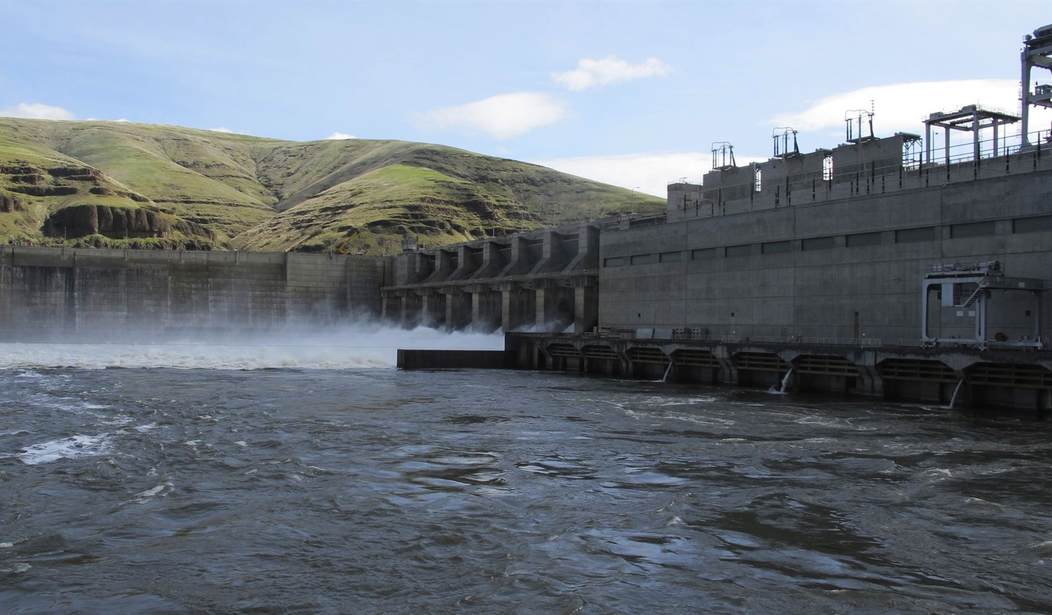
AP Photo/Nicholas K. Geranios

John Stossel bring us up to date on the fishy case for removing hydroelectric dams on the Snake River in Washington state.  His Townhall article is A Dam Good Argument.  Excerpts in italics with my bolds.and added images.

Instead of using fossil fuels, we’re told to use “clean” energy: wind, solar or hydropower.  Hydro is the most reliable. Unlike wind and sunlight, it flows steadily.

But now, environmental groups want to destroy dams that create hydro power.

The Klamath River flows by the remaining pieces of the Copco 2 Dam after deconstruction in June 2023. |Located on Oregon/California border.Juliet Grable / JPR

“Breach those dams,” an activist shouts in my new video. “Now is the time, our fish are on the line!

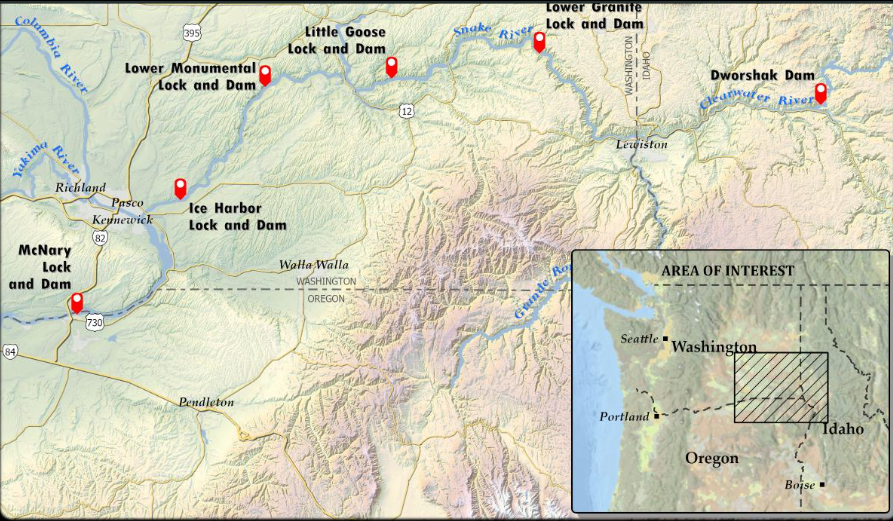
The activists have targeted four dams on the Snake River in Washington State. They claim the dams are driving salmon to extinction.

Walla Walla District Dams on the Snake & Columbia Rivers


It’s true that dams once killed lots of salmon. Pregnant fish need to swim upriver to have babies, and their babies swim downriver to the ocean.  Suddenly, dams were in the way. Salmon population dropped sharply.

But that was in the 1970s.Today, most salmon
make it past the dam without trouble.

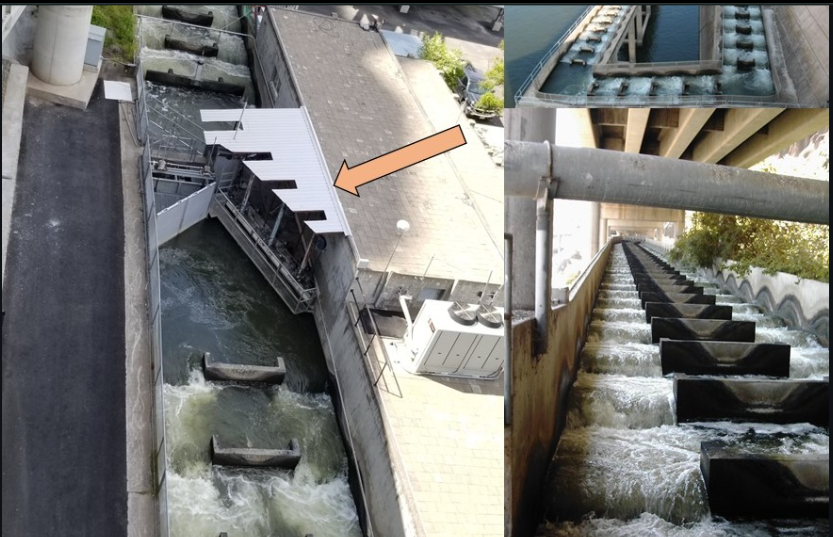
How?  Fish-protecting innovations like fish ladders and spillways guide most of the salmon away from the turbines that generate electricity.

Lower Granite fish count station & ladder (left, bottom right); Lower Monumental fish ladder (top right)  Source: Fish Passage Thru the Lower Snake & Columbia Rivers

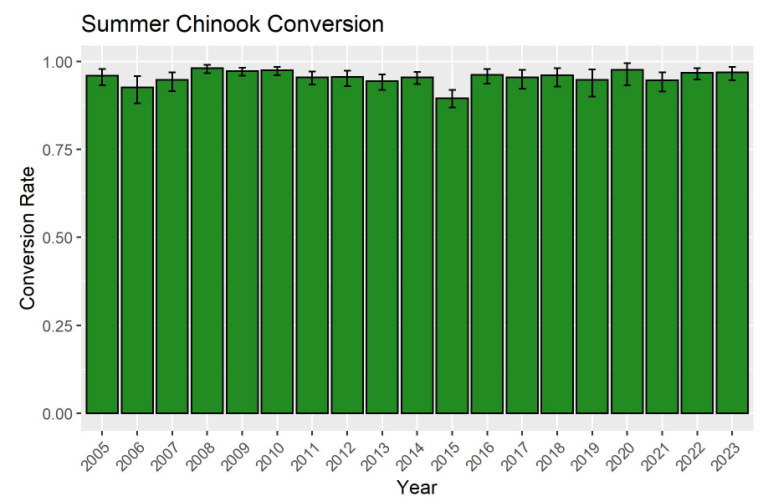
“Between 96% and 98% of the salmon successfully pass each dam,” says Todd Myers, Environmental Director at the Washington Policy Center.  Even federal scientific agencies now say we can leave dams alone and fish will be fine.

But environmental groups don’t raise money by acknowledging good news. “Snake River Salmon Are in Crisis,” reads a headline from Earthjustice.  Gullible media fall for it. The Snake River is the “most endangered in the country!” claimed the evening news anchor.

“That’s simply not true,” Myers explains. “All you have to do is look at the actual population numbers to know that that’s absurd.”  Utterly absurd. In recent years, salmon populations are higher than they were in the 1980s and 90s.

The fish passage report for 2023 (here) has many results like this for various species. Conversion refers to completing the Snake River run from Ice Harbor through Lower Granite.

“They make these claims,” Myers says, “because they know people will believe them … they don’t want to believe that their favorite environmental group is dishonest.”

But many are. In 1999, environmental groups bought an ad in the New York Times saying “salmon … will be extinct by 2017.” “Did the environmentalists apologize?” I ask Meyers. “No,” he says. “They repeat almost the exact same arguments today, they just changed the dates.

I invited 10 activist groups that want to destroy dams to come to my studio and defend their claims about salmon extinction. Not one agreed. I understand why. They’ve already convinced the public and gullible politicians.  Idaho’s Republican Congressman Mike Simpson says, “There is no viable path that can allow us to keep the dams in place.”

“We keep doing dumb things,” says Myers. “We put money into places where it doesn’t have an environmental impact, and then we wonder 10, 20, 30 years (later) why we haven’t made any environmental progress.”

Politicians and activists want to tear down Snake River dams even though they generate tons of electricity.

“Almost the same amount as all of the wind and solar turbines in Washington state,” says Myers, “Imagine if I told the environmental community we need to tear down every wind turbine and every solar panel. They would lose their minds. But that’s essentially what they’re advocating by tearing down Snake River dams.”

I push back: “They say, ‘Just build more wind turbines.’”  “The problem is, several times a year, there’s no wind,” he replies. “You could build 10 times as many wind turbines, but if there’s no wind, there’s no electricity.”

Hydro, on the other hand, “can turn on and off whenever it’s needed. Destroying hydro and replacing it with wind makes absolutely no sense. It will do serious damage to our electrical grid.”

“It’s not their money,” I point out.”Exactly,” he says. “If you want to spend $35 billion on salmon, there’s lots of things we can do that would have a real impact.”  Like what?

“(Reduce the population of) seals and sea lions,” he says, “The Washington Academy of Sciences says that unless we reduce the populations, we will not recover salmon.” “People used to hunt sea lions,” I note. “Yeah, that’s why the populations are higher today.”

But environmentalists don’t want people to hunt sea lions or seals. Instead, they push for destruction of dams. “Because it’s sexy and dramatic, it sells,” says Myers. “It’s more about feeling good than environmental results.”

PostScript

Of course there is a political dimension to this movement.  Left coast woke progressives are targeting Lower Snake River dams located in Eastern Washington state.  Folks there and in Eastern Oregon would rather be governed by common sense leaders like those in Idaho.

The case against the dams is actually about climatism.  The fish are not at risk, as shown by many scientific reports. But climatists do not include hydro in their definition of “renewable.”  And they promote fear of methane, claiming dam reservoirs increase methane emissions.

So here’s the political solution.  Keep the dams open and the fish running to their spawning grounds.  And to appease climatists ban any transmission of electricity from those dams to Seattle and Eastern Washington state.  Deal?

Background Post

Left Coast Closes the Dam Lights

via Science Matters

https://ift.tt/rEX3AIK

September 4, 2024 at 10:28AM