Month: September 2024

Hawarden WMO 03321 – Come Fly with me!

53.17553 -2.98646 Met Office rating CIMO Class 4 Opened 1/9/1944 moved between 2011 and 2015.

Airport site (Hawarden/Chester Airport) formerly RAF Bretton with a rich aviation history. Such airfield sites dominate not only the Met Office Synoptic and Climate reporting stations network but also the UK highest temperature recording sites.

It cannot be overstated how crucially important it is for detailed instant and immediate weather conditions reporting at every airfield for the benefit of pilots, air traffic control and the safety of passengers and crew of each and every flight. But are such sites really appropriate for reporting the natural environment and compiling climate records? This will be the topic of several other posts in future. For now the interesting story of Hawarden is the temperature recording in Wales and the potential for pursuing records.

Back on 2/8/1990 the highest ever temperature in Wales of 35.2°C was recorded not at Hawarden-Chester Airport but at Hawarden Bridge even nearer to England. Located at 53.21708 -3.02895 this was a very poor (likely Class 5) site behind a factory unit alongside its large car park. This somewhat inappropriate site was eventually closed 1/1/2005 – n.b. Tim Channon (instigator of the surface station project) noted how surprisingly common it is for record breaking sites to close not long after setting records notably Greycrook in Scotland and Cheltenham in Gloucestershire – a point for later discussion.

Whilst both England and Scotland were setting new high records in 2003, and 2019, that old rather suspect Welsh record stood firm – even the nearby airport site couldn’t quite break it. Then mysteriously the site moved. Here is Tim Channon’s review of the Hawarden Airport site back in 2012.

Compare the image from Tim’s report with that headline image above and it is evident the station has been moved just over 100 metres from a diagonal side route to a tee junction by a taxiway and service road.

Can any aviators reading this advise of any overall benefit to pilots in this relocation? None I have inquired of seems to think there is.

Can any meteorologists justify this relocation as improving the siting’s potential accuracy? Those I have spoken to suggest it is now in a much worse location in terms of reflecting the natural environment.

So was this relocation possibly record chasing? Well on 18/7/2022 a reading of 37.1°C was achieved on what was unquestionably a hot day and the record was finally broken. It does, however, beg the question that if the site had to be relocated due to the encroachment of new buildings in the vicinity, couldn’t the Met Office have simply put it a bit further away from likely extraneous heat sources? They were hardly short of space there. Or do we have a situation where questionable sites continuously have to be found to ramp up the figures – a bit like next to electricity sub stations, solar farms, in walled gardens, car parks, animal enclosures etc, etc ,etc ? Views anyone?

via Tallbloke’s Talkshop

https://ift.tt/4aLlYTm

September 2, 2024 at 03:31AM

Crushed: Biggest Wind & Solar State Suffers Astronomical Power Prices

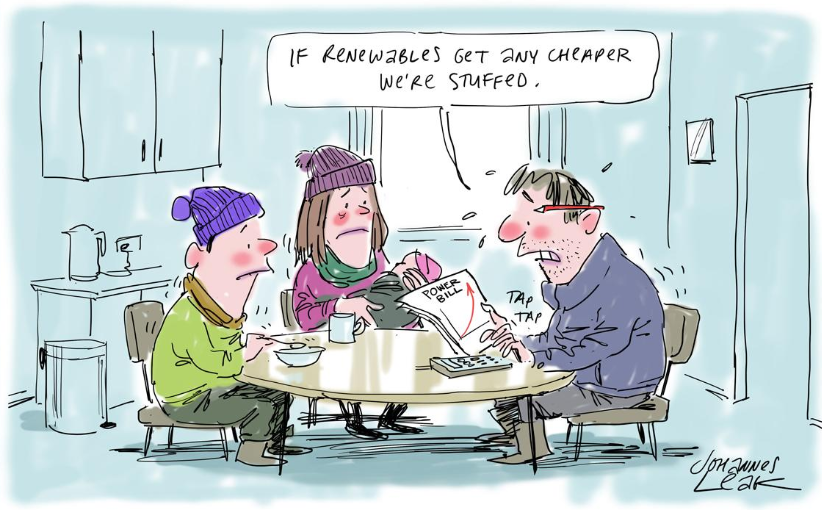
Germany and Denmark suffer Europe’s highest power prices, thanks to their subsidised wind and solar obsession. Likewise, South Australians are being belted by retail power prices that are (dollar for dollar) the highest in the world.

As night follows day, any attempt to run on sunshine and breezes leads to out of this world power prices, power rationing and mass blackouts.

South Australian businesses are being crushed, with retail power costs tripling over the last 5 years (for some large power users, doubling in the last 12 months).

Little wonder the State is an economic backwater, with manufacturers, food processors, and the like, shutting up shop and scurrying for the exit.

SA has become notorious as a first world economy with a third world power supply.

The wind and sun cult still present South Australia as the shining example of the transition to nature’s wonder fuels. They all rave about a period (never more than a few hours) when SA’s power needs are being met by wind and solar.

Although they remain remarkably silent on calm nights, when demand is being satisfied by coal-fired power drawn from neighbouring Victoria, gas and even diesel generators.

As they say, never let the facts stand between a deranged zealot and his favoured ideology.

Well, those footing the bill (being crushed by them) see the matter a little differently, as this piece from The Advertiser explains.

Leading regional businesses crippled by country’s highest electricity costs
The Advertiser
Andrew Hough and Paul Starick
27 August 2024

Leading regional South Australian businesses have been hit with surging power bills as the country’s highest electricity costs cripple the agriculture industry and send staple produce prices soaring.

In a striking example of an unfolding crisis, iconic firm Nippy’s monthly electricity bill more than doubled in a year despite the drinks manufacturer using fewer power hours.

Other industries have been slugged with bill increases, adding tens of thousands of dollars to overhead costs.

Despite expensive investment in renewable equipment and seasonal producers being in “off seasons”, country owners told how “network charges” still sparked large bills.

Concerned farmers have also been forced to employ special “energy consultants” to help save money.

As a new political row erupted, business chiefs revealed energy costs were among the top concerns for firms desperate to avoid hurting customers in a cost-of-living crisis.

Ben Knispel, joint managing director of the Knispel Group, the company behind the Nippy’s brand, said the increasing rate of electricity was a major concern.

The firm, which has two Riverland factories at Waikerie and Moorook along with a Regency Park warehouse in Adelaide’s northwest, had a “great” multi-year contract end in December 2023.

The company, founded almost 100 years ago and famed for its citrus juices and flavoured milk, was invoiced $51,600 last June for 260,073kw/h of use at its Moorook plant.

This month, its invoice was $109,580.10 – including almost $34,350 of market or network charges – despite using almost 6200 fewer hours.

After spending almost $1m on solar panels – which will cost significant money to repair – energy efficient lighting and special pump equipment, its annual power “spot price” bill is almost $2m.

“It just would be nice if we had reliable power 24 hours a day and grid stability because it’s a mess,” said Mr Knispel, company boss for 10 years who employs more than 200 workers.

“It’s just so frustrating doing the right thing, trying to reduce our footprint.

“But it’s all over the place. We’re growing and we’re doing OK but we will look to have price rises, sadly, as we can’t absorb these costs forever.”

Dairy Farmers Association president, former Upper House MP Robert Brokenshire, said his industry had suffered an “astronomical” rise in electricity costs that were 38 per cent on average.

His bill had increased from $70,000 last year to almost $100,000 in 2024 for his nearly 400ha Fleurieu Peninsula property that farms 800 cows.

He has been forced to hire a consultant to help deal with he said was a top 5 cost.

“These prices are so out of control, and complex, that you need an external consultant to organise the power,” said Mr Brokenshire, a farmer for 40 years.

Century Orchards chief executive officer Brendan Sidu, said his Loxton almond business had power bills surge up to 60 per cent in the past three years.

Mr Sidu, an Australian Almond Board member, said his annual electricity bill was almost $100,000 compared to $60,000 two years ago but his the industry can’t onpass costs.

“We just have to absorb it all and it’s definitely hurting,” he said.

Master Builders Association of SA chief executive officer Will Frogley said: “Massive power prices are killing our regions. They’re not just affecting consumers, they’re stifling developments and job growth.”

High energy prices were among the top three issues of the SA Business Chamber’s Regional Voice survey, published on August 11 and were of particular concern in agriculture, retail and accommodation sectors.

The report published data showing SA had experienced the greatest increase in electricity bills in Australia.

“Businesses in South Australia continue to have the highest annual electricity

bills ($10,427), almost double that of their counterparts in Tasmania ($5,902),” the SA Business Chamber report said.

The federal Liberal Member for Barker, Tony Pasin, whose electorate covers the Barossa Valley, Riverland, Coorong, and South East, condemned Labor’s “renewable only policy” that left SA with the “highest electricity costs in the country”.

“You can’t have a future made in Australia if present day electricity prices mean long standing successful business like Nippy’s are finding it increasingly hard to keep the lights on,” he said.
The Advertiser

via STOP THESE THINGS

https://ift.tt/9BpLiSs

September 2, 2024 at 02:31AM

GREENLAND ICE SHEET NOT ON TRACK TO MELT AWAY

According to the latest figures, the Greenland ice sheet is not giving rise to any alarm. This will, of course, not lead to any report in the main news.    

Greenland Icecap Carries On As Normal | NOT A LOT OF PEOPLE KNOW THAT (wordpress.com)

via climate science

https://ift.tt/NBK0kMo

September 2, 2024 at 01:44AM

Rising Global Temperatures Saving Millions Of Lives, Study Finds. Cold Kills 30 Times More!

From the NoTricksZone

By P Gosselin on 1. September 2024

By Dr. Peter F. Mayer – https://tkp.at

Hat-tip: Linke Zeitung here

Over the past 11,000 years of the current interglacial period, phases of prosperity and cultural flourishing are clearly linked to warmer temperatures. A reduction in deaths with rising temperatures can also be observed for the last two decades.

Fact: Cold kills nearly 30 times more people than extreme heat, 4.6 million vs. 0.155 million. Rising temperatures drive up the number of heat deaths, but not in extreme heat, but in moderate heat, as TKP recently reported and broke down. However, rising temperatures also reduce the number of deaths from cold.

Bjorn Lomborg used this data to illustrate the ratios graphically:

Chart: Björn Lomborg

Overall, this has meant saving 166,000 lives per year over the last two decades. This is according to the Lancet study by Qi Zhao (2021), which TKP has already reported on.

“Globally, 5,083,173 deaths per year were associated with sub-optimal temperatures, accounting for 9.43% of all deaths. 8.52% were cold-related and 0.91% were heat-related. There were 74 temperature-related excess deaths per 100,000 population. The mortality burden varied geographically.”

Eastern Europe had the highest heat-related excess mortality rate and sub-Saharan Africa had the highest cold-related excess mortality rate.

So we see that global warming saves lives, exactly the opposite of what politicians like Health Minister Karl Lauterbach or EU-Leyen claim and of course the mainstream media.

Full article here: https://tkp.at/2024/08/11/steigende-temperaturen-retten-leben

(Translated/summarized in the English by P. Gosselin)

via Watts Up With That?

https://ift.tt/5vT49ah

September 2, 2024 at 12:03AM