Month: September 2024

Scientists: Climate Forcing Measurement Errors Are ‘Only’ 150 Times Larger Than For CO2 Climate Forcing

When assessing the climate-altering effects of downwelling longwave radiation, the root mean square error associated with calculating this value is 29.7 W/m². For some reason, scientists characterize measurements with an observation error this large as “high accuracy”.

In an imaginary world where no clouds exist (clear-sky), the surface longwave downward radiation (LWDR) calculated for a CO2 increase of 22 ppm (2000-2010) has been assessed to be 0.2 W/m² (Feldman et al., 2015) per decade, or 0.02 W/m² per year. This value is acknowledged to contribute just 10 percent of the LWDR trend over this period. The other 90 percent is linked to clouds and water vapor.
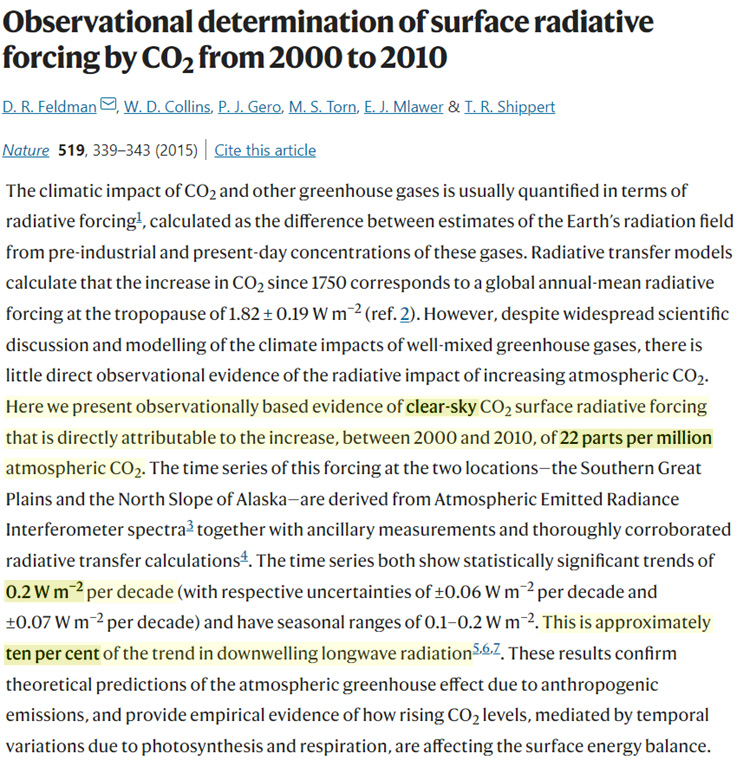
Image Source: Feldman et al., 2015

The root mean square error statistical value is defined in engineering as “the measure of the differences between values that are predicted by a model and values that are actually observed.” In other words, it’s the difference between what is expected to occur using simulated model inputs and what, in reality, occurs.

Climate modeling error in assessing LWDR is quite large. This is due primarily to the inability of the models to accurately assess the all-sky conditions occurring in the real world, where clouds exist.

Scientists acknowledge clouds are the principal “controlling factor” of LWDR trends, and yet their impacts “cannot be directly measured” (Du et al., 2024). Instead, they must be estimated using surrogate constructs with simulated values. Consequently, the real-world, all-sky atmosphere cannot be assessed with sufficient accuracy.

“With increasing attention to cloudy-sky LWDR retrieval, cloud-base height or cloud-base temperature is a primary controlling factor of cloudy-sky LWDR but cannot be directly measured by optical sensors and need to be estimated. To address this, some surrogate parameters are used to quantify the cloud contribution.”

Despite these fatal flaws, climate scientists eager to attribute climate forcing to human activity literally characterize measurements with observation error 150 times larger (~30 W/m²) than 10 years of CO2 forcing (0.2 W/m²) as “high accuracy.”

“This study generates an all-sky global LWDR product called LessRad LWDR with high accuracy.”

“Accuracy was evaluated using root-mean-square-error (RMSE), mean bias error (MBE) … an MBE of 5.5 W/m², and a RMSE of 29.7 W/m².”

“LessRad exhibits RMSE values of 29.7, 21.4, 31.0, 32.0, and 24.2 W/m² over the globe, low latitudes, midlatitudes, the Tibetan Plateau, the Arctic, and the Antarctic, respectively.”

Proponents of anthropogenic global warming (AGW) claim CO2’s LWDR forcing is the factor driving modern climate change. However, if the CO2 forcing contribution to LWDR is 150 times smaller than the error in calculating the surface background LWDR, then there can be no valid attribution assessment for CO2 forcing in LWDR trends.
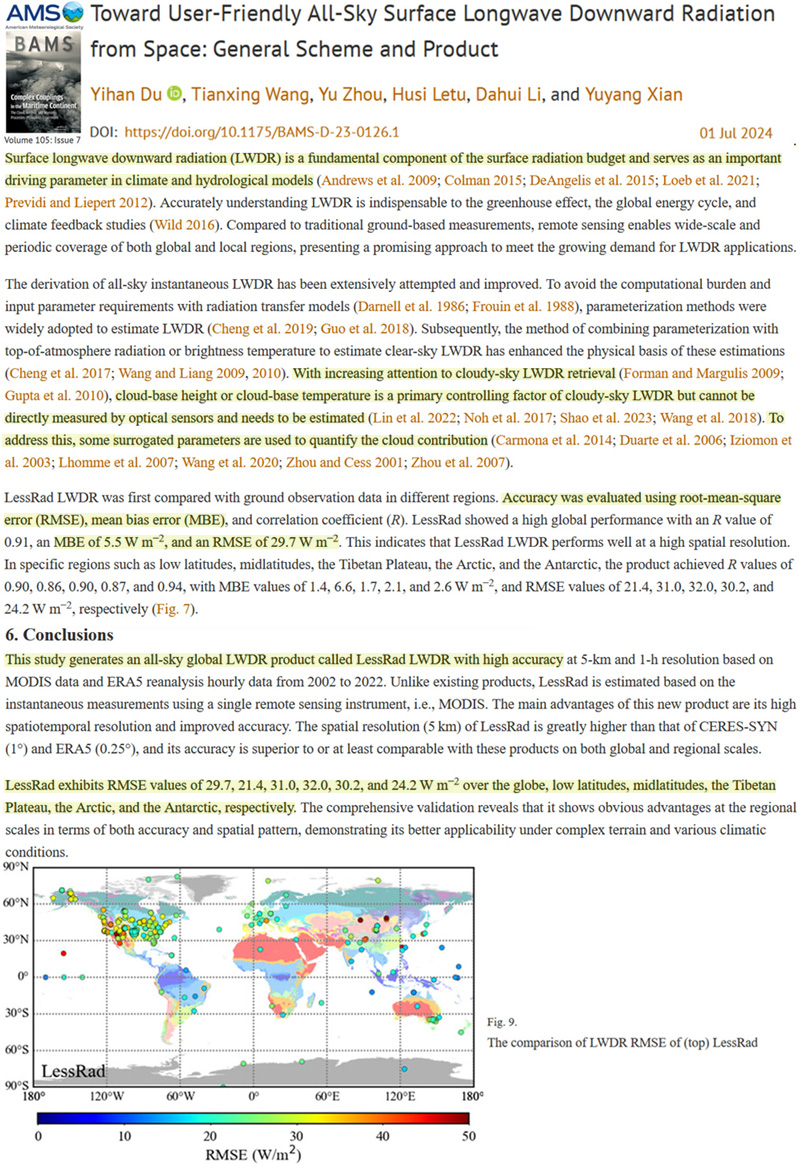
Image Source: Du et al., 2024

via NoTricksZone

https://ift.tt/bs6BSjw

September 23, 2024 at 09:19PM

“under the Intermediate Scenario”

NOAA has launched a new sea level website which is based on unsupportable claims and appeals to authority.

About Tony Heller

Just having fun

This entry was posted in Uncategorized. Bookmark the permalink.

via Real Climate Science

https://ift.tt/mTHyMIf

September 23, 2024 at 08:25PM

Yes, Louisiana, there is a Scandal-“Pause”

From Government Accountability & Oversight

by GAO Webadmin

DoE court filing supports claims of buried 2023 study, LNG “pause” based on a lie

In a recent court filing, after months of stalling and flouting numerous legal obligations and deadlines the Biden-Harris Department of Energy, through its lawyers at the U.S. Attorney’s Office for the District of Columbia, let slip something it had spent a year, including three months in litigation, trying to avoid becoming known.

Specifically, DoE has “identified 97 potentially responsive documents totaling 4,354 pages” of records meeting the following description:

 1) any LNG export study transmitted by the National Energy Technology Lab to the Office of Fossil Energy between January 1, 2023 and October 31, 2023, and 2) the email(s) transmitting the document(s) from the National Energy Technology Labs (NETL) to, inter alia, DoE’s Office of Fossil Energy.

This is the scope of a Freedom of Information Act request by GAO, whose parameters were very deliberately chosen, for reasons GAO laid out here. DoE’s admission that records exist came not only after months of stall tactics (below), but also repeatedly vague wordplay in its first offerings for this report to the court, avoiding disclosure of the fact until pressed by GAO lawyers to admit this most basic of answers—what have you got?

Further, DoE had known this particular something for six weeks and refused to let on, again despite statutory and judicially imposed deadlines to do so:

Screenshot

These delays were not mere bureaucratic sloth. In FOIA litigation brought by GAO, to avoid admitting these records exist DoE employed motions seeking extensions of time, motions to stay proceedings, motions  to tie unrelated cases together causing further delays, and outright refusal to provide even court-ordered answers.

This confession that DoE indeed has copies of such a study on liquified natural gas exports strongly indicates that the administration has been telling a spectacular non-truth to the public about the basis for “this crazy LNG permitting pause [t]he consequences [of which] will be dire for the industry in four to five years, but they also carry national security implications now.”

Recall, the stated reason for this “pause” was that DoE needed to conduct a macroeconomic study of the costs and benefits of LNG exports.

But we see it had already done so meaning, in very short, the supposed basis for “pausing” LNG exports appears to be untrue, the falsehood serving as pretext for this latest gambit to impose “President Joe Biden and Vice President Kamala Harris’s climate agenda, which has focused on limiting natural gas exports. Environmentalists argue that increased gas exports could result in far more domestic drilling and, as a result, more emissions.”

The decision to impose this “pause” caused shock throughout the energy industry, among U.S. allies… and among some others in the know. One of those people let the word go forth that in fact DoE had already conducted such an analysis, in 2023, but buried it because the conclusions would not support the preferred policy of strangling options for abundant, often “fracked” U.S. natural gas. With fewer things to do with the gas (hello, gas stoves they definitely don’t want to ban that’s a conspiracy theory akshully it’s a good thing that heck yeah they sure do want to do that), the opposition to fracking could be worn down.

DoE conducts these studies with some regularity, The most recent (acknowledged) version, the 2018 DoE report, ran 144 pages. The 2014 report was much shorter, at 42 pages.

DoE now admits through counsel that its search produced 97 documents/4,354 pages. This averages 45 pages a document (email threads will be shorter, of course). The most reasonable conclusion from this is that NETL sent several versions of the rumored report over these ten months. Or, put more simply: yes, it appears that the report which DoE claims to need to conduct before continuing LNG exports to non-FTA countries had already been prepared, and buried.

DoE is plainly in no hurry to let the public in on any further details, having taken three months too long to state the basic answer: yes, the study exists.

Post Script: To date, DoE has only responded to one of the four requests made in early June, producing records in response to the request for “chat” logs for certain senior officials over the three days surrounding and including the January “pause”.

Screenshot

It appears that DoE and the White House were “on the same page” in announcing the “pause” and the pretext. But the truth will out, and this recent confession is damning.

via Watts Up With That?

https://ift.tt/OMdB7qz

September 23, 2024 at 08:02PM

“under the Intermediate Scenario”

NOAA has launched a new sea level website In New York, under the Intermediate Scenario, sea level is expected to rise 11 inches from 2020 to 2050.”   National Sea Level Explorer – U.S. Sea Level Change Three years ago … Continue reading

via Real Climate Science

https://ift.tt/4ncQJuh

September 23, 2024 at 07:19PM