Month: September 2024

“carbon emissions may have now peaked”

Atmospheric CO2 is growing at a record rate, Asia is building nearly 1,000 new coal fired power plants, and Michael Mann says “carbon emissions may have now peaked” Global Monitoring Laboratory – Carbon Cycle Greenhouse Gases Tracker Map – Global … Continue reading

via Real Climate Science

https://ift.tt/jb3ieop

September 23, 2024 at 04:24PM

The Strongest Atmospheric River on Record for the Gulf of Alaska?

From the Cliff Mass Weather Blog

Cliff Mass

The atmospheric river currently over the Gulf of Alaska may be the strongest on record in that area.

The latest model runs show extreme values of the key measure of atmospheric river strength, vertically integrated moisture transport (IVT), which describes how much water vapor is being moved over a period of time.

Below is the map  of IVT for this morning, with values exceeding 1900.  I have personally never seen anything like it.

An estimate of the strongest atmospheric river  over observed for 1990-2019 by Dr.  Lexi Henny of NASA/Goddard suggested this is the strongest atmospheric river during that period of record.  Impressive.

The plume of moisture was very apparent in water vapor satellite imagery this afternoon (below). Do you see the southwest-northeast directed plume aimed at SE Alaska and BC? Some of the associated clouds have moved into Washington.

This atmospheric river is predicted to hit land as an AR-5, the strongest level observed.  We can be thankful that the center of the river will make landfall north of Washington State, where only AR-2 levels should occur on the northern Olympic Coast.

By Tuesday, as much as a foot of rain will fall over the coastal terrain of BC


Strong atmospheric rivers are not infrequent over SE Alaska and BC this time of year, with the path of the moisture plumes reaching Washington State in November. 

The fact we are in a neutral to La Nina year means that there is a higher probability of more rain than last year (an El Nino year)…something shown for the western Washington lowlands below.

My advice.  Make sure you have a decent umbrella.

via Watts Up With That?

https://ift.tt/N56eLVy

September 23, 2024 at 04:02PM

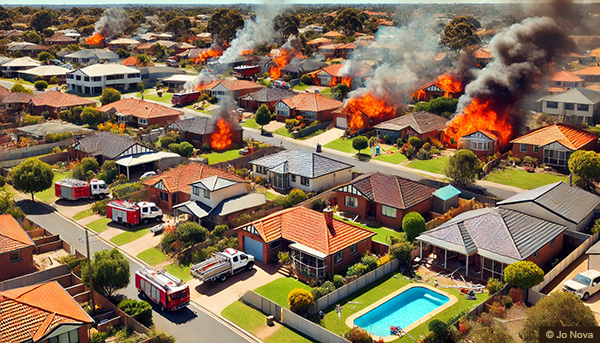
What if a foreign hacker could turn home batteries into “pager-bombs” but 7,500 times bigger?


Battery bombs in the suburbs?

Battery bombs in the suburbs?

By Jo Nova

You think exploding pagers was a wicked trick….

Hypothetically, suppose we were distracted while we tried to change tropospheric jet streams, and accidentally gave away our national manufacturing to a foreign adversary. Next thing we know, we’re buying the batteries they make, and installing them in essential grid infrastructure and thousands of homes. We’re patting yourself on the back for getting a cheap deal (never mind the slaves) and it all seems dandy until one sunny day, a leader who was cheesed off with a trade deal, quietly switched off the “overcharge protection” on all of them remotely.

At that point, millions of solar panels are pumping excess electricity into batteries that have no safety cut off. A few houses start to go off like popcorn, and an hour later we’re all living at the Western Front.

Brian Craighead – chief executive of Energy Renaissance, has come to warn us — it’s a hidden threat to national security. He says Australia has already installed 220,000 batteries that were made in potentially unfriendly places, and each home battery has roughly 7,500 times as much energy as a pager.  As he remarks: “overcharge is when all hell breaks loose”.

Now, he happens to sell secure battery management systems — so he has an interest in scaring the socks off Energy Ministers and hyping things up, but ask yourself this: would Anthony Albanese have seen this coming?

To ask the question is to know we’re in trouble.

Energy entrepreneur says Australia’s solar and battery boom is a ‘clear and present danger’

By Jared Lynch, The Australian

“When everyone talks about battery safety, we tend to think about the chemical stuff – these fires that you see on videos of Tesla cars going up. But those are relatively unusual. The key thing to focus on is battery software … that’s what protects them from overcharging.

“Let’s say you were a bad actor from a bad country, here’s what you could do, and this would be horribly easy. For example, you could say on January 7, 2025, I’m going to turn off the overcharge on 200,000 batteries installed in homes in Australia. Nothing is going to happen until then.”

It would make a great movie, but a lousy life:

“A co-ordinated attack exploiting these vulnerabilities could lead to widespread fires, explosions, and a crippling of our energy infrastructure. The risk extends beyond individual homes. Large, imported grid-connected batteries are becoming integral to Australia’s national energy grid. These massive storage systems, often managed by foreign-developed software, could be susceptible to cyber-attacks or sabotage, posing a threat to national security and public safety.

“There’s a clear and present danger.”

As Craighead says (so colorfully) — it’s like pink-batts on steroids. (A program here in Australia where a Big Government-made bubble in home insulation killed 3 poorly trained people and set fire to 200 homes.)

In the end, after the bombs and the blackouts, the hit to the GDP and the death toll, it will all be deemed a dreadful accident, due to a fault in a minor part, and a hot day caused by climate change. Everyone will know what happened, but no one will want to risk the lobster-wine-coal-barley-beer-students deal, and besides the nation needs to order new fridges and solar panels.

Unless, of course the home-battery-bombs were a decoy in a larger hostile plan, in which case we’ll have bigger things to worry about.

Speaking of which:

The US banned the Pentagon from buying batteries from six Chinese manufacturers earlier this year.


10 out of 10 based on 2 ratings

via JoNova

https://ift.tt/uoQENSW

September 23, 2024 at 03:17PM

Major global banks and financial institutions back effort to triple nuclear energy by 2050


Their hand has probably been forced by the emergence of electricity-hungry Artificial Intelligence, which will be way too much for intermittent renewables, promoted by the net zero crowd, to cater for. If these major players can’t process their vast amounts of data efficiently enough, or at all, due to power problems they can see where that goes for them, as the option of fuel-burning power stations is being choked off by many governments around the world under the sway of UN climate theories.
– – –
NEW YORK, Sept. 23, 2024 /PR Newswire./ — Today, nations endorsing the Declaration to Triple Nuclear Energy launched at COP28 in 2023 were joined by 14 financial institutions who expressed support for the call to action to triple global nuclear energy capacity by 2050.

The group of financial institutions in the convening include: Abu Dhabi Commercial Bank, Ares Management, Bank of America, Barclays, BNP Paribas, Brookfield, Citi, Credit Agricole CIB, Goldman Sachs, Guggenheim Securities LLC, Morgan Stanley, Rothschild & Co., Segra Capital Management, and Societe Generale.

The financial institutions recognized that global civil nuclear energy projects have an important role to play in the transition to a low-carbon economy.

They further expressed support for long-term objectives of growing nuclear power generation and expanding the broader nuclear industry to accelerate the generation of clean electrons to support the energy transition.
. . .
This expression of support for nuclear energy builds on the December 2023 outcome of the first global stocktake under the Paris Agreement, which included nuclear among the zero- and low-emission technologies that Parties should seek to accelerate, as well as the Declaration to Triple Nuclear Energy, launched at the 28th UN Climate Change Conference and endorsed by 25 countries.

“The only riddle left to solve is the financial side, the financial costs,” said Dr. Robert Golob, Prime Minister of Slovenia. “Financial markets need to adapt and develop new financial instruments in order for nuclear energy to become competitive with other CO2-free energy sources.”

Full article here.
– – –
Image credit: nuclearenergytech.net

via Tallbloke’s Talkshop

https://ift.tt/fvJpxzq

September 23, 2024 at 01:17PM