By Paul Homewood
Chris Kenny slams climate alarmism:
via NOT A LOT OF PEOPLE KNOW THAT
October 31, 2024 at 02:33PM
By Paul Homewood
Chris Kenny slams climate alarmism:
via NOT A LOT OF PEOPLE KNOW THAT
October 31, 2024 at 02:33PM
The higher sea levels in the tropical regions (Australia, Gulf of Thailand) were “primarily driven by eustatic processes,” not a result of vertical land motions.
This means the Mid to Late Holocene highstands were mostly a consequence of the larger volume of water in ocean basins at that time relative to today, when there is more water locked up on land as ice.
Terry et al., 2024 (Gulf of Thailand)

Kennedy et al., 2024 (Australia)

Freiesleben et al., 2024 (North Sea)

via NoTricksZone
October 31, 2024 at 02:19PM
ChatGPT says that major hurricanes are caused by the burning of fossil fuels.


The Red Cross described fiscal year 1927 as the worst disaster year in their history including “29 tornadoes, 24 floods, 23 fires, 4 earthquakes, 9 hurricanes”
“Floods and Tornadoes Make 1927 Worst Disaster Year in Red Cross History”
By RODNEY DUTCHER (NEA Service Writer)
WASHINGTON, Nov. 25.— Mother Nature’s disposition to settle hostile, the year 1927 was the worst disaster year in American history, according to the Red Cross.
But the Mississippi floods seem insignificant compared to Mother Nature’s wildest rampages in 1927, and the recent floods in New England have added yet till of misfortune major disaster only second in its proportions to that of the Valley states.
Tornadoes and floods have killed more than 300 persons and inflicted property damage estimated at more than $1,000,000,000 since January.
Red Cross Kept Busy The Red Cross has never been so busy in its twenty-five years. Get within four months after it had finished its work in the Florida hurricane area it had to tackle its greatest relief task in its experience in seven states of the south and the middle west. It has aided nearly 700,000 victims of disasters.
Complete Red Cross records are only available up to the end of the last fiscal year ending June 30, 1927. During that fiscal year, the relief organization rendered aid in 111 disasters—a few of them outside the United States—which included 29 tornadoes, 24 floods, 23 fires, 4 earthquakes, 9 hurricanes, 6 mine disasters and some cloudbursts, explosions, railroad wrecks, typhoons and epidemics.”

25 Nov 1927, Page 7 – The News-Review at Newspapers.com
According to NASA, temperatures at that time were cold.

Global Temperature | Vital Signs – Climate Change: Vital Signs of the Planet
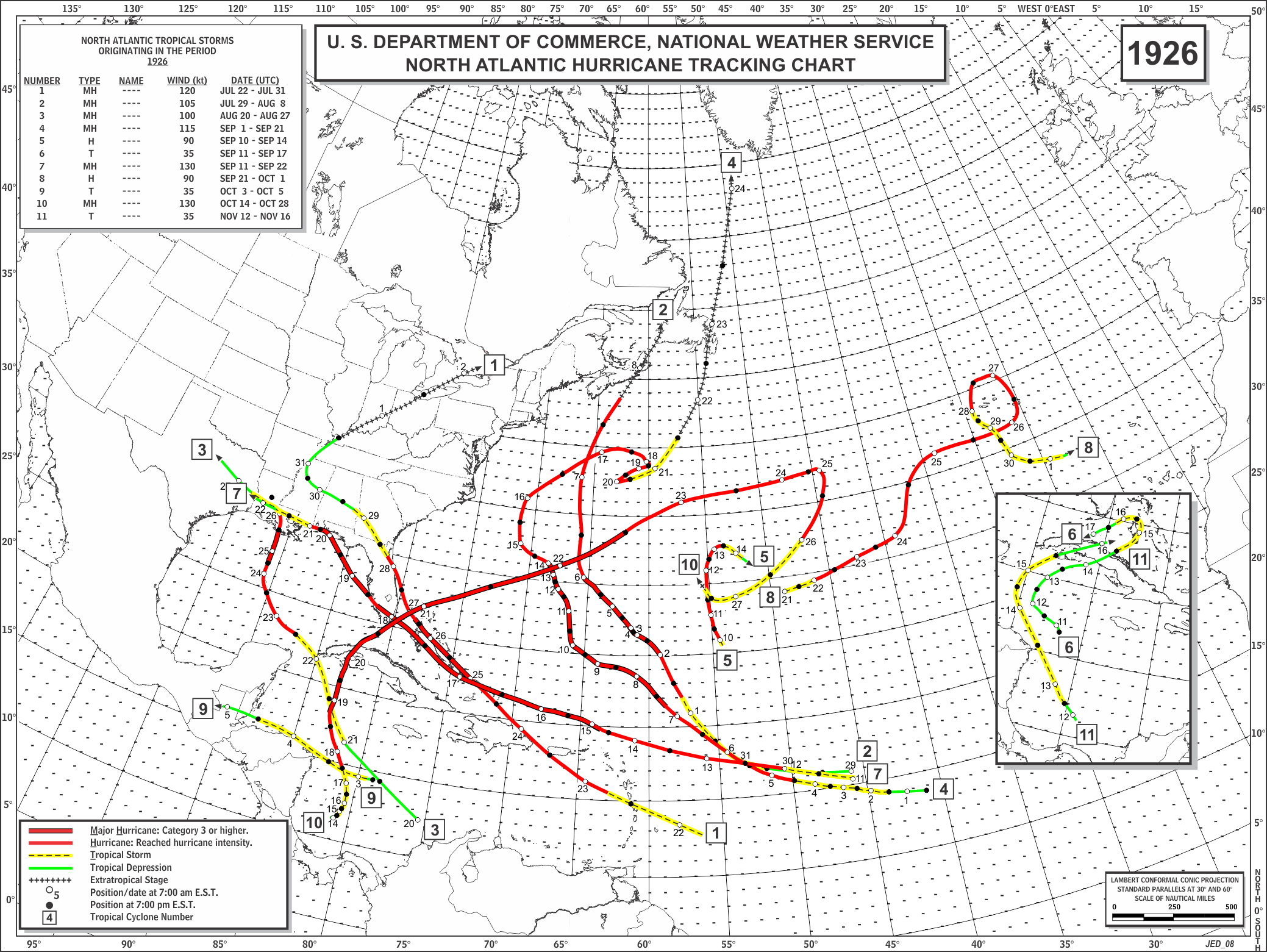
During September, 1926 Miami was destroyed by a hurricane.


20 Sep 1926, 14 – Evening Courier at Newspapers.com
That was one of six known major hurricanes that year.

1926_base_revised_4.gif (2078×1561)
NASA shows those hurricanes tracking across cold water.

Global Temperature | Vital Signs – Climate Change: Vital Signs of the Planet
At the time, scientists blamed the disastrous storms on solar activity, rather than a lack of windmills.
 20 Sep 1926, 12 – The Vancouver Sun at Newspapers.com
Then came the worst US flood on record in the Mississippi Valley


This was followed by a lot of disastrous tornado outbreaks.

13 Apr 1927, Page 1 – Corsicana Daily Sun at Newspapers.com

May 10, 1927, page 1 – The Boston Globe at Newspapers.com

13 Apr 1927, 1 – Henryetta Daily Free-Lance at Newspapers.com


The Pittsburgh Press – Google News Archive Search
A number of record heatwaves occurred in 1927, including a protracted one in September and October, which killed scores of people.

15 Sep 1927, 1 – The Gazette at Newspapers.com

The Pittsburgh Press – Google News Archive Search
September 30, 1927
“WOMEN MOTORISTS – Arctic and Australian Trips.”
“To drive by the light of the midnight sun, to race for life through forest fires caused by storm lightning, to lie for 15 hours at a time at the wheel, and to be caught in an endless heat wave and tormented by mosquitoes in what is known to us as the land of eternal snows, were among the recent experiences of an intrepid English woman, Mrs. Victor Bruce, who accompanied her husband and a companion in a 6000 motor tour through the Arctic zone.Through Belgium, Holland, Germany, Denmark, Lapland, and Finland, the motor party journeyed to 270 miles north of the Arctic Circle, prepared for freezing weather. To their continued astonishment the temperature was never less than 90 degrees in the shade.
The intention was to reach the Arctic Ocean, but 40 miles of marsh country on the coast prevented this.
An average of 210 miles a day was made on the journey, which was arduous in the extreme, and at one time the car had an actual race with death among the forest fires in Sweden over terrible roads.”

30 Sep 1927 – WOMEN MOTORISTS – Trove

02 Jan 1927 – SUNBATHING NEAR THE NORTH POLE – Trove
The heatwave was immediately followed by the worst flood in Vermont history.


via Real Climate Science
October 31, 2024 at 02:18PM
Essay by Eric Worrall
Still waiting for the promised climate disaster.
Australia is already 1.5 degrees hotter
By Bianca Hall
October 31, 2024 — 12.01amAustralia’s average temperatures have risen by 1.5 degrees for the first time since records began, and the world is on track to overshoot the Paris Accord’s aim to limit global warming to 1.5 degrees.
That’s the latest sobering assessment offered by scientists and meteorologists from the CSIRO and Bureau of Meteorology, who have mapped Australia’s changing climate for 14 years.
Their latest biennial State of the Climate report, released on Thursday, shows average temperatures continue to rise steadily, while the average number of extreme bushfire days have risen by as many as 25 days a year in parts of the country.
Two years ago, Australia’s temperatures had risen by an average 1.47 degrees since records began in 1910. This year, average temperatures in Australia have risen by 1.5 degrees, while global averaged temperatures have risen by 1.2 degrees since “reliable” records began in 1850.
…
“Beginning” the records in 1910 conveniently misses what may have been the worst heatwave ever in recorded Australian history, the Federation Drought of 1895 – 1903. But despite claiming temperature records before 1910 are too unreliable to include in official records, government climate scientists are confident that more recent droughts are hotter.
435 people died in an 1896 heatwave — but scientists say the extreme heat events of today are still hotter
By Sophie Meixner and Daniel Nancarrow
Sat 21 Dec 2019In the late 19th century, Australia was struck by a heatwave so intense that 435 people were killed and hundreds more were sent fleeing for their lives.
Key points:
- Bourke, NSW, is recorded as hitting 48.9C three times in 1896, with a maximum temperature of 38C for over three weeks straight
- But climate scientists say the methods used to record temperature in 1896 were flawed and heatwaves today are hotter
- They say the high death toll in 1896 was due to the community being more vulnerable to heat events
The 1895-1896 heatwave during the Federation Drought holds the record as Australia’s deadliest heatwave, closely followed by 2009, which recorded at least 432 heat-related deaths.
The town of Bourke lost at least 40 people — 1.6 per cent of its population — during the 1896 event, while Sydney authorities reported hospitals at breaking point and pedestrians collapsing in the streets.
Newspaper reports describe temperatures in Bourke reaching 48.9 degrees Celsius on three occasions, and the maximum temperature remaining above 38C for 24 consecutive days.
As Australia endures a series of intense and record-breaking heatwaves this summer, the 1896 event is sometimes viewed as evidence that Australia has always experienced extraordinary heat, and that the effects of climate change are overblown.
But climate scientists say that is an oversimplification, and the heatwaves we experience today are significantly hotter than those in the past.
…
A Stevenson screen was not installed in Bourke until August 1908, meaning temperature readings from before that could be inflated by as much as 2C.
…
The implication of the article above, that modern temperature recording is rigorous compared to the old days, ignores a lot of problems with modern temperature records. Australian climate scientist Jennifer Morohasy has fought a long running campaign to force the Aussie Bureau of Meteorology to admit they are less than perfect.
Whatever the truth about past heatwaves compared to the present, there are indications Australians are getting fed up with climate fear mongering. The greens suffered a major setback in the recent Queensland State Election.
The breaching of a 1.5C climate disaster limit which nobody notices is unlikely to add to the faltering credibility of climate doomsday pronouncements.
via Watts Up With That?
October 31, 2024 at 12:03PM
 Iowa Climate Science Education