Month: October 2024

Put Policy Pragmatism Over Climate Obsession

By Kristen Walker

We are continually being told that climate change is getting worse and natural disasters are becoming more frequent and intense. Neither is true.

Tropical hurricanes have battered the southeast for centuries, spanning the spectrum of severity. Category 4 and 5 storms, considered the worst of the worst, are nothing new; plenty occurred prior to the world’s so-called addiction to fossil fuels. The Labor Day Storm, considered one of Florida’s most powerful and destructive hurricanes, hit their shores in 1935. Governor DeSantis recently said, “This is something that the state has dealt with for its entire history. It’s something it will continue to deal with.”

The National Oceanic Atmospheric Administration’s (NOAA) records don’t indicate a strong correlation between hurricane intensity and carbon dioxide levels. Quite a few of those tropical storms struck various parts of the U.S. well before global warming became a concern.

Nor does NOAA show that tornadoes have become more powerful. The 1925 Tri-State Tornado, with a 219-mile path across three states in just 3.5 hours, is considered among the most intense.

When last year’s Maui wildfire raged, and many were quick to point fingers at climate change, countless climatologists cautioned not to link the two. Experts had warned for years that the over-grown brush and ignoring recommended mitigation measures would likely lead to deadly infernos.

Even the Intergovernmental Panel on Climate Change does not detect a strong relationship between climate change and extreme weather events.

Yet the panic-stricken rhetoric is driving energy policy with the belief that enacting legislation and overhauling how we develop and use energy will somehow alter global temperatures. Such drastic measures are affecting consumer welfare through energy shortfalls and price hikes, leaving increasing numbers of households energy poor. It has driven inflation and increased federal deficits. Adding insult to injury, these actions are having very little (if any) impact on climate.

Some researchers even assert that a few degrees of warming will benefit plant life and agriculture, and growing seasons will be longer. Renowned Danish political scientist Bjorn Lomborg often shares the fact that rising temperatures save lives because cold weather is more deadly.

Regardless, the U.S. has made tremendous progress in reducing its carbon footprint and curbing greenhouse gas (ghg) emissions and other pollutants over the last several decades. Much of the headway is due to operational improvements and innovation within the industry.

Despite record production levels, oil and natural gas companies continue to reduce ghg emissions through upgraded and modernized infrastructure. The increased use of natural gas, which has replaced a significant amount of coal, is responsible for nearly half the electric power sector’s emissions reductions since 2005; increasing its use has actually done more to cut emissions in the U.S. than solar and wind combined.

The Environmental Protection Agency notes that between 1970 and 2023, GDP increased 321%, vehicle miles traveled increased 194%, energy consumption increased 42%, and America’s population grew by 63%. During the same time frame, total emissions of the six principal air pollutants dropped by 78%.

Energy is produced responsibly in America. Curtailing production here only spurs production in other nations like China and India, which do not maintain the same strict environmental standards as the Western World. Both developing countries are seeing record levels of coal production and are the greatest contributors to global emissions. It makes little sense to restrict oil, gas, and coal generation on our soil only to have it shift to a substantially bigger polluter. Such maneuvers do not change global energy demand; they merely relocate where the resource originates.

Letting the market work and allowing individuals to innovate have facilitated abundant and sensible energy production. The U.S. has already established rigorous environmental requirements, and the industry has shown it can succeed within reasonable confines.

Alarmists would do well to cease the catastrophizing and end-of-world fearmongering. Energy is the lifeblood of our economy. Pragmatism and common sense, rather than climate hysteria, should be driving energy policy.

Energy demand is on the rise; practical solutions are vital to meeting those needs. Rather than a one-size-fits-all mentality, we must implement energy sources that best serve circumstances and do not restrict access to reliable and affordable energy. Consumers need energy that works, is plentiful and cheap, and allows them to carry out day-to-day functions. Anything less is unacceptable. Their well-being as well as the health of the economy should not be sacrificed at the altar of climate agendas.

Kristen Walker is a policy analyst for the American Consumer Institute, a nonprofit education and research organization. For more information about the Institute, visit www.theamericanconsumer.org or follow us on Twitter @ConsumerPal.

This article was originally published by RealClearEnergy and made available via RealClearWire.

via Watts Up With That?

https://ift.tt/bqFW0pD

October 31, 2024 at 04:02AM

DEFY LABOUR’S GREEN LUNACY, SAYS DAILY MAIL ARTICLE

I seem to detect a shift in the media here in the UK, or at least in the part that has traditionally been right leaning. This article is encouraging the continuation in the extraction of fossil fuels – not something I have seen in recent times, but welcome none the less. This is an admission that these fossil fuels are essential for our survival as a modern nation, and that renewables are simply not up to the job of supplying the reliable economical power that is needed. The penny has dropped, but I doubt it will penetrate the cloth ears of our new Labour government.

 Why BP and the other oil giants should defy Labour’s green lunacy – and give Britain the power up it needs | Daily Mail Online

via climate science

https://ift.tt/cmCoaBt

October 31, 2024 at 02:57AM

Big Green projects hoisted by their own petards

The very legal and regulatory obstacles the Greens erected and deployed against fossil fuel companies they were opposed to are now coming back full circle.

via CFACT

https://ift.tt/23jo15E

October 31, 2024 at 02:45AM

Brits Count Mounting & Staggering Wind Power Subsidy Cost

Unbeknownst to taxpayers and power consumers, the wind industry has engineered the most outrageous raft of subsidies, mostly hidden and all massively generous. These include being paid hundreds of $millions to produce nothing at all, with what are called “constraint payments”.

In Britain, taxpayers have stumped up £1 billion in constraint payments to wind power outfits over the last five years.

Under that aspect of the scam, by 2030, wind power outfits across the UK (principally in Scotland) are predicted to pocket £3 billion a year for simply doing nothing at all.

Then there’s the “Contracts for Difference” scam. Which guarantees a fixed price to wind power outfits, with the difference picked up by, you know who. As David Turner details below, the burden born by unwitting taxpayers is already staggering, and can only get worse.

Record August CfD Subsidies
Substack
David Turner
29 September 2024

Introduction
The Low Carbon Contract Company (LCCC) manage the Contracts for Difference (CfD) subsidy scheme and publish data to show how much it costs us. The data is usually published about ten days in arrears and sometimes gets adjusted. Now we have the full data for August 2024 and it has settled down enough for some reasonable analysis.

Overall Subsidy Levels Rising
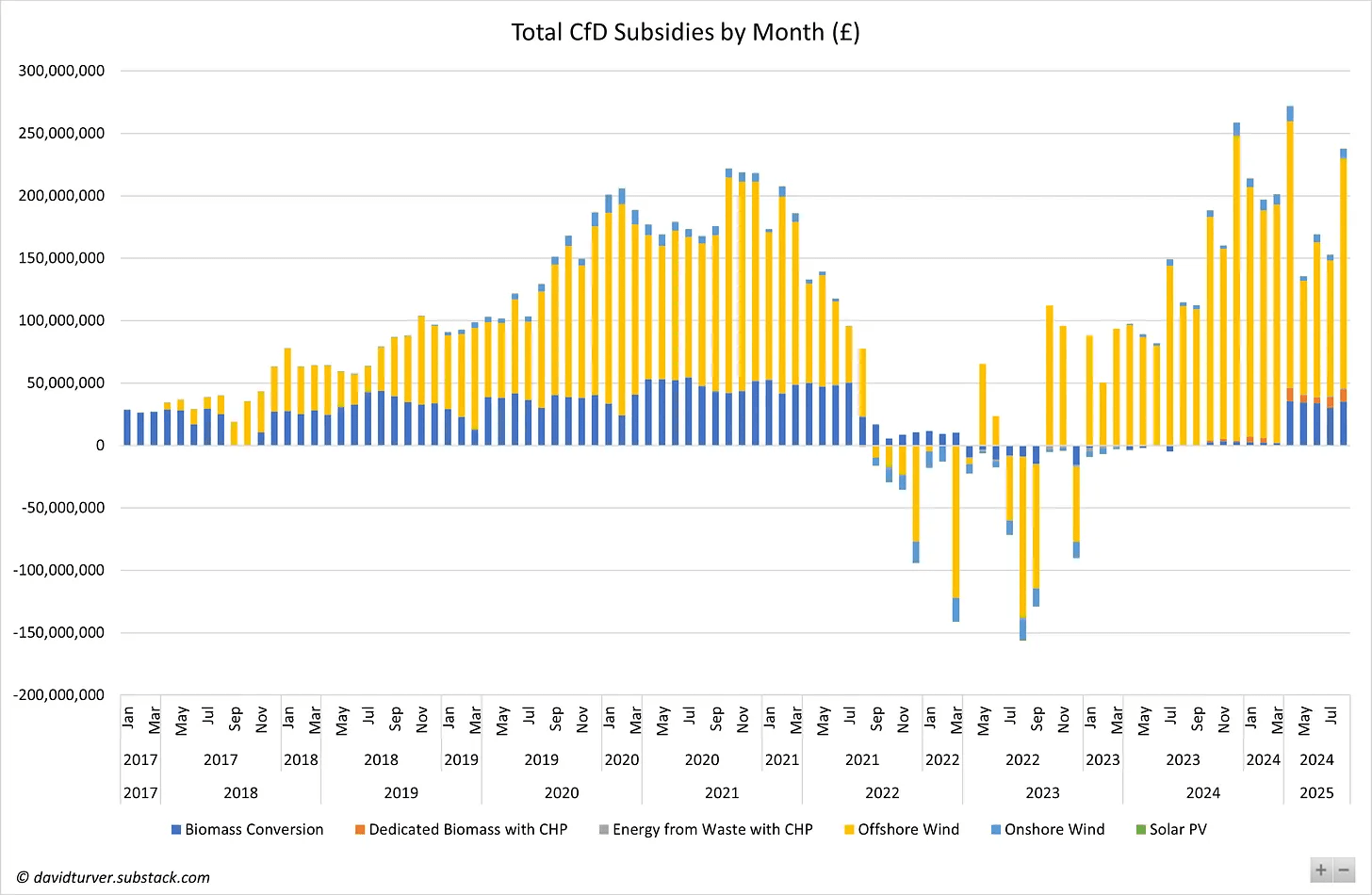
The headline is that overall CfD subsidies rose sharply in August 2024 to a total of £237m, the third highest total on record and by far the highest level for the month of August (see Figure 1).

Figure 1 – Overall CfD Subsides by Month and Technology (£)

The total is up £84.2m from July’s total. The main driver of the increase is offshore wind which is up £74.5m from a month ago. This August’s total is also up £123.8m from August 2023. Since August last year, offshore wind subsidies are up £72.3m, biomass conversion £35m, biomass with CHP up £10.2m, onshore wind £5.1m.

There are several factors driving the increase in subsidy since last year. First and most obvious is that more wind farms have now activated their CfDs since last year. Moray East and Hornsea Project 2 offshore projects came online earlier this year as did the Sneddon onshore wind farm. Moreover, the CfD part of Drax biomass plant was not used at all last August but attracted £25.6m in subsidy in August 2024.

Load Factors
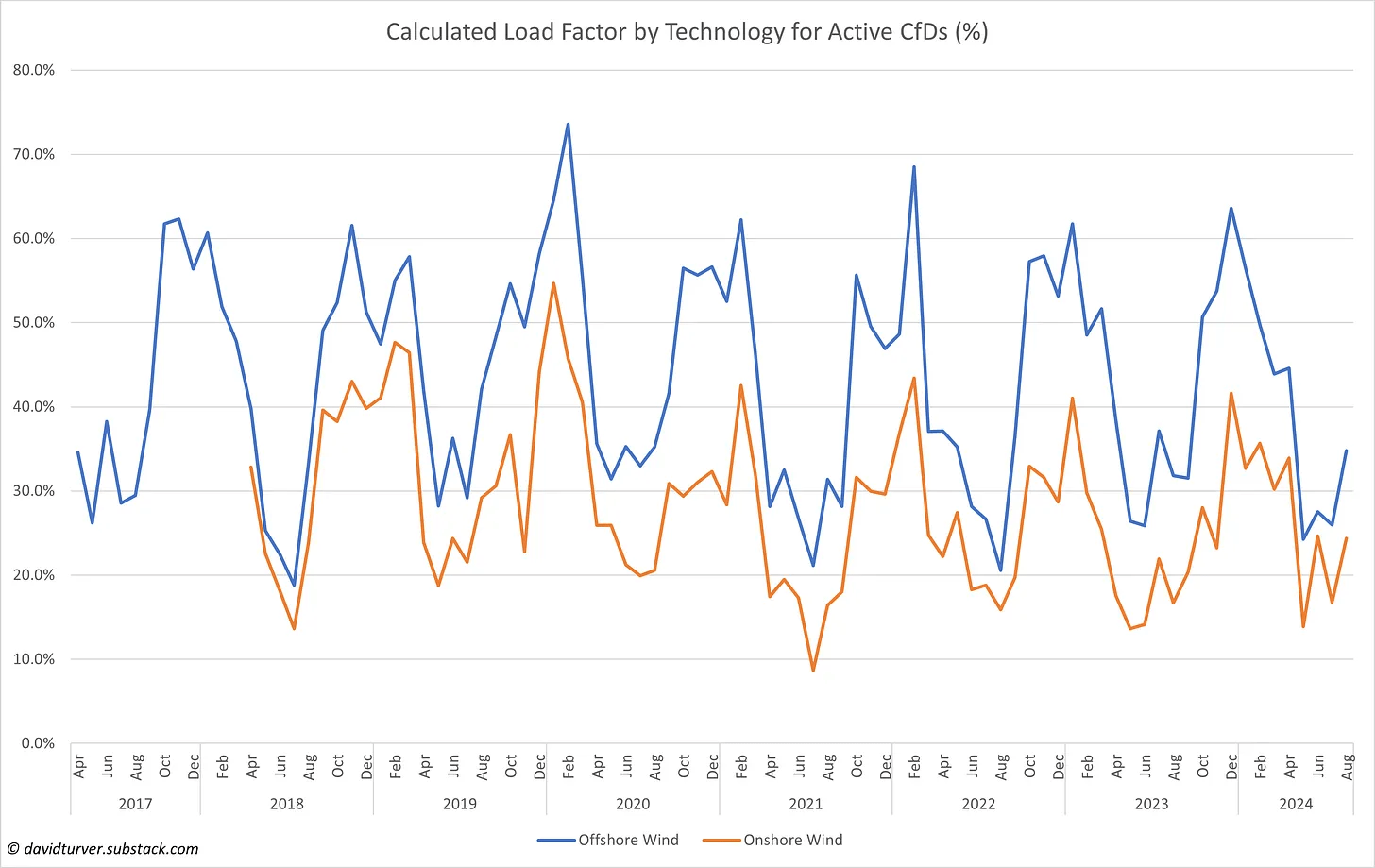
However, the number of turbines claiming subsidy is not the only driver of increased subsidy. Load factors are also up. This means that both onshore and offshore wind farms produced closer to their theoretical maximum during the month (see Figure 2).

Figure 2 – Calculated Load Factor by Month for Active Windfarms (%)

Using the nameplate capacity recorded by LCCC for each installation, we can calculate the load factor for each project and aggregate it by technology. In August 2024, CfD-funded offshore windfarms achieved a load factor of 34.7%, the third highest August on record, the highest since August 2020 and up three percentage points since last year. Onshore wind achieved 24.9%, the second highest August load factor on record and up from 16.7% last year.

More wind means more generation and other things being equal, more generation means more subsidy.

Subsidy per MWh
The other things that drive the levels of subsidy are the CfD strike prices and the reference price used to calculate the subsidy level. For offshore wind, the weighted average strike price has fallen ~£23/MWh from about £178/MWh in August 2023 to £155/MWh this year. This is because of the aforementioned addition of Moray East and Hornsea Project 2 which both have lower strike prices than the earlier offshore wind farms. The strike prices for onshore wind are up a few pounds from last year to £113/MWh and solar is up £4 to £110/MWh.

However, the Intermittent Market Reference Price (IMRP) which is used as the baseline for the price that renewable electricity was sold for in the market is down significantly on last year. The average IMRP, weighted by generation, has fallen about £25/MWh from £76/MWh in August 2023 to about £51/MWh in August 2024.

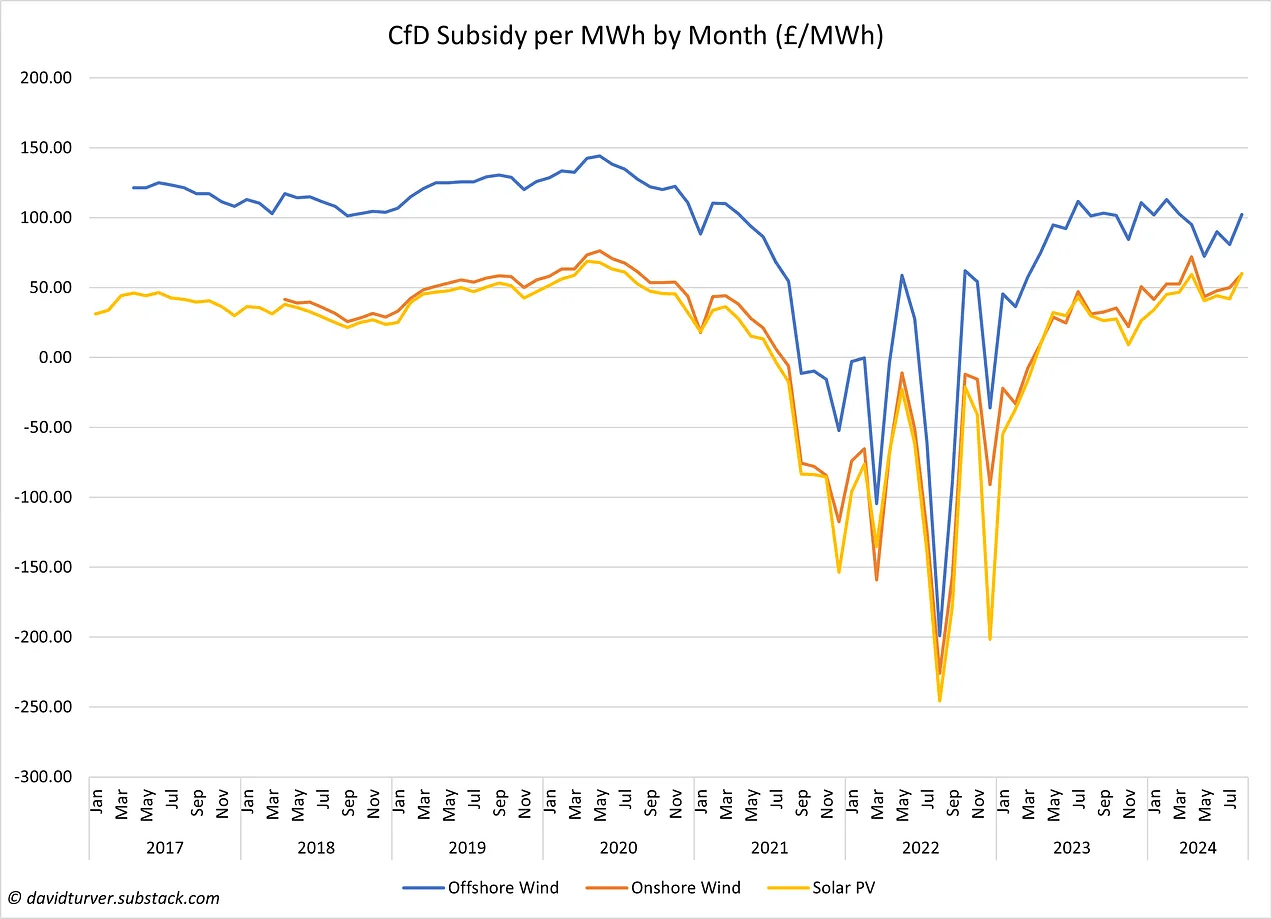
The subsidy per MWh is calculated as the difference between the strike price and the IMRP. The upshot is that the subsidy per MWh for offshore wind is up a bit since last year and is up sharply for onshore wind and for solar power (see Figure 3).

Figure 3 – Subsidy per MWh by Technology (£ per MWh)

Gas prices are lower this year than they were last, so that explains some of the reduction in IMRP, because gas often sets the market rate of electricity. However, adding more uncontrolled renewable generation can also affect the IMRP. There were two days in August when the weighted IMRP for offshore wind fell below £20/MWh and three occasions when the weighted IMRP for solar fell below £10/MWh. Provided the price stays positive, this does not matter to the generators, they just make up the difference with extra subsidies. If the price goes negative for a time, then some wind farms are not paid curtailment fees.

Conclusion
The addition of the newer, cheaper offshore wind farms has not had a significant impact on the subsidy per MWh. The reduction in average strike price has been overwhelmed by a combination of the indexation upwards in April and cheaper gas prices since last year. Even if gas prices stay at the current elevated levels, we are unlikely to see a significant reduction in the subsidy per MWh, because increased generation from renewables pushes down the IMRP, thus increasing subsidies. For the generators it is heads they win, tails the consumer loses. We can expect more record subsidies between now and February 2025 as the seasonal load factors creep back up and Drax is kept running to replace our last remaining coal plant which shuts shortly.
Substack

via STOP THESE THINGS

https://ift.tt/fELXoGO

October 31, 2024 at 01:31AM