Author: Iowa Climate Science Education

“How close is our planet to suffering the most catastrophic effects of climate change?”

Essay by Eric Worrall

“That’s the big question we’re all trying to pin down,” Professor Matthew England from UNSW told 9news.com.au.

How close is our planet to suffering the most catastrophic effects of climate change?

By Daniel Jeffrey 12:34pm Jul 30, 2024

…

How many years until we can’t stop climate change?

Rather than talking about whether climate change can be stopped it’s a bit more helpful to look at key “tipping points”.

“(These) include ice sheet collapse, permafrost thaw, ocean deoxygenation, ocean acidification, the die-back of the Amazon rainforest, and changes in ocean circulation, such as the slowdown of the Atlantic overturning circulation,” UNSW Climate Change Research Centre director Katrin Meissner told 9news.com.au.

…

So how far away are we from hitting them?

“That’s the big question we’re all trying to pin down,” Professor Matthew England from UNSW told 9news.com.au.

“In a way, that’s the biggest unknown we have. 

“It’s safe to say we know these tipping points exist. What we know less about is how close to the tipping points we are. 

“Some people say we’re already, for example, past a tipping point for the Greenland ice sheet.”

…

“On timescales that are relevant to humans, none of the effects we see right now can be reversed, not even those that are not related to tipping points,” Meissner says.

“They can only stay the way they are or get worse.”

…

Read more: https://www.9news.com.au/national/climate-change-progress-how-long-until-climate-change-is-irreversible/87a22a09-2420-44af-b243-f60280531766

The big question I’d like to pin down is whether these people are actually practicing science.

In science prediction is king – if your theory doesn’t make testable predictions, it’s not scientific.

Falsifiability (or refutability) is a deductive standard of evaluation of scientific theories and hypotheses, introduced by the philosopher of science Karl Popper in his book The Logic of Scientific Discovery (1934).[B] A theory or hypothesis is falsifiable (or refutable) if it can be logically contradicted by an empirical test.

Read more: https://en.wikipedia.org/wiki/Falsifiability

A statement like all the ice caps will one day melt – the paleo climate history of Earth is full of periods when the polar ice caps melted. For much of Earth’s history there were no polar ice caps, by paleo-climate standards today’s world is experiencing a period of extreme cold.

From NOAA;

…

Striking during the time period known as the Pleistocene Epoch, this ice age started about 2.6 million years ago and lasted until roughly 11,000 years ago.

Like all the others, the most recent ice age brought a series of glacial advances and retreats. In fact, we are technically still in an ice age. We’re just living out our lives during an interglacial.

…

Read more: https://www.climate.gov/news-features/climate-qa/whats-coldest-earths-ever-been

But a statement like “They can only stay the way they are or get worse.” implies things are getting worse – but doesn’t give us a way to falsify this hypothesis.

In my opinion making predictions which are not testable in a very fundamental way violates the basic principles of science. If your prediction of imminent catastrophe does not have a firm timetable, if it cannot be falsified with a scientific test, then it’s not science.

A prediction like “the ice caps will melt by 2030, and this will catastrophically inundate 100 billion dollars worth of realestate”, this would be a testable prediction. All we have to do is wait until 2030, then point and laugh.

More importantly we could use such predictions as a yardstick to measure the comparative value of proposed climate action. Should people living at higher elevations be taxed a trillion dollars, to pay for the mitigation of $100 billion of problems which only affect wealthy, high income lowlands? Perhaps the cities allegedly at risk should decide for themselves how credible such predictions are, and pay their own climate adaption bills.

via Watts Up With That?

https://ift.tt/rf9waU5

July 30, 2024 at 08:04PM

Legal Challenges to the SEC’s Climate-Related Disclosures Rule

By Rupert Darwall

“And When Did You Last See Your Father?” – William Frederick Yeames, 1878

The scene: Room 2128 Rayburn House Office Building at a hearing of the House Financial Services Committee on the SEC’s climate-related disclosures rule, April 10, 2024.

Representative Juan Vargas (D-CA): “How many of you believe in climate change?” Raises his right arm. “If you could please raise your hand.”

Chris Wright, founder, chairman and CEO of Liberty Energy, gesticulating: “It’s a bad question.”

—-

The Securities and Exchange Commission’s (SEC) 886-page climate disclosures document is its most controversial in its 90-year history. It has huge implications for every listed business, especially in the energy sector. The rule empowers climate activists by forcing companies to compile and disclose emissions data that their allies on Wall Street can then use to impose and monitor net zero targets on corporate America. Adopted on March 6, the rule was immediately challenged in the courts. Less than a month later, the SEC chose to stay the rule to pre-empt petitioners’ requests for an emergency stay pending judicial review.

When first proposed, the rule attracted an unprecedented volume of comments. It was adopted over the dissent of the SEC’s two Republican commissioners. In his withering dissent, Commissioner Mark Uyeda recalled the advice that he gives investors: “Do not rely on the marketing materials and read the prospectus instead.” The implication is devastating. In justifying the rule, the SEC falls beneath the standards of truthfulness it rightly expects of those whom it regulates.

In a speech shortly after adoption of the new rule, SEC chair Gary Gensler observed, “Materiality represents a fundamental building block of the disclosure requirements under the federal laws,” and went on to claim that the new role was “grounded in materiality.” This is bunk. As Commissioner Hester Peirce put it in her dissent, “While the Commission has decorated the final rule with materiality ribbons, the rule embraces materiality in name only.” In no context other than climate, writes Commissioner Uyeda, does the SEC require companies to provide an explanation for any expenses down to one percent of income before taxes, which it does for those incurred as a result of extreme weather.

Moreover, the SEC already requires disclosure of material climate information and had issued detailed guidance to that effect in 2010. As a brief on behalf of the U.S. Chambers of Commerce and the National Center for Public Policy Research (NCPPR) to the Eighth Circuit, which is hearing the case, points out, “the rule is necessarily duplicative and of no value.” The rule, the brief contends, contravenes the Administrative Procedure Act because “it purports to solve a ‘securities’ problem that the SEC failed to show exists.” In contravention of its own statutes, the SEC failed to conduct a rigorous cost-benefit analysis of its proposal, which, on its own massaged estimates, would cost more than double[RD1]  the compliance costs of all major existing SEC disclosures combined. The rule departs so far from what the SEC had initially proposed that the SEC erred in not re-proposing the rule and opening it up for comments, Commissioner Uyeda contends.

The standard of materiality adopted by the courts concerns whether there is a substantial likelihood that a reasonable investor would consider the information important in deciding how to vote or make an investment decision. What unites the universe of reasonable investors is the prospect of financial return. This means that there is an empirical test for materiality: Is the disclosure likely to move the price of the security? A statistical study submitted to the SEC by Professor Daniel Taylor at The Wharton School analyzed the market impact of corporate disclosures of greenhouse gas (GHG) emissions data. The study found “no evidence of a statistically significant change in stock price or trading volume in response to GHG disclosures” (emphasis in the original). But, as the U.S. Chambers/NCPPR brief notes, “the Commission inexplicably – and arbitrarily – failed even to consider Dr. Taylor’s findings” (emphasis in the original).

A second class of disclosure relates to the integrity of the principal-agent relationship, that is, the reliance of dispersed stockholders on the good faith of corporate executives to act solely in the company’s interests. The purpose of such disclosures, for example on executive compensation, is to facilitate transparency and assure investors that executives aren’t engaged in corporate looting. The integrity of the shareholder-management relationship is factor which can have an outsize impact on corporate valuations and thus is of great interest to the reasonable investor. As David McLean notes in “The Case for Shareholders Capitalism,” the reason why a barrel of oil in 2000 was worth $12 of market capitalization at ExxonMobil and BP but only 20¢ for Russian oil companies is explained by radically differing standards of corporate governance. “U.S. stock exchange and U.S. laws and regulatory agencies make it difficult and costly to expropriate from shareholders,” McLean writes.

In effect, the SEC subordinates materiality to investor demand. “Investors ranging from individual investors to large asset managers have indicated that they are making decisions in reliance on that information,” Chair Gensler says. But it is not the role of the SEC to mandate disclosure of corporate data in pursuance of every investment fad or fashion, however well grounded, thereby imposing costs on all investors. One of the SEC’s most cited “reasonable investors” in the rule’s text is As You Sow, a non-profit shareholder advocacy group. As You Sow’s mission is “to promote environmental and social corporate responsibility through shareholder advocacy, coalition building, and innovative legal strategies.” Its website has a prominent donate button, and two of its funders are the Soros-backed Foundation to Promote Open Society and the Open Society Foundations.

The SEC’s implicit categorization of climate-activist As You Sow as a “reasonable investor” demonstrates the truth of Commissioner Uyeda’s assertion that the SEC rule is “climate regulation promulgated under the Commission’s seal.” As the U.S. Chambers/NCPPR brief states, the SEC’s alleged justification for the rule is “pretextual,” that is, not the real reason, which, as I pointed out in my June 2022 comment letter, was the grounds on which the Supreme Court struck down the proposed citizenship question in the 2020 census.

Until the climate-related disclosures rule was proposed, the SEC had viewed the purpose of disclosure as providing investors with information pertaining to a firm’s financial condition. The rule sees a vast, unilateral expansion of the SEC’s remit to information “necessary or appropriate in the public interest.” To Commissioner Uyeda, this raises the red flag of the major questions doctrine. “Extraordinary grants of regulatory authority are rarely accomplished through ‘modest words,’ ‘vague terms,’ or ‘subtle device[s],” the Supreme Court stated in West Virginia v. EPA. It is by conflating the purpose of disclosures to reveal a firm’s financial condition with disclosures deemed by the SEC as necessary in the public interest that the nonprofit activist As You Sow – “Our vision is a safe, just and sustainable world” – becomes, in the eyes of the SEC, a “reasonable investor.”

The SEC performs a similar sleight of hand with the touchstone of materiality. When proposed, the rule would have required listed companies to nominate a director responsible for managing and reporting climate-related risk. That requirement was subsequently dropped. Instead, the SEC pressures boards to consider climate-related issues and then deems all such board-level discussion to be material and therefore disclosable. In effect, the SEC places a bug in the boardroom of every listed company that is activated whenever the words “climate” or “severe weather” are spoken. (Commissioner Uyeda notes that the SEC includes tornadoes as an example of a “severe weather event,” even though National Geographic says global warming could well suppress them – “the science just isn’t clear yet.”)

At the apex of the legal challenge to the rule is the First Amendment. The U.S. Chambers/NCPPR legal brief argues that the rule is contrary to the First Amendment prohibiting “the government from telling people what they must say,” as the Supreme Court had stated in 2006. “Yet that is exactly what the rule does, by design – forcing companies to engage in costly speech against their will on matters of contentious societal debate.” That freedom, the Supreme Court had previously ruled, “includes both the right to speak freely and the right to refrain from speaking at all.”

Few issues are as contentious as climate change and what, if anything, to do about it. Before Representative Vargas attempted to compel Chris Wright to indicate whether he believed in climate change, Wright testified about why Liberty Energy strenuously opposed the new rule, was challenging it in the courts, and had sought a stay. The SEC was venturing well outside its lane without any congressional mandate, Wright said.

Extrapolating the temperature trends derived from satellite measurement implies a two-degree Fahrenheit temperature rise by the end of the century. By contrast, Liberty Energy operates in minus 30°F in South Dakota and over 110°F in south Texas – a range of more than 140°F. There is no obvious growing threat to our business from extreme weather, Wright testified. The real climate risk to Liberty comes from climate regulations that are costly to comply with and invite litigation. With global demand for natural gas and oil at record highs and growing, the impact of the SEC rule will be to make it costlier and riskier to produce oil and gas in the United States. That cannot be in America’s economic or national security interests. Much is at stake as the Eighth Circuit hears the arguments against the SEC’s climate-related disclosure rule.

Rupert Darwall is a senior fellow of the RealClearFoundation and author of  The Folly of Climate Leadership: Net Zero and Britain’s Disastrous Energy Policies.

This article was originally published by RealClearEnergy and made available via RealClearWire.

via Watts Up With That?

https://ift.tt/GOItSun

July 30, 2024 at 04:03PM

Rolls-Royce One Step Closer To SMRs

By Paul Homewood

h/t Philip Bratby


 image

Rolls-Royce has cleared a key hurdle in the race to build Britain’s first mini-nuclear power plant, as competition across Europe ramps up.

On Tuesday, the FTSE 100 engineering giant became the first developer to advance a small modular reactor (SMR) design to the final stage of examination by UK regulators.

Helena Perry, director of safety and regulatory affairs at Rolls-Royce SMR, said the latest approval was “the most important milestone to date in advancing deployment of Rolls-Royce SMRs in the UK”.

She added: “We have built fantastic momentum and the team will move directly into step three of this rigorous independent assessment of our technology – ideally positioning us to deliver low-carbon nuclear power and support the UK’s transition to net zero.”

The Derby-based company wants to build a new generation of lower-cost power plants, made from modular parts that would be produced in factories and then assembled on site.

image

SMRs would each generate 470 megawatts of electricity and cost between £2bn and £3bn initially. Rolls-Royce aims to bring that number down gradually through economies of scale.

The Office for Nuclear Regulation (ONR) said Rolls has now been cleared to move into the third and final stage of the UK’s generic design assessment.

That process is expected to conclude by the end of 2026, after which Rolls will be able to apply for site-specific approval to build its first SMR.

A summary assessment published by the ONR on Tuesday said that the regulator has “not identified any fundamental safety, security or safeguards shortfalls that could prevent permissioning the construction of a power station based on the generic Rolls-Royce SMR design”.

https://www.telegraph.co.uk/business/2024/07/30/rolls-royce-clears-key-hurdle-race-build-mini-nukes/

.

Philip Bratby wrote this earlier this year about the painfully slow progress to SMRs:

Progress in the UK on SMRs has inevitably been slow.  In 2014 the UK government published a report on SMR concepts, feasibility and potential in the UK.  In 2015 the government announced that it would invest at least £250 million over five years in nuclear R&D including SMRs.  In 2016 the UK government called for expressions of interest in a competition to identify the best value SMR for the UK.  In 2017 the government announced that the SMR competition had been closed and a new two-phase advanced modular reactor competition was launched, designed to incorporate a wider range of reactor types.  In 2018 it was announced that eight organisations were awarded contracts to produce feasibility studies.  In 2020, the government awarded £10 million to two SMR developers.  In 2021 the government announced that it was setting up the Future Nuclear Enabling Fund (FNEF) with £120 million available “to help mature nuclear projects ahead of the government selection process”.

In 2021 the government also announced that it would contribute £210 million to development of the Rolls-Royce SMR.  The Rolls-Royce SMR is a PWR reactor, designed for hydrogen and synthetic fuel manufacturing as well as for electricity generation.  The Rolls-Royce SMR consortium, involving many of the major UK engineering firms, aims to build 16 reactors, each of 470 MWe.  In 2022 Rolls-Royce announced that it had identified four priority locations to build SMR-based power stations in the UK, all on previous nuclear power station sites currently owned by the UK Nuclear Decommissioning Authority (NDA).

In July 2023 the government launched Great British Nuclear (GBN) to administer a competition to create SMRs, and then to co-fund any viable projects.  It is intended to deliver the government’s long-term nuclear programme and support the government’s ambition to deliver up to 24GW of nuclear power in the UK by 2050.  GBN has launched the next phase of the SMR technology selection process and with six potential SMR vendors having registered their interest.  The process is intended to identify those SMR projects which the government will co-fund.  The date of the decision keeps getting put back.  GBN has now delayed its decision on where the first SMRs will be sited until after the next general election.  So after 10 years, it might just be possible that the UK will be in a position to start work on building the first SMR!

.

Of course, successful development of SMRs would soon make wind and solar power redundant. Why duplicate capacity?

One might almost think that the Green Blob has been deliberately putting the brakes on the development of nuclear power.

via NOT A LOT OF PEOPLE KNOW THAT

https://ift.tt/umWP8wb

July 30, 2024 at 03:38PM

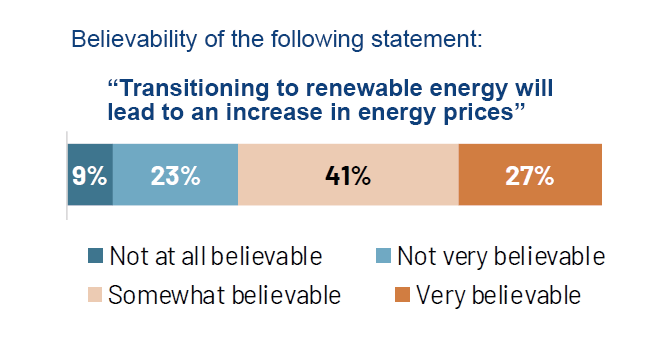
68% of Australians can believe renewable energy will push up power prices

By  Jo Nova

There is hope: Despite the censorship, and the partisan bias in the media, more than half the country has shaken off the propaganda.

All our institutions and experts have been telling us “renewables are cheaper” for twenty years, yet two out of three people don’t believe them. In a similar vein 58% of people could believe electric cars were just as bad for the environment as petrol cars. 50% believe renewable energy leads to blackouts, causes harm to whales and takes away our best farmland. And half the country agrees there is no consensus among the experts either.

We haven’t had a strong election battle on the renewables transition, but statistics like these suggest that if the Opposition picked up on this fear, they would be pushing on an open door.

The IPSOS survey (n=1,000)

Australians now more concerned about green energy’s impact on cost-of-living and electricity bills. Believability of higher prices.

And despite higher prices being exactly what happens in every country on Earth, IPSOS arrogantly labels this belief as “Misinformation”.

(Click to enlarge).

Misinformation is very believeable. Survey.

They also asked people whether they had “seen or heard anything in the social media about this?” But only 39% said they had seen something on this in the mainstream media.  So most of the population hadn’t even seen this discussed on TV or radio yet. Imagine how many more people would know that the transition would ramp up electricity prices if the TV news actually interviewed skeptical engineers, NASA astronauts or Nobel prize winners like John Clauser, every now and again.

We are a country divided and cynical. Half the nation don’t believe the CSIRO or the ABC even a bit. Only 40% think it will be good for the economy. Only 32% think it will increase jobs in their area.

Support for the renewables transition is falling away

In the last 2 years, a tenth of those who thought Australia should be “a world leader” in the energy transition have left the ranch.

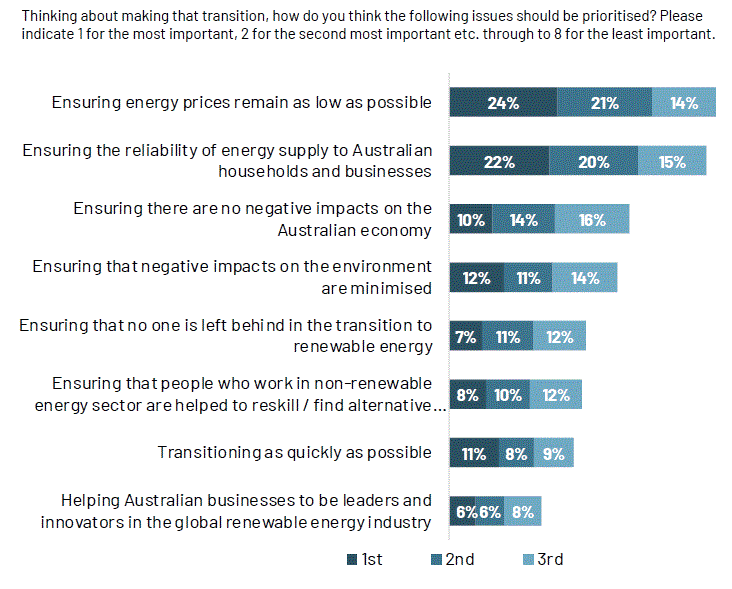
And the most important thing to the people was not a speedy transition, but cheap electricity and reliable power.

poll on climate change

Only 28% think we will meet our Net Zero targets

Boy are they in for a shock…


Half the nation still thinks (paradoxically) that switching to solar and wind power will improve air quality. Thirty years of teachers, news-readers and politicians calling carbon dioxide “pollution” sowed this confusion.

See the Epoch Times for more commentary on the survey.

See the crowd at Reneweconomy tie themselves in knots with excuses.

But it’s not difficult to see why more Australians are now associating wind and solar farms with higher power bills and cost of living more generally, says the Grattan Institute’s Allison Reeve.

“It’s only very recently that we’ve come to this point where renewables have become the cheapest form of energy, so people who don’t think about energy all the time for a living will have a shortcut in their brain and say ‘oh renewables are more expensive’,” she says.

They’re trying to pretend that the idea of “cheap renewables” is a whole new thing that the masses haven’t been trained-to-death with for two decades.


0 out of 10 based on 0 rating

via JoNova

https://ift.tt/1H6lZPK

July 30, 2024 at 03:06PM