Author: Iowa Climate Science Education

Britain’s Killing Fields: Offshore Wind Industry Wiping Out Whales, Dolphins & More

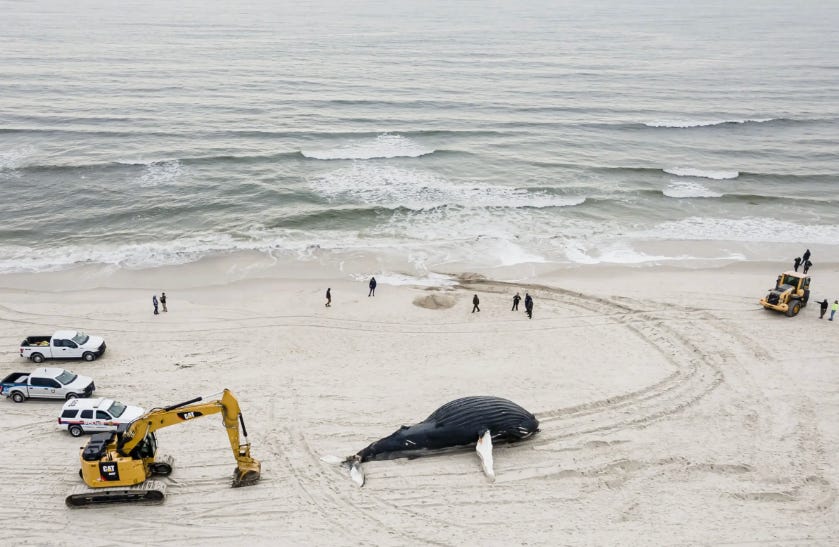
With thousands of whales, dolphins and porpoises washing up in areas given over to offshore wind turbines, the wind industry is having a hard time covering up its responsibility for the cetacean carnage.

The relationship between offshore wind turbine construction noise and marine mammal fatalities is now incontrovertible: Wind Industry’s Wanton Whale Slaughter Caused by Constant Deafening Construction Noise

While the focus has been on the ecological disaster unfolding on America’s Atlantic Coast, the wanton destruction has been gathering pace in the UK, as well. And, as Jason Endfield details below, the numbers being destroyed by the offshore wind industry around Britain are just as staggering.

Newly released data reveals record number of cetacean deaths in UK waters
Medium
Jason Endfield
3 May 2024

Shocking: 3,000 dead whales, dolphins and porpoises in just 3 years.

After months of asking the UK Department for the Environment, Defra, to share the data for cetacean strandings, at last some information is emerging.

I’ve been calling on Defra to share the data for some time, and now I’m pleased to see that the 2019 and 2020 reports have been published. At the time of writing this, we are still awaiting the 2021 and 2022 data, but already the figures are terribly alarming and raise many questions.

3,000 deaths in just three years
Tragically, more than 1, will 000 whales, dolphins and porpoises were stranded around the UK in 2018 – and it was a similar number the following year with 980 cetaceans reported to the Cetacean Strandings Investigation Programme (CSIP) in 2019.

But in 2020, there was an unprecedented number of cetacean strandings with the highest figures ever recorded in the UK by the CSIP since its inception – a shocking 1102 cetaceans, comprising at least 16 species.

Even allowing for some animals that were re-floated, it means that more than 3000 whales, dolphins and porpoises perished around the UK’s coast in just three years.

The extraordinary upward trend in whale, dolphin and porpoise deaths suggests something is very wrong in the seas around Britain.

Biggest mass stranding event since records began
The 2020 figures included a mass stranding of at least seven Sperm whales in Yorkshire, on the North Sea coast.

This particular tragedy was the largest Sperm whale mass mortality event ever recorded in England since routine recording of strandings began in the UK in 1913.

Post mortem sampling was carried out on a few of the animals, and there was no sign of recent ship strike or fishing gear entanglement. In addition to this, the whales were thought to be in reasonable nutritional condition.

What is causing the huge upturn in cetacean deaths around the UK?
There could be a number of factors of course, there are many theories out there, but at least in the case of the Sperm whales in Yorkshire, we can largely rule out ship strike and entanglement, often casually blamed for the deaths of marine mammals. Whatever your hypothesis, whether you choose to blame climate change, naval sonar, fishing, pollution or plastics, don’t ignore the elephant in the room – industrial offshore wind farms.

The North Sea – an industrial development zone – at the expense of wildlife?
There has long been a general denial that offshore wind farms might be associated with the increase in whale deaths, but it should perhaps be noted that the aforementioned Sperm whales were stranded in an area where at least two offshore wind farms were operational at the time of the mass stranding event, both of them within just a few miles of where the whales were found, near the town of Withernsea. Meanwhile, other North Sea wind farm projects were under construction that year and a vast area of the North Sea had by then been designated a ‘development zone’ with further industrial offshore wind projects in the pipeline. Countries bordering the North Sea have hugely ambitious plans to vastly increase offshore wind capacity in the coming years.

The North Sea is rich in wildlife, but I believe that large areas of important ecosystems are under imminent threat as the industry rapidly expands.

Any debate over the cause behind the increase in strandings must include public discussion surrounding the rapid expansion of the offshore wind industry and the potential damage being done to marine ecosystems in its wake.

The offshore wind industry – and the “potential to kill”
A report, entitled ‘An Approach To Impulsive Noise Mitigation In English Waters’, commissioned by Defra and published in 2022, examined the management of underwater noise during wind farm construction. The report acknowledged that “construction of offshore wind farms has the potential to harm the marine environment.” It went on to say that “a key area of concern is impulsive noise … that is often loud and has a sudden onset, primarily generated from activities such as clearing wind farm sites of unexploded ordnance, installing wind turbine foundations and when undertaking seismic and geophysical surveys.” It also pointed out that “marine mammals are sensitive to these noise sources, which have the potential to kill, injure or disturb without appropriate mitigation.”

“Potential to kill” – it’s there in black and white.

The report summarised the outcome of a workshop which examined ways to mitigate the problem of underwater noise caused by the planned expansion of wind farm construction. Those involved in the workshop, including representatives from academia, the offshore wind industry, policy makers, regulators, and noise abatement technology providers, generally acknowledged that the issue will become especially relevant with the UK’s ambitious target of installing 50GW of offshore wind capacity by 2030. In order to achieve this target, the UK has to build thousands of additional offshore wind turbines.

The matter of industrial ocean noise caused by human activities has been cited as a threat to marine life for a long time, though those involved in the wind industry would doubtless maintain that they have always responsibly implemented noise management during their operations. The problem is that the current noise management approach might not be sufficient moving forward.

Indeed, the report noted that “developers are already required to implement marine mammal mitigation when undertaking noisy activities,” but added that “additional levels of mitigation may be needed in the future when constructing wind farms to reflect the increasing size of turbine generators and their associated foundations, and to manage in-combination effects which are are a major concern given the number of developments required over the next ten years and beyond.”

To avoid the deaths of more marine mammals, the mitigation discussed at the workshop would have to be flawless. That seems unlikely without extraordinary levels of monitoring and constant assessment, given the huge scale of industrialisation planned.

This makes it a moral and ethical issue. We’ve already heard suggestions that thousands more seabirds could perish if the North Sea wind industry expands. Can we really be sure that cetaceans won’t face the same fate? Selling the idea of green energy, while knowing that your work might be killing wildlife, would be a conflict too far for many – but not apparently for the wind industry.

To think that the whale used to be the very symbol of environmental conservation and now it may well become a victim of ill-conceived environmental policy.

Looking forward, unless the government monitors the industry constantly and takes rigorous action when environmental misdemeanors take place, then I think we might well look back in a few years and see a wholesale destruction of wildlife in the name of green energy. It’s an appalling thought.

Now with the stranding data finally emerging, we can clearly see that the numbers of cetacean deaths continues to increase in line with the industrialisation of our seas.

It’s really not rocket science, it looks very much like common sense to me. Sometimes you just have to call a spade a spade – and call out the fact that placing vast arrays of industrial wind turbines in a natural environment must be damaging to that environment. It’s a fact, surely? How could it be otherwise?

On land or at sea, the principle remains the same. If you industrialise a space where nature exists, that nature will be adversely affected when its habitat is compromised. So it is with any natural environment, including the ocean.

Marine habitats are home to delicate ecosystems so complex that we don’t fully understand them – yet in our rush to solve a manmade energy crisis, (and for some, dare I say, in their haste to make money), we are destroying vast swathes of ocean and causing potentially catastrophic damage in the process. It is utter folly and inexcusably reckless.

Moving forward, it is imperative that the wider public are part of the discussion about industrial development that affects the natural environment.

While we await the next annual reports, due shortly, we can perhaps reflect on the fact that reported cetacean deaths have never been higher, that something is clearly wrong in our oceans – and that industrialisation of our seas continues at a rapid pace with scant regard for wildlife. It’s not that difficult to put two and two together to get a quite rational answer.

I think it’s something of a national scandal.
Medium

via STOP THESE THINGS

https://ift.tt/eWEPF0X

July 30, 2024 at 02:34AM

THE RECENT WARMER YEARS ARE JUST “NOISE”, SAYS PROFESSOR

Here is what Prof Roy Spencer, a leading scientist in charge of the satellite temperature data set at the University of Alabama in Huntsville, has to say: 

In a warming world due to increasing CO2 there will be a statistical increase in “unusually warm” years. But assuming the warming is entirely due to steadily increasing CO2 causing a slight (currently ~1%) energy imbalance in the climate system, then the warming that results is about ~0.02 deg. C per year.

Anything different from that small 0.02 deg. C per year warming is due to natural climate variability.

So, when we get a really warm year (like 2023, and probably 2024) then something other than CO2 is mostly to blame. All of the media and environmentalist hype is just noise. Really warm years will be offset by cooler years (which no one reports on because it’s not newsworthy) so that the long term temperature trends remains ~0.02 deg C per year of warming (+0.014 deg C per year in our satellite data).

 An unusually warm year or two cannot be blamed on climate change « Roy Spencer, PhD (drroyspencer.com)

via climate science

https://ift.tt/pDoW3Tk

July 30, 2024 at 02:00AM

Project 2025: Environmental Policy

“A more conservative EPA … will prevent unnecessary expenditures by the regulated community [and] … deliver savings to the American taxpayer. Improved transparency will serve as an important check … [to] deliver tangible environmental improvements to the American people in the form of cleaner air, cleaner water, and healthier soils.” ( – Heritage Foundation, Project 2025)

Last week’s post examined the energy section of the Heritage Foundation’s 922-page Mandate for Leadership: 2025. This post reproduces the environmental section of the same document (1,200 words) calling for a return to the basics of clean air and water–and away from the cancer of climate policy as ecological.

As explained below, EPA needs to prioritize achievable, definable environmental improvement, not engage in wasteful, futile climatism and forced energy transformation.

The challenge of creating a conservative EPA will be to balance justified skepticism toward an agency that has long been amenable to being co-opted by the Left for political ends against the need to implement the agency’s true function: protecting public health and the environment in cooperation with states. Further, the EPA needs to be realigned away from attempts to make it an all-powerful energy and land use policymaker and returned to its congressionally sanctioned role as environmental regulator.

Not surprisingly, the EPA under the Biden Administration has returned to the same top-down, coercive approach that defined the Obama Administration. There has been a reinstitution of unachievable standards designed to aid in the “transition” away from politically disfavored industries and technologies and toward the Biden Administration’s preferred alternatives. This approach is most obvious in the Biden Administration’s assault on the energy sector as the Administration uses its regulatory might to make coal, oil, and natural gas operations very expensive and increasingly inaccessible while forcing the economy to build out and rely on unreliable renewables….

As a consequence of this approach, we see the return of costly, job-killing regulations that serve to depress the economy and grow the bureaucracy but do little to address, much less resolve, complex environmental problems. In some instances, these actions even work to undermine environmental efforts as they push industries overseas to countries whose enforcement of pollution-control requirements is seriously deficient—if indeed they have any meaningful requirements at all. Meanwhile, agency costs and staffing have increased significantly….

Compared to the Obama Administration, there is one key difference in the Biden Administration’s approach: In a concerted effort to diminish congressional oversight, the position of EPA Administrator has been overshadowed by the creation of multiple “Climate Czars” at the Biden White House. In effect, current EPA Administrator Michael Regan, who has a reputation as a well-meaning, generally capable former state official, has been left out of the political loop, serving mostly as a pleasant distraction from EPA’s expansive, costly, and economy-destroying agenda.

A Co-opted Mission. The EPA has been a breeding ground for expansion of the federal government’s influence and control across the economy. Embedded activists have sought to evade legal restraints in pursuit of a global, climate-themed agenda, aiming to achieve that agenda by implementing costly policies that otherwise have failed to gain the requisite political traction in Congress. Many EPA actions in liberal Administrations have simply ignored the will of Congress, aligning instead with the goals and wants of politically connected activists.

Pursuit of this globally focused agenda has distracted the agency from fulfilling its core mission, thereby creating a backlog of missed statutory deadlines, and at times has even led to preventable environmental disasters. During the Obama Administration, for example, the U.S. experienced two of the worst environmental Environmental Protection Agency disasters in decades, including the Flint, Michigan, water crisis in 2014 and the Gold King Mine spill in 2015.

Beyond creating such immediate and tangible harm in various communities, an EPA led by activism and a disregard for the law has generated uncertainty in the regulated community, vendetta-driven enforcement, weighted analytics, increased costs, and diminished trust in final agency actions. Although the U.S. environmental story is very positive, there has been a return to fear-based rhetoric within the agency, especially as it pertains to the perceived threat of climate change.

Mischaracterizing the state of our environment generally and the actual harms reasonably attributable to climate change specifically is a favored tool that the Left uses to scare the American public into accepting their ineffective, liberty-crushing regulations, diminished private property rights, and exorbitant costs. In effect, the Biden EPA has once again presented a false choice to the American people: that they have to choose between a healthy environment and a strong, growing economy.

Policy Reform (“Back to Basics”)

EPA’s structure and mission should be greatly circumscribed to reflect the principles of cooperative federalism and limited government. This will require significant restructuring and streamlining of the agency to reflect the following:

  • State Leadership. EPA should build earnest relationships with state and local officials and assume a more supportive role by sharing resources and expertise, recognizing that the primary role in making choices about the environment belongs to the people who live in it.
  • Accountable Progress. Regulatory efforts should focus on addressing tangible environmental problems with practical, cost-beneficial, affordable solutions to clean up the air, water, and soil, and the results should be measured and tracked by simple metrics that are available to the public.
  • Streamlined Process. Duplicative, wasteful, or superfluous programs that do not tangibly support the agency’s mission should be eliminated, and a structured management program should be designed to assist state and local governments in protecting public health and the environment.
  • Healthy, Thriving Communities. EPA should consider and reduce as much as possible the economic costs of its actions on local communities to help them thrive and prosper.
  • Compliance Before Enforcement. EPA should foster cooperative relationships with the regulated community, especially small businesses, that encourage compliance over enforcement.
  • Transparent Science and Regulatory Analysis. EPA should make public and take comment on all scientific studies and analyses that support regulatory decision-making.

Climate Change

  • Remove the Greenhouse Gas Reporting Program (GHGRP) for any source category that is not currently being regulated. The overall reporting program imposes significant burdens on small businesses and companies that are not being regulated. This is either a pointless burden or a sword-of-Damocles threat of future regulation, neither of which is appropriate.
  • Establish a system, with an appropriate deadline, to update the 2009 endangerment finding.
  • Establish a significant emissions rate (SER) for greenhouse gasses (GHGs).

Needed Reforms: Day One Priorities

  • Notify Congress that EPA will not conduct any ongoing or planned science activity for which there is not clear and current congressional authorization. This priority should be underscored in the President’s first budget request.
  • The new President’s Inauguration Day regulatory review/freeze directives should avoid exceptions for EPA actions. This freeze should explicitly include quasi-regulatory actions, including assessments, determinations, standards, and guidance, that have failed to go through the notice-and-comment process and may date back years.
  • Pause for review all contracts above $100,000 with a heavy focus on major external peer reviews and regulatory models.
  • Call for the public to identify areas where EPA has inconsistently assessed risk, failed to use the best science, or participated in research misconduct.
  • Eliminate the use of unauthorized regulatory inputs like the social cost of carbon, black box and proprietary models, and unrealistic climate scenarios, including those based on Representative Concentration Pathway (RCP) 8.5.

CONCLUSION
A more conservative EPA that aligns with the policies outlined in this chapter will lead to a better environmental future without unintended consequences. It will prevent unnecessary expenditures by the regulated community, allowing for investment in economic development and job creation, which are keys to thriving communities.

Cutting EPA’s size and scope will deliver savings to the American taxpayer. Improved transparency will serve as an important check to ensure that the agency’s mission is not distorted or coopted for political gain. Importantly, a conservative EPA will deliver tangible environmental improvements to the American people in the form of cleaner air, cleaner water, and healthier soils.

Critical Comment

There is much to like in the above reform, but the political document goes easy on cutting the roots of a poisoned tree. Specifically, the new President should end the climate mission from the EPA in its entirety; withdraw the United States from the Paris Climate Accord; and cease funding and participation in the International Energy Agency. The infamous endangerment finding needs to be revisited and reversed, and the platform’s call for “establish a significant emissions rate (SER) for greenhouse gasses (GHGs)” should be removed.

The post Project 2025: Environmental Policy appeared first on Master Resource.

via Master Resource

https://ift.tt/rLlGpTe

July 30, 2024 at 01:08AM

Compendium of DEFR Analyses

Roger Caiazza

The organizations responsible for the New York State electricity system transition to net-zero agree that new technologies are necessary to keep the lights on during periods of extended low wind and solar resource availability.  This article references six analyses that describe a new category of generating resources called Dispatchable Emissions-Free Resources (DEFR) needed for a future grid that depends upon wind, solar, and energy storage resources.  

Compendium of DEFR Analyses

This article summarizes six analyses describing the need for DEFR: the New York Scoping Plan’s Integration Analysis, New York Department of Public Service (DPS) Proceeding 15-E-0302 Technical Conference, NYISO Resource Outlook, Richard Ellenbogen, Cornell Biology and Environmental Engineering, and Nuclear New York.  I also include the Jacobson and Howarth work that argues that no new technology is needed.

DEFR is not Required

When the Climate Action Council voted to accept the Scoping Plan draft, council members made statements justifying their positions. The statement of Robert W. Howarth, Ph.D., the David R. Atkinson Professor of Ecology & Environmental Biology at Cornell University argued that no new technologies are needed and was uncritically accepted by some members of the Council. Importantly, the leadership of the Council did not object to the following:

A decade ago, Jacobson, I and others laid out a specific plan for New York (Jacobson et al. 2013). In that peer-reviewed analysis, we demonstrated that our State could rapidly move away from fossil fuels and instead be fueled completely by the power of the wind, the sun, and hydro. We further demonstrated that it could be done completely with technologies available at that time (a decade ago), that it could be cost effective, that it would be hugely beneficial for public health and energy security, and that it would stimulate a large increase in well-paying jobs. I have seen nothing in the past decade that would dissuade me from pushing for the same path forward.

This is the reason I am compiling DEFR analyses because it simply is not consistent with any of the organizations accountable for New York energy policy.  The basis of the no new technology claim is the “Wind, Water, and Solar” work of Professor Mark Jacobson of Stanford.  In my summary of this belief, I showed that Howarth’s argument that no new technology is needed has been refuted in the peer reviewed literature.  In the remainder of this article I describe six other analyses that conclude that DEFR is required.

The Jacobson approach wass described in a widely publicized November 2009 Scientific American article by Mark Jacobson and Mark Delucchi that suggested all electrical generation and ground transportation internationally could be supplied by wind, water and solar resources as early as 2030. However, other contemporary projections were less optimistic, for example two examples disagreed: the 2015 MIT Energy and Climate Outlook has low carbon sources worldwide as only 25% of primary energy by 2050, and renewables only 16% and the International Energy Agency’s two-degree scenario has renewables, including biomass, as less than 50%.

Howarth’s statement cites a specific plan for New York (Jacobson et al. 2013) that he and Jacobson laid out a decade ago.  He says that “In that peer- reviewed analysis, we demonstrated that our State could rapidly move away from fossil fuels and instead be fueled completely by the power of the wind, the sun, and hydro.”   There was a formal rebuttal paper to this analysis by Nathaniel Gilbraith, Paulina Jaramillo, Fan Tong, and Felipe Faria. The rebuttal paper argued that: 

The feasibility analysis performed by Jacobson et al. (2013) is incomplete and scientifically questionable from both the technical and economic perspectives, and it implicitly assumes, without sufficient justification, that social criterion would not produce even larger feasibility barriers.

Jacobson et al. responded to that rebuttal claiming  that “The main limitations are social and political, not technical or economic.”  Given the significant differences between that analysis and the most recent projections by the organizations responsible for keeping the lights on, I agree with the Gilbraith et al. conclusion cited above.  I do not believe that the 2013 WWS analysis includes a defensible feasibility analysis proving that a dispatchable, emissions free resource is not needed during extended periods of low wind and solar resource availability.

Three books include analyses that also refute the Jacobson work.  Meredith Angwin’s 2020 book Shorting the Grid: The Hidden Fragility of Our Electric Grid cites academic work rebutting the Jacobson premise.  Angwin also describes two other books that directly refute it.  Roadmap to Nowhere: The Myth of Powering the Nation With Renewable Energy by Mike Conley and Tim Maloney is available as a free PDF download on the web. Mathijs Beckers, of the Netherlands, wrote The Non-Solutions Project, available as an ebook or paperback.

I conclude that the basis for the influential position that no new technology is needed is not supported by the Jacobson work.  More importantly, the following analyses all conclude new technology is needed.

Integration Analysis

The Final Scoping Plan is the “official” Hochul Administration strategy description of the New York Climate Leadership & Community Protection Act (Climate Act) transition.  The Scoping Plan directly contradicts the statement that technologies available when the Howarth paper was written and today are sufficient for the transition away from fossil fuels.  In particular, the Final Scoping Plan Appendix G, Section I page 49 states:

During a week with persistently low solar and wind generation, additional firm zero-carbon resources, beyond the contributions of existing nuclear, imports, and hydro, are needed to avoid a significant shortfall; Figure 34 demonstrates the system needs during this type of week. During the first day of this week, most of the short-duration battery storage is quickly depleted, and there are still several days in which wind and solar are not sufficient to meet demand. A zero-carbon firm resource becomes essential to maintaining system reliability during such instances. In the modeled pathways, the need for a firm zero-carbon resource is met with hydrogen-based resources; ultimately, this system need could be met by a number of different emerging technologies.

The analysis also recommends technologies for this resource:

Hydrogen effectively provides a form of storage to the system on the order of hundreds of hours. Large quantities of fuel can be produced during the spring and summer and then utilized over the course of the winter provided that there is sufficient fuel storage. In addition to hydrogen-based resources, the analysis also examined the potential to meet reliability needs with a long-duration battery storage solution. In this assessment, the firm zero-carbon capacity, as well as renewable resources needed to produce hydrogen, were removed from the system, and the analysis identified a need for 25 GW of 100-hour battery storage to replace the contributions of 21 GW of a fully dispatchable hydrogen-based resource, along with 14 GW of incremental renewable resources to provide storage charging.40 A 100-hour battery resource can provide firm capacity to meet system needs over several days. However, in contrast to a hydrogen-based resource, if sufficient excess energy is not available to fully recharge the batteries following a challenging stretch, their ability to meet a similar system need in subsequent weeks of the winter is diminished. As a result, a higher amount of 100-hour battery capacity is needed to meet the same level of reliability as hydrogen-based resources.

The analyst for the Integration Analysis reiterated this need at the Zero Emissions by 2040 Technical Conference session Gap Characterization  Kevin Steinberger, Director, Energy and Environmental Economics (E3) stated that their modeling consistently showed the need for a new resource that is firm, dispatchable, and has no emissions that can power the system for days without significant recharge from wind and solar resources. 

NYISO Resource Outlook

In all the resource analyses prepared by the New York Independent System Operator (NYISO) since Climate Act implementation began, the necessity of DEFR has been mentioned.  In the spring of 2024 the Power Trends 2024 report notes:

Renewable energy generation, subject to sudden changes in weather, also provides new challenges to grid operators that must balance supply and demand in real time. These variables highlight the need for new generation technologies that can fill in when weather-dependent resources are unavailable. Such new technologies, collectively referred to as Dispatchable Emission Free Resources (DEFRs), must be dispatchable, emissions free, and able to respond quickly to changing grid conditions. Such technologies do not exist yet on a commercial scale.

The NYISO described this resource in the 2021-2040 System & Resource Outlook:

DEFRs are a classification of emission- free resources that provide the reliability attributes of synchronous generation and can be dispatched to provide both energy and capacity over long durations. DEFRs must be developed and added to the system at scale to reliably serve demand when intermittent generation is unavailable. The lead time necessary for research, development, permitting, and construction of DEFR supply will require action well in advance of 2040 if state policy mandates under the CLCPA are to be achieved.

I described the presentation by Zachary Smith that gave an overview summary presentation of the DEFR issue.  In his first slide (shown below) he gave an overview of the generating resource outlook to make the point that a large amount of new generating resources needs to be developed.  The estimates shown are from the 2021-2040 System & Resource Outlook and represent two plausible load projections.  He noted that there are “a lot of attributes that fossil fuel resources provide today that wind, solar, and energy storage simply cannot provide”.  He also made the point that the DEFR replacements do not have to be a single technology but could be several technologies that in aggregate can replace the fossil generation.

Source: New York State Department of Public Service Zero Emissions by 2040 Technical Conference Agenda

Smith listed the attributes needed by DEFR in his presentation.  In my description of his discussion I offered comments on this list of attributes.

Source: New York State Department of Public Service Zero Emissions by 2040 Technical Conference Agenda

Smith’s presentation lists the attributes of twelve sample technologies in the following slide.  This represents the NYISO opinion of the capability of different technologies to meet the attributes necessary to maintain a reliable system.  In the future grid the insistence that all fossil fired units must be shut down means that numerous technologies that meet some of the necessary attributes will be required.  The added complexity of these technologies does not increase resiliency because wind, solar, battery and demand response are all energy limited.  Ancillary support services will be a major consideration because wind, solar and battery do not provide those services.  Just from this overview, it is clear that affordability and reliability will be challenges.

Attributes of Sample DEFR Technologies

Source: New York State Department of Public Service Zero Emissions by 2040 Technical Conference Agenda

Richard Ellenbogen

I described Richard Ellenbogen’s comments as part of the record for the Department of Public Service Proceeding 15-E-0302 related to the net -zero mandate of the Climate Leadership and Community Protection Act (CLCPA). His comments discuss “a viable, affordable, and rapidly executable Plan B to assist NY State in reducing its carbon footprint using technologies that actually exist at scale, unlike the technologies proposed by the CLCPA which only exist at scale in the fantasies of its proponents.”

Ellenbogen lays out reasons that things have changed as the Climate Act is implemented that could affect the schedule and viability of the Scoping Plan list of control strategies.  He concludes that an alternative that does not go to zero provides a better solution. He argues that Interim Combined Cycle Natural Gas Generation phasing to nuclear over time is a far more cost effective and secure way to power the state than what the CLCPA is mandating. Recovering the Combined Cycle emissions in greenhouses will mitigate the negative effect of the carbon emissions. That will also provide energy security that renewables can’t, while simultaneously providing food security as climate change makes food production more challenging.

Cornell Biology and Environmental Engineering

In a post describing the Zero Emissions by 2040 Technical Conference session Gap Characterization  I summarized work by Prof. C. Lindsay Anderson, Chair of Department of Biological and Environmental Engineering Cornell.  Professor Anderson described an analysis her group did using a model they developed.  They made projections for expected loads and potential resources then used 22 years of hourly historical data to model the system.  Without considering cost constraints they assessed system vulnerabilities to evaluate periods where there was insufficient generation to meet projected loads.  Even with optimistic projections they found there will be periods during the coldest and hottest periods where there will be insufficient generation from wind, solar, and energy storage resources.  That gap must be filled with DEFR.

Nuclear New York

I described the independent analysis of the future grid found that New York State has seriously underestimated the need for DEFR. The Filling the Gap in New York’s Decarbonization Plan: A New View of the Electric Grid report was authored by Leonard Rodberg, PhD, Research Director, Nuclear New York, Inc.; Consultant, Energy Policy; Reiner Kuhr, Founder, Center for Academic Collaborative Initiatives (CAIC); and Ahmad Nofal, Co-founder, CAIC. 

The report describes the results of a new modeling tool that allows an hour-by-hour analysis of electric system behavior.  This approach enabled the authors to see details of the hourly operation of each energy source, features not disclosed by existing models.  In my opinion, the CAIC analysis treats DEFR differently than the Integration Analysis does.  I believe that when the Integration Analysis determines which resources should be applied to meet load for each hour, they use DEFR as a last resort.  On the other hand, CAIC uses DEFR much more frequently.  That could be due to a difference in the hourly projections of wind, solar, energy storage, and load for the two models or presumptions in the models.

They found that:

Our hour-by-hour analysis shows that the firm dispatchable source has to run two-thirds of the year. The total load has increased from today. The summer peak has been replaced by a much higher winter peak. That greater demand is met by the extended operation of the DEFR which runs during most evenings in the cooler portion of the year. In fact, we find a capacity factor — the fraction of potential output actually used –of 14.4%.

The report concludes:

We have shown, with a modeling tool capable of performing an hour-by-hour analysis, that dispatchable emission-free resources are essential to meeting the goal of a reliable, zero-emission grid.  Further, this clean dispatchable source must be able to run a large portion of the year. The only such source likely to be available within the next several decades is nuclear power.

Conclusion

There is extensive evidence that a new category of generating resources is necessary for a future grid that depends upon wind, solar, and energy storage resources. Most analysts of the future New York electric system agree that DEFR is necessary to keep the lights on during periods of extended low wind and solar resource availability.   At this point the only questions should be how much, what technologies can be used, and whether any technologies can provide the necessary services affordably.  Arguments that DEFR is not needed are questionable at best.  I would appreciate references to other studies that argue that this resource is needed.


Roger Caiazza blogs on New York energy and environmental issues at Pragmatic Environmentalist of New York.  This represents his opinion and not the opinion of any of his previous employers or any other company with which he has been associated.

via Watts Up With That?

https://ift.tt/sPfZ1aL

July 30, 2024 at 12:03AM