Category: Daily News

Decline of the Great North American Decarbonization Charade

By Vijay Jayaraj

Through ESG – Environmental, Social and Governance – mandates, the titans of global finance positioned themselves as the arbiters of corporate virtue. They pressured companies to divest from fossil fuels. They built an entire moral and financial architecture around the concept of decarbonization.

But this June, two major events confirmed the slow demise of the great North American decarbonization experiment.

First, Nippon Steel finalized its historic acquisition of U.S. Steel, signaling a massive resurgence of energy-intensive manufacturing on American soil. Up North, the government of Saskatchewan announced its plan to keep coal-fired plants alive beyond 2030, openly defying federal regulations and international climate agreements.

They are not minor setbacks to the climate agenda but fundamental course corrections, powerful acknowledgments that the prosperity and security of nations depend on energy-dense resources and the industries they power.

Steel Deal That Shattered Green Illusions

On June 18, Nippon Steel acquired the legendary Pittsburgh-based company to reshape the global steel industry. The $14.9 billion transaction, one of the largest in recent industrial history, creates a powerhouse with a crude steel capacity of 86 million metric tons.

“Together, Nippon Steel and U. S. Steel are moving forward as the ‘Best Steelmaker with World-Leading Capabilities,’” says the press release. Massive capital will be unleashed across steelmaking facilities in Pennsylvania, Indiana, Arkansas, Minnesota and Alabama. The overall investment package is expected to protect 10,000 jobs and create 10,000 more in construction trades through the addition of a new electric arc furnace.

Steel production consumes enormous quantities of energy – primarily from coal and natural gas. The blast furnaces, coke ovens and electric arc furnaces that make up the lifeblood of steel mills are not powered by solar panels or wind turbines. They are powered by carbon-based fuels. Period.

This acquisition alone smashes multiple climate illusions in one blow. One, that emissions-intensive sectors would be phased out in rich countries. Another, that ESG-aligned finance would avoid “dirty” industries. And a third, that international treaties would keep governments and corporations aligned toward decarbonization.

Look who helped push this deal through. Citibank served as the financial advisor to Nippon Steel. Barclays, Goldman Sachs and Evercore were among the advisors for U.S. Steel. These are the same firms that plaster their websites with ESG statements and Net Zero commitments.

The same firms that swore to “align their lending portfolios with climate goals” and pressure companies to reduce carbon footprints. Yet here they are, actively greasing the wheels of a carbon-heavy industrial renaissance.

Saskatchewan Calls the Bluff on Coal Phaseouts

Then the same week, came another announcement, this time from the political frontier of Western Canada. The government of Saskatchewan made clear that it would extend the life of its coal plants beyond 2030, despite federal mandates to the contrary.

Energy Minister Dustin Duncan was unapologetic. “We’re not going to let federal politicians in Ottawa tell us to turn off the lights,” he said. Citing energy security and cost stability for residents, the province says it will keep coal-fired plants past the 2030 deadline imposed by Canada’s federal Clean Electricity Regulations,

This open rebellion is framed as a strategic return to realism with no use of euphemisms such as “transition” or “temporary extension.”

Collapse of the Climate Narrative

The Net Zero facade has collapsed massively, undeniably, irreversibly – because no policy survives violations of the laws of physics and market demand. Despite trillions spent on “renewables,” their contribution to energy production has barely budged in two decades.

What we’re witnessing in North America is not an anomaly but rather the beginning of a new phase. In 2023, fossil fuels still accounted for over 80% of global primary energy use. Globally, energy-intensive industries are thriving. China, the world’s largest coal consumer, approved 106 gigawatts of new coal power in 2024 alone.

The thud you hear is the sound of the decarbonization fantasy crashing to Earth. The sigh is one of relief as common sense returns to the public square.

There is no post-carbon future on the horizon, only a post-illusion present. And fossil fuels remain the lifeblood of progress.

This commentary was first published by RealClearMarkets on June 27, 2025.

Vijay Jayaraj is a Science and Research Associate at the CO₂ Coalition, Fairfax, Virginia. He holds an M.S. in environmental sciences from the University of East Anglia and a postgraduate degree in energy management from Robert Gordon University, both in the U.K., and a bachelor’s in engineering from Anna University, India.


Discover more from Watts Up With That?

Subscribe to get the latest posts sent to your email.

via Watts Up With That?

https://ift.tt/FMkG3tT

July 3, 2025 at 12:30AM

Burning Trash for Energy, People and Planet  

Waste-to-Energy reduces landfilling, increases recycling, powers society and avoids blackouts

Paul Driessen

After years of opposing them, but facing constituents increasingly angry about rising electricity prices, New York Governor Kathy Hochul recently gave grudging support for two new Williams Companies natural gas pipelines.

Assuming they clear new hurdles, the Constitution Pipeline will transport gas 100+ miles from northeastern Pennsylvania fracking fields toward Albany. The 23-mile Northeast Supply Enhancement Pipeline will connect New York to the New Jersey segment of the Transco Pipeline, America’s largest-volume natural gas pipeline system, and carry enough gas to heat 2.3 million homes.

Hochul, other state Democrats and environmental activists have long stymied the projects, using exaggerated and fabricated water quality and climate change arguments – and fanciful expectations that heavily subsidized solar panels and onshore and offshore wind turbines can provide enough affordable electricity, enough of the time, to meet steadily increasing New York City and State power demands.

In exchange, the Trump Administration will let them continue installing gigantic offshore wind turbines that will generate 9,000 MW of electricity (less than one-third of what the state needs on hot summer days) perhaps 30-40% of the year … and be supported by fire-prone grid-scale batteries that would provide statewide backup power for about 45 minutes.

New gas turbines would help avoid blackouts, ensure that poor families freeze less often in winter and swelter less in summer, and help the state meet power needs that are soaring because of data centers, artificial intelligence, and legislatively mandated conversions from gasoline and gas to electric vehicles, stoves, and home and water heating.

They could also help reduce the need to import electricity from Canada and other states: some 36,000 gigawatt-hours (11% of statewide electricity) annually.

But legislators want to put another hurdle in the way. New legislation would force homes and businesses to pay $10,000 or more to connect to natural gas lines. If Gov. Hochul signs the bill, or the legislature overrides a veto, few or no new customers would take advantage of the new gas.

It’s a kill switch, reflecting the state’s determination to impose “climate leadership” and “protect communities” from alleged dangers from fossil fuels.

It’s also hypocritical and irresponsible. New York doesn’t just import electricity; it also exports garbage.

New York City generates nearly eight million tons of waste annually. Its last municipal incinerator closed in 1990; its last municipal landfill in 2001. City trash is now mostly sent on barges, trucks and trains to landfills (80%) and incinerators (20%) in New Jersey, Upstate New York, Pennsylvania, and even Virginia, Ohio and South Carolina! NY State exports 30% of its garbage.

The city and state could address both garbage and electricity challenges by using natural gas to power waste-to-energy (WTE) generating plants that burn trash, thereby reducing the need to landfill or export garbage, while increasing recycling, producing reliable, affordable, much-needed electricity, and reducing blackout risks that are climbing every year.

In Fairfax County, Virginia, a WTE or resource recovery facility operated by Reworld Waste burns home, business, industrial and other garbage that doesn’t go straight into recycling programs and would typically be landfilled, including myriad extraneous plastics. The trash is dumped in a receiving area, sorted for unacceptable materials like rocks, mixed thoroughly, and burned with natural gas in a chamber at 2000 degrees F for up to two hours, until it’s totally combusted to ash. 

The heat converts water to steam, which is super-heated in tubes to drive turbines that generate electricity: 80 megawatts 24/7, enough for about 52,000 homes. Depending on its composition, a ton of waste generates 550-700 kilowatt-hours of electricity.

Since opening in 1990, the plant’s trash has replaced the equivalent of burning 2,000,000 barrels of oil for electricity every year.

Glass from lightbulbs and other nonrecyclable sources becomes part of the ash stream, from which ferrous and nonferrous metals are recovered. Most of the remaining ash is used as a substitute for sand and aggregates in road and building construction, cement and cinder block production, and manufacturing other building materials.

Unsold ash is landfilled but, by the time the metals are removed, only about 10% of the original trash bulk and 25% of its original weight is left.

Even staples, paper clips, bottle caps, metal light bulb bases, aluminum foil, and wires from spiral notebooks and furnace filters can be “recycled” this way. In fact, enough iron, steel, aluminum, copper and other metals are recovered from the resultant ash at the Fairfax facility to build 20,000 automobiles annually.

However, plastic-metal-glass waste (computers, monitors, keyboards, printers, microwaves), broken pots and pans, household appliances and other larger refuse should go to special “white goods” and metal recycling centers.

Lime neutralizes acids in the airstream, activated carbon controls heavy metals, and fabric filter bags remove particulates, keeping air emissions below EPA standards. The scrubber waste (fly ash) is then dewatered and chemically stabilized, before being landfilled or used in construction materials.  

Process steam condenses back into water and is reused. Water from the wastes and scrubbers is recovered, treated and used to cool the facility and equipment.

Two other trash-to-energy facilities serve the Washington, DC area; 75 across the USA generate over 2,500 MW of electricity. However, more WTE plants could help solve garbage, energy, landfill and pollution problems in metropolitan areas across the country (and worldwide), including:

* Philadelphia, PA – 1,300,000 tons per year of municipal solid waste (MSW), but only one WTE;  

* Chicago, IL – 3,100,000 tpy, but just one WTE plant (other proposed facilities were rejected);

* Houston, TX – 4,200,000 tpy, with one WTE facility;

* Phoenix, AZ – 1,000,000 tpy, and one WTE facility;

* Los Angeles, CA – 4,000,000 tpy, but again only one WTE facility.  

New York and other jurisdictions that have rejected natural gas and waste-to-energy/resource-recovery facilities are missing enormous opportunities to address challenges that will only become worse. They’re also dumping their own local responsibilities into their neighbors’ backyards.

These facilities ensure secure, affordable electricity generation close by, without the need for expensive backup power and multi-hundred-mile transmission lines to part-time wind and solar power.

They utilize fuels that America still has in abundance: gas and trash. And they reduce the need for resources that are in increasingly short supply: landfill space, cropland and wildlife habitats impacted, and bird, bat and other wildlife lost due to wind, solar and transmission installations.

From my perch, these clear and significant benefits clearly offset the cost and subsidy concerns that some have raised about WTE facilities.

Metro areas and states should apply pragmatism, reality and these benefits when reconsidering climate and “renewable” energy ideologies that have dominated public policies for far too long.

Paul Driessen is senior policy advisor for the Committee For A Constructive Tomorrow (www.CFACT.org) and author of books and articles on energy, climate change, environmental protection and human rights.


Discover more from Watts Up With That?

Subscribe to get the latest posts sent to your email.

via Watts Up With That?

https://ift.tt/XRJvghS

July 3, 2025 at 12:01AM

Fear in Campi Flegrei: Biggest Volcanic Earthquake in 40 Years

Essay by Eric Worrall

The Campei Flagrei volcano complex includes the volcano which wiped out the ancient Roman city of Pompeii.

Fear in Campi Flegrei: earthquake of magnitude 4,6. Punta Pennata ridge collapses – video

The mayor of Pozzuoli: “At the moment there are no damages”

30th June 2025

An earthquake of magnitude 4,6 occurred today at 12:47 in the Campi Flegrei area at a depth of almost five kilometers. The National Institute of Geophysics and Volcanology (INGV) reported, showing the epicenter as the Gulf of Bacoli. And it was in Bacoli that the partial collapse of a ridge at Punta Pennata occurred. There were many reports on social media about the shock that lasted several seconds. It would be the second strongest recorded in the last 40 years. At 12:51 a second earthquake of magnitude 2,2 was recorded.

“I am following the situation at Campi Flegrei with the utmost attention. After the violent earthquake this morning, one of the strongest ever recorded, I am in constant contact with Rfi, Anas and the Campania Public Works Department who are carrying out checks on the infrastructure and transport system” said the Campania MP of Forza Italia and Undersecretary of State at the Ministry of Transport, Tullio Ferrante.

Read more: https://www.agenzianova.com/en/news/fear-in-the-Phlegraean-Fields-earthquake-of-magnitude-46-a/

Campi Flegrei doesn’t qualify as a supervolcano according to the strict definition, there are no known VEI8 eruptions associated with this system – though it is still a large and scary volcanic field. The complex last suffered a VEI 7 eruption 37,000 years ago, though there have been many lesser eruptions, including a substantial eruption in 1538 which created a 433ft hill Monte Nuevo.

But unlike Yellowstone, Campi Flegrei is in the middle of a heavily populated region of Europe. If Campi Flegrei were to really let go, much of Europe and possibly Northern Africa would receive a dump of volcanic ash. Renewables could be especially vulnerable – volcanic ash is a super fine hard mineral abrasive which gets in everywhere, a real threat to fragile outdoor equipment.

There could be thousands of casualties in the immediate vicinity of the eruption, unless Italian authorities were proactive about evacuating Southern Italy at the first sign of serious trouble. The city of Naples, population just under a million people, is the same distance from Mount Vesuvius as the ancient city of Pompeii was. It is also likely a VEI 7 eruption or worse in the middle of Europe’s breadbasket region would have a substantial impact on food availability in Europe and beyond, at least during the year of the eruption.

I’ve seen Mount Vesuvius in person, a brooding ugly volcanic cone. I don’t think it has finished doing damage. According to the Wikipedia entry, 600,000 people live in the danger zone, and would be at risk of pyroclastic flows in the event of another major eruption. And Vesuvius is only one part of the much larger Campi Flegrei volcanic field, which contains 24 known volcanic craters.

A genuine low probability high impact risk like this kind of puts the anthropogenic climate scare into perspective.


Discover more from Watts Up With That?

Subscribe to get the latest posts sent to your email.

via Watts Up With That?

https://ift.tt/eTI41x9

July 2, 2025 at 08:04PM

Natural Gas to the Rescue… Again

Guest “Natural gas kicks @$$” by David Middleton

June 27, 2025

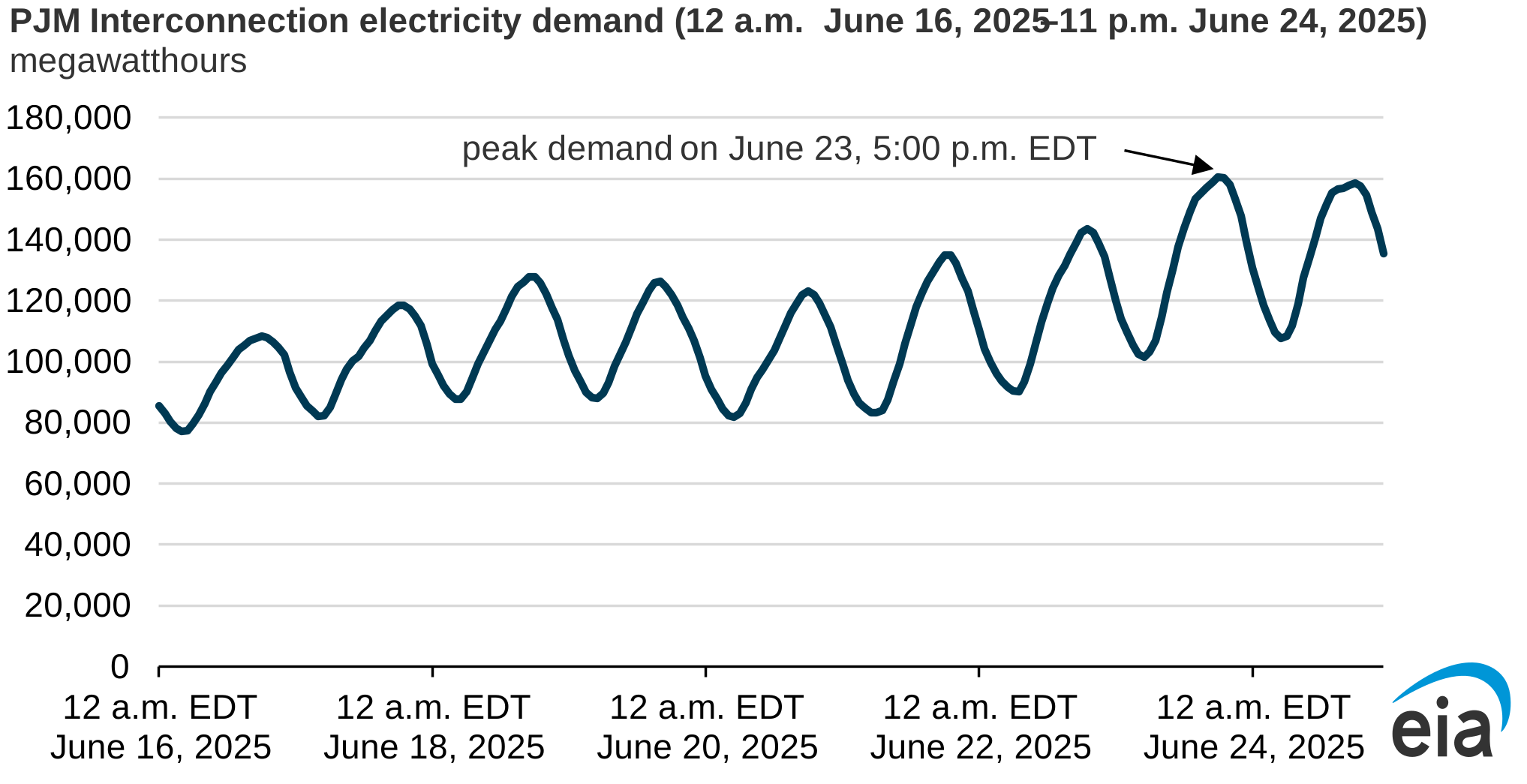
PJM interconnection electricity demand

Data source: U.S. Energy Information Administration, Hourly Electric Grid Monitor
Note: EDT=Eastern Daylight Time


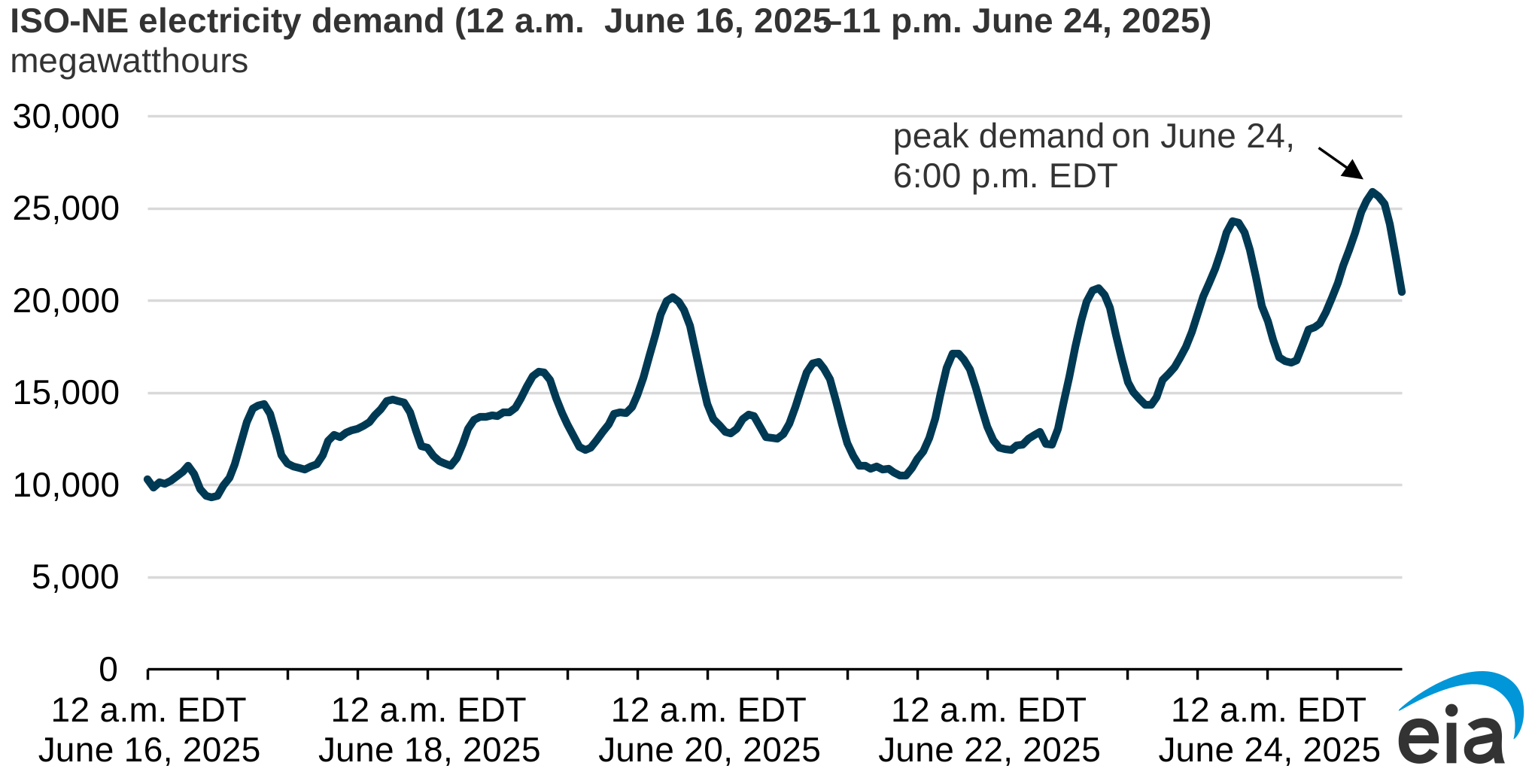
Electricity demand in the PJM Interconnection and ISO New England (two regional grid operators covering the Northeast United States) reached multiyear highs on June 23 and June 24, respectively. Electricity demand increased significantly due to a heat wave that affected most of the Eastern United States this week.

PJM Interconnection
Electricity load in the PJM Interconnection, the largest wholesale electricity market in the country, peaked at 160,560 megawatts (MW) on Monday, June 23, between 5:00 p.m. and 6:00 p.m. according to data from our Hourly Electric Grid Monitor. The load on the grid surpassed PJM’s seasonal peak load forecast of 154,000 MW but remained below the record load of 165,563 MW in 2006 (PJM has expanded numerous times, and this data point is based on PJM’s current footprint). PJM’s footprint includes 13 states and the District of Columbia.

Real-time wholesale electricity prices on June 23 peaked at $1,334 per megawatthour (MWh) at 7:00 p.m. according to PJM, compared with peak prices of $52/MWh on June 16.

At peak load on June 23, 44% of PJM’s generation came from natural gas, 20% from nuclear, 19% from coal, and 6% from solar. The remaining generation came from a mix of hydro, wind, petroleum, and other generation. Petroleum generation, which is generally the most expensive form and therefore only used to meet large demand loads, was three times greater compared with the same hour the day prior.

ISO-New England (ISO-NE)

ISO-NE electricity demand

Data source: U.S. Energy Information Administration, Hourly Electric Grid Monitor
Note: EDT=Eastern Daylight Time


As the hot weather moved eastward, demand peaked the following day in ISO-NE—the integrated grid operating in Maine, Vermont, New Hampshire, Massachusetts, Rhode Island, and Connecticut. Peak demand on Tuesday, June 24, between the hours of 6:00 p.m. and 7:00 p.m. eastern time was 25,898 MW, according to the data in our Hourly Electric Grid MonitorISO-NE reported that Tuesday’s evening peak electricity demand was the highest level seen in the region since 2013.

Real-time wholesale electricity prices on June 24 peaked at $1,110/MWh at 6:00 p.m. according to preliminary data from ISO-NE, compared with peak prices of $65/MWh the previous week on June 17.

New England’s electricity grid depended on a combination of oil-fired power plants, electricity imports from Canada, and increased natural gas power production to meet peak demand this week. At peak load on Tuesday, 47% of ISO-NE generation came from natural gas, 12% from imports, 13% from nuclear, 12% from petroleum, 1% from coal, and 4% from renewable sources including wind, batteries, and solar. The last remaining coal-fired plant in the region, the Merrimack facility in New Hampshire, supplied 280 MWh on average to the grid on Tuesday. The Merrimack facility is typically only used when demand is high.

Principal contributors: Lindsay Aramayo, Kimberly Peterson

Tags: electricityconsumption/demandweather

The PJM and ISO-NE balancing authorities cover almost all of the northeast United States, with the exception of New York.

Electric Power Markets (FERC)

While Pennsylvania, Ohio and West Virginia are fossil-fuel “friendly” states, New Jersey, Maryland, Delaware, Connecticut, Rhode Island, Massachusetts and Vermont are extremely hostile to fossil fuels. So, it’s always ironic to look at the electricity generation mix in these regions during periods of extremely hot and cold weather.

At peak load on June 23, 44% of PJM’s generation came from natural gas, 20% from nuclear, 19% from coal, and 6% from solar. The remaining generation came from a mix of hydro, wind, petroleum, and other generation. Petroleum generation, which is generally the most expensive form and therefore only used to meet large demand loads, was three times greater compared with the same hour the day prior.

At peak load on Tuesday, 47% of ISO-NE generation came from natural gas, 12% from imports, 13% from nuclear, 12% from petroleum, 1% from coal, and 4% from renewable sources including wind, batteries, and solar. The last remaining coal-fired plant in the region, the Merrimack facility in New Hampshire, supplied 280 MWh on average to the grid on Tuesday. The Merrimack facility is typically only used when demand is high.

Anyone else notice a pattern here? When demand ramps up, natural gas ramps up to meet the demand. When demand “really” ramps up, New England fires up its only coal-fired power plant and both regions fire up their petroleum-fired power plants. Neither ISO-NE not PJM ramp up renewables to meet demand.

I wonder how New York managed to deal with the heat wave…

“The answer is [NOT} blowin’ in the wind”…

Electricity

Natural gas generated twice as much electricity in New York in 2023 as any other fuel source.

In 2023, natural gas-fired power plants accounted for almost three-fifths of New York’s generating capacity and provided 46% of the state’s electricity net generation, generating twice as much electricity as any other fuel source.25,26 Natural gas fuels 6 of the state’s 10 largest power plants by capacity and 5 of the 10 largest by annual generation.27 To increase reliability, especially during the winter months when natural gas pipelines are highly congested, natural gas-fired electricity generating units with dual-fuel capability can switch fuels in the event of a natural gas supply disruption.28 In 2023, about two-thirds of the state’s natural gas-fired capacity had dual-fuel capability, allowing them to also burn petroleum products.29,30

EIA

Since New York has very little natural gas production, due to its idiotic ban on hydraulic fracturing (frac’ing), it must import almost all of that natural gas.

Natural gas

New York has few natural gas reserves, but it does have some natural gas production.100,101 The state’s first commercial natural gas well was drilled in 1821.102 Annual production reached a record high of nearly 56 billion cubic feet in 2006, but has declined almost every year since then. In 2023, New York produced 8.2 billion cubic feet of natural gas, the lowest output since 1975.103 Most of the natural gas consumed in New York is produced in other states. The largest share comes through and from Pennsylvania.104 The Marcellus Shale, named for a town in central New York where the shale is visible at the surface, is a natural gas-bearing formation that extends under parts of New York, Pennsylvania, Ohio, West Virginia, and Maryland.105 It is the largest natural gas area in the United States as ranked by estimated proved reserves.106,107 Much of the Marcellus Shale gas is produced by hydraulic fracturing, commonly called fracking, a drilling technique used to produce natural gas from low permeability shales like the Marcellus. In 2014, New York’s governor banned hydraulic fracturing, and in 2020 the state legislature made the fracking ban permanent. The legislature expanded the fracking ban in 2024 by prohibiting the use of carbon dioxide as a drilling agent to extract crude oil and natural gas from shale rock.108,109,110

EIA

New York banned frac’ing, yet derives most of its energy from natural gas… Produced from frac’ed wells in Pennsylvania… From the most prolific natural gas reservoir in the United States… A reservoir that underlies New York state and was named after a town in New York state. As Ron White said:

You not only can’t fix stupid… You can’t even prevent it from getting stupider…

Empire Wind Construction Resumes on a Deal to Allow New Gas Pipelines in New York

IER

June 9, 2025

New York Governor Kathy Hochul has been in discussions with President Trump to advance two natural gas pipelines alongside the resumption of construction on Empire Wind 1. While Hochul says there was no deal to do so, she indicated that she will approve the gas pipelines only if they meet federal and state requirements. 

[…]

Empire Wind 1 has a design capacity of 810 megawatts and is expected to begin commercial operations in 2027. Offshore wind, however, is a costly technology for generating electricity, and projects have been troubled by much higher costs than alternatives. Empire Wind sought renegotiation of its contracts, settling for a fee of $150.15 per megawatt-hour, which is about three times the price of natural gas-fired generation.

President Trump believes that natural gas prices are too high for New Yorkers and New Englanders and wants to provide relief by increasing the availability of supplies through pipeline construction. He wants to revive a canceled pipeline that would carry natural gas from Pennsylvania’s shale gas fields to New York, indicating that it could cut energy prices in the Northeast by as much as 70%. The 124-mile Constitution Pipeline project was abandoned due to legal and regulatory challenges that made it economically unfeasible.

The Constitution Pipeline was proposed in 2013 at a projected cost of under $700 million, but delays and legal challenges drove up the costs by nearly 40%. After the project received Federal Energy Regulatory Commission approval in 2014, New York regulators refused to issue water quality permits, citing concerns about danger to wetlands and stream crossings. New York and other Northeast states have special water-quality certification powers granted to them under federal law to impede planned gas projects in the region. New York State lawmakers have also passed anti-gas laws and banned fracking in the state, despite enormous natural gas resources, which are an extension of the Marcellus fields in Pennsylvania. The Constitution Pipeline project was scrapped in 2020. On May 29, however, Williams Cos. announced that it is giving the Constitution pipeline and Northeast Supply Enhancement projects another try. The two projects have investments totaling about $2 billion.

[…]

IER

Hochul might not block the construction of natural gas pipelines that could lower the cost of electricity for New Yorkers, in exchange for Equinor being allowed to resume construction of an offshore windfarm that will deliver electricity to New York City at triple the cost of natural gas-fired generation.


Discover more from Watts Up With That?

Subscribe to get the latest posts sent to your email.

via Watts Up With That?

https://ift.tt/hqZfdCP

July 2, 2025 at 04:04PM