Gases from Asthma Inhalers Cause Negligible Warming

From the CO2 Coalition

Frits Byron Soepyan

January 2025

Abstract:

Various educational and medical institutions, as well as policymakers, have expressed concerns regarding the use of metered-dose inhalers to prevent or treat shortness of breath associated with asthma and chronic obstructive pulmonary disease (COPD), as these inhalers use hydrofluorocarbons (HFCs), which are greenhouse gases, as propellants. In response, “environmentally friendly” alternatives to metered-dose inhalers have been proposed for patients with asthma.

To determine if prescribing these alternatives is necessary, we used the concentration and radiative forcing of the HFCs that are used as propellants (HFC-134a and HFC-227ea) in current inhalers to predict the temperature rise caused by the continued emissions of these HFCs into the atmosphere. Based on our estimates, the continued emissions of these HFCs would cause a combined temperature increase of about 0.0132 °C in 50 years and of about 0.0264 °C in 100 years. Such a rise in temperature is negligible and cannot be measured or felt.

Therefore, curbing the emissions of HFCs from inhalers is unnecessary and would have minimal effect on the climate. Given this conclusion, the selection of inhalers to prescribe to patients with asthma or COPD should be based on the health, safety and needs of the patients, rather than on a purported environmental benefit.

Read the entire publication here.


Discover more from Watts Up With That?

Subscribe to get the latest posts sent to your email.

via Watts Up With That?

https://ift.tt/vYSqAVP

January 17, 2025 at 01:03PM

Live at 1 p.m. Eastern Time: Trump’s Climate Cabinet – The Climate Realism Show #141

Senate committee rooms on Capitol Hill were buzzing with activity this week as many of President Trump’s picks for cabinet posts were underway. Three of the key hearings on climate and energy policy were Lee Zeldin for EPA, Doug Burgum for Interior, and Chris Wright for Energy. We hope you caught Heartland’s two three-hour long “watch parties” with gavel-to-gavel coverage this week, but there’s still more to examine. What did the hearing performances of Trump’s picks say about how they will serve in their roles? Which federal agency of the three needs the most work to change its purpose? And can these appointments succeed in carrying out Trump’s agenda in the face of a deeply entrenched federal bureaucracy that is opposed to almost all of Trump’s major climate and energy goals?

The Heartland Institute’s Anthony Watts, H. Sterling Burnett, Linnea Lueken, and Jim Lakely will dive deeper into that topic. Plus, we’ll review some of the Crazy Climate News of the Week, including a deep freeze that’s on the way for most of the continental United States.

Join us LIVE at 1 p.m. ET and join the chat to engage in the show with other fans.

This show will be archived in WUWT Climate TV, a collection of over six hundred videos, featuring new interviews and analysis, and covering dozens of media sources discussing, debating and analyzing the latest in climate science, climate politics, and energy policy, including topics concerning temperature, sea level, polar bears, ocean acidification, extreme weather, censorship, wild fires, and more.


Discover more from Watts Up With That?

Subscribe to get the latest posts sent to your email.

via Watts Up With That?

https://ift.tt/XE4MxJQ

January 17, 2025 at 11:37AM

NESO Must Come Clean

By Paul Homewood


Kathryn Porter has the latest on the near blackouts last week:

 image

The National Energy System Operator (“NESO”) has been stung by my analysis of the blackouts near miss on 8 January, at one point apparently telling journalists, somewhat pompously that “WE are the National Energy System Operator, and SHE is “just” an independent consultant!” In this blog I will carry out further analysis of what happened on 8 January and what NESO has said about it at different times, and highlight the system operator’s disappointing lack of transparency.

https://watt-logic.com/2025/01/17/nesos-approach-to-transparency/ 


As Kathryn explains. NESO, after trying to stonewall, produced a short note claiming that they really had 3.7 GW of “headroom”, without actually giving any detail or proof, a claim Kathryn goes on to demolish.

After doing a detailed bottom up analysis of every single generator, Kathryn proved that her initial top down analysis was essentially correct, that we really were down to 0.6 GW of spare capacity.

As Kathryn concludes:

 Both my bottom up and top down analyses have yielded essentially the same result – about 500 MW of margin at the peak on 8 January. On top of this there was about 700 MW of reserve. This means that the single largest infeed loss of 1,400 MW could not have been covered. The 3.7 GW “headroom” appears to be a complete fiction, which could only be met by units that are not BMUs as these are the ones I considered (other than some STOR units). However, NESO could clear this up very easily by simply publishing the list of units providing margin and reserve at the 8 January peak, including volumes.


David Rose at UnHerd has also written an article about Kathryn’s findings. He makes this interesting observation:

The UK power market, she concludes, came “close to disaster” on Wednesday. Neso told me the following day it disputed her findings, claiming it had merely “used our standard operational tools to manage the electricity network and ensure that we maintained enough electricity,” and that its margin had at all times been greater than 580MW. However, in the course of a dialogue that lasted for the following 24 hours, I asked its spokesperson to tell me why he thought her analysis was wrong, and what would have been the source of the additional electricity. He simply refused to answer.

https://unherd.com/newsroom/uks-blackout-near-miss-shows-danger-of-net-zero/


Such a refusal from a public body is unacceptable. If NESO’s figures are correct, they should be able to prove it very easily, by providing a list making up their 3.7 GW.

NESO are of course the government owned body tasked with ensuring that Britain has the essential energy it needs by ensuring supply meets demand every second of every day. However, as their own website makes clear, their real purpose is to deliver decarbonisation. As such, they are a hopelessly conflicted organisation, as the twin objectives may often be incompatible.

Clearly NESO cannot be trusted to provide reliable information, as we have already seen in their craven report on decarbonising the electricity system by 2030, sent to Miliband in November.

Under their watch, we are heading ever closer to catastrophic blackouts. They must now publish the data which supports their claim of 3.7 GW reserves if they are to retain any credibility.

via NOT A LOT OF PEOPLE KNOW THAT

https://ift.tt/IBtJuZ8

January 17, 2025 at 11:29AM

Canada’s Choice: Elite Globalist or Common Sense Canadian

Trump will soon fill a 4-year WH vacancy known as the “Biden/Harris Administration.” Meanwhile federal governance in Ottawa is shut down by Trudeau resigning without leaving but also suspending parliament.  There being no one at the helm is eerily similar to the US adrift, and a fitting close to the Trudeau decade. Jamie Sarkonak goes to the core of the upcoming election in his National Post article It doesn’t matter to Mark Carney if Canada survives.  Excerpts in italics with my bolds and added images

As a member of the global elite, he will always be free
from the consequences of his political actions.

The problem Mark Carney, likely Liberal leader-to-be, will always run into is this: his fate doesn’t depend on a successful Canada.

Carney announced his leadership run Thursday. Odds are good he’s going to win. He’s not as recognizable as his only real competition, potential candidate and former finance minister Chrystia Freeland, but he doesn’t share her bruised record of inflating the deficit to multi-billion dollar highs, and last week’s polling shows that more people are open to voting for him than for her.

I hope he wins the party’s support. The Liberals aren’t likely to resonate with the population by running an out-of-touch cabinet minister in the next federal election — and they’re certainly less likely to do so by running an out-of-touch global elite who left small-time federal politics behind for a career at the pinnacle of international poshdom.

Yes, Carney is Canadian. But he’s also a citizen of Ireland,
and through it the European Union,
as well as a national of the United Kingdom.

He can leave this country any time he wants, and he already has: after serving as governor of the Bank of Canada from 2008 to 2013, he moved on to head the Bank of England. Now, he’s embedded in the international ecosystem as a climate finance adviser at the United Nations (among other things, he’s a strong advocate for mandatory climate disclosures by banks).

Oh, and according to his World Economic Forum bio — another mark of borderless eliteness — he is also the following: “an external member of the Board of Stripe, a member of the Global Advisory Board of PIMCO, Harvard University, Rideau Hall Foundation, Bilderberg, the boards of Bloomberg Philanthropies, the Peterson Institute for International Economics, the Hoffman Institute for Global Business and Society at INSEAD, Cultivo, as well as Senior Counsellor of the MacroAdvisory Partners, Advisor of the Watershed, and Chair of Chatham House, the Group of Thirty and also Advisory Board Chair for Canada 2020.”  Us rubes have no idea what most of that even means.

Carney might call himself an “outsider,” and it’ll be true — in the sense that he is not currently in the Trudeau government’s cabinet. But he’s still very much an elite, one who has advised the Liberal party, and one whose well-being doesn’t depend on local happiness and prosperity.

And everyone filling out a ballot next election will know it.

Different people have different terms for this. Freeland wrote a book on the new richesse mondiale, calling them plutocrats. Circa 2013, she was warning the rest of us that the global plutocracy might one day end up turning into a system of crony capitalist “insiders”; perhaps an aristocracy. Carney’s not Bill-Gates rich, but he’s still part of the global upper class.
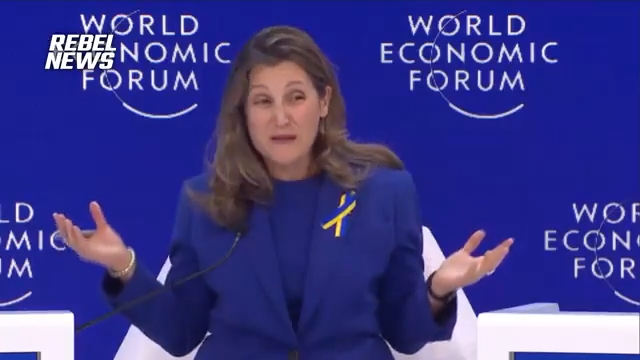
Chrystia Freeland is also a Trustee on the WEF Board.

Former prime minister Stephen Harper put it in more digestible terms in his 2018 book, “Right Here, Right Now”: there are people who live “anywhere,” and there are people who live “somewhere.” “Anywheres” are cosmopolitan types who usually have professional, internationally oriented careers. “Somewheres” live and work closer to where they grew up, and share more of their values with people of a similar, localized background. The former tends to look down on nationalism; the latter depends on it.
Carney counts among the “anywheres” of Canadian society; yes, he’s got the passport, but he’s got more in common with a foreign banking executive who makes an annual Davos pilgrimage than he does with regular Superstore-shopping Canadians.

We “somewheres,” on the other hand, can’t just up and leave
in the face of turmoil because our entire life is here.

Our friends and families are here. Our savings and investments (if we have them) are in CAD; our partly-paid mortgages are tied to Canadian land; our children’s education depends on the quality of Canadian schools; our safety depends on Canadian laws; our job prospects suffer when low-wage foreign labour is allowed to flood our local markets. We’re not being forced to leave, but the price of relocating is prohibitively high.
Carney’s Monday appearance on Jon Stewart’s Daily Show was revealing in that way: he targeted his pre-audition pitch to the world through an American late-night show that treated him with the same humorous fascination as it would a fuzzy exotic animal. It was a soft and unserious interview because the people our former central banker is campaigning toward aren’t Canadian and aren’t witnessing the country’s dire situation firsthand.

Poilievre’s appearances on Dr. Jordan Peterson’s American-produced podcast were of a whole different category; both men are Canadian and can talk about Canadian issues with the weight and care they deserve.

None of this is to say that the upper crust of society should stay out of politics — many great leaders come from the elite class, including on the conservative side of politics. But after years of regular Canadians being the low-priority afterthought of a trust-fund supported, second-generation prime minister who seemed happiest at G7 photoshoots and Gavin-Newsom meetups, the animal spirits are hungering for a leader who truly has skin in the game.

And yes, I’d count Conservative Leader Pierre Poilievre among the “somewheres.” He’s had an entirely Canadian career, he isn’t gunning for CV-padding UN advisory roles, his ongoing career doesn’t depend on pleasing the moral sensibilities of the world’s politically active, post-national liberals, and he doesn’t seem to think that pre-election media courting should be performed for an international audience.

If the ship that is Canada starts sinking — and it’s been sitting alarmingly low in recent years — most of us are going down with it. Not Carney, who has and always will have a premium life raft, ready to isolate him from the consequences of his political actions. Which is exactly why I can’t wait to see him run.

via Science Matters

https://ift.tt/7zaekCX

January 17, 2025 at 09:09AM