The article explains why there are water shortages in LA, and how poor forest management is the real reason for the severity of the wildfires, not climate change.
Before he has even taken up office there has been a sea change in the banking world regarding net zero. This looks like something that will make a big difference. I wonder how long it will be before the UK Labour government has to also change course?
Ed. Note: With yesterday’s background, Part II examines the politization of one of Alaska’s major hydroelectric projects to reveal ulterior motives from “stakeholders” and elected officials.
“Once an RPS becomes law, the boards will be able to point to the new law in effect requiring them to adopt unreliable and expensive sources and be held harmless once things start to spiral out of control, up to and including rolling brownouts and blackouts.”
“Pumped energy storage is only necessary as a mitigating backup to the planned 100% unreliable not-so renewables. The Renewable Portfolio Standard will mandate a government-subsidized solar, wind and transmission build-out by grifters and profiteers. Wind and solar power producers should be made to pay for all infrastructure that makes them as reliable as a gas turbine.”
For environmental groups and their political carriers, the question is how to expand wind and solar power in the state, that very resources that are dilute, intermittent, fragile, expensive, and taxpayer dependent. Here is where the proposals, deceit, and back-door blackmail come in.
Pumped/Energy Storage
Per US Department of Energy: Pumped storage hydropower (PSH) is a type of hydroelectric energy storage. It is a configuration of two water reservoirs at different elevations that can generate power as water moves down from one to the other (discharge), passing through a turbine. The system also requires power as it pumps water back into the upper reservoir (recharge). PSH acts similarly to a giant battery because it can store power and then release it when needed.
On February 3, 2020, a report by Alaska Institute for Climate and Energy (ALICE) titled “Pumped Energy Storage for Alaska – A path to lower energy costs for Alaska’s new energy future,” was published. The idea is to build on to the existing Eklutna Hydropower infrastructure, pumping water uphill for a conversion to stored energy. With water flowing back down hill, it works as a regulator of sorts for unreliable sources of power. It is a closed-loop concept involving five reservoirs and new phased-in wind sites for $4.7B. This project requires massive excavation, adding more dams and tunnels – all to address the problem of wind/solar intermittency.
The executive summary paints the picture that Railbelt energy is expensive because it is generated from expensive fuel. Since fuel for the Railbelt is coming from Cook Inlet as a single source, the authors suggest ratepayers are left “vulnerable to swings in price or supply,” and the prices may “increase further due to taxes and regulations aimed at emissions reductions”.
From what appears to be justification for their proposal, they reference Alaska’s non-binding goal of generating 50 percent of electricity from renewable sources by 2025 and state, “currently, the Railbelt generates only 15 percent of its power from renewable sources.” To meet the stated non-binding renewable goal, the report compares the idea of the pumped storage hydro and wind combination to Susitna-Watana Hydro.
According to the authors, the pumped storage and wind combination solution win. As this land is located in the Chugach State Park, the report offers the “careful design and construction of an aerial tram system instead of roads” to build and maintain the reservoirs, while also providing “low-impact access to the high country above Eklutna Lake.” The time and costs to permit such a project are so staggering they could not be included.
False Claims
In a April 2020 letter to the coordinator of the Eklutna Fish and Wildlife Plan ALICE provided written comment early on in the process to the Initial Information Package (IIP), showcasing their idea of pumped storage, wherein they state they have been working on the Eklutna Pumped Energy Storage concept for several years and that in January 2020, “Governor Dunleavy became interested in the idea and requested more information.”
Egregious claims in the ALICE report include that wind is the cheapest solution. It states that proposed and existing wind sites would provide a capacity factor of 48-60%. The report states fallaciously that Fire Island wind is at a capacity factor of 48%. Chugach Electric actually notes the annual capacity factor for CIRI Fire Island wind is 32%. As stated previously, Fire Island has demonstrated to be much lower than 32% when Alaskans have needed it most.
To justify cost, the authors use Lazard’s Levelized Cost of Energy (LCOE) to state that new wind projects are less expensive than new gas plants. The problem is LCOE doesn’t account for the cost of necessary redundancies for non-firm renewable generation, such as the pumped storage itself for $1.5B that is required for wind, and we don’t need new gas plants.
The authors of the report believe that 100% of the Railbelt energy can be provided by the PES wind combo for a price tag of $4.7B. The project would require massive and wasteful public financing, and the idea has piqued the interest of other investors, which was brought to light when Governor Dunleavy wrote Berkshire Hathaway in May of 2020 expressing his interest in “Transitioning Alaska.” Additionally, the report mentions that Independent Power Producers (IPPs) “(including Alaska Native corporations) are well placed to build and profit from the wind farms.”
In a November 2020 comment on the October 2020 draft study plan, NVE provides a glimpse into their vision for Eklutna, stating “The Eklutna pumped hydro storage battery would solve the problem of excessive costs to power companies from releasing large flows into the river, while allowing for full restoration of river flows, lake access, and stabilization of lake levels for salmon habitat.” And “Government should supplement responsible restoration of the Eklutna River ecosystem, along with private enterprise that could profit from pumped hydro development.”
The October 2023 draft Fish and Wildlife plan referenced other entities conducting studies in the Eklutna basin, two of them include references to pumped hydro:
State-wide Pumped Hydro Study conducted by AEA
Pumped hydro system flow analysis and animation conducted by ALICE in coordination with NVE.
Narrative Shift
Resolutions from the Anchorage Assembly calling for the restoration of the full river date back to 2017. The 2024 Legislative Program, presented by the Anchorage Assembly and Mayor Dave Bronson, listed supporting full restoration of the Eklutna River as a statutory and policy request. This legislative program was approved by the Anchorage Assembly on December 5, 2023.
That same day, the Anchorage assembly read AO 2023-131 into the record – the creation of a new section of the electric service code establishing that it was official policy of the Municipality of Anchorage, in part to “restore the continuous water flow of the Eklutna River and the fish populations of the River and Eklutna Lake, to the greatest extent possible, subject to all provisions of the 1991 Fish & Wildlife Agreement.”
In February of 2024, the Anchorage Assembly approved Resolution 2024-40. As a body through resolution, they submitted public comment on the Draft Fish and Wildlife Program, reiterating their support of restoring the Eklutna River since 2017. In the resolution, the Assembly touted their “creation of a specific law” regarding restoration of the river in 2023, they raise doubts about whether the proposed $57M solution by the Project Owners will work. The Assembly goes on to admonish the Project Owners for their refusal to consider the removal of the dam as an alternative. The resolution closes by stating they oppose the Draft Fish and Wildlife Program and request a two-year extension of the 1991 Agreement.
In the months leading up to the October 2024 final decision date of the Fish and Wildlife Program, expansion of the scope of fish and wildlife mitigation became apparent.
Although the Municipality was no longer a voting member of the project, they were desperate to demonstrate technical expertise to the RCA to get their voting rights back for greater input on the Fish and Wildlife Program. On July 3, 2024, per press release Mark Corsentino, P.E. was confirmed by the Anchorage Assembly to be Anchorage’s Hydropower Utility Director. According to the assembly, this was a “critical step in reclaiming the Municipality’s voting seat on the Eklutna Hydroelectric Project owners group.”
Much of this appointment to do with attempting leverage over the 1991 Fish and Wildlife Agreement, there was a shift to another topic with Chris Constant stating “Not only does this give the Municipality more oversight and input on the Eklutna Hydropower project, it also provides exciting opportunities for the Municipality to pursue new forms of renewable energy in response to the Cook Inlet gas shortage.”
The Latest
On August 23, 2024, new Anchorage Municipality Hydropower Utility Director, Mark Corsentino gave a presentation on a modified pumped energy storage concept with wind & solar. The proposal scaled back the proposal originally offered in 2020 by ALICE with Anchorage Hydropower stating that the original concept “didn’t appear to offer additional water or provide downstream river flows.”
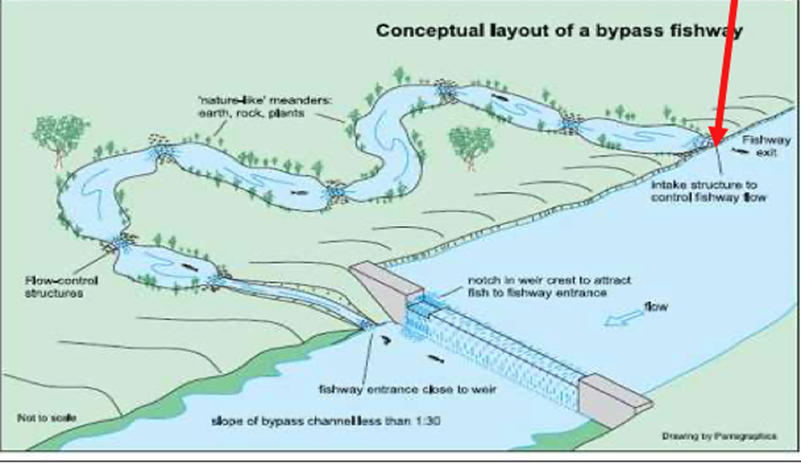
Devoid of cost estimates, the Muni proposal offered an opened loop concept with 1 reservoir, new wind and solar that claimed to provide “Full instream river flows, fish passage and lake connectivity.” It included an idea to construct an entire river for fish to get up and around the dam to the lake.
On September 3, 2024, in preparation for a meeting with Governor Dunleavy on September 9, the Anchorage Assembly passed a resolution approving a legal brief addressed to Governor Dunleavy’s office. At this point the assembly is fully selling the idea of pumped storage where they admonish the project owners for excluding it as an alternative by stating:
The Minority Owners mistakenly overlooked the pumped storage hydropower alternative without realizing that using existing infrastructure would sharply limit costs.
And
Pumped storage hydro is widely used in the U.S. and eligible for federal funding. It could re-water all 12 miles of the Eklutna River, reconnect the River to the Lake, create the conditions for the return of sockeye salmon to the Lake, and provide improved fishing and recreation for all Alaskans in a crown jewel of the Chugach State Park—all while also increasing useful power production by providing what would essentially be an enormous battery to save variable wind-and-solar power for later usage any time of the day or year, regardless of whether the wind is blowing or the sun is shining at any given moment.
On September 5, 2024, a joint resolution by the Assembly and NVE “In support of exploration of alternative solutions to attain our shared policy goals for full restoration of the Eklutna River” was signed. This joint resolution “urge Governor Dunleavy to establish a Final fish and Wildlife Program that requires the owners to use two years of the three year pre-implementation period to explore alternative infrastructure options, including pumped storage hydropower”
On September 9, an output of the meeting with the governor’s staff provided revealing answers in response to the idea of pumped storage from project owners MEA and Chugach. Regarding the $4.7B ALICE concept, the owners reiterate that this venture is out of the scope of the 1991 Agreement, which was to “mitigate the effects of the existing project, not build a new project, which would likely be FERC regulated.”
In response to the modified pumped energy storage concept proffered by the Anchorage Municipality, the Project Owners state that the plan appeared to be infeasible. The Project Owners list a myriad of incorrect and costly assumptions Anchorage Hydropower made in their proposal, including the idea to build a massive new river (40-50’ deep by a few hundred feet wide) effectively proving the idea to be DOA in their quest for it to become a viable option in the final fish and wildlife plan.
Massive amounts of energy and water would be required to simultaneously provide water to two rivers, fill the lake, serve as the battery to regulate unstable sources of energy and supply water to 90 percent of Anchorage residents who rely on it. In the end, the Final Approved Program, approved by Governor Dunleavy on October 2, 2024, included the request by the Municipality of Anchorage and NVE to study “Pumped Storage Hydro.” The low-end 35-year cost presented in the final plan to restore 11 out of 12 miles of the river came in at $58.2M, with the high end at a potential of $72.2M for a maximum owner commitment of $10M for a fixed wheel gate to replace the overfill spillway if determined to be required in the future. The Chugach rate impact is estimated to be anywhere from 0.78-1.15 percent.
What is Going On?
It is now known that “restoring the river” did not include plans to remove the dam. As the experts tell us, this was never about the fish. What, then, is the real goal of the activists?
The Alaska State Legislature has been turned over to the Democrats. With the Red Wave sweep across the nation at a federal level, the Alaska Democrats, seeking to line the pockets of cronies and ENGOs through the Inflation Reduction Act, will be looking for any and all opportunities to codify mandates to snuff out their free-market competitors, particularly in the energy realm.
To this end, Renewable Portfolio Standard (RPS) is imminent. Given these conditions, if introduced for a third time, it has a high likelihood of passing. RPS mandates that utilities adopt increasing percentages of renewable sources.
There are multiple nefarious reasons why an RPS is sought. Utilities have adopted decarbonization goals. Chugach Electric’s 2022 Strategic Plan includes “a goal of reducing Chugach’s carbon intensity, from a 2012 baseline year, by at least 35% by 2030, and by at least 50% by 2040, provided there is not a negative material impact to electric rates or reliability.” The RPS is important because co-ops cannot achieve the decarbonization goals without adding liability and cost.
Once an RPS becomes law, the boards will be able to point to the new law in effect requiring them to adopt unreliable and expensive sources, and it also allows them to be held harmless once things start to spiral out of control, up to and including rolling brownouts and blackouts. There is no doubt that it will come at great cost (mandates always do) with no known effect to the underlying goal – and that is to stop the planet from warming.
Chugach took ratepayers down the first step to energy serfdom when they signaled support for the RPS in January of 2024 when they approved the resolution with the stipulation that the legislation “provide waivers for non-compliance due to reasons beyond the reasonable control of the utility.” The last proposed RPS in 2023 called for 25% renewable by 2027, 55% by 2035 and 80% by 2040. The Railbelt is at 15% renewable.
There is a greater interest in pumped energy storage in Alaska at the federal level, in an U.S. Department of Energy report dated July of 2023, “The Prospects for Pumped Storage Hydropower in Alaska.” The experts listed on the Advisory Group for the project include Ceal Smith of ALICE, and Brian Murkowski, Senator Lisa Murkowski’s brother. The key summary finding is the state’s “potential for more than 1,800 closed loop PSH systems in Alaska, with a total energy storage capacity of about 4TWh.”
The Railbelt System Analysis provides a scenario where RPS has been adopted “The RPS scenario shows a rapid increase in PV and wind investments.” The study shows age-based retirements of primarily natural gas provided assets in the Anchorage area in 2028 with battery, PSH, solar and wind outpacing natural gas by 2037.
Pumped energy storage can be considered as an insurance policy to sell reliability and “green” to the public. Stand-alone wind and solar have already shown their true colors in Alaska. Pumped energy storage is only necessary as a mitigating backup to the planned 100% unreliable not-so renewables. The RPS will force by mandate the government subsidized solar, wind and transmission build out provided by grifters and profiteers, the pumped energy storage is supposed to make up for the unreliable power we get in return. Wind and solar power producers should be made to pay for all infrastructure that makes them as reliable as a gas turbine, with consumers footing the bill many times over. What would the tariffs be for independent power producers if had to pay for their own grid upgrades and pumped storage unit? The only way renewables are going to exist in this state is if they are mandated by way of the Renewable Portfolio Standard.
RCA against RPS
In early 2024, Chugach Electric took public testimony before the vote on the resolution supporting an RPS. Of note was the board’s complete disregard for the fact that two of the testifiers referenced. There was a unanimous decision by the Regulatory Commission of Alaska (RCA) on December 13, 2023, to oppose RPS legislation. Pointing to Germany’s demise, RCA Commissioner Robert Pickett stated:
We’ve heard about the German miracle for, I would say, at this Commission, for six or seven years at least, that it’s a shining example, points in time where the penetration of renewables has been 70 percent, 80 percent, but if you look at what’s happened in the last couple of years, it is clear it is not an economic miracle. In fact, it has devastated German industry and the German government itself is forced to pour in massive amounts of subsidy and Germany has some of the – if not the highest rates per kilowatt in Europe, it’s right at the very top and it’s getting worse, and reliability issues are associated with that.
Commissioner Pickett went on:
And so, I guess what has sort of shaped my thinking, when I look at the bill, and there’s some very aggressive, by admission of the bill sponsors for SB 101 and HB 121, that today, they’re estimating about 15 percent of the supply is renewable. And they’re proposing by 2027 to get that up to 25 percent and here we are almost 2024 and so, how does that work? It takes 50 years to get to 15 percent and you’re going to increase that by, you know, 65, 67 percent in the next three years? It doesn’t make any sense and that’s even if the external environment was more stable. I mean, our financial system is sort of on the cusp right now with 35 trillion dollars worth of debt and a massive wall of federal debt coming back to the market in the next two years and the interest rates, compared to what they were a year ago, are astronomically higher and all the project sponsors are going to be confronted with that.
It is with much fecklessness and hubris that the six CEA board members ignored the RCA’s ruling.
Stopping the RPS
We will know with a high degree of certainty what direction Alaska will be going in if the RPS is passed. With calls for the Trump Administration to work towards a full repeal of the Inflation Reduction Act, the subsidies that prop up the green ventures may dry up. This will cause an epic collapse to all the mini-Enron’s of the world who selfishly put their chips all in on the wrong bet for consumers.
This is a huge risk to the green lobby and if successful, will result in exponential costs to ratepayers whose fate now relies on lawmakers to make economical and environmentally sound decisions.
It is not too late to start the preemptive messaging to your representatives that an RPS is too risky for Alaskans. As the saying goes “follow the money.” As outlined herein, it’s not about the fish, it’s not about the environment, and there is no limit to the lengths that special interests will go for the sake of a payout. Alaska is on multiple parallels to wastage; we need to ditch the “all of the above” mentality and move forward with only sensible solutions.
—————
This concludes a two-part series. Part I was yesterday.
Guest Essay by Kip Hansen — 10 January 2025 — 1400 words/5 minutes
What are Ultraprocessed Foods? The UPF literature gives long and confused definitions, but in almost every case, falls back on the definition provided by Carlos A. Monteiro (and his colleagues Inês Castro, Renata Bertazzi-Levy, Rafael Claro and Geoffrey Cannon) in his original work in 2009 on the subject titled: “Nutrition and health. The issue is not food, nor nutrients, so muchas processing”.
[Note: The use of the word “muchas” is in the original, Monteiro is Brazilian.]
That definition has not changed in all these years since, but the actual lists used by researchers in all of studies ‘measuring exposure to UPFs’ in Food Frequency Questionnaires (FFQs) and 24-hour dietary recalls (24HR) has changed over time – adding another layer of uncertainty to the results of the studies when pooled. Not all studies used the same FFQ and not all decisions as to which items in FFQs/24hr Recalls were to be considered UPFs for each study. Lane et al. 2023 [ .pdf ] includes this:
“SACN [UK’s Scientific Advisory Committee on Nutrition] expressed concerns about various key points. For example, it highlighted that the available studies applying the Nova system are primarily epidemiological in nature and may lack adequate consideration of confounding factors or covariates. Criticisms of Nova as a classification system also exist, with concerns raised about its possible imprecision and inconsistency among evaluators. In contrast, more recent assessments show acceptable construct validity and strong agreement among coders, with the definitions and examples provided by the Nova system deemed adequate in classifying more than 70% of the food items reported in food frequency questionnaires from various cohorts from the US, as well as more than 90% of the food items reported in 24 hour dietary recalls from participants in a national Brazilian dietary survey.”
Then there is one of the more popular short-form definitions, offered by Dr Chris Van Tulleken, an infectious diseases doctor at University College London, a BBC science presenter and a New York Times bestselling author who, gave this simple one-sentence: “If it’s wrapped in plastic and it contains at least one ingredient that you don’t typically find in a domestic kitchen, then it’s ultra-processed food.””
The Supplemental information of Monteiro et al. 2019 labels its chart of NOVA food groups:
“NOVA food groups: definition according to the extent and purpose of food processing”
We see the anti-corporate mantra appearing in the definitions of UPFs, even in the original from Monteiro et al. (2019):
“Their convenience (imperishable, ready-to-consume), hyper-palatability, branding and ownership by transnational corporations, and aggressive marketing give ultra-processed foods enormous market advantages over all other NOVA food groups. Marketing strategies used worldwide include vivid packaging, health claims, special deals with retailers to secure prime shelf space, establishment of franchised catering outlets, and campaigns using social, electronic, broadcast and print media, including to children and in schools, often with vast budgets.”
You may rightly ask yourself, how does the ownership of the manufacturer of a food cause heart disease? or diabetes? or all-cause-mortality? How does the “extent and purposes” of the processes used to manufacture the food cause those things? Neither food company ownership or processing purposes are physical components of the food consumed.
You would not be the only one asking. Opinion in the nutrition field is growing in both directions: support for anti-UPFs ideas has grown to include all the liberal journals and organizations, including the UN World Health Organization and various national health organization, as they flock to the band-wagon for research funds and publication credits. At the same time, individual nutrition experts are beginning to speak out against the anti-UPF movement particularly its use all-inclusive definitions and the potential to nutritionally worsen, instead of improve, human diets.
Levine and Ubbink (2023) , from the Department of Food Science and Nutrition, University of Minnesota, says this:
“The world’s daily food supply is and will remain critically and increasingly dependent on the processing of foods and ingredients. With future population growth, climate change and the need for agricultural practices to become more sustainable, continued innovation in food processing is essential to guarantee a sustainable, healthy, and abundant food supply.”
“While many types of processing can have negative effects, food processing does not need to result in only unhealthy foods, but rather constitutes a critical and essential component of our food system. Ensuring public trust in food processing technology is undermined by the categorization of ultra‐processed foods without more nuanced understanding of the factors that determine the nutritional value (positive or negative) of these foods.”
Classifying foods according to their assumed ‘purpose’, including their design to be, for example, ‘highly profitable’, ‘intensely appealing’ or ‘convenient’ is subjective and has been suggested to reflect an ideological bias against modern food production systems (Forde, 2023b [.pdf]; Visioli et al., 2022 [.pdf]). There is no evidence that foods which are unprofitable, unpalatable, expensive or inconvenient are linked to better health outcomes (Forde, 2023b [.pdf])
Classifications are too broad and inclusive and not based on scientific evidence
The classifications are diverse, based on the extent and nature of change in a food from its original form, including changing inherent properties of foods, the addition of ingredients, as well as considering the place of processing, and the purpose of processing. There is no agreement as to what constitutes a processed food or different degrees of processing, including to what extent they should only reflect technical processes and/or include formulation/ingredients. From a food science and technology perspective, without evidence for a correlation between the extent of processing and a products nutritional value, these aspects should remain distinct. Furthermore, the classifications seem to assume that most food processing is deleterious for health, and are hypothesis driven rather than derived from strong scientific evidence i.e. studies using NOVA to support claims made by the NOVA classification itself may represent a circular argument (Sadler et al., 2021).
Without scientific evidence for adverse effects of specific ingredients or processing methods, the ultra-processed category may be too broad and inclusive – covering a high proportion of energy sources (up to 60% in some developed countries) and approximately ten to twelve different food groups with a wide and diverse nutrient composition (Forde, 2023a [.pdf], 2023b [.pdf]).”
The FoodDrinkEurope review [remember, it was produced by a food industry advocacy group] may be biased against the anti-UPF movement, but it does include a extensive list of the literature on the subject through early 2024, and its summaries of the papers listed seem to be straightforward. In any case, it represents a good summary of the criticisms of the NOVA system of classification of foods from the professional nutrition field.
The best actual answer to the question:
“What are Ultraprocessed Foods, exactly?”
seems to be:
“Almost everything on the shelves, in the aisles, of your grocery storeand in the cupboards and refrigerators of your home.”
Such an answer leaves us to ask “If not UPFs, what are people to eat?”
# # # # #
Author’s Comment:
This is yet another ongoing Modern Scientific Controversey (MSC). That means that scientists and experts are taking sides, for and against, and battling it out in the media and in the journals. In these controversies, these “Wars”, the usual niceties are often forgotten and papers are written to bash the “other side”, editorials are written in which insinuations of scientific impropriety are allowed to be spoken. And, as we have seen in other MSCs, views are hardened and papers become more and more biased towards whatever view attracts more research funds and buys more publication credits. Currently, journals favor “UPFs are bad”, which has become a Popular Health Fad, but, at the same time, nutrition experts willing to take a contrary view are making some headway in the journals and are being given some preferential space in the mass media as the contrarian view.
The next part of this series will cover a more in-depth view of what is up with the science, as opposed to food-world politics, of the UPF issue.
Thanks for reading.
# # # # #
Discover more from Watts Up With That?
Subscribe to get the latest posts sent to your email.