Have a look at the costs, due to the unreliable nature of renewable energy. We used to power ships with wind, and there was a reason why we stopped in favour of diesel engines. A lesson for the government.
“An increase in low cloud cover of only about 1% could largely compensate for the doubling of CO2.” – Wijngaarden & Happer, 2025
Ph.D physicists detail just how insignificant CO2 is as a factor in climate change, revealing that doubling the CO2 concentration from 400 ppm to 800 ppm – a 100% increase – hypothetically reduces radiative heat loss to space by just 1%.
Since CO2 has only risen by 50% since 1750 (280 ppm to 420 ppm), CO2’s total greenhouse effect influence in reducing outgoing radiation has thus far been in the range of tenths of a percentage point. A less than 1% change in outgoing radiation over hundreds of years is not even detectable amid the noise of outgoing radiation measurement. Observation error in measuring Earth’s outgoing radiation is 33 W/m², for example.
Furthermore, this negligible CO2 greenhouse effect impact is only a calculated value for an atmosphere that is perpetually cloud-free. As clouds are present 60-70% of the time, this clear-sky-only condition only occurs in an imaginary world – an atmosphere that doesn’t exist.
In contrast to CO2’s role within the greenhouse effect, the greenhouse effect of clouds is tens of times more influential. As Drs. Wijngaarden and Happer point out in their conclusion, all that is needed to offset or wipe out the impact of doubling CO2 is a mere 1% change in cloud cover.
Since cloud cover changes of well more than 1% occur routinely, both from year-to-year and decadally, the role of CO2 within the greenhouse effect is rendered insignificant, if not irrelevant.
Ed. note: Alaskans are waking up to a sneak attack on electric affordability and reliability by agenda-driven special interests and their pliable politicians. The latest concerns the state’s third largest hydro project that has become a Trojan Horse for Green New Deal programs. “Cronyism, abuse and manipulation of our critical energy infrastructure is the result of ‘stakeholder inclusion’,” as energy expert Kassie Andrews writes in this two-part post.
At 40 MW capacity, the Eklutna Hydro Dam Project generates 5–6 percent of the total electricity for the Railbelt. Eklutna provides the most significant share of renewable energy, 44 percent of Matanuska Electric Association (MEA)’s renewable portfolio and 25 percent of Anchorage area-service-provider Chugach’s renewable portfolio.
With capital depreciation and small operating costs, Eklutna is the lowest-cost electricity source for Southcentral Alaska. Assuming carbon dioxide is of concern, this project offsets approximately 72,500 metric tons of CO2 annually, equivalent to 16,911 gasoline powered passenger vehicles driven for one year, equating to roughly half of daily commuters on the Glenn Highway.
Chugach’s effective share of Eklutna is 64.3 percent, up to 25.7 megawatts. Allowing for storage of spring and summer runoff, Eklutna Hydro acts as a pseudo storage battery for power generation and provides on demand firm spinning reserve capacity. Natural economics, no special government subsidy required.
This was demonstrated in the early 2024 cold snap. During the seven-day coldest duration (January 28–February 3, Anchorage Airport reading), the average capacity factor of Eklutna was 77 percent. Compare this to 17.6 MW Fire Island Wind at an average capacity factor of 20 percent, with 0% on February 1, 2024. For Alaskans, wind and solar is 100% unreliable, when we need it most.
New Hydro Politics
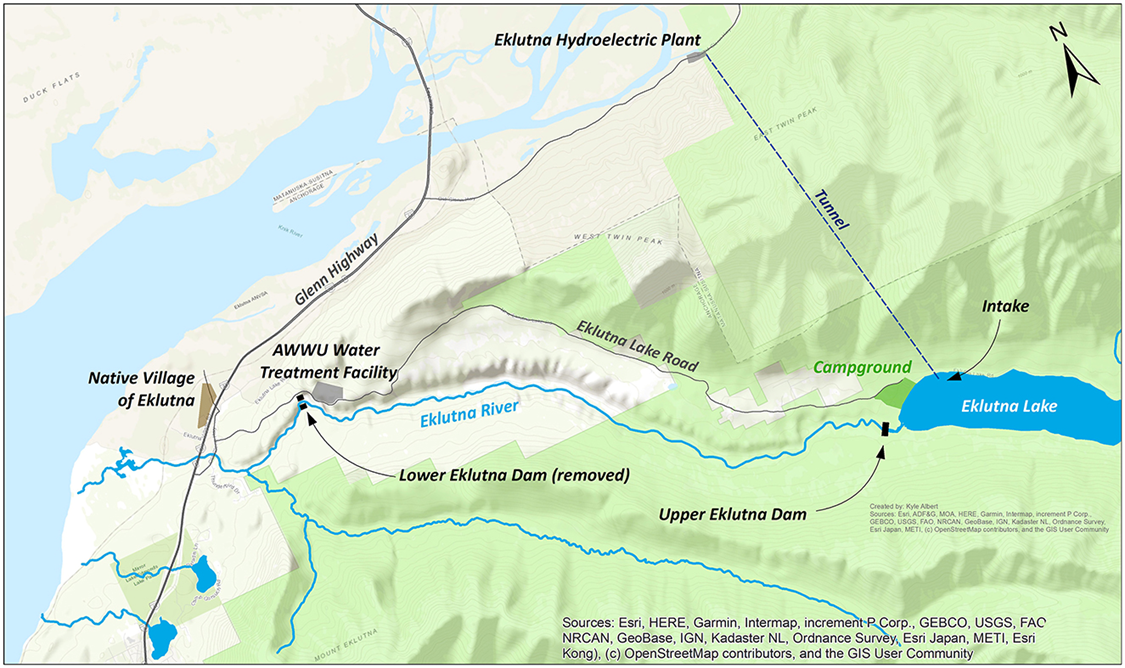
The Upper Eklutna Dam was a Federal Bureau of Reclamation Project, constructed in the 1950s. While the transfer of ownership in Eklutna Hydro to the parties of today became official in 1997, a stipulation of the sale was a congressionally approved Fish and Wildlife Agreement. Think politics, and of the worst kind.
The 1991 Fish and Wildlife Agreement acknowledged that hydroelectric developments may have resulted in a “yet to be quantified impact to fish and wildlife resources.” Since the project was not subject to FERC licensing, there “is no opportunity to determine the extent of that fish and wildlife impact.”
The Project Owners, the Municipality of Anchorage, Chugach Electric Association, and Matanuska Electric Association were required to examine and quantify “if possible” the impacts to fish and wildlife from the Eklutna Project. They were to develop proposals for the protection, mitigation and enhancement of fish and wildlife affected by hydroelectric development.
The Municipality of Anchorage lost voting rights on the Eklutna Hydro Electric Project and, subsequently, the 1991 Fish and Wildlife Agreement, when Chugach acquired Municipal Light & Power in 2020.
The timeline set forth in the agreement required the owners to initiate the study process “no later than 25 years after the transaction date,” this process began in 2019, three years early. A final fish and wildlife plan was due to the Governor at least three years prior to implementation in 2027. The final proposed plan was submitted in April of 2024.
New Proposed Agreement
The agreement gave the power to the Governor to issue the final program and remediation plan. The agreement stipulates that the Governor must give equal consideration to the following:
the purposes of efficient and economical power production
energy conservation
the protection, mitigation of damage to, and enhancement of fish and wildlife
the protection of recreation opportunities,
municipal water supplies
the preservation of other aspects of environmental quality
other beneficial public uses
requirements of State law
A critical aspect to major projects is stakeholder engagement. Deciding who becomes part of your project, or in this case who should not be involved can make or break the budget, schedule and can negatively affect the outcomes of the project. A grand misstep in the process was the expansion of the consultation process to include “not only the parties to the 1991 Agreement, but also the Native Village of Eklutna (NVE), Eklutna, Inc., The Conservation Fund, Trout Unlimited, Alaska Pacific University, and several other stakeholders interested in the project.”
A New Narrative
Even before the study process began, a narrative was built around the idea that damages to be mitigated included bringing back a sockeye salmon run that existed prior to the placement of the original dam that was constructed in 1929. That dam, the Lower Eklutna River Dam, was removed in 2018 with primary support and funding of the “stakeholder” Conservation Fund, headed by Brad Meiklejohn, who has written extensively in support of degrowth and overpopulation, shamelessly admitting he is in favor of “rapidly downsizing” the United States population to “one hundred million Americans.” And in a statement that should disqualify citizenship, “The last thing the world needs is more Americans, but the second to last thing the world needs is more people.”
While the removal of the Lower Eklutna River Dam helped to solidify the standing of The Conservation Fund as a stakeholder to the future of Eklutna, it did not restore the water to the full length of the river.
no water spills over the Eklutna Lake Dam down the river except during floods. A 4.5-mile bypass tunnel diverts water from the lake to the power plant. Of the water diverted, 90 percent is diverted to the Knik River for hydropower, while 10 percent is diverted for Anchorage drinking and wastewater, effectively blocking the remaining 14 miles of Eklutna River from its water source.
A portion of the Eklutna River has been left dry, therefore affecting fish runs.
Getting Fishy
In the Supporting Information Document of the Proposed Final Plan, the Project Owners highlight statements regarding fish made by NVE through Traditional Ecological Knowledge (TEK). The document states: “The Traditional Ecological Knowledge (TEK) from NVE indicates that there was a sockeye salmon run in Eklutna Lake before the lower dam was constructed in 1929.”
However, in a 2011 report, the U.S. Army Corps of Engineers (USACE) stated
It is doubtful that significant numbers of sockeye salmon ever spawned in the Eklutna River drainage because suitable spawning area upstream of the lake is limited and water quality in the lake would likely have limited opportunities for spawning in the littoral zone of the lake. Fully 80 percent of the water entering Eklutna Lake comes from two glacial streams that would not be conducive to the consistent survival of sockeye salmon from egg to fry, and the remaining spawning area would not be sufficient to support large numbers of spawning anadromous salmon. In addition, the physical limnology studies of Eklutna Lake suggest that the turbidity in Eklutna Lake during much of the year is not conducive to significant primary production.
And
A separate study was conducted by Loso et al. to try to determine “whether there was an anadromous salmon run into Eklutna Lake prior to 1929” by using marine derived nutrients (MDN) as a biochemical marker in lake sediment. The study found that there was no significant difference in the composition of sediment layers from before and after 1929. However, a sensitivity test was conducted to assess the possibility that a small salmon run may have gone undetected by the isotopic analysis. It was determined that “a salmon run of up to 1,000 per year, and potentially as many as 15,000 per year, would be possible without noticeably altering the measured isotopic composition of the sediments in Eklutna Lake.” Therefore, the results “provide no evidence that such runs occurred, but do not preclude the possible existence of a relatively small sockeye fishery in Eklutna Lake before 1929.
Experts are telling us the lake doesn’t support fish because it doesn’t generate food. There is, however, an abundant, albeit stocked, source of fish at Eklutna Trailrace exists for all Alaskans, with a 2019 stocking plan stating objectives of an 7,500 return of coho and 4,000 return of chinook salmon.
The draft plan, published in October of 2023, outlined the preferred option being to return water flow to 11 of 12 miles of the Eklutna River. This came with a price tag of $57M, with the study alone costing the project owners $8M through November 2023.
Evolution of Plan
After the draft plan was published in October of 2023, the screams by environmental activist stakeholders and the Native Village of Eklutna became louder. In response to the plan, NVE wrote a letter to the Anchorage Assembly on November 10, 2023. This letter highlighted NVE’s disapproval with the draft plan where they unveiled their wishes for the fate of the dam – “We propose simply removing the Eklutna Lake dam within the next decade when sufficient renewable generation capacity exists to replace any power production capacity lost at Eklutna.”
According to NVE, the only viable solution was to remove the Eklutna Dam, along with the clean, reliable and affordable power and water to 90 percent of Anchorage residents it provides only to be replaced with other nonexistent sources – most likely not inexpensive, firm and reliable. In closing, NVE stated:
We are committed to the expansion of renewable energy in Southcentral Alaska, and we are eager to work with all parties towards that goal. Recent projections are that Alaska will easily meet the 80% renewable portfolio standard by 2040 given the known opportunities that include a major expansion of the Bradley Lake hydro that will generate more power than the Eklutna project, and an estimated 200 MW of new wind and solar projects under consideration across the Railbelt.
In a December 4, 2023, letter to the consultant overseeing the draft fish and wildlife plan, NVE slammed the Project Owners for excluding dam removal as an alternative, calling it an “egregious error” in the environmental analysis. According to NVE, “Dam removal is a reasonable alternative because it would provide the most protection, mitigation, and enhancement of fish and wildlife at a cost far lower than the alternatives considered.”
In an attempt to validate the idea of removing the dam, NVE cited a technical report done in 2011 by the US Army Corps of Engineers –
In 2011, the U.S. Army Corps of Engineers (“USACE”) proclaimed that “[t]rue restoration of the Eklutna River ecosystem would require removal of both dams […].”
However, NVE failed to include the rest of the sentence in the report –
at a cost estimated to be well beyond the funding limits on the 206 authority, and that would leave the majority of the Municipality of Anchorage without a water and electrical power supply.
NVE states in closing: “As such, we request that the Project Owners consider our proposed dam alternative to comply with the Agreement’s purposes and provide a myriad of public interest benefits, including the long-term benefit of affordable energy from truly renewable sources.”
Environmentalists Against Hydro
The environmental stakeholders who have weaseled their way into the process are waging a full-on frontal assault against hydropower, aiming to convince people that it is not “green” and that we need to replace our firm and already paid for infrastructure with an extremely expensive and environmentally destructive building block to facilitate Green New Deal profiteering. In the twisted view of depopulationist Brad Meiklejohn: “You can’t really call Eklutna hydropower a renewable resource if you are killing off Alaska’s ultimate renewable resource, salmon.” Those salmon not being for human consumption, apparently.
————–
Part II tomorrow will examine the proposed solutions, past and present, to reveal major questionable ulterior motives from stakeholders and elected officials.
President-elect Donald Trump is reportedly considering taking executive action to protect gas stoves from regulatory overreach, Reuters reported Tuesday.
The executive order being considered would also cover other gas-powered appliances, including heaters, after Democrats and the Biden administration spent years advancing regulations that would restrict their use over time, according to Reuters. The details of the action under consideration are not yet clear, but the policy would likely be in line with a Congressional push to cut funding to dissuade state and local governments from pursuing gas appliance phase-out policies.
Interesting little tidbit from @EENewsUpdates this morning.
It came as a surprise, especially since we have all been reliably informed that Democrats are not trying to get rid of gas stoves. pic.twitter.com/nEyEUWfqhm
Approximately 75 million American households used natural gas to power at least one appliance as of 2020, according to the U.S. Energy Information Administration. Approximately 47 million U.S. households used gas for cooking purposes in 2020, an increase from 39 million households in 2015.
Over its one term in office, the Biden administration pushed forward energy efficiency rules for stoves, portable generators, pool pump motors, water heaters and more, many of which would gradually guide markets toward electric or energy-efficient models and away from gas-powered versions. Consumer Product Safety Commission Commissioner Richard Trumka Jr. suggested in 2023 that gas stoves could potentially be banned after studies linked the appliances to cases of childhood asthma, though the Department of Energy declared in May 2023 that the notion the federal government is targeting gas stoves is “misinformation.”
Moreover, the Biden administration also worked to spend hundreds of millions of dollars to help state and local governments devise building codes that effectively amount to backdoor efforts to phase out gas-powered appliances, energy policy experts explained to the Daily Caller News Foundation in December 2023.
Environmental activists and blue state officials are still working to find ways to force the phase-out of gas-powered appliances despite the country’s rightward shift in the 2024 elections, according to E&E News.
The Trump-Vance transition team did not respond to a request for comment.
All content created by the Daily Caller News Foundation, an independent and nonpartisan newswire service, is available without charge to any legitimate news publisher that can provide a large audience. All republished articles must include our logo, our reporter’s byline and their DCNF affiliation. For any questions about our guidelines or partnering with us, please contact licensing@dailycallernewsfoundation.org.
Discover more from Watts Up With That?
Subscribe to get the latest posts sent to your email.