Ocean Temperatures and Climate Hysteria: A Lesson in Perspective

For the past two years, headlines, policy statements, and social media feeds have been flooded with dire warnings about rising ocean temperatures. Every uptick in the graphs was treated as irrefutable proof of humanity’s march toward ecological collapse. The news cycle offered little room for nuance, and as usual, the loudest voices declared the end was nigh. But a recent tweet from Javier Viños, supported by a graph of global sea surface temperatures (SST), reminds us how quickly climate “emergencies” dissolve when confronted with even the faintest hint of natural variability.

Viños’s tweet is remarkable in its simplicity and restraint. For the first time in 21 months, global ocean temperatures have returned to levels seen in December 2015—nine years ago. Let that sink in for a moment. After two years of being bombarded with claims that the Earth’s oceans were on an unstoppable trajectory of warming, we find ourselves… back where we were nearly a decade ago. The graph he shared makes this clear, showing the average SST dipping out of the “anomalous” zone, contradicting two years’ worth of sensational headlines.

What the Data Shows

The chart, which aggregates SST data from NOAA and the University of Maine’s Climate Change Institute, plots daily SST readings from 60°S to 60°N, covering a broad swath of the Earth’s oceans. The most striking feature is the orange 2023 line that shows pronounced warmth—well above the 1991–2020 baseline average—before gradually declining. The 2024 data (dark red) follows suit, steadily falling back to levels not seen since 2015.

Viños describes this trend as part of “poorly understood natural climate variability,” a phrase that should be plastered across every climate model and policymaker’s desk. The graph itself illustrates this beautifully: the chaotic, squiggling lines of each year reveal the natural ups and downs of ocean temperatures, starkly contrasting the prevailing narrative that climate change operates on a simple linear trajectory of doom.

The Last Two Years of Hyperbole

In 2023, the narrative around ocean temperatures reached fever pitch. Every spike in temperature was portrayed as an existential crisis. Headlines screamed about unprecedented oceanic heatwaves, ecosystems pushed to the brink, and melting polar ice accelerating sea-level rise. Phrases like “off the charts” and “new normal” were thrown around with reckless abandon.

Yet here we are, with the average SST plummeting back to levels seen nearly a decade ago. What does this tell us? That ocean temperatures fluctuate. That long-term trends are more complicated than the alarmists would have you believe. And perhaps most importantly, that the overconfidence in computer models and the myopic focus on short-term anomalies is profoundly misplaced.

Misunderstanding Natural Variability

Viños’s choice of words—“poorly understood natural climate variability”—cuts to the heart of the issue. Despite decades of research and countless billions of dollars spent, the science of climate variability remains riddled with uncertainties. Climate models struggle to replicate observed phenomena like the Pacific Decadal Oscillation (PDO), Atlantic Multidecadal Oscillation (AMO), and El Niño-Southern Oscillation (ENSO).

Take 2023’s anomalous warmth, for example. It coincided with a strong El Niño event, which naturally warms surface waters in the Pacific and influences global weather patterns. While the media pounced on this as evidence of human-caused warming, a significant portion of it was likely due to this entirely natural phenomenon.

Moreover, the complexities of ocean-atmosphere interactions, deep-sea currents, and solar variability are still poorly understood. As a result, the idea that we can attribute every blip on the graph to anthropogenic CO2 emissions is not just simplistic—it’s scientifically irresponsible.

The Danger of Overreaction

The problem with climate hyperbole is not just that it’s wrong, but that it leads to bad policy. Over the past two years, nations have doubled down on costly decarbonization efforts, citing “unprecedented” ocean temperatures as justification. Policies like Net Zero, which aim to eliminate fossil fuel use entirely, have disrupted energy markets, driven inflation, and plunged millions into energy poverty—all in the name of “saving the planet.”

But what if this episode of warming was primarily natural in origin? What if the 2023 temperature spike was just another bump in the chaotic rhythm of natural variability? The billions spent on “fixing” the climate would then amount to a colossal waste, solving a problem that doesn’t exist or was never fully understood in the first place.

Lessons for the Future

Viños’s tweet and the accompanying data highlight the need for humility in climate science and policymaking. The complex interplay of factors that influence ocean temperatures defies simplistic explanations and linear trends. Instead of rushing to declare every fluctuation a crisis, we should acknowledge the vast uncertainties that still exist and adopt a more measured approach to both science and policy.

Policymakers would do well to remember the following:

  1. Natural variability is not a bug; it’s a feature of the Earth’s climate system.
  2. Short-term trends do not equal long-term trajectories. Two years of anomalous temperatures do not prove climate catastrophe, just as this return to 2015 levels doesn’t disprove it.
  3. Correlation is not causation. Just because temperatures are higher doesn’t mean human activity is the sole—or even primary—cause.
  4. Precautionary policies are not free. When governments pursue drastic measures like Net Zero without understanding the full picture, the economic and social consequences can be severe.

Conclusion

The graph shared by Javier Viños should serve as a wake-up call for anyone who’s been swept up in the climate hysteria of the past two years. While it’s tempting to view every uptick in temperature as evidence of impending doom, the reality is far more nuanced. Ocean temperatures are now back to levels seen in 2015, a stark reminder of the chaotic, unpredictable nature of the climate system.

In the end, the greatest threat to rational policy isn’t rising temperatures—it’s the unrelenting tide of hyperbole that drowns out careful analysis and critical thinking. If we truly want to address environment challenges, we must first learn to distinguish between signal and noise. And as this latest data shows, there’s a lot more noise out there than we’ve been led to believe.


Discover more from Watts Up With That?

Subscribe to get the latest posts sent to your email.

via Watts Up With That?

https://ift.tt/cLfCHOw

December 20, 2024 at 04:03PM

AI finds the legal bombs: The Blob can’t hide things in 1,000 page OmniPork bills anymore

AI finds the legal bombs: The Blob can’t hide things in 1,000 page OmniPork bills anymore

By Jo Nova

This will slow down the parasites

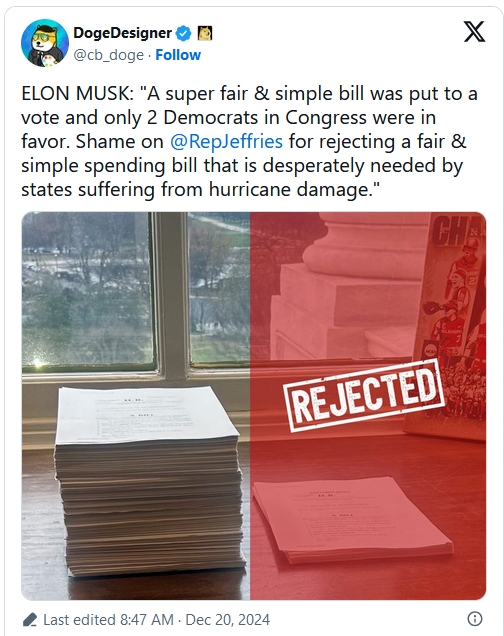
The most exciting thing I heard today was that AI was used to find all the nasty surprises secreted away in the 1,500 pages of US legislation that was being pumped through Congress in the days before Christmas. Legal aides must have spent all year stacking the deck with tricks to enrich the political class. No human could unpack the fine print overnight, but AI could. Then, free speech saved the day, the Capitol Pork was exposed when Elon Musk spread the word to his 208 million readers.

As Elon Musk says: I’m suspicious of laws that are longer than The Lord of the Rings.

No matter how corrupt you think Big-government is, it’s worse:

Posters on Twitter exposed some of the hidden surprises which included a payrise for Congress, funding for Bill Gates mosquito games, bioweapons research, vaccine mandates and new rules to define National Emergencies like “climate change”.

Omnibus Congressional Bill Dec 2024.

How else to describe this other than rampant theft, hidden under a confected “rush” and loaded up with manipulative coercion to get it through?

The cancer research bill was passed in March and left to fester for months so that it could be used as a hostage against Republicans? (— Glenn Reynolds)

Seen on Twitter:

What is more outrageous, refusing to pass a 1,574 page monstrosity of a spending bill, or using kids with cancer as human shields by writing them into it? “We had to pass all the graft and corruption to help kids with cancer” – that was going to be their defense.

When Republicans reduced the bill to 115 pages, the Democrats who would have presumably passed all of it the day before, would not pass the short form without the self serving sweeteners and authoritarian clauses.

The mega-long legislation affects all of us in the West. The longer the laws are the more it favors the rich who can afford the QCs, and the more it punishes the poor who can’t pay off a lawyer to find the loopholes that weren’t written into the rules for them.

Australia voted against and emissions trading scheme in a landslide in 2013 but got one anyway. The laws were snuck through in deceptive clauses just before Christmas 2015.

Now the talk all over US political circles is this radical idea of voting for one bill at a time. Excellent.


10 out of 10 based on 1 rating

via JoNova

https://ift.tt/G7tZdj1

December 20, 2024 at 03:21PM

Data Centers Are Eating the US Grid Alive


It’s not only the US. Ireland’s data centres have already exceeded 20% of the nation’s annual electricity consumption. Intermittent weather-dependent renewables can’t solve this, almost by definition. Microsoft is taking over the Three Mile Island nuclear power site. Climate policy versus the never-ending march of progress – what wins? The data centre AI boom is already here.
– – –
The future of data centers is about to make a huge draw on the power grid, says OilPrice.com.

According to a DOE-backed report from Lawrence Berkeley National Lab, U.S. data center energy use could nearly triple by 2028, eating up as much as 12% of the country’s electricity.

Why? Blame AI and its insatiable hunger for powerful chips and energy-guzzling cooling systems.

Currently, data centers are responsible for a modest 4% of U.S. power demand. But with AI servers becoming the star of the show, the power draw has already doubled since 2017. The GPU chips that are needed to run complex machine learning algorithms are pushing the limits of what the grid can handle.

And then there is the heat they generate, causing cooling systems to work overtime.

The report warns that this growth could strain electrical grids, spike energy prices, and raise a few eyebrows about the climate impact. Researchers are calling for better transparency around energy use and efficiency improvements, but Big Tech isn’t exactly eager to spill the tea on their proprietary power habits.

And don’t count on renewables to ride to the rescue just yet. A study last month highlighted that scaling up solar and wind power isn’t happening fast enough to keep up with this demand surge. Plus, when the sun doesn’t shine or the wind doesn’t blow, the grid still needs fossil fuels to back it up.

Full article here.
– – –
Image: Three Mile Island nuclear power site

via Tallbloke’s Talkshop

https://ift.tt/sWXiTx9

December 20, 2024 at 01:06PM

Claim: 1300 People Dying of Heat Stress on the Pilgrimage to Mecca is Proof of the Climate Apocalypse

Essay by Eric Worrall

“… the upper limits of human heat tolerance were breached for a total of 43 hours over the six days of Hajj. …”

More than 1,300 Hajj pilgrims died this year when humidity and heat pushed past survivable limits. It’s just the start

Published: December 19, 2024 6.08am AEDT
Emma Ramsay Research Affiliate in Climate Adaptation, Monash University
Shanta Barley Adjunct Lecturer in Ecology, The University of Western Australia

Every year, hundreds of thousands of Muslims undertake the Hajj –the sacred pilgrimage to Mecca. In 2024, the pilgrimage took place in mid-June, the start of the Saudi summer. 

But this year, more than 1,300 pilgrims never made it home. Lethal heat combined with humidity proved deadly.

Our new research shows the upper limits of human heat tolerance were breached for a total of 43 hours over the six days of Hajj. During these periods, heat and humidity passed beyond the point at which our bodies are able to cool down. 

Scientists are increasingly worried about the death toll caused by humid heatwaves, and how it will escalate in the near-term. This year is now the hottest year on record, overtaking the previous hottest year of 2023.

…

This year’s pilgrimage started on June 14. Over the next six days, the temperature topped 51°C, while “wet-bulb temperatures” (the combination of temperature and humidity) rose as high as 29.5°C. 

…

Read more: https://theconversation.com/more-than-1-300-hajj-pilgrims-died-this-year-when-humidity-and-heat-pushed-past-survivable-limits-its-just-the-start-245271

The abstract of the study;

  • Comment
  • Published: 18 December 2024

Humid heat exceeds human tolerance limits and causes mass mortality

Nature Climate Change (2024)Cite this article

The hottest boreal summer on record has driven widespread humid heat mortality across every continent of the Northern Hemisphere. With critical physiological limits to human heat tolerance drawing ever closer, this Comment highlights the urgent need to limit further climate warming and emphasizes the adaptation challenge ahead.

Read more: https://www.nature.com/articles/s41558-024-02215-8

The wet bulb limit claim is nonsense.

When I was young, one of my first jobs was working in a poorly ventilated plastic factory. My fellow workers were a pregnant South Sea Islander and a bunch of chain smoking elderly East Europeans who used to smuggle vodka into the lunch room.

During Summer the temperature on the factory floor regularly hit 55C (130F). The factory was extremely humid, not only did the decrepit hot presses release huge amounts of steam, the chemical processes also released lots of water vapour. You could see visible clouds of steam hovering around the work area, everything was dripping wet. The work was physically demanding, continuously moving material by hand and operating a heavy hot press lever.

It was the strangest experience walking out into a 110F day at the end of my shift, and shivering with cold for two minutes while my body adjusted to outdoor temperatures.

I don’t know what the wet bulb temperature on that factory floor was, but on the hottest days all the managers played serving maid, offered us rehydration drinks every 5 minutes. They were probably breaching some workplace health and safety law operating in those temperatures, and wanted to make sure none of us dropped dead.

So what happened to those Hajj pilgrims?

Obviously we can only speculate, but it seems much more likely the pilgrims died from dehydration and neglect, or didn’t give themselves enough time to adapt to the heat.

You can’t walk into the extreme conditions I just described, or the extreme conditions of an Arabian Summer, and expect to feel fine immediately. You have to build up hot weather tolerance the same way you build altitude tolerance when preparing for extreme mountain climbing. Hajj pilgrims who just flew in from colder countries without giving themselves time to adapt would have severely stressed their bodies the moment they set foot outside the airport.

In addition, to survive such heat you have to consciously remind yourself to drink regularly – if you wait until you feel thirsty, your body is already in trouble. Those managers in that factory I described were offering rehydration drinks every 5 minutes because that is what your body needs in such conditions, it is easy to become distracted and forget to take care of yourself. You also need well balanced drinks, an electrolyte imbalance is lethal in such conditions – drinking soda cans or anything other than a well balanced rehydration drink, you could suffer a health crisis within hours if you don’t take proper care of yourself.

My grandpa who worked in even more extreme conditions in a WW2 steel foundry told me how managers walked the factory floor making sure everyone took salt pills, to prevent workers from fainting.

I’m sure the locals know how to survive, this is where they live – they would have learned as kids how to survive in such a climate. But people who aren’t used to such conditions, or who get caught up in the moment and forget to drink water, it’s no different to someone who lives in a temperate climate visiting somewhere really cold in winter. If you don’t know and rigorously follow the rules, if you don’t take care of yourself, you could lose your life.


Discover more from Watts Up With That?

Subscribe to get the latest posts sent to your email.

via Watts Up With That?

https://ift.tt/MgsewUG

December 20, 2024 at 01:02PM