Danish Fart Tax No Laughing Matter

Paul Schwennesen explains the nefarious intent behind this latest government hostile takeover in his Daily Economy article.  Excerpts in italics with my bolds and added images.

Cow farts are a distraction, and the joke’s on us. The Danish tax is a
significant step toward state ownership of the means of production.

Denmark, according to The New York Times, is going ahead with its livestock “Burp Tax.” Though hotly contested, the Danish government has nevertheless finally settled on levying farmers 300 kroners (~$43) per ton for carbon dioxide emissions, ramping to $106 per ton by 2035. As is the case with many of these farm-targeted green interventions, the action is ludicrously ineffectual at addressing the trumped-up problem, while remarkably effective at further cementing state controls over economic production.

Part of the reason farms (and especially cows) are such fat targets for this kind of statist intervention is that, politically speaking, they are the perfect scapegoat. It all seems so harmless, after all — so silly even — that serious-minded folk risk looking ridiculous if they object. Is it really so very draconian, goes the argument, to ask farmers to reduce their cow flatulence? The ever-so-reasonable request (enforceable by law, to be sure) glides under the radar in a scree of giggle-inducing copy that distracts readers to what is really afoot.

The Times plays its part in this façade, relishing the chance to print “poop, farts, and burps” in the business section so that the regulation seems plucked from an impish children’s story rather than what it is: a deadly serious infringement on economic liberty.

Defenders of the scheme insist it is necessary to address the pressing issue of climate change. But even if we were to accept the lobby’s poorly understood climate science at face value, the claims would be dubious. Cows stand accused of emitting 5.6 metric tons in annual “CO2 equivalent” emissions. All this politically motivated tabulating and assessing completely ignores the other side of the ledger, the growing recognition that grazing livestock have a complex, largely offsetting (and quite probably net-positive) impact on overall carbon emissions. Nature, after all, doesn’t work in simple equations and we are woefully under-informed about the rich and inherently unmodelable world of stochastic ecology.

Give Daisy a Break.

The New York Times, by way of perspective, accounts for 16,979 metric tons of its own, meaning that it, as a single company, has the footprint of ten Danish dairies. What would readers of “All the News That’s Fit to Print” have to say about an annual tax of $730,000 a year, ramping to $1.8 million, being added to the newspaper stand price? Advocates of a free press might well ask why the government was using state power to make the newspaper of record less competitive.

But in any case, climate science and cow farts aren’t really the issue here.
The issue is essentially about control, and who gets to occupy the
commanding heights of a centrally managed economy.

“A tax on pollution has the aim to change behavior,” says Jeppe Bruss, the Danish “green transition” minister in an unguardedly candid moment. Government programs to change behavior are much easier to introduce slowly, and against somewhat laughable minority sectors like farming than against, say, the population at large. They do not seem eager, for instance, to levy additional burdens on average people’s heating and transport emissions, which combined dwarf the agricultural sector’s. The Times says that livestock emissions are “becoming” the largest share of Denmark’s share of climate pollution which is another way of saying that it isn’t the largest share.

If beef and milk production indeed posed such an existential climate risk, then why not simply tax the consumers of beef and milk who, after all, are the real source of the production signal? The answer, of course, is obvious: no politician wants to be pegged as the one who raised the price of butter for average Danish grandmothers. Politically, it is far easier to go after the farmers, knowing full well that any cost burdens on farm production will be passed along to consumers anyway — only then it will be the farmers’ fault, not the government’s.

It’s an old trick, a kind of regulatory-impact laundering scheme.

The success of the Danish strategy remains to be seen. If examples from the Netherlands and New Zealand are any indication, the plan may well backfire, with frustrated farmers taking to the street and even grabbing back the reins of power. It is a useful warning:

allowing government the power to surgically tax and thereby “change behavior”
of producers is the same as granting them economic planning privileges.

The Danish “Burp Tax” is a significant step toward the state ownership of the means of production, and as the history of centrally managed economies shows, it’s not likely to end well.

•


via Science Matters

https://ift.tt/Jq5KxrR

December 18, 2024 at 02:45PM

Trump to Bury Already Dead ESG

John  Authers explains the demise of ESG in his Bloomberg article Trump Will Bury ESG, But It Was Already Dead. Excerpts in italics with my bolds and added images.

The green investing revolution never stood a chance in the US once
ensnared by the culture wars, but that wasn’t the only cause of death.

Ever So Gone

As was obvious even before voters went to the polls, ESG was already a decisive loser in the US. The concept of Environmental, Social and Governance investing became hopelessly entangled with the culture war agenda, failed to deliver on its promises, and went into retreat. Rather than attempt a technocratic, clean, green way of changing capitalism, America has opted for something more nationalist, even mercantilist.

ESG as a term has been demonized by politicians on the right, to the point that BlackRock’s Larry Fink said that it had been “weaponized” and should no longer be used. Because of Fink’s stand on ESG issues, BlackRock has become a lightning rod for conservative attacks lumped in with identity politics. Startlingly, the company shows up in a list of “decadent and rootless” institutions that should be burned to the ground in a new book by Kevin Roberts, the head of the Heritage Foundation, a distinction it bizarrely shares with the Boy Scouts of America and the Chinese Communist Party.

Supporters of the concept were already disillusioned that ESG had become little more than a marketing wheeze, and several big fund managers, including WisdomTree and Invesco, have faced fines in the US for “greenwashing” (claiming their products were greener than they really were). In France, BlackRock is under fire over allegations that 18 of its funds sold as sustainable are in fact investing in fossil fuels.

Regulator attitudes differ starkly across the Atlantic. In Europe, regulators have raised the ante by telling fund managers that they must reach minimum thresholds for environmental impact before they can use the ESG label — a move that makes it hard for them to keep investing in the US, where the best returns are, and requires them to become more active than is currently the case for many.

In the US, the Securities and Exchange Commission (SEC) has watered down its requirements on companies to disclose ESG statistics — and the whole concept is close to unworkable unless everyone has to disclose standardized statistics. In September, it quietly disbanded its task force on ESG enforcement. Now, the Trump administration is likely to make dismantling such rules one of its first acts in office.

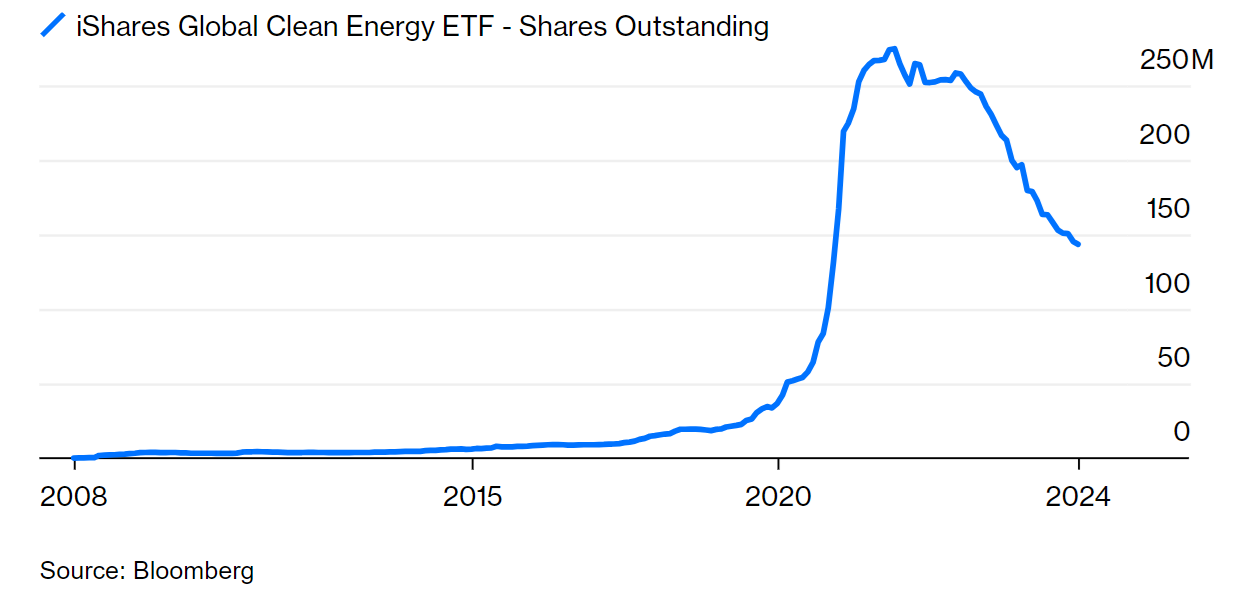
That will complete a retreat that has largely already taken place. A look at the total market cap of BlackRock’s flagship ETFs covering the global energy and clean energy sectors shows that after a boom in 2021, the clean energy fund has steadily dwindled, and is now worth slightly less than the main energy fund:

Investors Wash Their Hands of Clean Energy
There has been an exodus from clean energy stocks in the last two years

Much of this is driven by the declining share prices of clean energy stocks. However, if we look at the number of shares in the ETF, it’s clear that there were huge inflows during the pandemic, and much of that money has now been withdrawn.

Investors are losing interest in the concept, and claims that ESG would reduce
global warming, or starve fossil fuel groups of capital, look overblown.

Interest among the public has waned in the US — although not elsewhere. Google Trends shows that US searches for ESG and its synonyms tanked over the last two years, while continuing at much the same level elsewhere. The rest of the world still seems happy to give it a try, but America is no longer going along for the ride.

The pattern recurs in the news media. Counting stories published on the Bloomberg terminal from all sources shows interest peaking in 2016, when Donald Trump was first elected, and long before the flow of money went into reverse. By the time that Fink said ESG had been “weaponized,” interest was barely a third its 2016 level and has continued to dwindle.

Critically from the point of view of how capitalism is operating, the same pattern shows up in earnings call transcripts. Bloomberg’s Document Search function shows that executives — not just Larry Fink — no longer want to talk about it. This is our quarter-by-quarter measure of mentions of ESG and its various synonyms since 2010. Mentions exploded after the pandemic, and have tumbled since 2022. With this earning season roughly 90% over, interest from executives in ESG looks to be right back to pre-pandemic levels’.

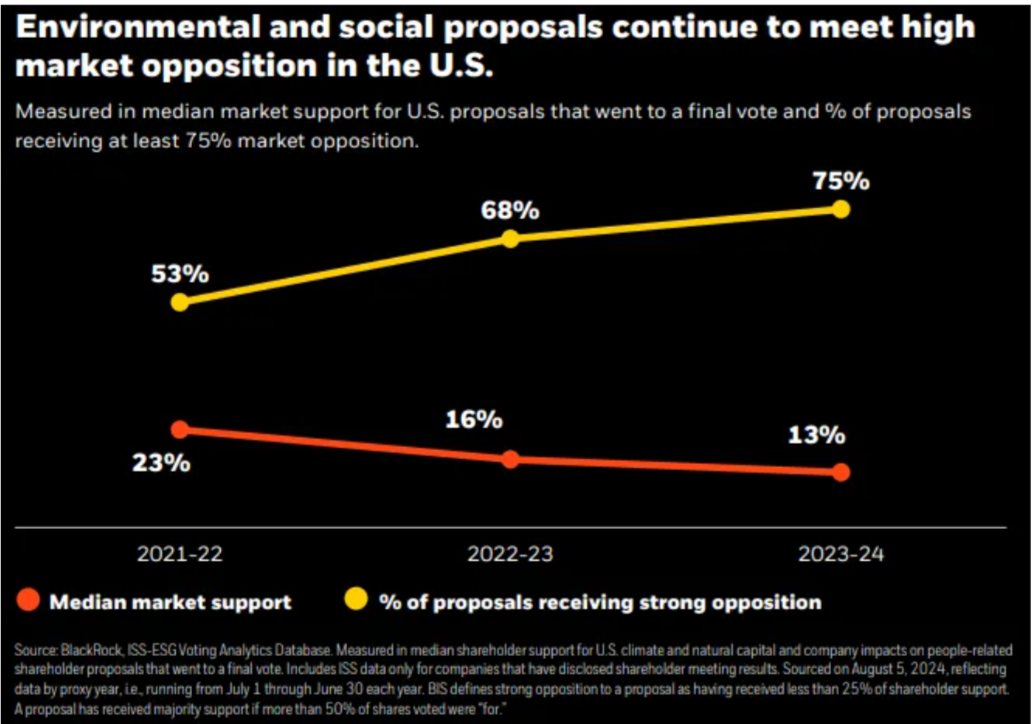
This is at least in part because fund managers are no longer forcing the issue. BlackRock is admirably transparent about the way it votes its shares, and produces regular reports; here is the latest. As this chart from the report (which is worth a read) demonstrates, the amount of support from shareholders for environmental and social proposals has declined markedly over the last three years:

BlackRock itself upped its support for corporate governance proposals, but only backed 4% of social and environmental proposals (down from 20% two years earlier). It also declined to support any of the various anti-ESG proposals that were put forward, and complained that many of them were duplicative or poorly drafted. But the notion that ESG was going to change the way companies operate seems to be in retreat.

Once Trump is back in the White House in January, we’ll learn much more about how his economic nationalism will work. Fine-tuning capitalism to make it more long-termist and take into account more than the narrowly defined interests of shareholders — the big ESG idea — has been comprehensively defeated. Now we wait to see what version of mercantilism comes in its stead.

Footnote: Fundamental Reasons People Reject ESG Were Not Addressed by Author


via Science Matters

https://ift.tt/T2HBp9M

December 18, 2024 at 12:30PM

Peak Climate Derangement Syndrome?! No packing necessary — Japan Airlines’ pushes ‘rental clothes’ to travelers at their destination ‘to reduce the weight of baggage & reduce carbon emissions’

From CLIMATE DEPOT

By Marc Morano

Bloomberg News: Holiday Air Travel Is Easier With a Handbook – November 21, 2024

Excerpt: You can finally fly with (almost) no clothes

The grim environmental effects of flying were weighing on Miho Moriya. “I love to travel but also felt guilty about using flights that produce CO2,” says the 40-year-old accountant based in Japan. So when her employer, Japanese trading house Sumitomo Mitsui Financial Group Inc., held its annual entrepreneurship competition in 2019, she pitched an idea that could make a tiny dent: a clothing-rental service for travelers. Instead of flyers hauling luggage—the weight adding to a plane’s carbon emissions—they could borrow clothes on the ground.

The idea became Any Wear, Anywhere, part of a venture between Sumitomo and Japan Airlines Co. Travelers arriving in Japan can now rent clothing for as little as $31 for up to two weeks, delivered to their hotel. The online service, more for the utilitarian-minded than the fashionista, rents sets—including perhaps three pairs of pants, three tops and a couple of jackets—all secondhand or sourced from overstock to keep with the eco-friendly vibe. It offers seven size options for adults and nine for children, with sweaters and jeans for winter and shorts and T-shirts for summer.

The service is currently available only in Japan, which happens to be enjoying a tourism boom. But traveling entirely suitcase-free is still just an aspiration: Shoes, underwear, PJs and toiletries aren’t yet part of the pitch. Moriya, who left her job in accounting to help operate Any Wear, Anywhere as its project leader, says going green feels good, but traveling without carrying luggage is even better. “My ultimate dream,” she says, “is making it possible to travel anywhere in the world hands-free.” —Supriya Singh

#

Japan Airlines Will Rent You Clothes (Bizarre Sustainability Initiative) – One Mile at a Time

Excerpt By Ben Schlappig:

Japan Airlines’ new clothing-sharing service

Japan Airlines has teamed up with Sumitomo Corporation to launch a trial of a clothing sharing service, which is called “Any Wear, Anywhere.” The idea is that foreign tourists and business travelers landing in Japan on JAL will be able to rent clothes for their trip, meaning they just have to bring their underwear and socks.

Here’s how JAL describes the concept behind this service:

With more and more people flying again after the COVID-19 pandemic, and with the recent emphasis in sustainability, there is a growing movement around the world to promote sustainable tourism. Travelers increasingly desire to make more sustainable choices regarding their travel destinations, accommodations, transportation, etc., they still lack sufficient options. For example, most travelers now enjoy eating at restaurants and staying at hotels at their destination, but they generally bring their own clothing from home.

The concept of the Service is therefore to provide a travel experience with minimal luggage by offering clothing rentals at the destination, thereby creating environmental value. By expanding the use of the Service, we aim to create an environment where travelers can use local options for all aspects of their clothing, food, and accommodation, transforming travel and business trips into more sustainable experiences. In providing the Service, Sumitomo Corporation will be responsible for developing the reservation system as well as for the procurement, laundering, and delivery of clothes. All clothing items available for rent will be obtained from excess stock of apparel and pre-owned clothing, thereby promoting the concept of a circular economy. JAL will monitor changes in passengers’ checked-in baggage weight and verify the reduction effect of carbon dioxide emissions by reduced airplane weight due to use of the Service.

  • You can reserve your clothes online prior to your trip, selecting the clothing set that best suits the season and purpose of your visit
  • You’ll need to enter your Japan Airlines booking reference, the date of pickup and return, and information about your destination where you intend to pick up and drop off your clothing set; you’ll need to make a payment in advance, and reserve your clothes at least one month prior to your trip
  • You’ll then fly Japan Airlines to Japan with less baggage, and can pick up and return your clothing set at the hotel; the return date for clothes must be within two weeks
  • …
  • Here’s how it works:
    • You can reserve your clothes online prior to your trip, selecting the clothing set that best suits the season and purpose of your visitYou’ll need to enter your Japan Airlines booking reference, the date of pickup and return, and information about your destination where you intend to pick up and drop off your clothing set; you’ll need to make a payment in advance, and reserve your clothes at least one month prior to your tripYou’ll then fly Japan Airlines to Japan with less baggage, and can pick up and return your clothing set at the hotel; the return date for clothes must be within two weeks

    How JAL’s shared clothing service worksLooking at the selection, there are a variety of categories, including choosing casual or smart casual, selecting summer, winter, or spring/fall, and picking how many tops and bottoms you want. Pricing per collection is ¥5,000-7000 (~$35-50), and that includes the cost of shipping.Japan Airlines shared clothing selectionJapan Airlines shared clothing selectionBen Schlappig comments: Is this clothes sharing concept brilliant or silly?While it’s great that sustainability is a more important topic in the airline industry nowadays, personally this seems to me like an initiative where the juice isn’t worth the squeeze, so to speak.First there are the complicated logistics. You have to request these outfits at least a month in advance, and can only rent them for periods of two weeks. Furthermore, while you can select a clothing set in advance, it’s anyone’s guess if they end up fitting right, or what they actually look like on you. Never mind the potential risk of irregular operations, leaving you stranded at another airport without a change of clothes.I understand where the initiative is coming from, in the sense that carrying extra weight on planes burns a bit more fuel. But honestly, how much could these clothing sets really weigh? The biggest set has nine pieces of clothing, so does that maybe weigh 10 pounds? Let’s say 5% of people on a Japan Airlines Boeing 787-8 use this service (that number seems way too high, but let’s just pretend). That would mean nine people use the service, and that’s a weight reduction of 90 pounds, on a plane with a maximum takeoff weight of over 500,000 pounds. What kind of fuel savings are we talking about here — a couple of liters of gas?Maybe I’m in the minority, but I just don’t see how this concept makes sense. And that doesn’t even account for the concept of having to wear clothing styles you wouldn’t necessarily otherwise want to wear at home. Heck, next time I go to Japan, maybe I’ll just take the JAL pajamas off the plane and wear those for my whole trip.Bottom lineJapan Airlines is trialing a new concept whereby you can rent clothes for your trip to Japan in advance. You can choose based on how many pieces you want, and the clothes will be delivered to your hotel. This is intended as an environmental initiative, so that you can travel lighter, reducing the amount of luggage you have (and in turn, reducing aircraft fuel burn ever-so-slightly).While this is a unique concept, I don’t see it gaining much traction.

#

Japan Airlines to Rent Clothes in Effort to Lower Carbon Emissions and ‘Promote Sustainable Tourism’ – EcoWatch

Excerpt:

One of the most stressful things about traveling is having to pack. But what if all you had to do was book your flight and the packing part — choosing, organizing, folding and making the clothes fit in your suitcase — came with your airline ticket?

Japan Airlines (JAL) is taking the term “packing light” to a new level with its new clothing rental service, “Any Wear, Anywhere.” The service provides international travelers with the option to rent sets of clothing from a range of choices, starting at a little over $27 for two bottoms and three tops, reported Travel + Leisure.

…

Multiple sets of seasonal clothing are available for rental in a range of sizes, from casual to smart casual or a combination of both, provided by Wefabrik. Travelers may rent as many as eight outfits for up to two weeks. The service is intended to reduce the weight of baggage and reduce carbon emissions, as well as save travelers hassle and time packing and laundering their own clothing. It also allows them to try on new styles without the pressure of buying them.

…

“Travelers increasingly desire to make more sustainable choices regarding their travel destinations, accommodations, transportation etc., they still lack sufficient options. For example, most travelers now enjoy eating at restaurants and staying at hotels at their destination, but they generally bring their own clothing from home,” the press release said.


Discover more from Watts Up With That?

Subscribe to get the latest posts sent to your email.

via Watts Up With That?

https://ift.tt/fVjtY1S

December 18, 2024 at 12:06PM

Antarctic Sea Ice Volume Higher Than 1980s

By Paul Homewood

Antarctic sea ice extent has been relatively low for the last couple of years, but has recovered since this time last year

image

https://nsidc.org/data/seaice_index


But when we look at sea ice volume, rather than extent, we see a different story.

As at October, when ice was close to its maximum, the volume was higher than some years in the 1980s.

image

 image

https://zacklabe.com/antarctic-sea-ice-extentconcentration/

This usually indicates wind patterns. Strong winds from the north push the ice polewards, thus reducing extent but also increasing thickness. This is when the Southern Annular Mode (SAM) goes negative, a perfectly natural oscillation that has nothing to do with climate change.

Certainly there is nothing alarming to be seen in the bottom two graphs.

via NOT A LOT OF PEOPLE KNOW THAT

https://ift.tt/cmx01Rt

December 18, 2024 at 12:01PM