MET OFFICE TRY TO COVER UP THEIR FAILINGS

Recent changes made by the Met Office to its climate average pages shows that the state-funded operation is fully aware of the growing interest in its entire temperature recording business. This interest has grown because the Met Office is fully committed to using its data to promote the Net Zero political fantasy. But it is silent on the biggest concern that has been raised of late, namely the promotion of temperatures, accurate to one hundredth of a degree centigrade, obtained from a nationwide network where nearly eight out of 10 stations are so poorly sited they have internationally-recognised ‘uncertainties’ as high as 5°C.

 Massive Cover-up Launched by U.K. Met Office to Hide its 103 Non-Existent Temperature Measuring Stations – The Daily Sceptic

via climate science

https://ift.tt/xbdEPKu

December 15, 2024 at 01:38AM

Stop These Things’ Weekly Round Up: 15 December 2024

Our weekly roundup has articles smashing the myth that wind, solar plus giant batteries are perfectly designed to power first world economies – with one drawing focus on the disaster that unfolded in Broken Hill, NSW, and another on “demand management”, a policy that involves telling power consumers to stop consuming power because wind and solar can’t cut the mustard when it counts.

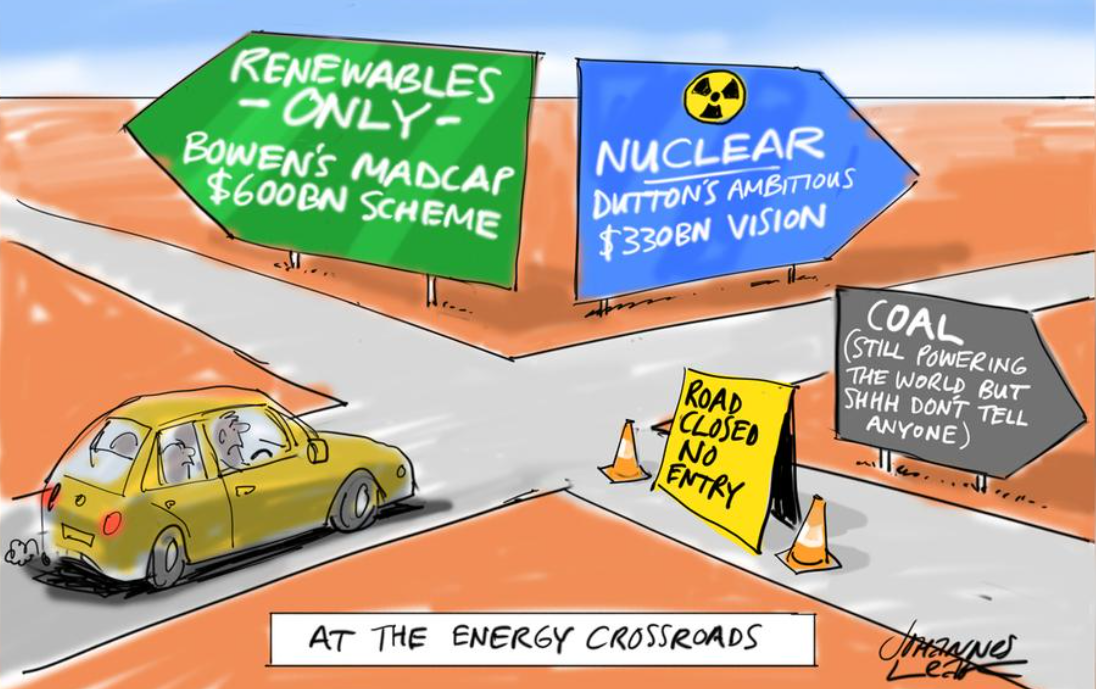
We’ve got articles showing the desperate lengths being taken by the Climate Industrial Complex to avoid any competition with ever-reliable, emissions free nuclear power. Hysteria amongst wind and sun cult reach new levels this week, when Australia’s Federal Leader of the Opposition, Peter Dutton pitched a do or die energy policy that would retain Australia’s coal-fired power fleet into the immediate future, while building large-scale nuclear power plants right alongside them. Predictably enough, politicians and their rent-seeking mates have taken self-interested apoplexy to new heights.

Another piece details how dilute and diffuse wind and solar generation is creating a cyber security nightmare, with hackers salivating at the opportunity of using backdoor attacks through wind and solar plants (including rooftop solar) to bring down an entire grid. We’ve got a collection covering Europe’s self-inflicted subsidised wind and solar calamity. And we round out the list with a piece giving thanks and praise for hydrocarbons and their myriad benefits, critical to civilised societies.

Infantile hopes collide with physical reality 

Wind and Solar Can’t Support the Grid
Climate Etc
Russ Schussler
5 December 2024

Grid not-fit-for-purpose: On a warm day, Crazy Australia paid $3.5m to industry to *stop* working
Jo Nova Blog
Jo Nova
7 December 2024

Bevy of lies show wind and solar outfits terrified of Nuclear power

CSIRO report criticised by energy expert for ‘lack of transparency’ after declaring renewables to be cheapest form of energy
Sky News
Oscar Godsell
9 December 2024

More misinformation from CSIRO on Nuclear
YouTube
Centre for Independent Studies
8 February 2024

Wind and solar adds to cyber attack risk

Energy Transition Security
The Right Insight
Edward Reid
3 December 2024

Europe’s wind and solar disaster

Residents of Northeastern Bulgaria Demand National Referendum on Construction of Wind Power Plants on Agricultural Land
Bulgarian News Agency
Mila Edreva and Filip Pavlov
5 December 2024

High Energy Costs Continue to Plague European Industry
Oil Price
Tsvetana Paraskova
26 November 2024

The Green Energy Apocalypse
Front Page
Bruce Thornton
5 December 2024

Storm Darragh leaves UK’s Biggest solar farm in pieces
MSN
Richard Marsden
10 December 2024

Denmark offers largest offshore wind area for auction, but no one bids anything
Jo Nova Blog
Jo Nova
11 December 2024

Thank the Lord for Hydrocarbons – fuel for life

Giving Thanks for Fossil Fuels
The Daily Economy
Paul Mueller
28 November 2024

Stay tuned, STT will be back next week with more.

via STOP THESE THINGS

https://ift.tt/TtiDKHb

December 15, 2024 at 12:37AM

An Epic Saga of Climate Defiance: A Case Study in Self-Parody

Radical anti-fossil fuel activist group Climate Defiance on Thursday protested at Energy Department’s Washington, D.C., headquarters, claiming to have “shuttered” the entrance. 

“Breaking: we have shuttered the entrance to the Department of Energy. Cops swarming by the 100. Senior officials on edge. Revolution in air. Updates imminent,” the group stated in a post on X. 

Andrew Follett, senior analyst at Club for Growth and former DOE contractor, said the group was actually blocking an unused entrance to a parking garage. 

“That’s the entrance to a closed parking garage you notwithstanding nitwit! The entrance is around the other side!” Follett said in a comment on Climate Defiance’s post.

It’s not clear that the protest was “shuttering” the agency as the group claims. The Department of Energy is one of the least-utilized federal headquarters in Washington, D.C. 

https://justthenews.com/politics-policy/energy/protest-against-fossil-fuel-use-climate-defiance-blocks-unused-entrance-doe

When the dust of history settles, some episodes are destined for the “You Can’t Make This Stuff Up” department. Case in point: Climate Defiance, a climate activism group, recently made headlines by “shutting down” the Department of Energy. Or so they claimed. In reality, they staged a protest blocking the entrance to an unused parking garage, which is as effective as barricading a revolving door with a sticky note. Their social media triumphalism was rich: “Revolution in the air!” they proclaimed, while senior DOE officials apparently remained blissfully unaware of this Earth-shaking inconvenience.

Blocking a Ghost Entrance: Bold Strategy, Guys

The self-described “shuttering” of the DOE turned out to be a laughably ineffective gesture. Andrew Follett, a senior analyst at Club for Growth and former DOE contractor, summed it up best: “That’s the entrance to a closed parking garage, you notwithstanding nitwit!” This group’s idea of guerrilla climate warfare is the equivalent of cutting off a phantom limb. But hey, when your primary goal is attention, success is measured not in CO₂ reductions but in retweets.

Virtue Signalers Backed by Big Money

Climate Defiance’s antics might seem like grassroots foolishness, but their funding paints a different picture. The group is backed by the Climate Emergency Fund, a $6 million war chest fueled by Hollywood elites like Adam McKay and Abigail Disney. These champagne environmentalists fork over millions from their air-conditioned mansions to bankroll protests that inconvenience no one except a few bemused D.C. commuters. McKay’s $4 million donation alone could buy enough private jet fuel to make Al Gore blush.

And speaking of mixed-up priorities, this crew also dipped its toe into Gaza activism, because nothing says “climate justice” like conflating environmental issues with geopolitical flashpoints. It’s as if the group spun a wheel labeled “causes to hijack” and just went with whatever came up.

Civil Disobedience Meets Champagne Socialism

Jane Fonda, Hollywood’s perennial activist-in-residence, graced a Climate Defiance event with her presence, urging attendees to engage in civil disobedience. It’s unclear if Fonda stayed long enough to endure the consequences of such acts or if she promptly returned to her five-star accommodations. The hypocrisy isn’t lost on anyone who remembers Fonda’s past escapades in Vietnam or her more recent knack for blending activism with high-gloss PR.

The Real Victims: Sanity and Public Discourse

What makes Climate Defiance uniquely absurd isn’t just their misguided tactics but their utter lack of self-awareness. They act as though they’re modern-day Rosa Parks while blocking an entrance that nobody uses. They cry injustice as “dozens” of members are arrested, calling it a “crime” to demand an end to fossil fuels. Meanwhile, their arrests are about as consequential as their protests. After all, no movement has been more coddled by sympathetic media and deep-pocketed donors.

Let’s not forget the irony of these activists relying on modern transportation and digital platforms—both heavily dependent on fossil fuels—to organize their protests. Perhaps their next act of civil disobedience will involve chaining themselves to an ExxonMobil gas pump while tweeting their demands from an iPhone.

Final Thoughts: A Movement Adrift

The Climate Defiance debacle isn’t just an indictment of the group’s tactics but a microcosm of the broader movement’s intellectual bankruptcy. Their actions scream privilege and superficiality, not substance. Blocking an unused garage in D.C. does less to “save the planet” than it does to confirm the movement’s image as a playground for Ivy League dilettantes who confuse hashtags with hard work.

So here’s some unsolicited advice for Climate Defiance: If you want to be taken seriously, try doing something that, you know, actually matters. Until then, enjoy your time in the police van—it might be the closest you get to making an impact.

via Watts Up With That?

https://ift.tt/aJgA4OT

December 15, 2024 at 12:02AM

Hot Death Valley Days: Don’t Trust Those Temperatures

From Dr Roy Spencer’s Global Warming Blog

by Roy W. Spencer, Ph. D.

Summary

  • Previous research has shown the temperatures recorded at Death Valley National Park (DVNP) have curious warm biases on very hot days, possibly due to instrument deficiencies or proximity to mounting structure apparatus and other manmade structures.
  • Here it is shown from 21 years of summertime (June, July, August) data that DVNP has many more days when temperatures are much higher than those at the nearby Stovepipe Wells station, than when Stovepipe Wells has hotter days than DVNP station.
  • These lines of evidence suggest that the hot summer daytime temperatures reported at Death Valley National Park have potentially large biases, and should only be used for their entertainment value.

In our continuing examination of the world record hottest temperature of 134 deg. F recorded at Greenland Ranch (now Death Valley National Park station) on 10 July 1913, we are finding some curious behavior in recent summertime temperatures there. (The Bulletin of the American Meteorological Society [BAMS] has accepted my proposal for a BAMS article showing the evidence that the 134 deg. F world record was 8 to 10 deg. F higher than what actually existed on that date [10 July 1913]).

Previous Work on Excessively Hot Death Valley Temperatures

Weather forecaster and storm chaser Bill Reid has blogged extensively over the years on the evidence against the 134 deg. F world record. A good place to start is his most recent post (Part 6) that deals with the Greenland Ranch foreman who made the excessively hot temperature measurements in the first half of July 1913. Bill has agreed to co-author the BAMS paper with John Christy and me.

There was also an experiment carried out with a variety of temperature instrumentation placed next to the DVNP weather station during 2021 and 2022. This revealed that on the near-record hot day of 9 July 2021 (130 deg. F), the “official” DVNP sensor produced temperatures a few degrees hotter than the other instruments (AMS conference poster here). The photo in Fig. 1 shows that the older-style DVNP instrument (which is not aspirated) is mounted next to a lot of metal structure and a small solar panel.

Fig. 1 Death Valley National Park weather station, with additional instrumentation added by Dirk Baker (Campbell Scientific, Inc.) and co-investigators to compare to the ‘official’ temperature readings in 2021 and 2022. (Figure adapted from this AMS conference presentation).

The experimental setup in Fig. 1 used several temperature sensors, some with aspirated shields, others with no aspiration. The data shown in their AMS conference presentation suggests to me that the near-record 130 deg. F reading on 9 July 2021 was 2-3 deg. F too hot partly because of the non-aspirated design of the sensor. There was some additional warm bias that could have been due to all of the mounting structure seen in Fig. 1, including a small solar panel next to the DVNP station sensor.

More Evidence: DVNP vs. Stovepipe Wells Temperatures

For the last 21 years there have been two stations in Death Valley: the DVNP station next to the Furnace Creek Visitors Center, and a climate reference network (CRN) station at Stovepipe Wells, 29 km northwest of the DVNP station.

Fig. 2 shows a comparison of the daily maximum temperatures (Tmax) recorded at these two stations for every day in June, July, and August in all years from 2004 through 2024.

Fig. 2. Comparison between daily high temperatures (Tmax) recorded at Stovepipe Wells and Death Valley National Park, for all days in June, July, and August for the years 2004 through 2024. The dashed red line represents the median difference between the 2 stations (2 deg. F, DVNP warmer than Stovepipe Wells). Gray lines connect the days in chronological order.

The median of the Tmax differences between these 2 stations is 2 deg. F (DVNP warmer, represented by the dashed red line), while the average difference is 2.3 deg. F. The expected difference based upon elevation alone is 1.3 deg. F (DVNP station is 278 ft lower in elevation than Stovepipe Wells).

Note in Fig. 2 that there seem to be more outliers to the left of the dashed red line than to the right. That is, there are more days where DVNP is much warmer than Stovepipe Wells than there are days when Stovepipe Wells is much warmer than DVNP station.

This can be better seen if we look at a frequency distribution of these station differences, adjusted for the 2 deg. F median difference between stations (Fig. 3).

Fig. 3. Frequency distributions of how many days where one Death Valley station is hotter than the other. This is after shifting of the distributions to account for a 2 deg. F difference in their median difference.

As shown in Fig. 3, DVNP station has many more days where it is hotter than Stovepipe Wells, than Stovepipe Wells has days that are hotter than DVNP station. For the 3-4 deg. F hotter category, the difference is 2X, for the 5 to 9 deg. F hotter category the difference is 3x, and for 10 deg. F or greater the difference is 7.8X.

This suggests there is something wrong with the Death Valley National Park instrumentation itself or the immediate environment around the temperature sensor that causes some days to be biased too hot. Bill Reid, who has researched this issue extensively, suspects that days with low wind have excessive heat build-up at the DVNP thermometer site, both in the general area around the instrumentation, and due to the non-aspirated design of the temperature sensor used there.

The difference in exposure at DVNP station and Stovepipe Wells is shown in Fig. 4.

Fig. 4. Google Earth imagery of Stovepipe Wells station (top) and Death Valley N.P. station (bottom), stations circled in red. The inset photo at top is of the Stovepipe Wells Climate Reference Network station, courtesy of William T. Reid. The E-W distance across these images is just over 0.5 km.

As can be seen in Fig. 4, the Death Valley N.P station has quite a bit of development surrounding the station, with parking lots, a paved campground, the Visitors Center, solar panels (black) and trees just to the south. The Stovepipe Wells site has almost no development and no vegetation. It is possible that during the prevailing southerly wind flow during the summer, the structures and trees to the south of the DVNP station lead to stagnation of air flow around the temperature sensor.

Conclusions

The evidence presented here, along with evidence presented previously by Bill Reid, Dirk Baker, and others, suggests that Death Valley National Park temperatures should not be relied upon for accurate daytime readings, and that near-record temperatures there are biased too high. The reasons for the biases are not obvious, but the evidence suggests poor sensor ventilation during the daytime when various structures in the vicinity heat up: whether the shield of the sensor itself, its supporting structure, or various manmade objects around the station site. It is also possible that the trees and other structures to the south of the station restrict air flow, further reducing effective convective heat transport away from the solar heated desert surface.

It is my opinion that “official” Death Valley temperatures should use the Stovepipe Wells site data, which come from state-of-the-art Climate Reference Network instrumentation. The traditional site near the Death Valley National Park Visitors Center should only be used for entertainment purposes.

Maybe the National Park Service should investigate adding a CRN station; a good location would be about 1.6 km southwest of the current station, well away from the Furnace Creek tourist area.

via Watts Up With That?

https://ift.tt/QNXIrVE

December 14, 2024 at 08:05PM