BBC AND MET OFFICE IN ATTEMPT TO USE STORM DATA AS PROPAGANDA

The Met Office have only been using extremely exposed sites such as Aberdaron and Capel Curig for a few years, both opening in 1993. Pembrey Sands, another regular on the wind gust list was also opened in that same year. It is almost as if the Met Office wanted to make people believe winds were getting stronger! What the BBC refuse to tell viewers is that the storms of the 1980s and 90s were much more severe than anything seen since, which even the Met Office have been forced to admit. Read the details at the links below:

 Storm Darragh | NOT A LOT OF PEOPLE KNOW THAT

Storm Darragh’s Winds Were 60 mph, Not 90 mph | NOT A LOT OF PEOPLE KNOW THAT

via climate science

https://ift.tt/ZsSQHX9

December 10, 2024 at 01:58AM

Rate Inflation in New England (perils of political electricity)

“Electricity bills in New England are poised to experience a sharp increase driven by the clean energy mandates in five of the six states, which require duplicative, overbuilt renewable energy.”

Connecticut ratepayers suffered sticker shock this summer when they opened their July electric bills. While their energy consumption was relatively flat, the “public benefits” component doubled for some and tripled for others. The culprit was not hard to find given a legislative requirement for utilities to itemize the cost components of monthly bills.

“Public benefits” cover the cost of subsidies the state provides for low-income electricity customers and energy-efficiency programs. They also include solar, electric vehicle, and other renewable energy incentives.

The wide array of renewable energy subsidies and aid to low-income residents who cannot afford high-cost electricity, growing everywhere, is an increasing cost burden for power users in the Northeast.

Connecticut: Worst of the Worst

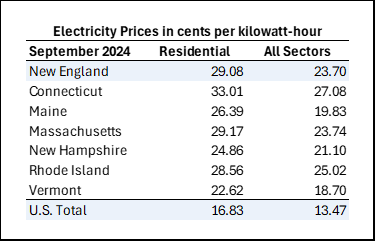
The Northeast has become the most expensive region in the continental United States for electricity. Connecticut has the most expensive electricity in the 50 states outside of Hawaii. Connecticut’s overall electricity price for this September, according to the Energy Information Administration, was 23.70 cents per kilowatt-hour (ȼ/kWh), compared to Hawaii’s 35.46 ȼ/kWh.

Usually, the most expensive state for electricity is California, but its price fell $0.50 per kilowatt-hour behind Connecticut’s. When we look at residential electricity prices, California was nearly 1.5 cents behind Connecticut’s 33.01 ȼ/kWh price.

Connecticut had the highest price of the six New England states. Even the least expensive state’s power, Vermont, was over 22 ȼ/kWh. Compared to the U.S. price, New England Residential and All Sector prices were roughly 75% more expensive, and every state exceeded the national average by a healthy margin.
Connecticut State Senator Ryan Fazio of Greenwich (R) has been investigating the electricity market during his three years in office. Just re-elected, he is more intent on changing the law to have the expense of public benefits come from state taxes and not utility bills. His rationale is that while many of these programs are worthy, they should be subject to public hearings and vetting every two years for cost and benefit analysis rather than automatically being funded “through a hidden tax in your electric bill.”

Connecticut electricity customers are starting to understand the exposure they have to the growing cost of subsidizing renewable energy programs, which are key to the state’s decarbonization goal. Their concern played a role in Connecticut Governor Ned Lamont (D) declining to participate in the purchase of offshore wind this past summer despite being a partner in a ballyhooed tri-state offshore wind agreement between Connecticut, Massachusetts, and Rhode Island. His reluctance was due to the high cost of the power and the growing pushback from residents over their rapidly rising electricity bills.

A portion of the public benefits charge is to finance the continued operation of the state’s Millstone nuclear power plant, which legislators thought was a good idea in 2019. Lamont tried unsuccessfully to get his fellow governors in the offshore wind agreement to purchase some of the plant’s output, which would help Connecticut residents by having more power paid for by others. They turned him down.

At a presentation to the Stamford Board of Representatives’ State & Commerce Committee, Fazio discussed the public benefits charge and the “policy mistakes” Connecticut has made in its electricity market, contributing to the state’s high prices. He showed a chart breaking down the costs of electricity bills. Producing electricity represented 30% of the bill, while transmitting it from the generation plants to substations was 11%, distributing it to homes was 31%, and public benefits represented 28%.

As a Republican in a Democrat-controlled state, Fazio’s effort to revamp the regulation of the public benefits charge may not progress. While he has 64 co-sponsors, he still lacks 25 for the bill to get a hearing. However, his efforts to educate the public and his fellow legislators will keep the issue of who pays for what (and how much it will cost) in the renewable energy transition under state policy front and center with the public. And “green” politics is becoming a harder and harder sell.

Rhode Island

Rhode Island is experiencing rapidly rising residential electricity prices. The culprit? The renewable energy charge, which increased eightfold between 2017 and 2023.

In light of Fazio’s comments about the public benefits, consider my electricity bill for our summer home in Rhode Island. Using the same categories as Fazio, Rhode Island’s breakdown is notably different. Power generation represented 49% of our bill, distribution 24%, transmission 12%, public benefits was 15%. Some of these differences would be expected, given the difference in the geographic size of Connecticut versus Rhode Island. Additionally, Connecticut’s population is three times that of Rhode Island.

These differences help explain the higher distribution share in Connecticut. Surprisingly, the transmission shares are similar. The most surprising difference is the cost of the power, which is partly explained by the nuclear power supply in Connecticut, as Rhode Island has none. It appears Rhode Island isn’t spending as much on public benefits as Connecticut. That is probably because of its smaller population, so fewer people benefit from or need public support programs.

Massachusetts

Consider a recent study estimating the cost of “green” energy programs of New England, The Staggering Costs of New England’s Green Energy Policies, by Isaac Orr, Mitch Rolling, and Trevor Lewis (September 2024) found:

The annual cost of Massachusetts renewable energy policies has quadrupled in 10 years from $250 million in 2011 to $1 billion in 2020. Cumulatively, this has cost Massachusetts ratepayers $6 billion in increased electricity prices in that period.

This charge cost the seven million residents of Massachusetts $143 in 2020 and approximately $850 over 2011–2020. The 2020 cost is about $12 per month in ratepayer bills. We do not know if or by how much that charge has increased to 2024, but we assume it has. In Rhode Island, the equivalent program cost is about $18 per month in our electricity bill.

More Rate Hikes Ahead

Electricity bills in New England are poised to experience a sharp increase driven by the clean energy mandates in five of the six states, which require duplicative, overbuilt renewable energy. A new report outlines the cost of decarbonizing the Independent System Operator – New England (ISO-NE) electricity system that provides power to the six New England states by 2050. This effort necessitates renewable energy generation, increasing its share of total power generation from 6% in 2023 to 71% in 2050. That means adding 97 gigawatts (GW) of new renewable generation capacity.

The grid expansion is required to power the 106% increase in New England’s electricity by 2050 predicted by the shift to electric vehicles and heat pumps. This massive increase in power use will also shift the region’s seasonal peak from summer to winter. Additionally, winter days will experience two peaks a day – when people start their day and return to their homes in the late afternoon and early evening.

Conclusion

The Orr, Rolling, and Lewis study documents the staggering costs for New England residents’ decarbonization plans. This joins a two-year study by ISO-NE estimating the need for 97 GW of renewable power with projected blackouts calling for overbuilding capacity. Is the public aware of the cost tsunami heading their way courtesy of state decarbonization plans?

As the public becomes better educated about their electricity system’s current and future costs, expect increased resistance to state decarbonization efforts. Shockingly high electric bills are turning out to be a huge motivational push for people to learn more. An educated public is good, but not for the politicians and regulators pushing the decarbonization agenda.

The post Rate Inflation in New England (perils of political electricity) appeared first on Master Resource.

via Master Resource

https://ift.tt/4ui9cbt

December 10, 2024 at 01:03AM

Stop The ‘Green Hallucinationists’ Plan to Close All 200 Coal Power Plants.

China is Building Coal-Fired Power Plants at an Alarming Rate of two new coal plants every week!

Ronald Stein, P.E. is an engineer, columnist on energy literacy at America Out Loud NEWS, and advisor on energy literacy for the Heartland Institute and CFACT, and co-author of the Pulitzer Prize-nominated book “Clean Energy Exploitations.”

.

George Harris has served as Executive Director of Montana Coal Council since September 2022.  He has a Master of Public Administration degree from BYU.  He has served as Executive Budget Officer in Montana’s Governor’s Budget Office. He was the State Risk Manager and served as President of the National State Risk Managers Association.

Co-authored by Ronald Stein, and George Harris

Published December 9, 2024, at America Out Loud NEWS

America continues to subsidize the development of occasionally generated electricity from weather dependent wind turbines and solar panels, to replace coal power plants, with the expectation that America, with about 4% of the world’s population, can drastically impact the world’s emissions occurring from the other 96% people on this planet.

Coal is the world’s most abundant and reliable energy source. The United States has the world’s largest coal reserves.  Of the 15 major coal producing States, Montana has the largest coal reserve with 118.4 billion tons. 

There are about 200 coal-burning power plants still operating in America, with many concentrated in Pennsylvania, Texas, Indiana, and the Powder River Basin of Wyoming and Montana, i.e. only 8% of the world’s coal plants.

Worldwide there are over 2,400 coal-fired power stations, i.e., the other 92% of the world’s coal plants.

Right now, China already has a total of 1,142 operating coal-fired plants  and is building six times as many coal-fired power plants as the rest of the world combined – China is building the equivalent of two new coal plants every week!

Most in the wealthier developed counties are oblivious that about 80 percent of the world’s 8 billion, many of which are in Africa, Asia and Latin America still live on less than $10 a day – and the billions who still have little to no access to electricity. For others, life is severely complicated and compromised by the hypocritical “green” agendas of wealthy country elites who have benefited so tremendously from fossil fuels since the modern industrial era began in the 1800’s.

While wealthier countries are shelling out billions of dollars in subsidies for so-called clean ELECTRICITY from wind and solar, those poorer developing countries cannot subsidize themselves out of a paper bag.

Developing countries desperately need dependable, affordable electricity and the products and fuels manufactured from fossil fuels to create jobs, lift families out of poverty, modernize homes, schools, and hospitals, provide clean water, and replace wood and animal dung for cooking and heating.

Even today, for the more than 6 billion on this planet living on less than $10 a day, millions of parents and children die from respiratory and intestinal diseases that are unheard of in wealthy countries, because they don’t have electricity nor any of the 6,000 products made from oil derivatives manufactured from crude oil that did not exist before the 1800’s.

Coal is primarily used for generation of electricity, especially in China, India, and Africa.

As the number one importer of both crude oil and coal, China is the largest consumer of energy and producer of emissions in the world. 

  • China, with 1,142 coal-fired power plants in operation as of July 2023, mainland China currently has a far greater number of coal-fired plants than any other country. 
  • India comes in a distant second with 282 coal-fired plants.
  • The U.S.is third with 210 plants. Due to onerous regulations by the Biden Administration and the overreach of his BLM and EPA, approximately 170 of the remaining coal-fired plants in the U.S. are scheduled to be de-commissioned by 2030, and there are no plans to build any new coal-fired plants in the U.S.  Meanwhile China is adding to its inventory of coal-fired power plants at a record rate.  

During the first six months of 2023, China issued permits for the construction of approximately 50 new coal-fired power plants, an average of two per week. China currently has more than 300 coal-fired plants that are either under construction, permitted, or awaiting permitting. If all 300 plants are constructed, China’s inventory of coal-fired power plants will increase by more than 25%. Currently, China has six times more coal-fired power plants under construction than the rest of the World combined. 

Officials within the Chinese Communist Party (CCP) offer a variety of reasons for the rapid reliance upon coal-fired power plants such as recent heat waves that have increased the demand for air conditioning. New coal-fired plants will simply serve as backup support for the undependable renewable sources of electricity generation from weather dependent wind and solar and during periods of intense electricity demand. 

Given that China is also currently leading the world in the construction of renewable energy sources, such as wind and solar energy, China’s increased reliance upon coal contradicts the justifications offered by the CCP. Critics point out that most of the new coal-fired power plants are being constructed in locations that fail to support the justifications offered by the CCP, such as no reported instability of the grid or unreliability of renewable energy sources. Other critics indicate that the new coal-fired plants are being constructed in locations that are already powered almost entirely by coal as opposed to supposed unreliable renewable electricity generation sources. 

Whatever stance is taken, while the wealthier developed nations are rapidly decreasing reliance upon coal-fired power plants by subsidizing wind and solar, China and other developing countries are moving even faster in the opposite direction, drastically increasing reliance upon coal that is abundant and affordable for their economies.

Hope is on the horizon.  The landmark US Supreme Court Chevron case has taken much of the teeth out of overzealous federal bureaucrats. US Senator Steve Daines of Montana has proposed legislation to keep coal mines operational.  The landslide victory of the incoming Trump administration including the coal friendly majority in the US Senate and House which are committed to energy independence, will likely reign in bureaucratic red tape, shortsighted energy hysteria from those who Senator Daines refers to as “Green Hallucinationists,” and put the American people first with clean, reliable and affordable electricity from the hard-working coal miners of the good old USofA!  There is a new sheriff in town, especially DC town and the American Coal industry is proud to help wear that badge!

Please share this information with teachers, students, and friends to encourage Energy Literacy conversations at the family dinner table. 

Click this Link to Sign up for Energy Literacy from Ronald Stein

via Watts Up With That?

https://ift.tt/6fmGjeA

December 10, 2024 at 12:06AM

Take Note, VOA, Island Nation’s International Court of Justice Lawsuit Over Sea-Level Rise Is Pointless and Toothless

In the article Big polluters, small island states clash on climate change, the Voice of America (VOA) claimed that climate change threatens the survival of Pacific island nations due to sea-level rise, and that they should be compensated by other countries who are said to be the major drivers of climate change, such as the United States. This claim is false, lacking any scientific support. Data refutes any claims made by island nations that they are losing land to rising seas

VOA notes:

Nearly 100 countries and more than a dozen intergovernmental organizations are set to give evidence across two weeks of legal proceedings that began on Monday and ends December 13. The judges are expected to give their legal opinion sometime next year.

…

The judges’ opinion is advisory and won’t be legally binding.

The recent proceedings at the International Court of Justice (ICJ) have brought to the forefront claims by small island nations that rising sea levels, attributed to climate change, threaten their very existence. These nations seek to hold major polluting countries legally accountable for the alleged damages. However, a closer examination of the scientific evidence and observable realities challenges the foundation of these claims.

Many Pacific islands are atolls—ring-shaped coral reefs encircling lagoons. Contrary to the narrative of inevitable submersion, atolls have demonstrated a remarkable ability to adapt to changing sea levels. Research indicates that these landforms can grow and adjust in response to environmental changes. A study published in Nature Communications found that 88.6% of Tuvalu’s islands remained stable or increased in size over recent decades, despite rising sea levels.

The New York Times (NYT) recently posted an article, titled “A Surprising Climate Find,” which explains how island nations like, Kiribati, Maldives, the Marshall Islands, Tuvalu, and Vanuatu are not, in fact, in danger of sinking under the seas due to climate change. This is true; a fact that Climate Realism has repeatedly discussed. Atolls in particular are known to grow with rising water levels, this has been known for years if not decades.

Climate at a Glance: Islands and Sea Level Rise, also confirms the fact that, Tuvalu in particular, often a poster child for islands supposedly threatened by sea level rise, “eight of Tuvalu’s nine large coral atolls have grown in size during recent decades, and 75 percent of Tuvalu’s 101 smaller reef islands have increased as well.” This expansion is due to natural processes where coral debris and sediment accumulate, enabling atolls to maintain their landmass. Put simply, the assertion that these islands are inevitably sinking lacks scientific support.

Another argument being made before the court is the concept of “climate refugees” from sinking islands, which is often cited in discussions about climate change impacts. However, there is a notable absence of documented cases where populations have been displaced solely due to sea-level rise. For instance, despite concerns, Tuvalu’s population has not been forced to evacuate en masse, rather it and other similarly situated island nations’ populations have grown. When migration from these islands occurs, it is driven by economic opportunities rather than environmental factors.

Contrary to the portrayal of Pacific island nations as being on the brink of disappearance, many are actively investing in infrastructure to boost tourism—a sector incompatible with the notion of imminent submersion. Fiji, for example, has experienced a surge in tourism, leading to the development of new resorts and the expansion of existing ones. The InterContinental Hotels Group is expanding its presence in Fiji, with new projects in areas like Nadi, the islands, and Suva.

Similarly, other Pacific nations such as Kiribati, are enhancing their tourism infrastructure, such as building hotels and improving airports, indicating the confidence they have in their long-term viability. This trend suggests that these countries do not perceive an existential threat from sea-level rise, as such investments would be imprudent if submersion by sea level rise were imminent.

The push to hold so-called polluters legally accountable for the alleged impacts of climate change on small island nations is legally unsupportable. Climate change isn’t harming the islands, a necessary component of any legal claim. In addition, the United States argued during the during the ICJ hearings that international human rights law does not obligate states to mitigate greenhouse gas emissions nor provides for a human right to a healthy environment. This stance underscores the challenges in attributing specific environmental changes to the actions of individual nations, given the multifaceted nature of climate dynamics.

The concerns of small island nations regarding climate change seem to be more about extracting money from wealthier nations, as the scientific evidence suggests that many pacific atolls are not only surviving but adapting and growing. The absence of climate refugees and the active expansion of tourism infrastructure further challenge the narrative of imminent existential threat. Therefore, the basis for legal action against developed countries appears tenuous, as the purported damages lack clear and direct causation linked to their actions.

In light of these facts, it appears that the lawsuits being pushed are little more than a legal shake-down by using the alarmist narratives about climate change induced sea level rise to win a case that actually has no basis in fact nor law. Even if the case should be ruled in favor of the island nations, they have no way to enforce the “advisory” ruling against other nations, rendering the outcome essentially toothless.

Anthony Watts

Anthony Watts is a senior fellow for environment and climate at The Heartland Institute. Watts has been in the weather business both in front of, and behind the camera as an on-air television meteorologist since 1978, and currently does daily radio forecasts. He has created weather graphics presentation systems for television, specialized weather instrumentation, as well as co-authored peer-reviewed papers on climate issues. He operates the most viewed website in the world on climate, the award-winning website wattsupwiththat.com.

Originally posted on ClimateREALISM

via Watts Up With That?

https://ift.tt/yZI26kD

December 9, 2024 at 08:05PM