“Minoritize” This: Paternalistic Woke Academic Climate Change Preening

Oh, fantastic. Another unreadable study with a title so boring it might as well come with a pillow for nap breaks: Localizing (or Not) Climate Change in Spanish-Language Newspapers in the United States. Don’t let that faux-neutral title fool you. This paper is the academic equivalent of a toddler stomping its feet because it didn’t get its way. Spanish-language newspapers aren’t panicking enough about the climate? Time for a lecture!

ABSTRACT

Most research on climate change news coverage has examined individual countries or cross-national comparisons and has focused largely on mainstream news outlets. Scholars have not thoroughly examined ethnic media that serve as a main source of information for minoritized people, such as Latin American immigrants, the primary audience for Spanish-language publications in the United States. This study examines Spanish-language newspaper coverage of climate change in the United States using thematic analysis. Results show that news coverage during 2010 and 2013 was very limited, followed by a positive trend between 2014 and 2019. Coverage dipped in 2020 and 2021. Results show that the coverage resembles coverage in mainstream English-language media, and does not localize the issue for their audiences, which suggests a significant information gap for millions of immigrants.

…

The present study examines Spanish-language newspaper coverage of climate change in the United States using thematic analysis. Most past research on climate change news coverage has examined individual countries or cross-national comparisons (e.g. Hase et al., Citation2021). That research has mostly focused on mainstream news outlets, with a recent focus on specialized publications (e.g. Russell et al., Citation2023). Researchers have not examined ethnic or immigrant media that serve as a main source of information for minoritized people, such as Latin American immigrants, the primary audience for Spanish-language publications. This study examines the extent to which climate coverage in US Spanish-language media localize the issue – similar to other issues of importance to Spanish-language publications. Climate reporting poses challenges for immigrant media, which often prioritize content that supports community assimilation – such as local news, legal services, and health care – over specialized, technical topics that may seem less immediately relevant to their audience’s daily lives (Takahashi et al., Citation2015).

What follows is a tour de force of tone-deaf paternalism, packed with enough buzzwords and woke terminology to choke a climate-conscious electric vehicle. Let’s break it down.

The Paternalistic Tone

The authors Bruno Takahashi and María Fernanda Salas must have been wearing capes while writing this. You can almost hear them whispering, “Don’t worry, marginalized communities! We’ll show you the way!” This paper oozes the kind of elitist arrogance that assumes a Florida construction worker or California farmhand needs academics to teach them about the real dangers in their lives. Spoiler alert: they don’t.

The authors complain that Spanish-language newspapers like La Opinión and El Diario la Prensa aren’t sufficiently alarmist about climate change. Apparently, stories about hurricanes, wildfires, or the local impacts of rising temperatures aren’t “localized” enough. According to these ivory-tower heroes, these papers should be running wall-to-wall climate hysteria rather than focusing on things their audiences actually care about—like immigration policies, health concerns, and, you know, making rent.

Instead of recognizing that these newspapers prioritize content their communities find relevant, the authors swoop in with the grace of a malfunctioning drone to criticize. How dare these outlets focus on practical matters when there’s an abstract “climate crisis” to spotlight? Takahashi and Salas seem to believe that Spanish-speaking communities are just waiting to be enlightened by headlines about melting glaciers in Antarctica.

Offensive Jargon: “Latinx” and Friends

We have to talk about the linguistic crimes committed here, starting with “Latinx.” Despite the fact that 97% , (a real 97% btw) of Hispanic people have rejected this bizarre concoction​, academics just won’t let it go. It’s like a bad fashion trend that no one asked for but keeps showing up on the runway. The authors sprinkle “Latinx” throughout the paper as if it’s universally embraced, blissfully unaware that most Spanish speakers consider it at best unnecessary and at worst offensive.

But wait—there’s more! Enter “minoritized,” a term that sounds like it was created in a college activism seminar after too many pumpkin spice lattes. “Minoritized” is supposed to be an upgrade from “marginalized,” because why use a perfectly good word when you can create a clunky replacement that makes you sound more important? This term gets deployed liberally to describe communities that, according to the authors, are victims of their own media’s failure to adequately fearmonger about the climate.

The Idiocy of “Localization”

One of the authors’ main gripes is that Spanish-language newspapers fail to “localize” climate change coverage. Let’s unpack this nonsense. According to Takahashi and Salas, articles about hurricanes devastating Florida or wildfires scorching California aren’t localized enough because they don’t always connect these events explicitly to climate change. Apparently, describing the immediate impacts of natural disasters isn’t sufficient without a lecture about global carbon emissions.

Here’s an idea: maybe local audiences care more about finding resources to rebuild after a hurricane than about a report from the IPCC. But no, the authors insist that these newspapers are failing their communities by not sufficiently integrating climate science into their disaster reporting. It’s the academic version of yelling at someone for not reading the ingredients on a box of cereal while they’re starving.

“Raising Awareness” Is Not a Solution

As expected, the authors fall back on the tired cliché of “raising awareness.” You know, because if people just knew about the climate crisis, they’d stop driving cars, plant trees, and hold hands around a solar panel. The authors provide no evidence that more localized climate coverage would inspire meaningful change. They simply assume that Spanish-speaking communities would suddenly embrace Net Zero policies if their newspapers ran more articles blaming extreme weather on climate change.

This blind faith in the transformative power of awareness is painfully naive. If decades of mainstream media coverage haven’t moved the needle much, why would Spanish-language outlets suddenly change the game? But hey, when you live in a bubble of academic groupthink, facts don’t really matter.

The Paris Agreement: A Familiar Villain

A significant chunk of the paper’s analysis centers on coverage of the Paris Agreement, because nothing says “local news” like a global climate summit. The authors praise newspapers for increasing climate coverage during Trump’s presidency, attributing the spike to his withdrawal from the Paris Agreement. Of course, they can’t resist taking a swipe at Trump, framing his climate skepticism as uniquely dangerous. This narrative is so predictable it might as well come with its own theme music.

Meanwhile, the authors bemoan the dip in climate coverage during the COVID-19 pandemic. Imagine their dismay when newspapers prioritized, you know, a global health panic over their pet topic. But in the world of climate academia, nothing—not even the global pandemic coverage—should overshadow the climate crisis.

“Solutions” for Spanish-Language Media

The authors conclude with a list of “practical implications,” which boil down to telling Spanish-language media to copy-paste mainstream climate narratives. They suggest these outlets adopt “solutions journalism” and practice “solidarity journalism,” which are just fancy ways of saying, “Be less objective and push our agenda.” The paper also suggests that more training and resources be funneled into these newspapers so they can hire specialized climate reporters. Because what underserved communities really need is more articles about carbon sequestration and fewer about jobs or housing.

Final Thoughts

This paper is a masterclass in academic tone-deafness. It critiques Spanish-language media for failing to center climate change while ignoring the possibility that these outlets know their audiences better than a couple of researchers with word processors and a superiority complex.

Instead of chastising these newspapers for not toeing the climate line, perhaps the authors should spend more time addressing the actual priorities of the communities they claim to care about. Until then, they’ll continue producing unreadable studies filled with terms like “Latinx” and “minoritized” that serve no one but their own egos.

Here’s the harsh truth for Takahashi and Salas: Spanish-language newspapers don’t need your help. What they need is for you to stop treating their audiences like clueless pawns in your climate crusade.

via Watts Up With That?

https://ift.tt/sj74W9X

December 3, 2024 at 04:07PM

Renewables Star state “urgently” wants to force two diesel plants back to stop blackouts

By Jo Nova

Going Green with Diesel

Back in February, South Australia was the Renewables Wonderland basking in the thrill of driving two diesel plants out of business. The remarkable transition had claimed two new fossil fuel scalps. But the farce of last week’s near blackout in Sydney must have scared the management in South Australia. Suddenly this week, the government announced it wants to change the rules and force those mothballed diesel plants back into action.

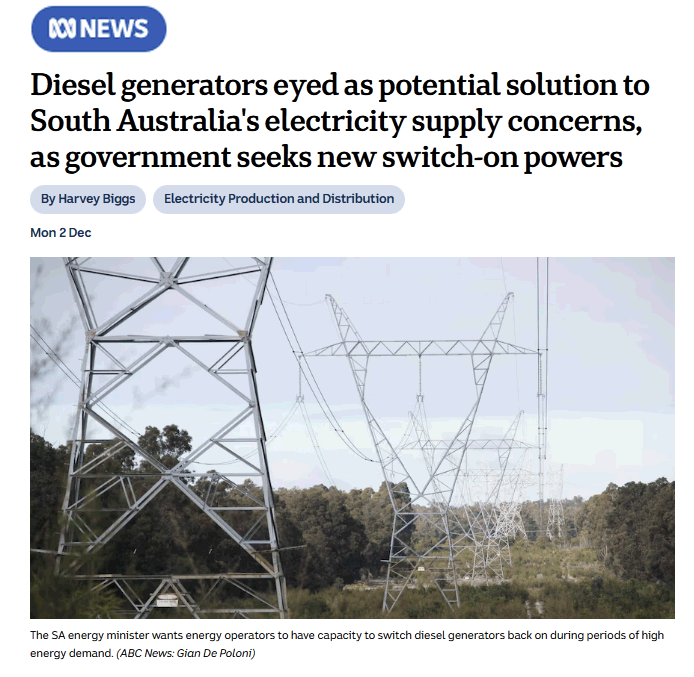
Diesel generators eyed as potential solution to South Australia's electricity supply concerns, as government seeks new switch-on powers

The Frankenstein economy fails (again)

The government created a monster — an artificial market that favoured random energy and drove dependable power out of business. So, not surprisingly, now they have to do emergency market surgery and spend even more money, to force Engie to reopen these uneconomic plants.

The fact that essential plants are “uneconomic” only shows what a Quasimodo market this is. If the rules favored the cheap reliable electricity (that customers want) instead of hobgoblin-electrons that change the future weather (maybe), no one would have to order Engie to restart the plants. They wouldn’t have gone out of business. Instead, a bunch of unreliable wind farms and fields of glass would never have been created. No one could afford to build them with their backup or their batteries or their 1,000 miles of wires.

Excuses, excuses

It’s not that the South Australian government has only just realized summer has arrived (unexpectedly in December), apparently it’s because the interconnector they’re building to NSW is 12 months behind schedule. Which might make sense, except it was not scheduled to finish until mid 2026 in any case:

Mr Koutsantonis has warned the forecast for the reliability of power supply in SA this summer – which shows a predicted shortfall of 200 megawatts — has been underestimated because the AEMO has not accounted for the delay in a new interconnector with New South Wales.

It [EnergyConnect] was due to be completed by July 2026 but is currently about 12 months behind schedule.

Somehow we’re supposed to believe the blackout risk is higher this summer because a high voltage line that dead-ends 900 km away should have reached a couple of hundred kilometers closer. Like that would help…

In the next breath the Energy Minister admitted that this is really about what happened in Sydney last week:

Mr Koutsantonis argued energy operators needed greater powers to bring back thermal generators “to address reliability risks arising during the peak demand periods expected from December 2024”.

Speaking on 5AA radio on Monday, Mr Koutsantonis said: “given what happened in New South Wales last week, when they had one 40 degree day and they were nearly short on power, and told people to turn their air conditioners off and not turn dishwashers on, if we rely on an interconnector to New South Wales and it’s hot across the entire national electricity market, we’re in trouble”.

The South Australian Energy Minister has just realized that even when the $2 billion dollar interconnector is finished, they don’t want to rely on our most populated state’s electricity grid, because it’s a debacle.

Is this the moment when the fantasy of saviour interconnectors came undone?

South Australia has walked the plank right out to 70% renewable energy, a feat only possible because of they are just 6% of a larger stable system. So far the baseload power in other states could keep the lights on in South Australia,  and interstate homes and factories could soak up their excess solar and wind power. But this isn’t a game every state could play.

South Australia was the Show Pony for renewable energy, but it was an illusion based on reliable energy hidden in other states.

Now finally the Energy Minister of South Australia gets it:

“Every state should have sufficient capacity to look after itself first and not rely on other jurisdictions,” he said.

These two diesels plants are not large. Engie, the French electricity giant owns the 75 megawatt (MW) Port Lincoln plant and the 63MW Snuggery plant that were closed in July this year.

Apparently when the Federal government got puritanical about their “capacity investment scheme” they ruled out fossil fuel generators, which meant Engie mothballed the diesel generators. (Reneweconomy)

But we didn’t need “capacity investment schemes” before we had renewable subsidies, and if we had a free market in capacity the diesel generators could still have saved the day. We’re up to second and third order screwiness in this market.

The more Frankenstein-markets we make the sooner we get to the Tragedy.

h/t OldOzzie, Neville, David Cooyal in Oz


0 out of 10 based on 0 rating

via JoNova

https://ift.tt/anv0cYL

December 3, 2024 at 02:14PM

Climate Change over the past 4000 Years

By Andy May

I last wrote about Climate Change and Civilization for the past 4,000 Years in 2016. Since then, a lot has changed, and I’ve learned a lot more about the subject. First, we learned that various air and sea temperature proxies, such as ice core δ18O or tree rings, are all different. For a discussion of some temperature proxies used and the problems with them, see here. Proxies have different accuracies, they are often sensitive to the temperature of different seasons, and they have different temporal resolutions. Thus, as pointed out by Soon and Baliunas in 2003, they are all local and “cannot be combined into a hemispheric or global quantitative composite.”

The global average surface temperature (GAST) reconstruction relied upon in the IPCC AR6 report was by Kaufman, et al. The authors admit that the average spacing of each temperature (the temporal resolution) is 164 years. Thus, to compare the entire global instrumental temperature record to the proxies in a valid way, one must average all the daily readings since 1860 into one point. That is, the rate of warming since 1860 is irrelevant, the proxy record cannot see a 164-year increase. The problem of comparing daily modern instrumental temperature records to proxies is discussed by Renee Hannon here.

Temperature Proxies

Most temperature proxies are sensitive to only one season, yet it is clear that seasonal temperatures vary at different rates and yearly average temperatures vary differently than seasonal temperatures. Mixing them statistically to create an accurate GAST record of the distant past is not possible. This problem is discussed in more detail here and here. Further most proxies are affected by precipitation frequency and/or CO2 levels as well as temperature. We know CO2 is higher today than in the past few thousand years and cannot correct for precipitation frequency or amount.

While combining hundreds of proxies into one composite “global” or “hemispheric” record is a fool’s errand, we can look at high-quality, high-resolution local proxies from multiple places to get a qualitative sense of global or hemispheric climate changes, which is also what Soon and Baliunas did in 2003. Two records are especially helpful, they are the Greenland ice core record by Vinther, et al. and the Indonesian Throughflow 500-meter water depth record from the Makassar Strait by Rosenthal, et al. The Makassar Strait record is representative of northern Pacific sea surface temperatures and the Vinther Greenland record is representative of air temperature in the Greenland-Renland-Agassiz area. The Vinther record is superior to the more commonly used GISP2 record (Alley, 2004) & (Alley, 2000) because it accounts for elevation changes and ice flow. Both corrupt the GISP2 reconstruction.

Both the Vinther and Rosenthal temperature records have a 20-year resolution over our 4,000-year period, which is a good resolution for proxies. Accuracy is good in both records and about ±0.3°C. Both are Northern Hemisphere proxies but are located 9,500 miles apart. They are compared to a comparable (10-year resolution) Antarctic proxy (Jouzel, et al., 2007) in figure 1. As you can see, averaging Northern Hemisphere proxies with Southern Hemisphere proxies is not always a good idea, temperature trends vary with latitude.

Figure 1. Proxy temperatures for the Holocene from Antarctica (Dome C, Jouzel et al., 2007), Greenland (Vinther), and Indonesia (Rosenthal). The Neoglacial climatic period is labeled. It is a Northern Hemisphere temperature decline.

As figure 1 suggests the long decline in temperature labeled the “Neoglacial” is mainly a Northern Hemisphere phenomenon, this is more clearly seen in figure 1 here. Figure 2 compares the Vinther and Rosenthal records from figure 1 with selected historical events and Usoskin’s solar grand minima (SGM) record (Usoskin, 2017) shown as orange outlined black dots. Notice the smoothed version of the Vinther record is plotted in figure 1 and the unsmoothed 20-year record is plotted in figure 2. To see figure 2 in full resolution, click on the image or here. The figure prints well on 8.5×11 inch or A4 paper.

The Blytt-Sernander climatic periods (Schrøder, et al., 2004) are identified at the top of figure 2. Below that the Vinther and Rosenthal proxy temperature records are plotted along with major historical events. The red dashed line on the right is a smoothed HadCRUT4 composite of the six populated grid cells (meaning grid cells with temperature values) near Greenland that have sufficient data since 1850. The line was adjusted vertically to the Vinther record where they overlapped. Both the Vinther and the 20-year smoothed HadCRUT4 records show a peak near 1934. The Rosenthal record is from 500 meters down in the Makassar Strait in Indonesia. The red box is the average temperature, at the same depth, from 2004-2016, from the University of Hamburg global ocean climatology database (Gouretski, 2019).

Figure 2. The Vinther (black) and Rosenthal (green) proxy temperature records compared to major historical events. The Greenland area HadCRUT4 anomaly is a dashed red line and the University of Hamburg Makassar Strait 500-meter temperature is shown as a red box. Click on the image or here to see in full resolution.

Major historical climatic periods are identified below the solar grand minima. Both proxies show a decline in Northern Hemisphere temperature that bottoms out between 1700 and 1810. Taken together they show peaks from 800 to 1000AD (the Medieval Warm Period), 500BC to 400AD (Roman Warm Period), and 1700BC to 1000BC (Minoan Warm Period). Significant differences in the proxies appear from 1400 to 800BC, 200BC to 0AD, and 300 to 500AD.

Historical Details

In 2000BC the most advanced cultures in the world were in the eastern Mediterranean and they were in disarray. The Egyptian Old Kingdom had collapsed and was in the Egyptian Dark Age, before that the Akkadian Empire (mostly in present day Iraq) had collapsed. What grew out of the chaos were the Egyptian New Kingdom in 1975BC and the development of the great Minoan “Palaces” on Crete and the surrounding islands. The Minoans had the most advanced ships of the time and traded widely. The Minoan trading culture peaked between 1690BC and 1450BC when an unknown catastrophe destroyed all the palaces except Knossos on Crete (Cunliffe, 2008, p. 190). Knossos survived until the Mycenaean and Hittite civilizations collapsed in the great catastrophe of 1177BC (Cline, 2014).

Farther east, there was an advanced civilization in northwest India and Pakistan called the Harappa. While the Harappan civilization can trace its roots to 5500BC or earlier, the mature Harappan period existed between 2600BC and 1300BC when it collapsed. Although the Mesopotamian and Egyptian civilizations pre-date the Harappan, it was probably larger than they were (Britannica).

In China, the Shang Dynasty ruled most of the Yellow River valley from around 1600BC until about 1046BC (Britannica) when it collapsed and was overthrown by King Wu of Zhou. The final decades of the Shang Dynasty were very turbulent climatically and unusually cold and dry, with common dust storms. Ice appeared in the Yellow River and there were frequent harvest failures and famines. The poor weather aided King Wu’s conquest (Behringer, 2010, p. 57).

In 800BC there was a “Climate Plunge,” sometimes called the Hallstatt disaster, in Europe and the Middle East (Behringer, 2010, p. 60). It marks the beginning of the Iron Age in Europe and is associated with a drop in temperatures, longer winters, and glacier advances. Large scale migrations occurred, and civil wars broke out in Egypt.

China was finally unified by Ch’in about 200BC, but chaos ensued after his death and the Han Dynasty formed in 202BC. It lasted until 220AD. This is also the period when the Roman Empire was at its peak (Behringer, 2010, p. 62).

Grapes were introduced to Britain by the Roman Emperor Probus in 280AD. A worsening climate initiated the so-called “great migration” period about 250AD, it led to troubles in the Roman Empire and the collapse of the Han Dynasty in 220AD. Later, around 375 the Huns invaded Europe, driving the Germans toward Rome, which they destroyed. Rome had a brief revival about 400AD, but eventually collapsed. A climatic disaster about 537AD, possibly due to a major tropical volcanic eruption, aided in the fall of the Empire. This was near the beginning of the European Dark Age.

One of the most catastrophic climate disasters in recorded history occurred around 800 AD. In 843 a starving wolf burst into a church in Sénonais, France during services and attacked the flock. Charlemagne deployed teams of wolf hunters in every county of his kingdom. A third of the people in Europe died in 784AD. The decades around 800AD were miserable in Europe. Yet the period was unremarkable in China and Japan. However, the Maya suffered several severe droughts between 760 and 910AD and the Mayan government and nobility disappeared around 900AD amid a severe population decline (Behringer, 2010, p. 71).

Around the mid-800s the Vikings emerged as the North Atlantic warmed and they conquered portions of Britain, Ireland, Russia, France, and Sicily. The Medieval Warm Period began earlier in Northern Europe than in the south, which benefited the Vikings. They settled in Greenland in 985AD and they prospered until around 1410 when the last letter from Greenland arrived at the Vatican. Sometime after 1410 they all perished and some of their farms are now in permafrost. Ships trying to sail to Greenland during this time could not get past the abundant icebergs.

Little Ice Age

While most sources start the Little Ice Age around 1300, it did not begin in earnest until the late 1400s. The most severe part of the Little Ice Age was from about 1645 to 1715, although extremely cold periods occurred from 1310 to 1322, 1560-1600, and 1800-1850. The period from 1560-1660 became known as the “age of the witch persecutions” (Behringer, 2010, p. 130). There had to be someone or some group to blame for the lousy weather, and the group most often blamed were older single women. Others claimed the weather was a punishment from God for sins such as sodomy or staging plays.

The effect on society of the poor weather of the Little Ice Age was horrible. The mid-1600s saw more wars around the world than any other era until the 1940s (Parker, 2008). In the 1640s, the Ming Dynasty and the Polish-Lithuanian Commonwealth collapsed. Serious revolts shook the UK, Spain, Russia, France, and Istanbul. In London, King Charles I was the first king to be put on trial. One of China’s later emperors, Yongzheng, estimated that during this period over half the Chinese population died (Parker, 2008).

In France the Fronde Revolt (1648-1653) and the resulting illness, want, and misery may have killed two-thirds of the population of the villages around Paris. Thomas Hobbs wrote in 1651 that the “life of man is solitary, poor, nasty, brutish, and short” (Parker, 2008).

It wasn’t just the cold that made the Little Ice Age miserable, it was also drought, severe storms, and the occasional summers with extreme heat (May & Crok, 2024). The weather in the Little Ice Age was much more extreme than now. I have written elsewhere that storminess was worse during the Little Ice Age see figure 6 here. This is logical since colder periods have a steeper temperature gradient from the tropics to the poles and it is the gradient that powers storms.

As Geoffrey Parker writes, the extraordinary claims of misery of the people that lived in the 1600s have been shown to be correct. It is understandable that many today looking back on the period are skeptical of the stories, but they have been repeatedly shown to be true. The Little Ice Age was real, and devastating to humanity.

Conclusions

Many paleoclimatologists, archeologists, and historians agree that there is a correspondence between the level of solar activity and climate. They also agree that humans do better in warmer times than in colder times. It is time for the “consensus” to face up to the historical and archeological facts.

Download the bibliography here.

via Watts Up With That?

https://ift.tt/a1o7hwI

December 3, 2024 at 12:03PM

Return of an old chestnut: ‘Nearly all Arctic sea ice could melt by the summer of 2027’ (or maybe 2074?), scientists warn


We’re told this is ‘greatly concerning to researchers, who aren’t yet sure what repercussions it might have.’ But the piece mentions “catastrophic” so we get the idea. Snowfall on the Arctic land cancels out sea ice losses to some extent, but the article doesn’t mention it. Earlier predictions of the imminent demise of the summer sea ice were an embarrassing failure.
– – –
Nearly all of the Arctic’s sea ice could melt by the summer of 2027, a group of international scientists has warned. (From The Independent).

Sea ice – frozen seawater that floats on the ocean’s surface – in the region has diminished to near-historic lows following decades of shrinking and thinning in one of the fastest-warming areas on the planet.

The warming has been driven by ever-increasing greenhouse gas emissions: the result of humanity’s reliance on fossil fuels. [Talkshop comment – that’s just an IPCC hypothesis].

The day when the majority of the ice disappears is greatly concerning to researchers, who aren’t yet sure what repercussions it might have.

Research published Tuesday in the journal Nature Communications finds the Arctic will be “ice-free” when it has less than 1 million square kilometers of ice. The least amount of sea ice, which typically melts and reforms with the changing of the seasons, in a day this year was at 1.65 million square miles: a stark decline compared to the average between 1979 and 1992.

“The climate models show that unless we can stay below 1.5 degrees Celsius globally in the climatological average, which is becoming less and less likely every month basically, it’s guaranteed that we will see ice-free conditions this century,” Alexandra Jahn, an associate professor of atmospheric and oceanic sciences at the University of Colorado Boulder and co-author of the research, told The Independent on Monday.

Nations agreed in 2015 to limit global warming to 1.5 degrees Celsius of warming. But, the United Nations said in October that Earth is on the track for as much as 3.1 degrees – and that this could be “catastrophic.”
. . .
But, whether or not it happens, remains up in the air. There’s uncertainty in projections based on climate models. So, it could happen between three years and 50 years.

“These projections are probabilistic, so we’re not saying an ice-free Arctic will happen in three to six years. It’s really three to 50 years. That’s what the models are showing, depending on the variability and the strength of the global emissions … But, it could happen earlier than people might expect …” she said.

To avoid an ice-free day, the world must limit global warming, researchers warn. There is still a possibility that, if the world urgently acts, ice-free conditions may not ever come about, they say.

Full article here.
– – –
Image: Arctic Ocean ice [credit: Wikipedia]

via Tallbloke’s Talkshop

https://ift.tt/enx1yb4

December 3, 2024 at 11:54AM