Germany’s CO2 tax is set to increase from the current 45 euros a tonne to 55 euros at the turn of 2025… This will drive up heating and energy costs consumers and businesses.
The hefty rise means the tax on CO2 will almost double in just 2 years. In 2023, the carbon tax was 30 euros a tonne.
But it doesn’t stop there, reports Blackout News. The CO2 tax gets taxed by the value added tax, which is currently 19 percent.
“Households and businesses that rely on petrol, diesel, heating oil or natural gas are facing growing financial challenges, writes Blackout News. “A liter of petrol will be 4.3 cents more expensive due to the CO2 tax, diesel will rise by 4.7 cents per liter. Heating costs will also rise dramatically. A kilowatt hour of gas will become a further 0.21 cents more expensive, which means a total increase of 1.21 cents compared to the time before the CO2 tax. Heating oil costs 17.5 cents more per liter – an increase that affects many households.”
The sharp increases will certainly bode ill for the current SPD-Greens-FDP coalition government – which undergoes a vote of no confidence later this month in Parliament. A no-confidence vote will lead to the dissolution of parliament and thus a new election within 60 days of the vote.
The pain at the gas pumps and from higher utility bills will make the current coalition government partners even more unpopular. But whether a new government led by Friedrich Merz (CDU) will change anything remains highly doubtful. Only the opposition AfD party has staunchly opposed the CO2 tax. Currently Merz’s CDU party is well ahead in the polls.
65 euros per tonne in 2026
The CO2 tax is set to rise to 65 euros a tonne in 2026, making the energy cost gap between Germany and other countries potentially unsustainable. Already there’s a growing dissatisfaction among German citizens and businesses as energy prices skyrocket into the stratosphere. Meanwhile the Trump administration as signaled a strong interest in making energy affordable again in USA.
Who’s profiting from the CO2 tax? The government.
According to Blackout News: “More than 18 billion euros flowed into the coffers, including 10.7 billion euros from national emissions trading for heat and transport. Compared to 2022, revenue in this area increased by 67 percent. Revenue from European emissions trading also increased by 12% to €7.7 billion.”
British bill payers have spent an “absurd” £1bn to temporarily switch off wind turbines so far this year as the grid struggles to cope with their power.
The amount of wind power “curtailed” in the first 11 months of 2024 stood at about 6.6 terawatt hours (TWh), according to official figures, up from 3.8 TWh in the whole of last year.
Curtailment is where wind turbines are paid to switch off at times of high winds to stop a surge in power overwhelming the grid. Households and businesses pay for the cost of this policy through their bills.
The cost of switching off has reached about £1bn so far this year, according to analysis of market data by Octopus Energy which was first reported by Bloomberg. This is more than the £779m spent last year and £945m spent in 2022.
The jump in curtailment follows the opening of more wind farms at a time when the country still lacks the infrastructure needed to transport all the electricity they generate at busy times.
The real problem currently is the lack of transmission capacity between Scotland and the South, where demand is. But that is ignoring the real issue, which is that we should never have built wind farms in remote places where there is no demand in the first place. And the cost of new transmission capacity should have been built into the business case before construction went ahead. If that had been done, wind farms in such places would never have been viable.
The Grid of course are now planning to spend over £100 million on upgrading the transmission network, but the real problem going forward is that there will huge amounts of surplus wind power once Miliband has quadrupled wind power capacity. As the Telegraph notes:
According to the National Energy System Operator (Neso), curtailment costs are on course to surge to £6bn by 2030 if the status quo continues
Although this is not a new debate it is still worth watching because the arguments brought out in it are still relevant today and the standard of both speakers is excellent. A vote was taken at the start of the debate and at the end. Both results were only revealed at the end. I will not spoil the ending for you.
“It is our sincere hope that the incoming Trump Administration, the Department of Energy, the newly formed National Energy Council and/or its Department of Government Efficiency (DOGE) make use of these resources in considering what to overhaul and what to scrap.”
The incoming Trump Administration, committed to tame inflation and the Deep (Administrative) State, recognizes energy as the master resource. This blogsite by the same name was established in 2007 to demonstrate the importance of energy exceptionalism free-market style.
Politicized “energy efficiency” policies increase costs and limit choice for consumers, thus the need for government mandates and subsidies. The failed history of government in this area–and why–are cross-referenced here by author and subject. These resources are freely available to anyone interested in the evolution of energy policy.
It is our sincere hope that the incoming Trump Administration, the Department of Energy, the newly formed National Energy Council and/or its Department of Government Efficiency (DOGE) make use of these resources in considering what to overhaul and what to scrap.
Of particular interest to us is the Department of Energy (DOE) Office of Energy Efficiency and Renewable Energy (EERE). Simply put, EERE is obsolete and counterproductive to a free-market economy. Structural reformation of EERE is overdue for improving consumer choice and prosperity. And it is a relatively easy budget cut.
The Krebs category uniquely provides the devils-in-the-details of how EERE routinely flouts its own laws and regulations and manipulates “data” to stifle legitimate interests of everyday consumers. Further, the original justification for EERE, dating back to the 1970’s oil embargoes, has long been solved. Some 50-years later, it’s well past time to declare victory and move on.
Beginning in 2013, Mark Krebs (with frequent collaboration from Tom Tanton) has authored 60 articles at MasterResource. It is our hope that these articles (listed below) provide the incoming Trump Administration with ample rationale for eliminating EERE.
Major Themes
These are the top four re-occurring themes:
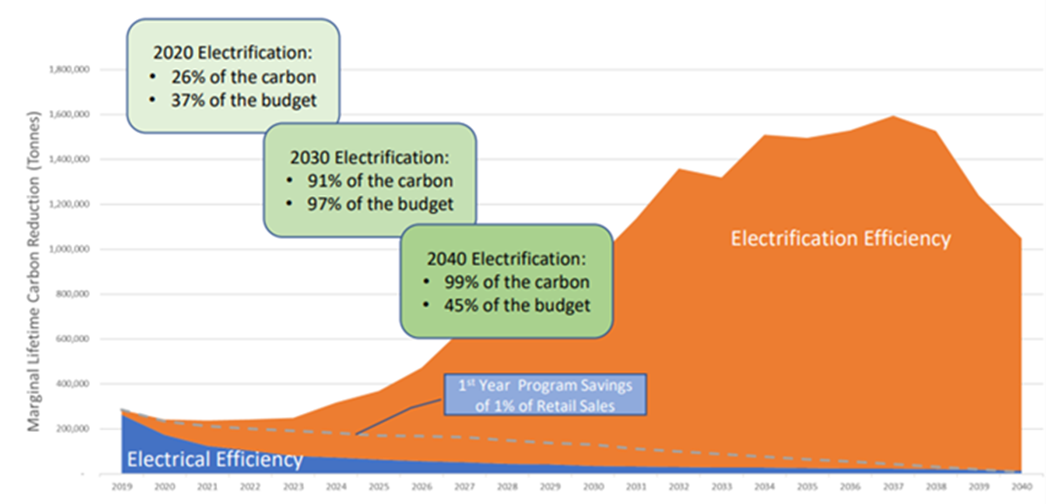
EERE’s irrational push for societal electrification via renewable generation is Congressionally unauthorized mission creep that overloads already challenged electric grids and will conservatively cost taxpayers $18-29 Trillion. Others estimate “electrifying everything” can’t be done at any cost due to raw material constraints.
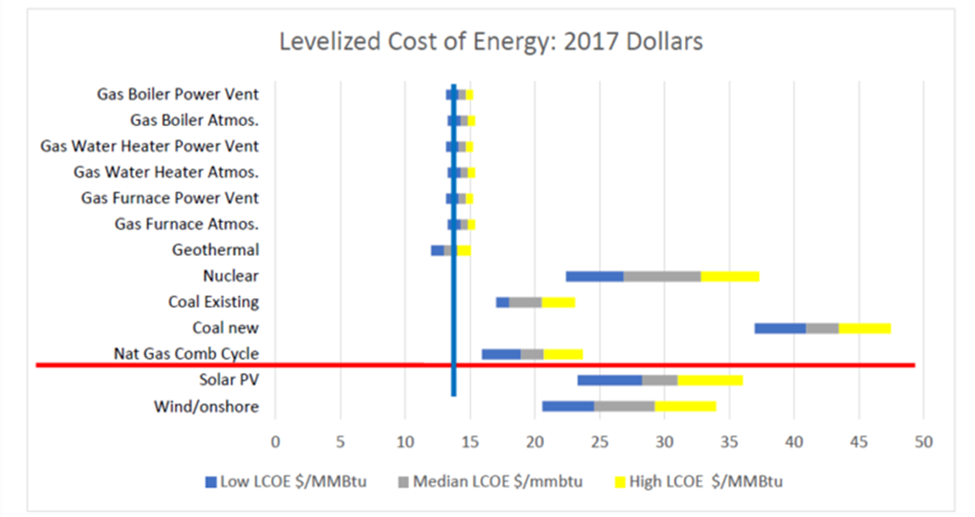
EERE’s renewable energy favoritism further inflates electricity costs and reduces energy security through limiting energy diversity and shifting the market to electric appliances.
EERE and its beholding minions (e.g., the “National Labs”) routinely “pack the bleachers” and rig the apparatus of so-called “consensus” building energy codes to move the market to electrocentric “net zero” construction. The added expenses of such homes deters the American Dream of home ownership.
Illustrations
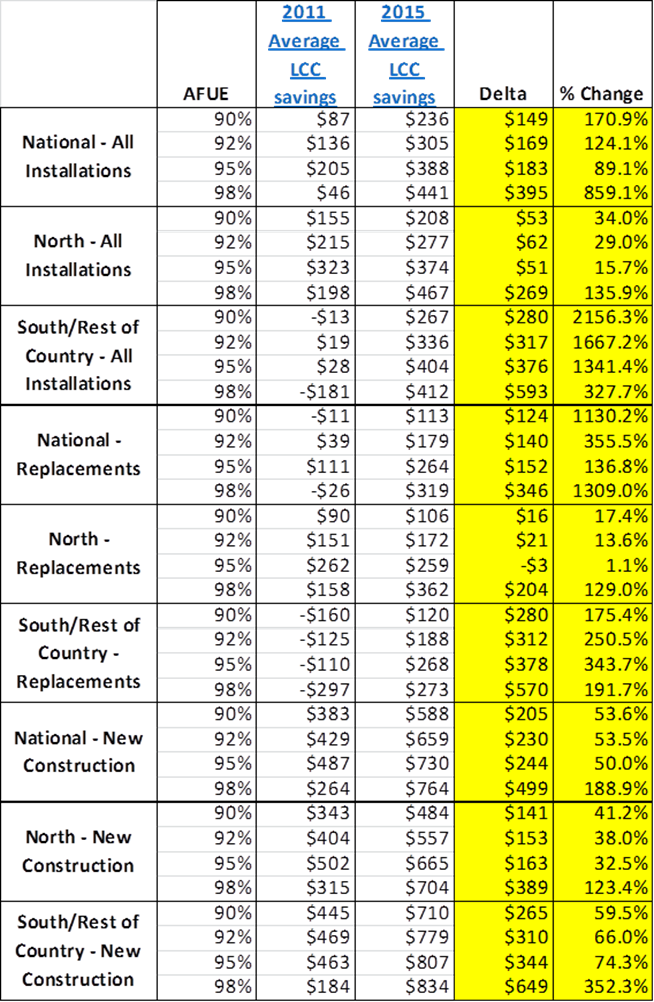
Pictures can be worth a thousand words when it comes to understanding EERE’s self-serving motives. The most pernicious of which is arguably its self-serving empire building/mission creep of the “Deep State.” Here are pictorial examples:
Comparison of 2011 & 2015 Life Cycle Cost (LCC) Spreadsheet Cost-Saving Inflation Calculations for Non‐Weatherized Residential Gas Furnaces
Archive Posts
While several other excellent analyses populate the MasterResource’s energy efficiency category, authors Krebs and Tanton[1] are the most prolific and proficient in documenting and explaining the routine gaming of DOE’s “energy efficiency” policies. The following is a listing of the complete “Krebs Category:”
MasterResource has long documented DOE’s abuse of its of energy efficiency authority (predominately through articles by Krebs and Tanton) in the hope that the time would come for someone willing, able, and insightful enough to make significant course corrections. Finally, with the Trump 47 Administration, the time is now to purge the Deep State’s self-serving, empire building/mission creep that permeates EERE. Please feel free to contact us as shown below, if we can be of further assistance.
Mark Krebs (markedwardkrebs@gmail.com), a mechanical engineer and energy policy consultant, has been involved with energy efficiency design and program evaluation for over thirty years. Mark has served as an expert witness in dozens of State energy efficiency proceedings, has been an advisor to DOE and has submitted scores of Federal energy-efficiency filings. His many MasterResource posts on natural gas vs. electricity and “Deep Decarbonization” federal policy can be found here. Mark’s first article was in Public Utilities Fortnightly, titled “It’s a War Out There: A Gas Man Questions Electric Efficiency” (December 1996). Recently retired from Spire Inc., Krebs has formed an energy policy consultancy (Gas Analytic & Advocacy Services) with other veteran energy analysts.
Tom Tanton (tantontwitter@gmail.com) is a Director of the Energy and Environmental Legal Institute. Mr. Tanton has 45 years in energy and environmental policy, focused on enabling technology choice and economic development. Mr. Tanton has testified to numerous state Legislatures and Congress as an expert on energy policy. He formerly served as Principal Policy Advisor at the California Energy Commission.