Wind and Solar Are Fragile

“As a result of hail and other weather damage, insurance premiums for solar facilities are skyrocketing, in some cases up by as much as 400%. In addition, policy coverage is being capped at as little as $10-15 million, requiring system developers to obtain multiple policies to try to cover their projects.”

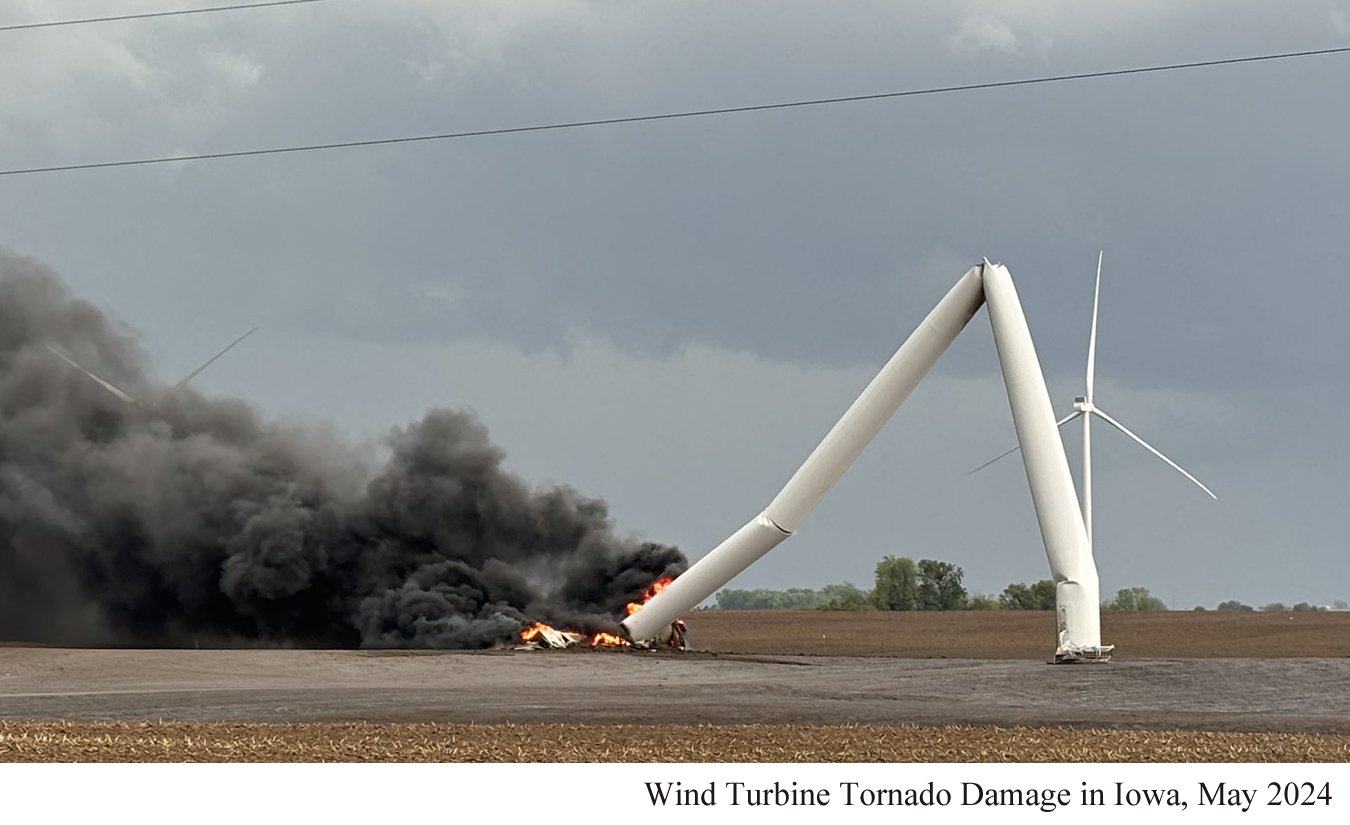
Wind and solar have been growing as a share of US electrical power generation over the last two decades. State and federal mandates and subsidies have driven the expansion of renewables because of their inherently dilute and intermittent nature. But it’s clear that renewable electricity sources have a third strike: they are fragile and prone to weather damage and destruction.
Twenty-three states now mandate Net Zero electricity by as early as 2035. Their aim is to replace coal- and gas-fired power plants with wind and solar generators. Wind and solar have grown from near zero in 2000 to 14.1% of US electricity generation in 2023 (10.2% wind and 3.9% solar). 

Weather Risk

Wind and solar systems are located on ridge lines, on plains, and offshore, and are exposed to weather forces that usually don’t affect building-housed coal and gas generators. In addition, these systems require about 100 times the land area of traditional generators to deliver the same average electricity output, increasing the chances of storm damage. Damage incidents are rising as more and more systems are deployed.

In May 2019, a massive hailstorm in West Texas destroyed 400,000 solar modules of the Midway Solar Project, about 60% of the facility. The project was only one year old. The system was rebuilt, costing insurers more than $70 million.

On June 23, 2023, the Scottsbluff solar system was destroyed in western Nebraska. Baseball-sized hail falling at up to 150 miles per hour smashed most of the 14,000-panel system. The system had only been operating for four years of its 25-year lifetime and had to be completely rebuilt.

Solar loss insurance claims from hail damage now average about $58 million per claim. Hail damage claims have increased to account for about 54% of solar insurance loss claims. Analysis by Iowa State University shows that severe hail (greater than one inch in diameter) can occur for 20 to 30 days per year in Great Plains states, a wide area of the country stretching from North Dakota to Texas and Colorado to Indiana.

“Fighting Jays Solar” became operational in July of 2023, 40 miles northwest of Houston, Texas. Less than one year later, on March 15 of this year, hail destroyed much of the system, with repair costs estimated to be hundreds of millions of dollars. The system had not yet completed full construction.

Hail is not the only weather hazard facing solar installations. This fall, a tornado associated with Hurricane Milton destroyed much of the Lake Placid Solar Plant in Sylvian Shores, Florida. The facility had only been operating for about five years.

Insurance and Liability Ahead

As a result of hail and other weather damage, insurance premiums for solar facilities are skyrocketing, in some cases up by as much as 400%. In addition, policy coverage is being capped at as little as $10-15 million, requiring system developers to obtain multiple policies to try to cover their projects.

The federal government has been promoting the installation of wind systems off the US East Coast. Maryland, Massachusetts, New Jersey, New York, North Carolina, South Carolina, Rhode Island, and Virginia are constructing or planning offshore wind systems. But offshore wind must operate in one of the world’s harshest environments, buffeted by wind, waves, lightning, and salt spray that is very corrosive to man-made structures.

To date, most offshore wind systems have been deployed in China, Europe, and Vietnam. These systems are prone to weather damage. Turbines deployed in Asia coastal areas suffer typhoon wreckage. Eighty percent of the turbines installed in Europe’s North Sea have required repairs due to weather damage.

The London Array, east of England, the world’s largest offshore wind system, required extensive repairs after only five years of operation. Danish wind operator Ørsted needed to repair undersea cables to offshore wind systems in the North Sea at a cost that exceeded $100 million.

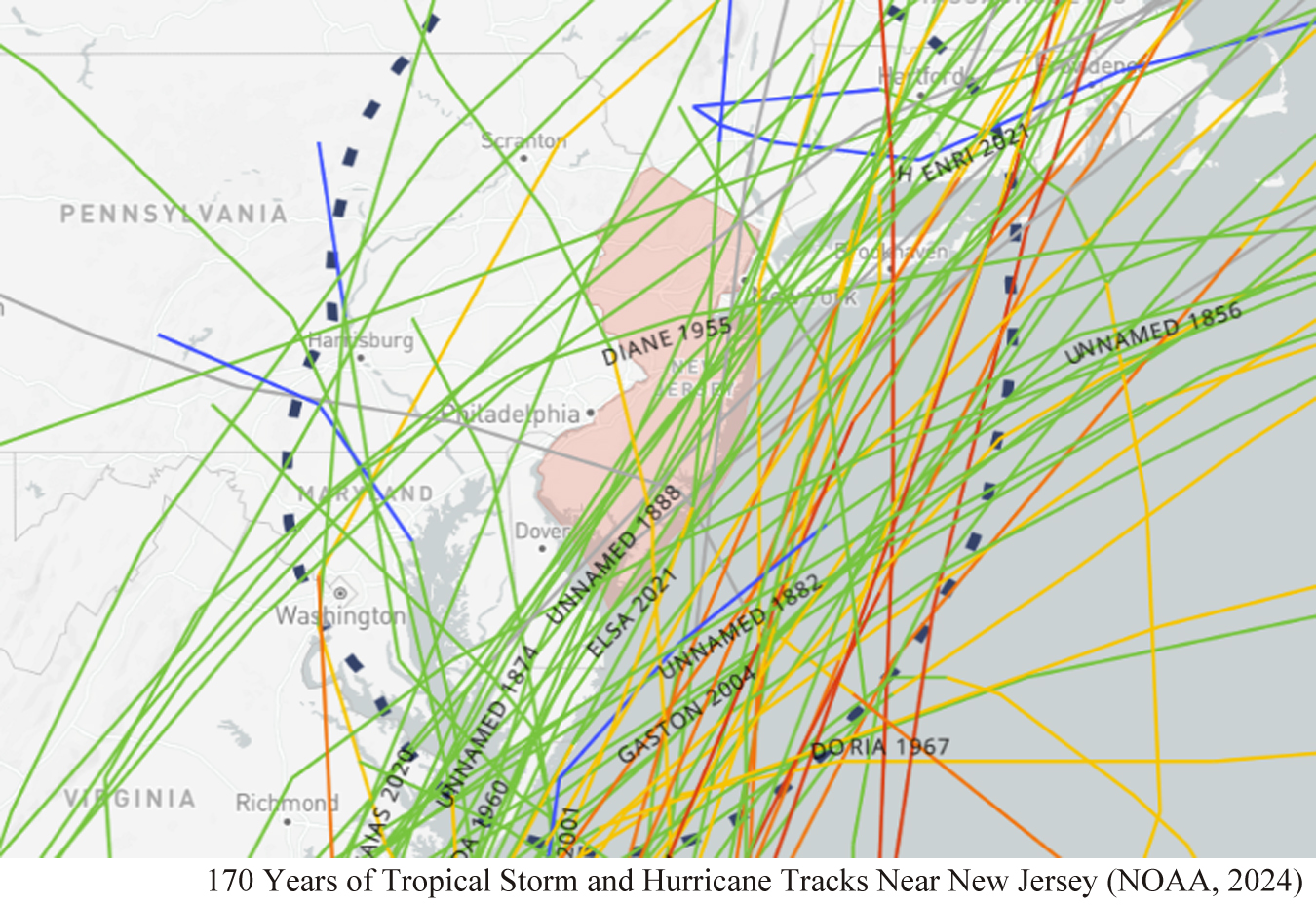
But turbines sited off the US East Coast must survive brutal weather, more severe than offshore turbines in Europe. Tropical storms, hurricanes, and nor’easters periodically traverse the coastal sites planned for new offshore wind systems.

For example, historical data from the National Oceanic and Atmospheric Administration shows that 26 hurricanes and 51 tropical storms passed through New Jersey coastal waters during the last 170 years, or almost five storms each decade. Wind installations will be vulnerable to these weather systems.
In 2018, Hurricane Maria passed over Puerto Rico, ripping blades from many turbine towers. East Coast wind systems will likely suffer the same fate.

Wind systems are designed to try to protect wind towers and blades in high winds. When winds exceed 55 MPH, a braking system brings the rotor to a standstill to try to avoid turbine damage. Tower blades are also “feathered” or oriented so that they no longer catch the wind.

But near the eye of a hurricane or tropical storm, violent winds can change direction instantaneously and powerfully, too fast for damage-prevention systems to react. The result will be destroyed blades and damaged towers.

Conclusion

In July, a 351-foot-long offshore wind blade splintered and washed up on the beaches in Nantucket, Massachusetts. Beaches were closed and clean-up crews collected six truckloads of fiberglass and plastic debris from the single destroyed blade. Wind operations were temporarily shut down.

Residents, beachgoers, fishermen, and local businesses posted signs, complained to the press, and spoke out at board hearings. But this was just one turbine blade. Image the outcry when a whole offshore system is destroyed by a hurricane, producing mountains of beach debris at Myrtle Beach, Virginia Beach, Atlantic City, or Long Island?

Media headlines claim that weather is becoming more extreme because of human-caused climate change. But to solve the problem, it’s proposed that we install more and more wind and solar systems, which are fragile and vulnerable to violent weather. Incidents of weather destruction of wind and solar installations will continue to rise.

—————-

Steve Goreham is a speaker on energy, the environment, and public policy. His books include the bestselling Green Breakdown: The Coming Renewable Energy Failure.

The post Wind and Solar Are Fragile appeared first on Master Resource.

via Master Resource

https://ift.tt/jsNEafr

December 2, 2024 at 01:06AM

How the Rush to Net Zero is Accelerating Britain’s Industrial Decline

From THE DAILY SCEPTIC

by Sallust

It’s Toytown basic economics that the price of any commodity or service is determined by the relationship between supply and demand. The less there is of anything, the higher its price will be, depending on the level of demand. The greater the level of supply the lower the price, and thus the greater the demand and usage.

Nothing could exemplify that better than energy. Restricting the supply of energy whether by design or circumstance, or even elevating the price artificially with taxes and levies, is bound to inhibit demand. And that diminishes the economy.

The Telegraph has published an article by Jonathan Leake on how Net Zero has accelerated Britain’s national decline:

For Ed Miliband and Sir Keir Starmer, Net Zero is the route to clean energy, economic growth and turning the U.K. into a global green superpower.

Across the Atlantic, however, Britain’s drive for “decarbonisation” is increasingly seen as an economic experiment – one that risks tipping the U.K. from miniscule economic growth into full-scale decline.

Chris Wright, Donald Trump’s nominee for US energy secretary, has warned that Britain’s rush to ditch fossil fuels in favour of wind and solar power is causing higher prices, driving away energy-intensive businesses and contributing to Britain’s national decline.

“The U.K., although no longer part of the EU, has continued aggressive climate policies that have driven up energy prices for its citizens and industry,” he wrote in a recent report. “The once world-leading United Kingdom now has a per capita income lower than even the poorest state in the United States.”

Leake doesn’t dispute the effects of climate change or “other consequences of greenhouse gas emissions”. His main point is that a key part of Net Zero policy is to reduce energy usage, but only in Britain. How much less?

To quote the Government’s advisory Climate Change Committee: “In our Balanced Net Zero Pathway, the U.K. economy becomes much more energy efficient, with total energy demand falling by around 33% in end-use sectors between now and 2050.”

Improved efficiency – delivering more output for the same amount of fuel, or less – could help to deliver a reduction in energy consumption. Yet huge advances would be necessary to yield a reduction in consumption of a third. Many observers believe the tail will wag the dog when it comes to this target, meaning the U.K. may be forced to curtail energy use in order to hit it.

For Wright and others, slashing energy consumption by a third and still expecting growth is heresy – an economic experiment no other country has achieved, or even attempted before.

Their view – one supported by most economists – is that access to energy has historically always been directly related to prosperity. The more energy we have, the richer we will become. And if we have less, we get poorer.

Britain’s Industrial Revolution, driven by cheap and abundant coal, is proof, Wright says, of the theory. But with decline in energy usage now far advanced, it’s clear the prioritising of climate targets is having a drastic impact on Britain’s wealth and productive capacity.

In 1970, U.K. industry consumed the equivalent of 62 million tonnes of oil each year, making most of what the nation needed including energy intensive products like steel, cement and petrochemicals. Manufacturing was by far the largest sector of the economy, contributing 30.1% of total output.

Last year, manufacturing accounted for just 9% of the U.K.’s economy.

The point is that a key part of Net Zero policy is to reduce energy usage, but only in Britain. Other countries don’t matter because it’s all about the U.K. Government’s climate policy.

For example, one of the U.K.’s proudest boasts is that it has slashed emissions from more than 800 million tonnes in 1990 to just under 400 million tonnes in 2023. These figures refer to the greenhouse gases emitted within Britain’s borders, from power stations, vehicles, homes, offices and industry.

However, it excludes all the emissions generated from things we buy from abroad, including cars, clothes, steel and cement. Such “consumption emissions” have grown, from under 200 million tonnes of CO2 in 1990 to 400 million tonnes today

If you add our overseas and domestic emissions together, the overall U.K. carbon footprint is about 800 million tonnes. This is only a slight decrease from 1990 and the U.K. has paid a pretty high price to achieve it, including continuing high energy prices and increased vulnerability to global price shocks and shortages.

“The U.K. has too little production, too much consumption, too little savings and too much debt,” Dieter Helm, Professor of Energy Economics at Oxford University, wrote recently. “Perhaps not surprisingly, since it takes time for the politics to catch up with the economics, the new Labour Government is in the process of doubling down on all four of these.

“Current (and proposed) economic policy is perpetuating an unsustainable economy. What is unsustainable will not be sustained. It will have to end, probably in a series of economic crises played out into the future. The next generation will pay the price.”

Leake goes on to explain that the U.K. is not the U.S. and does not have abundant supplies of energy on its doorstep. Britain is dependent on imports.

The key conflict then is between replacing old sources of energy with new ones or simply reducing energy consumption. Britain is steadily running down its oil-refining and steel-manufacturing capacity.

For Miliband, falling energy consumption is a sign of progress rather than an ominous portent. A spokesman for the Department of Energy Security and Net Zero said: “Making the U.K. a clean energy superpower is essential to end the U.K.’s dependency on insecure fossil fuel markets.”

Exactly where we are headed is therefore not clear. It’s also a moot point whether any government can survive enforcing a vision of the future with policies that seem destined to make people poorer, more immobile, colder, hungrier, and with less and less choice in the matter.

Readers may remember the irony of this pronouncement five-and-a-half years ago:

“We will be able to look back on this period – this extraordinary period – as the beginning of a new golden age for our United Kingdom.”

Boris Johnson, statement to the Commons July 25th 2019

He was right about it being an extraordinary period.

The Telegraph piece is worth reading in full.

via Watts Up With That?

https://ift.tt/HSbadGV

December 2, 2024 at 12:00AM

Automakers may rue choosing bureaucrats over customers

From CFACT

By Duggan Flanakin

Whatever happened to the old bit of business wisdom: The customer is always right?

U.S. and European automakers abandoned this mantra to please unelected bureaucrats in Brussels, New York, and Doha and the sycophants who rose to political power by championing their prophecies of doom. They may now be regretting that “gung-ho” accession to the marching orders of the climate commandos.

Today, the sign of doom in the auto industry is lots full of unsold battery-electric vehicles (BEVs) that customers have said for years they do not trust with their lives and fortunes.

Admittedly, the post-COVID inflationary spiral that has led to soaring interest rates has not helped the auto industry, but far too many of their woes are self-inflicted. Meanwhile, the Chinese are smiling, knowing they hold four aces in their hands.

General Motors CFO Paul Jacobson in June announced a 50,000 cut in BEV production. The reason? “We don’t want to end up in a position where we give out a production target and then we just blindly produce and end up with hundreds of thousands of vehicles in inventory because the market’s just not there yet.”

Perhaps Jacobson was reading the tea leaves, predicting a Trump victory that could signal the end of the $7,500 tax credit under Biden’s misnamed Inflation Reduction Act. Or maybe he was looking at the numbers showing over half the public has zero interest in buying a vehicle that does not meet their real-world needs.

Or maybe Jacobson had realized that most of the billions of taxpayer dollars allocated to build out a charging network had disappeared down a rabbit hole.

No matter. GM just announced it was cutting 1,000 jobs and promising to provide incentives equaling those from that likely canceled $7,500 tax credit.  This was on top of the September layoffs of 1,700 factory workers. GM had earlier reported a $1.7 billion loss in the sales and production of its BEVs in the fourth quarter of 2023.

Ford, equally desperate to unload its BEV inventory, announced in September that BEV chargers and home installations would be covered in the purchase price of their Model e BEVs. The downside of this bold move is that Ford lost nearly $130,000 on every one of the 10,000 BEVs it sold during the first quarter of 2024 and projects a $5 billion loss on the Model e line for 2024.

Ford also furloughed 730 factory workers and halted production of its BEV F-150 Lightning pickup truck, 2023’s “truck of the year,” until next year “amid waning consumer demand for electric vehicles.” But the real problem may be that BEV pickups are, as one auto industry maven said, “the wrong product”?

Earlier, Ford had scrapped plans for an all-electric, three-row SUV to focus on hybrid models that use an entirely different technology and offer longer driving ranges and greater affordability. All this despite a nationwide 2-year drop in BEV prices from $65,000 to $56,648.

And just this week, Ford announced it was cutting 4,000 jobs, mostly in Germany and the United Kingdom – a 14% cut in its European workforce. Ford cited weak BEV demand, poor government support for the BEV shift, and competition from subsidized Chinese automakers.

Auto rental giant Hertz just expanded its BEV selloff, with used Tesla Model 3s now available for under $20,000. Hertz hopes to sell off 30,000 BEVs as it withdraws from the BEV market, but the 89% increase in BEV depreciation costs (about $537 per vehicle per month) has impacted its bottom line. Tesla’s own price reductions apparently created a ripple impact in the used BEV market.

Meanwhile, the Detroit Free Press reported in October that “it’s been a noisy, turbulent and troubling year for [Stellantis], the automaker that owns the Jeep, Ram, Chrysler, Dodge, and Fiat brands, and the future isn’t exactly clear.” During 2024, said the paper, Stellantis haws seen consecutive quarterly reports of 20% or more in declining U.S. sales after “eye-popping profits” in 2023. The company has also paused production at its Italian plants several times this year.

Elsewhere in Europe, despite equally draconian BEV mandates, automakers are approaching panic mode over the wide gap between customer choice and government mandates.

Germany’s largest auto insurer reported that one in three BEV owners switched back to gasoline or diesel vehicles this year, up from 14% in 2021. The drop could stem from the abolition of the taxpayer-funded $4,900 to $6,500 discounts. Or maybe, as one German reporter observed, “Apparently, electric cars cannot convince many owners to stick with this form of propulsion in the long term.”

Things are so bad in Germany that Volkswagen, for the first time in its 87-year history, is planning to close “at least” three of its factories, lay off tens of thousands of employees, and downsize its remaining German plants.

A recent survey showed that only 29% of Germans would comply with a law forcing them to buy BEVs and just 18% would consider a BEV for their next purchase. Worse, just 3.6% of ICE drivers switched to BEVs in Germany this year, and BEVs accounted for just 2.9% of all vehicles on Germany’s highways.

The collapse of Germany’s governing coalition is in part due to its ongoing commitment to banning the sale of most ICE vehicles by 2035. Germany also suffers from the high cost of electricity, fueled largely by taxes, that only add to the cost of an all-electric vehicle fleet. The influx of cheap Chinese BEVs only adds to Germany’s woes in a nation that has depended on the automobile for 8% of its annual economic output and 16% of its exports.

In the United Kingdom, sales of BEVs are failing to keep up with the wider market, according to the BBC. While fleet BEV sales increased, sales of BEVs to individuals fell by 7.7%, reflecting (according to the Society of Motor Manufacturers and Traders) “low growth, weak consumer confidence, and high interest rates.” This prompted SMMT to urge the Starmer government to provide incentives to get private buyers to choose BEVs.

While Jaguar rebrands itself to please a societal fringe, British automakers were shocked by a Court of Appeal ruling that auto dealers have a “fiduciary duty” to inform customers about bonuses, commissions, and fees they receive from lenders.

Lenders responded by barring auto dealers from receiving commissions on the 90% of vehicles purchased via auto loans. The decision could lead to the closure of auto dealerships, forcing people to buy directly from the manufacturer, usually sight unseen. But it could also lead to a major downward trend in auto purchases, as people are accustomed to dealers, not bankers.

It remains to be seen just how the incoming Trump Administration will impact the BEV marketplace. Trump keeps saying that BEVs have a role while disparaging automakers now venturing into hydrogen-based fueling systems. But if, as expected, the subsidies go away, will the BEV revolution merely be slowed or brought to a screeching halt?

That may depend in large part on how automakers respond to the shifting sands of time and money.

This article originally appeared at Real Clear Energy

via Watts Up With That?

https://ift.tt/ixcCNJS

December 1, 2024 at 08:04PM

Michael E. Mann’s Forecast Fiasco

Well, the 2024 hurricane season has come to an end and we can now close out Michael E. Mann’s forecast—delivering a prediction so spectacularly off-target it could make a dartboard blush. As we previously noted in our post “Michael E. Mann, the Black Knight,” he reminds us of the Monty Python character who loses every limb in battle yet stubbornly insists, “’Tis but a scratch!” This time, Mann’s sword of speculative forecasts landed on a projection of 33 named storms for the 2024 Atlantic hurricane season—”the highest count ever predicted,” as he proudly declared back in April.

Well, the season has closed, and reality had other plans. Instead of the hurricane Armageddon Mann foresaw, we ended up with a grand total of 18 named storms—a far cry from the 33 he predicted. For perspective, that 18 is just barely above the historical average of 14. And for Mann, whose forecast has been roundly criticized as one of the most inaccurate in recent memory, it’s more like a monument to overconfidence.

Steve Milloy of JunkScience summed it up aptly by calling Mann’s prediction “the wrongest count ever predicted.” While that might sound harsh, it’s tough to argue with the numbers. Mann didn’t just miss the bullseye—he missed the entire dartboard and hit the pub wall.

Let’s be clear: there’s nothing inherently wrong with making predictions. But when those predictions are presented with the weight of academic authority and serve as fodder for climate alarmism, they deserve scrutiny. Mann’s forecast wasn’t some cautious, probabilistic estimate; it was a bold declaration of climate doom. And when reality came knocking, it left Mann’s claims in shambles. Yet, much like the Monty Python knight, Mann continues to stand in the wreckage of his prediction, defiantly insisting, “I’m invincible!”

This isn’t the first time Mann’s claims have faced challenges. His career includes the controversial “Hockey Stick” graph, which has been the subject of ongoing debate for decades. While Mann’s defenders argue that his methods were groundbreaking, his critics contend that they relied heavily on selective data and opaque statistical techniques. The 33-storm prediction seems to follow a similar pattern: overselling an extreme scenario to grab headlines, only for the facts to come up far less dramatic.

Now, Mann’s defenders might argue that a lower-than-expected storm count is itself evidence of climate unpredictability or variability. That’s the beauty of these forecasts—they’re often so malleable that no matter what happens, they can be spun to support the broader narrative of a climate crisis. If there had been 33 storms, Mann might have been hailed as a prophet. With 18 storms, he can pivot to discussing how unpredictability is proof of our dangerous climate future. It’s a win-win—for him, at least.

The real issue here isn’t just Mann’s blown forecast; it’s the broader impact of such exaggerated predictions. They feed into the narrative that extreme climate policies—like Net Zero mandates, carbon taxes, and bans on conventional energy—are urgent and necessary. But when those policies are based on flawed or overstated science, the costs fall on ordinary people. Energy prices spike, economic growth slows, and yet the climate models driving these policies continue to falter.

So what should we take from Mann’s hurricane misfire? First, that bold claims demand bold evidence—and a track record of accuracy to back them up. Second, that predictions are only as useful as their outcomes, and Mann’s hurricane forecast falls squarely into the “not useful” category. Finally, that science isn’t served by doubling down on failed predictions; it’s served by acknowledging uncertainty and revising approaches when the facts don’t align.

Mann’s 2024 hurricane forecast wasn’t the tempest he predicted—it was a storm in a teapot, a phrase that’s been around far longer than Monty Python’s Black Knight but captures the same essence of exaggerated drama leading to anticlimactic reality. Instead of ushering in a new era of catastrophic storms, the season fizzled into an average year that left Mann’s 33-storm prophecy looking more like a footnote in the annals of overblown climate predictions. Perhaps next time, instead of swinging wildly at reality, Mann might consider grounding his forecasts in, well, reality itself. Because when your predictions consistently miss the mark, it’s time to set down the teapot and take a good, hard look at the kettle.

via Watts Up With That?

https://ift.tt/tjHCkQg

December 1, 2024 at 04:04PM