Energy & Environmental Review: November 25, 2024

This post excerpts energy and climate material from the Media Balance Newsletter, a free fortnightly published by physicist John Droz Jr., founder of the Alliance for Wise Energy Decisions. The complete Newsletter for this post can be found here.

Greed Energy Economics:
Another Wind Project Surpasses $ Billion in Subsidies
The Disastrous Economics of Trying to Power an Electrical Grid with 100% Intermittent Renewables

Unreliables: Energy Health and Ecosystem Consequences:
*** Inaudible Infrasound from Wind Turbines Disturbs Health of Humans and ALL Organisms

Wind Energy — Other:
*** Red Power
Trump must trash Biden’s radical ‘environment justice’ rules on Day 1

Miscellaneous Energy News:
*** Ten Climate/Energy Action Items Trump Should Take On
*** Chris Wright, An Unapologetic Energy Humanist, Will Be The Next Secretary Of Energy
*** Chris Wright: An Energy Secretary Nominee Who Actually Knows Energy
*** Why I strongly support Chris Wright for Secretary of Energy — Epstein
Trump says Interior pick Burgum will chair new National Energy Council
Weatherizing Your Home for Winter
New Data Shows NY is Nowhere Near Its Energy Goals
Utility Companies are Run by Technocrats Obsessed with Control Over Energy

Manmade Global Warming — COP29:
 *** COP29 is immoral (Alex Epstein)
 *** The injustice of climate reparations
 *** 3 undeniable facts about climate for #COP29
 *** BRICS’ Kazan Declaration Trumps COP29 Climate Blather
Argentina walks away from COP29 – amid fears Trump may pull US out of Paris climate deal
COP29 Preview: Hot Talk vs. Reality
It’s All About the Money
Green Activists Are Coming for Your Money

Manmade Global Warming — Some Deceptions:
 *** How Can We ‘Trust The Science’ When We Can’t Trust The Data?
 *** Science Shock: U.K. Met Office is “Inventing” Temperature Data from 100 Non-Existent Stations
*** Manufacturing Consensus on Climate Change
Charitable Climate-Change Entities have Adopted Woke Attributes

Manmade Global Warming — Miscellaneous:
*** President-Elect Trump: The final nail in the coffin of the environmental globalists?
*** Dutch appeals court overturns landmark climate ruling against Shell
Let’s Make CO2 Great Again
“Hygiene Poverty”: The Brutal Reality of Life in Net Zero Britain

The post Energy & Environmental Review: November 25, 2024 appeared first on Master Resource.

via Master Resource

https://ift.tt/9NiObF0

November 25, 2024 at 01:09AM

AI Energy Surge – Microsoft to Re-Open Three Mile Island

Essay by Eric Worrall

The entire output of the re-opened Three Mile Island nuclear plant will be used to drive artificial intelligence computers.

A once-shuttered nuclear plant could soon return to the grid. 

The planned reopening of the Three Mile Island nuclear plant is praised as a boon for Pennsylvania and a boost for AI, but it is loathed by residents still haunted by a near-catastrophic meltdown there in 1979.

…

The resurrection of Three Mile Island (TMI) — half of which remained operating after the 1979 meltdown, only closing down due to economic reasons in 2019 — was prompted by Microsoft’s need to fuel its power-hungry data centers.

A revolution in generative artificial intelligence has triggered a surge in energy needs for those data centers, pushing cloud computing giants to look for additional low carbon energy sources. 

…

For others, the fear and anxiety of 1979 is still strong.

…

A series of equipment malfunctions and human errors saw the plant’s Unit 2 melt down in 1979, releasing radioactive materials into the atmosphere and launching mass evacuations.

…

Read more: https://www.msn.com/en-us/news/world/cheers-angst-as-us-nuclear-plant-three-mile-island-to-reopen/ar-AA1uDRIg

It is hard to get your mind around – the entire output of the re-opened Three Mile Island nuclear plant will be used by Microsoft’s artificial intelligence data centers.

Why does AI need so much power? The reason is big AI systems need to sift through trillions, sometimes quintillions of failed attempts to find the solution they are looking for. Even at billions of potential solution evaluations per second it can take days, months or even years to achieve a result. But this process of digitally mining neural networks to find the nuggets of rightness can be accelerated by adding more computer hardware – an AI hardware arms race which has led to the current situation, in which big tech companies have started rehabilitating nuclear reactors, for the sole purpose of powering their next generation data centers.

Anyone wanting to delve deeper into why AI needs so much power can read an explanation in my recent article about AI, and see a real AI in action.

The renewable energy revolution is dead man walking thanks to the rise of AI. Even if better algorithms are discovered, the huge AI data centres won’t be retired, the better algorithms will be used to increase the processing power of existing AI systems, and help design next generation systems which suck even more power.

We stand at the dawn of the Information Age, the age of Artificial Intelligence. Politicians and even tech companies might still pay lip service to renewables, and some of the more intellectually challenged holdout politicians in Britain and Australia still haven’t received the memo, but one thing is beyond doubt: the energy hungry Information Age will not be powered by rooftop solar and “community batteries”, it will be powered by nuclear, coal, gas, whatever scraps of power energy hungry AI companies can scrounge to feed the wolf, to cast into the gaping maw of their frantically growing AI systems, to maintain their competitive edge. Anyone who hesitates or pauses even slightly to question what they are creating will be trampled by the stampede, the race to the finish line.

Drill, baby, drill.

via Watts Up With That?

https://ift.tt/nUd5EBb

November 25, 2024 at 12:01AM

Oceans Warms Atmosphere, with Meteorologist Bill Kininmonth

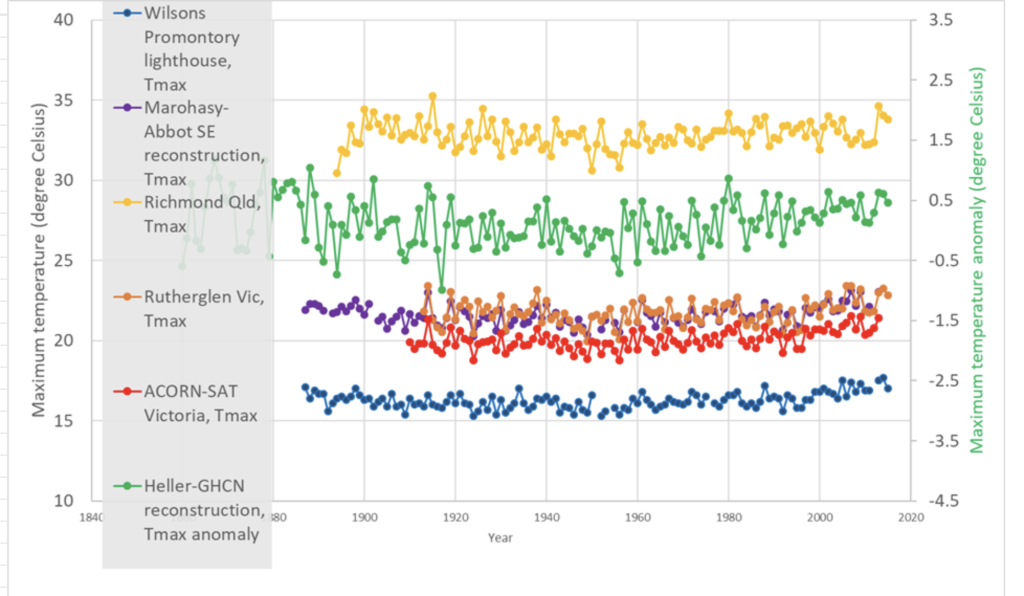
Australia experienced severe drought during the 1990s, and for much of that decade Australia’s National Climate Centre was headed by meteorologist Bill Kininmonth.  He provided advice to government and also to the IPCC.  Bill subsequently published an important book entitled ‘Climate Change: A Natural Hazard’.  In it he explains that the model of the climate system represented by the IPCC is inadequate as a foundation for future planning.  Of course, we need to have some idea of the likely severity of droughts and floods if we are to adequately plan for them.

Just recently, Bill wrote a short piece (click here) based on his analysis of publicly available temperature data concerning both the tropical oceans and lower atmospheric temperatures as measured by satellites.   Based on this evidence, Bill argues:

  1. Temperatures, and rates of warming globally, are regulated by the tropical ocean,
  2. The pattern of warming both at altitude and across latitudes is not consistent with the theory of human-caused global warming.

This is important information, if we are to understand how the Earth might heat up and how it might cool down.   Some of us like reworking this puzzle, as we develop a new and more robust theory of climate complete with accurate new equations to describe global energetic constraints as they apply to the atmosphere.

If you would like to zoom in to listen to my very first interview, it will be next Thursday, with Bill.

You are invited to listen live.
When: Dec 5, 2024 07:00 PM Brisbane

Register in advance for this meeting:
https://us02web.zoom.us/meeting/register/tZItdeCuqjwoE90uponYR8ANj-jtzXpQo7bc

After registering, you will receive a confirmation email containing information about joining the meeting.

At Lake Weyba ten years ago, photographed for The Australian newspaper, when it ran a series explaining  how the Bureau corrupt the historical temperature series stripping away the natural climate cycles until the record shows slow and consistent warming.

Postscript

Very often, I’m told that it would be more useful if I simplified my message, as though the world needs another slogan.    Of course, those who subscribe to the theory of human-caused global warming have many successful slogans and symbols, it is just a pity that their theory has no predictive value because it is not really a scientific theory at all.   It persists because of its political utility.

The history of science shows that paradigms, even when they turn out to be nonsense, are never disproven.  They are only ever replaced.

So, for sure we need a new theory of climate change, one based on realistic historical temperature reconstructions and consistent with the laws of physics.

One of the best tests of any scientific theory is its predictive value, its capacity to generate forecast and predictions with some degree of skill.

My historical temperature reconstructions for mainland Australia, when I concerned myself with understanding the accuracy of the measurements and sorting and extracting the best data.

via Jennifer Marohasy

https://ift.tt/Q2ufl0P

November 24, 2024 at 10:10PM

About Those Plummeting Fertility Rates

Research Brief by Kip Hansen — 23 November 2024 – 700 words

A very interesting paper has been published by Anup Malani and Ari Jacob, both out of the National Bureau Of Economic Research in Cambridge, MA, USA,  “a private, nonprofit organization that facilitates cutting-edge research on and analysis of major economic issues.”   ( The views expressed in the paper are those of the authors and do not necessarily reflect the views of the NBER.)

The paper is titled “A NEW MEASURE OF SURVIVING CHILDREN THAT SHEDS LIGHT ON LONG-TERM TRENDS IN FERTILITY” [ or as .pdf here ]. 

What long-term trends in fertility?  This [ blue trace is 1950 through 2023]:

The authors start with this:

“The world has experienced a dramatic decline in total fertility rate (TFR) since the Industrial Revolution. Yet the consequences of this decline flow not merely from a reduction in births, but from a reduction in the number of surviving children. We propose a new measure of the number of surviving children per female, which we call the effective fertility rate (EFR). EFR can be approximated as the product of TFR and the probability of survival.”

“We specialized EFR to measure the number of daughters that survive to reproduce (reproductive EFR) [EFRR]  and the number children that survive to become workers (labor EFR) [EFRL].”

“We use three data sets to shed light on EFR over time across locations. First, we use data from 165 countries between 1950-2019 to show that one-third of the global decline in TFR during this period did not change labor EFR [EFRL], suggesting that a substantial portion of fertility decline merely compensated for higher survival rates.”

And the result is that:

“In this paper we offer a new measure of the number of surviving children per reproductive age female. It is motivated by economic models, which posit that households care about the number of children who survive—not merely the number who are born. It can also be used to test those models. Our measure of surviving children can be specialized—via EFRL and EFRR—to measure growth in the population that produces or that reproduces, respectively.”

This figure from the paper gives the best graphical representation of their point:

Why should  we care?

Worldwide and National Fertility Rates are predictive of future population totals and very important for future economic conditions.  Falling populations have led, in some countries, to shortages of workers to keep up industrial production.

The United Nations has been making a great deal of fuss about Total Fertility Rate and I have written about the issue in “Population Bombing”.  The popular press hack on about both excessive population growth and population degrowth. 

But here is my thought after reading this new paper:

Maybe we have been looking at the wrong statistic.  Malani and Jacob suggest that a better way of looking at fertility, from a demographic viewpoint, is to look at their two “new and improved” statistics:  Effective Reproductive Rate – Labor and Effective Reproductive Rate – Reproductive.

In the advanced nations, these are running far below the necessary 2.1 replacement rate but have stabilized (no longer dropping) since about 1990.    This gives a different picture than the older Total Fertility Rate.

So what?

Analyses of modern societal problems are often based on statistics about or related to the perceived problem.  The statistic(s) favored by policy makers are, more often than not,  not measures of the problem itself but of something merely related to the problem.

 At this website, the statistic most favored by policy makers for the generalized topic here, Climate Change, is one of the many “global average surface temperature” indexes.  That statistic is touted in every COPxx meeting as being/going too high.

However, there are well-reasoned opinions that view that index, that statistic, as flawed or even concocted.  Some opinions view that statistic as a non-scientific “apples and oranges” mishmash. 

Others are perfectly willing to accept statistic in current use but opine that it is not the measure of “Climate Change”.

The discussion points for today:

1.  World fertility rates – a problem, a solution, an improvement, and/or looming disaster (in which direction)?  None of these?

2.  Are ANY of the so-called  Global Average Surface Temperature indexes appropriate to stand as a measure of Global Climate change?

3. Do you know of any other fields of research that are based on what you think is the wrong metric/measure/statistic?

# # # # #

Author’s Comment:

The idea that TFR is not an appropriate or the most appropriate statistic for population growth studies is intriguing.  And has led to the question:  are we using the right and/or best statistic as an/the indicator for other societal problems?   Are some that we commonly use appropriate in any way whatever or are some simply wrong from the start?

I do have personal opinions about GAST and its indexes, previously expressed on the pages here at WUWT.

Overall, maybe we should be rebooting a lot of topics by asking: “Are we using the right measure of the problem?”  Give examples if you have them.

Thanks for reading.

# # # # #


via Watts Up With That?

https://ift.tt/EqQPfG1

November 24, 2024 at 08:13PM