The Climate Road to Serfdom in One Graph

Dr. Faig S Askerov, (self-described as the Former Regulatory Compliance and Environment Director, BP Azerbaijan, Georgia, and Turkey Region, PhD in Petrochemistry Scientist, Lecturer) has presented a graph and definitions that can be used as “Exhibit A” against the climate road to serfdom. At a time of political change against climate alarmism/forced energy transformation, even deep ecologists should question whether CO2 greening is better than wind, solar, battery industrialization.
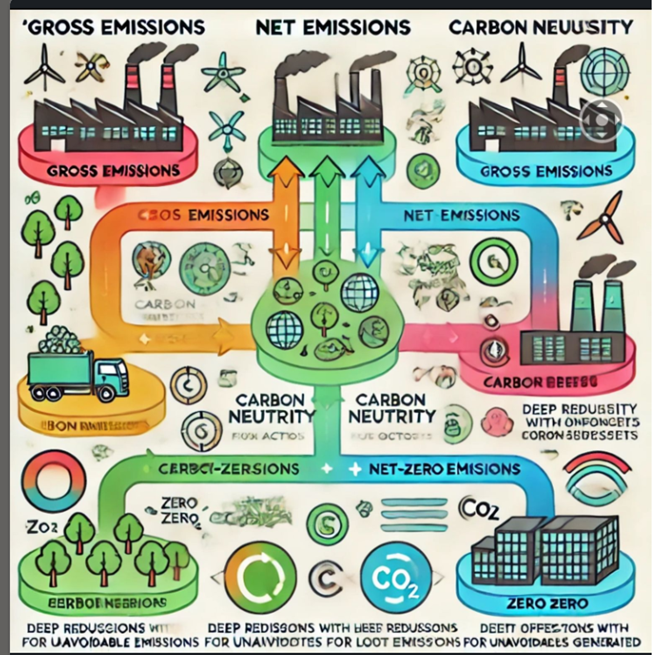
Greenhouse gas (GHG) calculations

1. Gross GHG Emissions

• Definition: Total emissions generated by an entity (such as a country, company, or individual) without accounting for any offsets or sequestration efforts.
• Example: A factory emits 100,000 tons of CO₂ annually.

2. Net GHG Emissions

• Definition: Emissions after accounting for offsets, carbon removal, or carbon sequestration (e.g., planting trees, carbon capture technologies).
• Formula: Net GHG Emissions = Gross Emissions – (Carbon Offsets + Carbon Sequestration)
• Example: If the same factory invests in reforestation that absorbs 20,000 tons of CO₂, its net emissions become 80,000 tons.

3. Carbon Neutrality

• Definition: Achieving a balance between emissions produced and emissions removed from the atmosphere through offsets. This doesn’t require eliminating emissions but offsetting what remains.
• Achieved through: Renewable energy investments, Purchasing carbon credits or offsets
• Example:
A company emits 10,000 tons of CO₂ but buys carbon credits from projects that absorb an equivalent amount, making it carbon-neutral.

4. Net-Zero Emissions

• Definition: Refers to reducing emissions as much as possible and using offsets or removals only for unavoidable emissions. The focus is more on eliminating emissions upfront rather than relying on offsets.
• Key Principles: Long-term, permanent reductions are prioritized. Any residual emissions must be balanced with direct removals (e.g., through carbon capture and storage).
• Example: A company redesigns operations to cut emissions by 95% and removes the remaining 5% through sequestration.

5. Zero Emissions (True Zero)

• Definition: Achieving no emissions at all from an activity, product, or process, without relying on any form of offsetting. This is technically challenging for most industries.
• Example: An electric vehicle that uses only renewable energy throughout its entire lifecycle could be considered a zero-emission vehicle.

6. Science-Based Targets

• Definition: Reduction targets aligned with the Paris Agreement goal of limiting global warming to 1.5°C or 2°C. Companies or governments commit to a pathway that includes GHG reduction milestones.
• Example: A company may aim to cut emissions by 50% by 2030 and reach net-zero by 2050.

7. GHG Protocol Scopes (1, 2, and 3)

• Scope 1: Direct emissions from owned or controlled sources (e.g., fuel combustion on-site).
• Scope 2: Indirect emissions from purchased electricity, heat, or steam.
• Scope 3: Indirect emissions from the supply chain and product use.

In summary, these different approaches to GHG calculations reflect varying levels of ambition and strategies. While carbon neutrality can be achieved through offsets, net-zero focuses more on eliminating emissions directly, with limited reliance on offsets for unavoidable emissions. Zero emissions is the most stringent target, aiming to produce no emissions at all.

The post The Climate Road to Serfdom in One Graph appeared first on Master Resource.

via Master Resource

https://ift.tt/mp5FV2i

November 8, 2024 at 01:03AM

New Study: Antarctic Sea Ice Has Been Increasing Since The 1970s…Due To Internal Decadal Variability

“Since the late 1970s, Antarctic sea ice area (SIA) has slowly increased, despite significant global warming. The increase in Antarctic SIA occurred largely between 2000 and 2014.” – Bonan et al., 2024

Scientists attribute the long-term (1979-2022) expanding Antarctic sea ice trend, as well as the abrupt decline in sea ice extent from 2016 to 2019, to natural factors such as:

a) decadal variability

b) internal climate variability

c) intrinsic variability of the Southern Annular Mode (SAM)

d) El Niño-Southern Oscillation (ENSO)

e) Indian Ocean Dipole (IOD)

f) ocean preconditioning

g) weakened circumpolar westerlies

h) zonal atmospheric wave structures

i) surface wind variability

j) Pacific decadal variability

k) Atlantic multi-decadal variability

The authors acknowledge that a “unified understanding of how each process manifests spatially and temporally in the observational record is lacking.”

On the other hand, anthropogenic CO2 emissions are not considered as a contributing factor in 45 years of Antarctic sea ice expansion or decline.


Image Source: Bonan et al., 2024

via NoTricksZone

https://ift.tt/dH03MRx

November 8, 2024 at 12:12AM

Scholz’s Green Fantasy Government Collapses – Proof That Climate Policy Mania Is Ruining Germany

Folks, it’s happening again. Germany—the economic powerhouse of Europe, the land of engineers and precision—has fallen flat on its face. Why? Because its leaders are chasing a climate dream that’s got more holes in it than a Swiss cheese. Chancellor Olaf Scholz’s coalition just imploded, and the reason is as simple as it is obvious: climate policy lunacy meets fiscal reality.

The German government went green alright. It went green as a tree frog, all while dumping logic and accountability out the window. Scholz kicked out his finance minister, Christian Lindner, for daring to do his job—keeping the books balanced and calling out the green pipe dream for what it is. So now the government’s in shambles, and it’s all because of the unhinged climate crusaders.

Here’s what went down.

Scholz’s Coalition: A Train Wreck Waiting to Happen

Scholz was sitting on a three-party coalition made up of his center-left Social Democratic Party (SPD), the eco-zealous Greens, and Lindner’s Free Democratic Party (FDP), which is actually trying to keep Germany’s economy from spiraling into oblivion. The alliance wasn’t exactly built on a rock-solid foundation; it was a Frankenstein’s monster of climate obsessives, social spenders, and a few people who could still do basic math.

Scholz and his Green pals wanted a Germany running on sunshine, unicorns, and the faint hope that solar panels would magically start generating power 24/7. Lindner? He’s a business-minded guy who realized that paying for this nonsense was going to hammer German industry, drive energy prices into the stratosphere, and leave average Germans with electricity bills that could buy a decent used car.

So, Lindner, as finance minister, tried to put a stop to this runaway train of green spending. He defended Germany’s “debt brake” law—yeah, you heard that right, they actually have a law to prevent the government from going nuts with the credit card. But the Greens wouldn’t hear it. Their climate ambitions were “non-negotiable,” meaning Lindner had to go. Scholz, ever the genius, gave Lindner the boot, and boom—the coalition collapsed, just like every house of cards built on wishful thinking eventually does.

The Green Agenda: Just How Bad Are We Talking?

Here’s a reality check for the folks pushing the Green Gospel: Germany is in a tough spot because its so-called “energy transition,” or Energiewende in their high-falutin’ German, is a flop. The Greens have been in the driver’s seat, shoving Germany off of reliable energy sources like coal and nuclear and onto renewables that simply can’t meet demand.

  1. Unreliable Power: Germany’s power grid has been wobbling around like a toddler on stilts. Wind and solar only work when Mother Nature feels like it, and guess what? Winter is coming. As renewable energy fizzles, Germany’s been forced to import coal-fired power from Poland and nuclear energy from France, which is rich given that the Greens want both of those options gone. A little ironic, don’t you think?
  2. Skyrocketing Prices: Energy prices are through the roof, but hey, that’s what happens when you swap out cheap, reliable power for pricey, unreliable green dreams. Germany’s average citizens are getting hammered by higher bills, and industry? Let’s just say manufacturers are looking at relocating faster than a college kid headed to Cancun for spring break. Good luck being Europe’s “economic engine” when factories start fleeing to places that can keep the lights on without bankrupting them.
  3. Social Impact: This green fantasy is hitting Germany’s working class the hardest. The well-off folks who don’t mind splurging on “eco-friendly” gadgets are doing fine. But lower-income families are shelling out more just to keep warm. And the response from the Greens? More taxes, more spending, more pain for people who can least afford it—all in the name of “saving the planet.” If you think they’re upset now, wait until winter when they’re paying triple for heating.

Europe’s Noticing – Is This the Beginning of the End for Green Utopia?

The collapse of Scholz’s government isn’t just a German problem; it’s a flashing red warning for Europe as a whole. Brussels has been shoving similar climate goals down everyone’s throat. They love talking about a green Europe that’s going to be all “carbon-neutral” and “sustainable,” but when push comes to shove, they’re all about making you pay the price while they collect virtue points. Germany was the model for this fantasy, but now? It’s the cautionary tale.

  1. The EU’s Own Coalition Problem: With Germany’s collapse, European leaders are looking at this and maybe—just maybe—questioning if it’s worth tearing down their economies for carbon targets. They’ve been running on the same unworkable assumptions as Scholz’s coalition. Countries like France, Italy, and Poland will have to ask themselves if they’re ready to go down with the ship or start questioning the EU’s blind climate fanaticism.
  2. Economic Self-Harm: Germany’s economic issues will likely spread, especially with key industries struggling under the weight of energy costs. The more the EU doubles down on the green agenda, the faster Europe loses its competitive edge. It’s a bad sign when your big “climate leader” is importing coal power because it turned its back on everything that actually works.
  3. The Rise of the Right: In Germany and across Europe, the populist right is licking its chops at this mess. People are sick of politicians who preach green dreams while everyday folks shoulder the costs. The opposition parties—especially those to the right of the SPD—now have a golden opportunity to ride the wave of public discontent. With Germany’s “Green miracle” exposed as a mirage, it’s only a matter of time before people demand leaders with a shred of common sense.

The Bottom Line: Germany’s Collapse Is a Reality Check

The fall of Scholz’s government is a textbook example of what happens when idealism replaces logic. Germany went all-in on a climate policy that ignores reality and punishes regular people, and now they’re paying for it. Without Lindner’s fiscal sanity, Scholz’s government threw the doors open to limitless spending on unproven green policies. And what did they get? A broke coalition, an economy in trouble, and an energy sector on the verge of collapse.

It’s time to stop pretending that throwing money at solar panels and wind turbines is a substitute for a stable energy policy. Germany just proved that, and Europe better be paying attention. Scholz’s green agenda may have sounded like the way forward, but now we see where it really leads—to higher costs, angry citizens, and a government in tatters.

If there’s any lesson to take from this, it’s that energy policy needs to be grounded in reality. Maybe next time, Germany will remember that an economy runs on reliable energy and balanced budgets—not on wishful thinking and political posturing.

via Watts Up With That?

https://ift.tt/0k9CGj5

November 8, 2024 at 12:05AM

Wrong, Bloomberg, Real World Evidence Proves Extreme Rainfall Hasn’t Become More Frequent or Deadly

From ClimateREALISM

A November 4th Bloomberg article, titled “Extreme Rainfall Is Becoming More Frequent and Deadly,” covering the recent floods in Valencia suggests that climate change is producing greater numbers extreme rainfall events that are also more deadly now than before. This is false. Data proves that Bloomberg’s claims fail the truth test since floods aren’t becoming more frequent or severe.

First, it’s important to distinguish between weather and climate. While extreme weather events, like heavy rainfall, are a natural part of weather patterns, they are often wrongly attributed to climate change without actual evidence. As Climate Realism has repeatedly pointed out, many claims that link extreme weather events to climate change data and evidence to show causation. For example, in the case of recent European floods, experts admit that it’s difficult to conclusively link individual events to long-term climate trends without comprehensive studies, yet headlines like Bloomberg’s frequently jump to conclusions about climate change being the cause.

Furthermore, extreme weather events like floods have occurred throughout history, well before the industrial era and the recent rise of atmospheric carbon dioxide emissions. Spain, in particular, has experienced severe floods throughout the centuries due to its unique geographic and meteorological conditions, known as “gota fría” weather pattern, also known as a “cold drop.” Spain’s geographical location makes it susceptible to these well-known local Mediterranean storm patterns. The heavy rainfall followed by floods in Valencia, have tragically been all too common throughout the region’s history driven by well-established natural weather patterns. There is no data supporting the claim that they are a sign of climate change causing worsening weather.

Even reports from the Intergovernmental Panel on Climate Change (IPCC) acknowledge that there is no clear trend in increasing floods, despite claims otherwise. See Figure 1 below:

IPCC-table-12-12-floods
Figure 1. Table 12.12 from the IPCC AR6 Report. Note the yellow highlighted topics, and the lack of climate attribution in the present and forecast for the future as indicated by the white spaces.

The IPCC findings indicate that, globally, the data does not support a significant increase in the frequency or intensity of rainfall events. Therefore, media outlets attributing every extreme weather event to climate change are engaging in what could be termed as alarmism, rather than reporting based on sound scientific data.

In addition, much of the increased damage from heavy rains resulting in floods in recent years can be attributed to urban expansion and poor land-use planning, particularly in flood-prone areas. As cities like Valencia grow, impermeable surfaces expand, leading to more runoff and higher flood risks when heavy rains occur. The costs of flood damage are often more reflective of increased development and human activity in vulnerable areas rather than a direct consequence of climate-driven increases in rainfall.

In summary, while extreme weather events like the Valencia floods are tragic and warrant strong responses in terms of preparedness and resilience, there is no solid evidence tying this specific event—or the purported increase in such events—to global climate change.

Instead of leaping to conclusions, Bloomberg and other media outlets should focus on reporting about realistic strategies like improved infrastructure, better flood management, and adaptation to natural weather variability—solutions that address flooding problems without resorting to unfounded climate scare tactics.

via Watts Up With That?

https://ift.tt/Oigp7IX

November 7, 2024 at 08:04PM