The Generational Opportunity for U.S. LNG

By Tristan Abbey

It should go without saying that natural gas in normal conditions doesn’t liquify itself. It’s a shame the Biden-Harris administration acts as if it does.

When the gas comes out of the ground it must be captured immediately, transported by pipeline to a processing plant, processed, fed into another pipeline, and transported to a liquefaction facility, where it is super-cooled to 260 degrees below zero (Fahrenheit) and becomes a liquid. But that’s only half the deal. After it is liquified, the gas is loaded onto a specialized ship called an LNG carrier, transported across the ocean to a regasification facility, regasified, fed into another pipeline, and delivered— to residential customers where it will warm their homes or cook their food; to power plants to generate electricity; and to all manner of factories as a raw component in the manufacture of fertilizers, steel, plastics, paint, and other commodities. 

Breaking into the global LNG market has been a generational endeavor—and an outstanding success—for the American economy. The technical sophistication required to master the liquefaction, transportation, and regasification of this vital hydrocarbon is not trivial. Each LNG cargo represents the fruits of years of permitting and construction, the investment of billions of dollars, and negotiations of contracts (also known as “off-take agreements”) that will be in force for decades. Long-term operations, long-term relationships, long-term impact.

The arrival of carriers laden with American LNG to Europe in the months after Russia’s invasion of Ukraine in 2022 was celebrated by the Biden-Harris administration. These ships, metaphorically speaking, set sail a decade earlier, as LNG export terminals navigated the dilapidated federal regulatory process. These liquefaction facilities, in turn, rely on natural gas supplied from fields that themselves had to be explored and developed over many years.

But now the White House incumbents are playing with fire. Their decision in January 2024 to pause most export approvals until the completion of duplicative economic and environmental studies has already damaged the trustworthiness of American natural gas supplies. Japan, one of our closest allies and most important customers for LNG, was the first to sound the alarm. That damage will be compounded if these studies provide an excuse for the federal government to extract concessions from the U.S. natural gas industry before approvals resume.

Regulatory uncertainty means higher costs, longer and delayed timelines, and potentially disrupted supply chains. “Turning off” LNG exports would cause a cascading series of dislocations throughout the economy, not only in the export sector. It has taken the better part of a generation already to achieve the nation’s dominant position in natural gas. That is at risk with the stroke of a pen. The next president can lift the pause on approvals, but that will need to be done carefully to mitigate the risk of litigation, and only Congress can provide a permanent solution.

Tristan Abbey is a senior fellow at the National Center for Energy Analytics and the author of the new report, “A Generational Opportunity: Achieving U.S. Dominance in Global LNG.”

This article was originally published by RealClearEnergy and made available via RealClearWire.

via Watts Up With That?

https://ift.tt/Yw0SpAx

October 29, 2024 at 08:01PM

Ford Lost Another $1.2 Billion in 3Q On EVs

From Robert Bryce’s Substack

FoMoCo lost $58,391 for every EV it sold during the quarter.

The ugly EV news from Ford Motor Company just keeps coming. This afternoon, the company reported that it lost $1.224 billion in its EV business during the third quarter. In early October, the company reported EV sales “were up 14.8 percent on best-ever sales of 20,962 vehicles.” Thus, simple division shows that the storied automaker lost $58,391 for each EV it sold during the quarter.

The company’s losses on its EV business, known as Model e, for the first nine months of 2024 total $3.7 billion. For reference, that $3.7 billion loss is equal to the gross profit (Ford calls it EBIT, short for earnings before interest and taxes) it made on Ford Blue, the division that makes internal combustion vehicles.

EBIT for Ford’s ICEV and EV lines for the first three quarters of 2024. Source: Ford Motor Co.

Alas, these results aren’t surprising. Ford has been hemorrhaging cash on EVs for the past two years. It lost $4.7 billion on EVs in 2023 and $2.2 billion on EVs in 2022. The third-quarter numbers simply show, yet again, that Ford’s leadership has made a colossal blunder. CEO Jim Farley and his lieutenants didn’t understand what motorists want to buy. That’s a bad thing if you’re running one of the world’s biggest car makers.

FoMoCo’s third-quarter losses are being made public just two months after the company announced it was killing a planned three-row, all-electric SUV. In August, the company said, “With pricing and margin compression, we’ve made the decision to adjust our product and technology roadmap and industrial footprint to meet our goal of reaching positive EBIT within the first 12 months of launch for all new models.”

In other words, Ford was warning two months ago that it was having to slash prices on its EVs and that the third quarter would be a stinker. And it was. Also in August, the company said it was going to move some of its battery production out of foreign factories into US locations so it could qualify for more federal subsidies available under the Inflation Reduction Act. As I reported here last year, Ford and other automakers are aiming to collect tens of billions of dollars via the 45X tax credit in the IRA for making batteries in the US. For instance, Ford is building a battery plant in Marshall, Michigan, which is expected to create about 4,200 jobs. According to Good Jobs First, each job at the new Ford plant will cost taxpayers $3.4 million.

From Morningstar: “Are Electric Vehicles Short-Circuiting? Auto Manufacturers Revise Electrification Strategies After Slowing Demand.”

While Ford can claim its sales have increased, the fundamental problems in the EV market have not changed. As seen above, the credit rating agency Morningstar, which 13 months ago was forecasting huge growth in EVs, has now turned negative on the sector. In an October 21 report titled, “Are Electric Vehicles Short-Circuiting? Auto Manufacturers Revise Electrification Strategies After Slowing Demand,” (registration required) Morningstar said the major automakers, including VW, Ford, GM, and Mercedes, have delayed their EV plans or slashed planned output due to weak sales. Morningstar noted that while some automakers, including Ford, have cut prices, that has hurt their profitability. It also says that with EV sales “to early adopters now seemingly exhausted, EVs are struggling to maintain ongoing sales momentum among mainstream consumers.”

Morningstar then listed the issues that have plagued EVs for decades:

EV ranges remain significantly affected by extreme weather conditions, with cold weather (i.e., below 40 degrees Fahrenheit) potentially decreasing range by about 25%). Concerns about the EV charging infrastructure are exacerbated by lackluster reliability records of public EV charging stations. Moreover, charging times, notwithstanding significant developments in recent years, remain considerably longer than the typical time it takes to refuel a conventional ICE vehicle. Additionally, while EVs have fewer parts than ICE models and typically require less maintenance than ICE vehicles, one-off repairs (notably involving the EV battery pack) can prove inordinately expensive. Accordingly, across most jurisdictions, insurance premiums for EVs are typically higher than for comparable ICE vehicles, mainly because of the potentially markedly higher repair costs. (Emphasis added.)

That paragraph pretty well sums up the EV marketplace, particularly regarding cold weather, charging infrastructure, and charging times. (See this story on Hertz for more on the repair cost issue.) All those problems have been evident since the days of Edison. So why didn’t Ford and the other automakers see this debacle coming? Was it herd mentality? Were they responding to government pressure? If so, why didn’t they push back? What did they know about EV demand from their own market research?

Here’s my prediction: A few years from now, after the automakers have lost billions more due to their misplaced bets on EVs, business schools and analysts will be asking those very same questions.

via Watts Up With That?

https://ift.tt/P1dHKTo

October 29, 2024 at 04:05PM

Climate change kills the unborn: The UN wants us to save babies with solar panels and wind plants

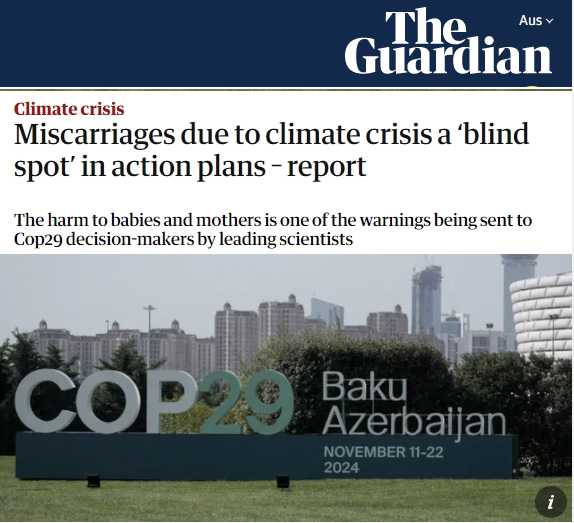
Miscarriages due to climate crisis a ‘blind spot’ in action plans – report

By Jo Nova

This week’s UN witchcraft is that a half a degree of global warming will kill babies and pregnant women, give us your money.

The UN COP29 meeting starting Nov 11th, fights for relevance in the shadow of the US Election, like a suckerfish under an aircraft carrier.

The latest confected attempt to get attention is to guilt trip the West — telling us that women and babies will die if we don’t install enough solar panels. This is despite humans being mammals which evolved to cope with the heat and the cold. We live a more closeted, protected existence than any time in the last million years. Not many people give birth in caves these days. Indeed we’re a species that inhabits towns with monthly temperatures that vary by 90 degrees Celsius and we are supposed to panic about another half a degree?

The truth is that being cold, poor and hungry increases stillbirths just as much as any heatwave, and the thing that saves babies on a hot day is an air-conditioner. The answer to all four killers is cheap electricity and fossil fuels.

One day history students will study how the UN uses biblical paraphrasing to demand their tithe and control:

The report follows an ultimatum from the UN secretary general, António Guterres, on the climate emergency: “We’re playing with fire, but there can be no more playing for time. We’re out of time.” He said global heating was supercharging monster hurricanes, bringing biblical floods and turning forests into tinderboxes, and said governments had to rapidly wean the world off its fossil fuel addiction.

Naturally, only babies that die from heat stress are politically marketable, the UN doesn’t care about the ones that die from the cold:

Increasing climate extremes are causing more lost babies, premature births and cognitive damage to newborns, the report said. For example, a study in India found a doubled risk of miscarriage in pregnant women suffering heat stress, while another in California found a significant association between long-term heat exposure and stillbirth and premature birth.

Awkwardly, cold temperatures also cause stillbirths and miscarriages (Ruan et al) so if man-made climate change is warming the world, it must be saving babies too. Shh!

Five minutes of research, which the Guardian team don’t do, turns up a meta-study showing that poverty doubles the risk of death in babies:

Numerous studies confirm that mothers of low socioeconomic status and unemployed parents face a far higher risk of having a stillbirth or a low birthweight child [7–10]. It has been demonstrated that women or families living in adverse socioeconomic conditions have twice the risk of having a stillborn baby compared to their more privileged counterparts [11]. Unemployment and unfavourable economic conditions are usually associated with poor maternal nutrition, elevated psychological stress during pregnancy and limited access to medical supervision and prenatal care. Several studies show that pregnant women with elevated levels of stress have considerably higher risks of a stillbirth, independent of age, parity, education, smoking and alcohol habits or other compromising characteristics…. Moreover, in low income countries or deprived environments, poor maternal nutrition and low body mass index can result in higher stillbirth frequency [15]. — Tsimbos et al (2021)

Thus to save babies, and follow the science — we must burn more fossil fuels

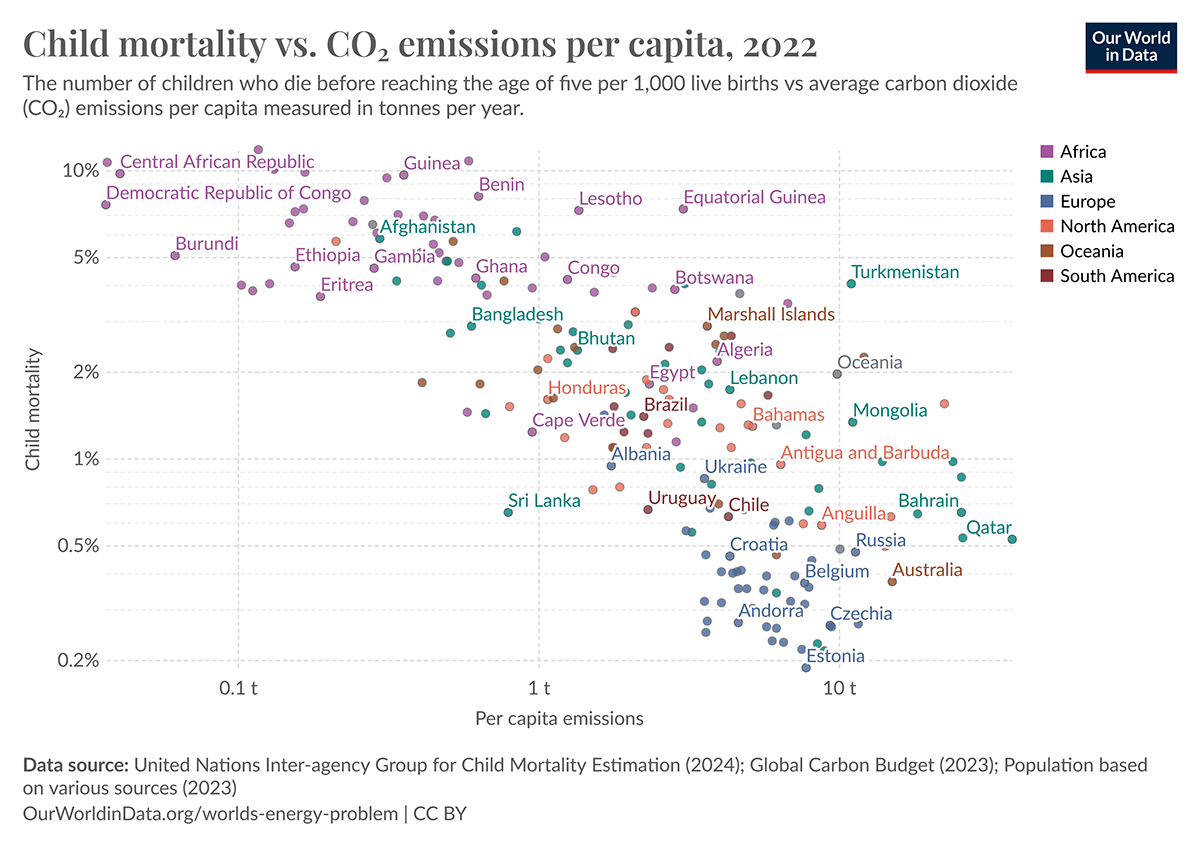
Wealthier nations have higher CO2 emissions, more heaters, more air conditioners, better food, and their babies don’t die as often.

It is a crime the UN is not helping poor African nations build coal plants.

Child Mortality, CO2 emissions.

Child Mortality, CO2 emissions. OWID

REFERENCES

Cleon Tsimbos, Georgia Verropoulou Dimitra Petropoulou (2021) Economic crisis and stillbirth ratios: Evidence from Southern Europe, PLoS One, 2021 Nov 18;16(11):e0259623. doi: 10.1371/journal.pone.0259623

Ruan T, Yue Y, Lu W, Zhou R, Xiong T, Jiang Y, Ying J, Tang J, Shi J, Wang H, Xiao G, Li J, Qu Y, Mu D. Association between low ambient temperature during pregnancy and adverse birth outcomes: A systematic review and meta-analysis. Chin Med J 2023;136:2307–2315. doi: 10.1097/CM9.0000000000002361


0 out of 10 based on 0 rating

via JoNova

https://ift.tt/KVNSjBo

October 29, 2024 at 03:58PM

Settled Science At The New York Times

Twelve years after predicting an ice-free Arctic, the New York Times predicted a new ice age.

“Some scientists estimate that the polar ice pack is 40 per cent thinner and 12 per cent less in area than it was a half-century ago, and that even within the lifetime of our children the Arctic Ocean may open, enabling ships to sail over the North Pole”

October 19, 1958

timesmachine.nytimes.com/timesmachine/1958/10/19/91415262.html?pageNumber=327

“The United States and the Soviet Union are mounting large-scale investigations to determine why the Arctic climate is becoming more frigid, why parts of the Arctic sea ice have recently become ominously thicker and whether the extent of that ice cover contributes to the onset of ice ages.”

July 19, 1970

TimesMachine: July 18, 1970 – NYTimes.com

About Tony Heller

Just having fun

This entry was posted in Uncategorized. Bookmark the permalink.

via Real Climate Science

https://ift.tt/wsec3JX

October 29, 2024 at 03:28PM