Do You Trust the Mass Media?

Opinion by Kip Hansen — 19 October 2024 — 1200 words/5 mins

If your answer is:  “Of course not!” then you are in the majority.

The latest Gallup Poll shows that less than 1 out of 3 people in the United States have  even a fair amount of trust and confidence in the mass media — such as newspapers, TV and radio – particularly when it comes to reporting the news fully, accurately and fairly. 

Interestingly, Gallup chooses to combine “trust a great deal” and “trust a fair amount” into one category.  This is not true, by the way, in the actual numerical results, just on the graph.   I dug into the data and found that just 8% trust the media a Great Deal.  As a journalist, I find that simply embarrassing.  [I don’t, however, write for the mass media, even so….]

It doesn’t get better when broken down by age:

The fact that on 8 %, less than 1-of-10, of the general public only trusts the news media a Great Deal means that the news media is known to have abrogated its very purpose which is to act as a source of objective, unbiased and fair information about what is happening in the world, or, as stated in the Wiki:

“Objectivity in journalism aims to help the audience make up their own mind about a story, providing the facts alone and then letting audiences interpret those on their own. To maintain objectivity in journalism, journalists should present the facts whether or not they like or agree with those facts.”

Newspapers of record are national newspapers that are known for their trustworthiness and quality reporting.  In the United States, the list is: The New York Times, The Wall Street Journal and The Washington Post.  In the UK:  The Times, The Guardian and The Daily Telegraph.

Readers are invited to give their opinions on those six newspapers.  Biased?  In which direction?  On which topics? 

But, my experience is this:  The New York Times generally acts as a propaganda arm of the  United States’  Democratic National Committee [ DNC ], as does The Washington Post.   I don’t follow politics in the UK, but The Guardian is a founding partner of the journalist’s climate crisis propaganda cabal Covering Climate Now, thus on that topic publishes nothing but stories meant to frighten which are filled with blatantly false and intentionally alarming information. 

According to a survey conducted every few years by Indiana University:

“According to a new survey titled “The American Journalist Under Attack,” released by Syracuse University’s S.I. Newhouse School of Public Communications, Republicans in the industry fell from 18% in 2002 and 7.1% in 2013 to 3.4% in 2022.

That’s significantly lower than the number of American adults who say they’re Republicans (26%), according to a 2022 ABC News/Washington Post poll.

Democrats in the news industry saw their ranks swell by eight percentage points in 2022 to 36%.”  [ source ] 

National Public Radio [ NPR ] in the 1970s was the go-to news source for well-balanced mostly unbiased news reporting,  leaning only a tiny bit to the liberal side of things.  By 2023, according to a tell-all by Uri Berliner, “the network lost its way when it started telling listeners how to think”  [ source ]  a change brought about by “…the extent to which people at every level of NPR have comfortably coalesced around the progressive worldview.  And this, I believe, is the most damaging development at NPR: the absence of viewpoint diversity. “

As I let this essay sit dormant for a few days, a terrific story broke that paints this problem in broad strokes with no uncertainty.  The NY Times’ take on it is here:

L.A. Times Editorial Chief Quits After Owner Blocks Harris Endorsement

“The head of The Los Angeles Times’s editorial board resigned on Wednesday after the paper’s owner quashed a presidential endorsement for Vice President Kamala Harris.” 

This example comes from what the mouths of those involved:

“Mariel Garza, who held the title editorials editor, [ this is the editor who resigned] said she had quit because “I want to make it clear that I am not OK with us being silent. In dangerous times, honest people need to stand up. This is how I’m standing up.”

“Ms. Garza said that the editorial board had planned to endorse Ms. Harris, but that Dr. Patrick Soon-Shiong, the billionaire owner of The Los Angeles Times, decided this month that the newspaper would not make any endorsement for president.”

“It makes us look craven and hypocritical, maybe even a bit sexist and racist,” she [ Garza ] wrote. “How could we spend eight years railing against Trump and the danger his leadership poses to the country, and then fail to endorse the perfectly decent Democrat challenger — who we previously endorsed for the U.S. Senate?”

And the other side of the story?  What did the owner of the newspaper have to say?

In a social media post on Wednesday, Dr. Pat Soon-Shiong, the owner of the LA Times,  [@DrPatSoonShiong] said:

“So many comments about the @latimes Editorial Board not providing a Presidential endorsement this year. Let me clarify how this decision came about.

The Editorial Board was provided the opportunity to draft a factual analysis of all the POSITIVE AND NEGATIVE policies by EACH candidate during their tenures at the White House, and how these policies affected the nation. In addition, the Board was asked to provide their understanding of the policies and plans enunciated by the candidates during this campaign and its potential effect on the nation in the next four years. In this way, with this clear and non-partisan information side-by-side, our readers could decide who would be worthy of being President for the next four years.

Instead of adopting this path as suggested, the Editorial Board chose to remain silent and I accepted their decision. Please #vote. “

The owner of the paper expected the Editorial Board to do their jobs and do journalism…giving the readers the information would they need to make a rational intelligent choice. 

The Editorials Editor, Mariel Garza, who freely admits that they, the editors of the LA Times, had spent “eight years railing against Trump and the danger his leadership poses to the country” [simultaneously  demoting Kamala Harris to be a merely “decent Democrat challenger”] quits her job in protest when the paper’s owner asked her to do her job as a journalist ….

How dare he?

# # # # #

Author’s Comment:

This OpEd is about the demise of journalism in the news media.

On politics:  I abhor the political situation in the United States, in which the long-standing two-party system has short-circuited our carefully designed democratic federal republic form of government as laid out in the Constitution of the United States and left us with warring political parties which have little concern for the welfare of the citizens.  The American people have not been offered the best candidates that our country has to offer – but only one each from the two parties which the party leaders think represent their best chance to hold gain power.

This OpEd is not intended to promote any political campaign or support any particular candidate. 

On journalism:  Newspapers, news magazines, broadcast news (radio and television and cable) journalists have, for the most part, abandoned journalism as an outmoded quaint occupation akin to the making of buggy whips.   These modern junior-warrior-journalists all want to tell their audiences how to think, what to think, and what to believe.  Most of them have no clue.

Thanks for reading….and for goodness sake, turn up those Critical Thinking knobs to FULL BLAST!

# # # # #

via Watts Up With That?

https://ift.tt/AyLbBYv

October 24, 2024 at 04:07PM

Just like that: World Bank bureaucrats lost track of $24 to $41 billion “fighting climate change”

From the world banks website

The World Bank — Who We Are. As they say — we’re “Accountable to ourselves”.

By Jo Nova

The World Bank is the largest climate funding multinational blob on Earth, and the world is about to end, the oceans are about to boil, but no one at the World Bank can explain where billions of dollars worth of the Earth saving funds have ended up. It’s almost as if no one there gives a toss about the climate. Indeed, if the World Bank was a giant parasitic squid feeding off the taxpayers of the West, it might look just like this.

A new Oxfam report shows that over six years, $24,000 million dollars (at least) has probably gone missing off the balance sheets, but it could be as much as $41 billion. Essentially, the World Bank budgeted to spend a lot of money, but no one bothered to track whether that money was spent, whether the budget blew out, or whether it never happened and the team went surfing in Costa Rica. Imagine if we could do our taxes this way? Indeed, it’s a bit rich to say the money was “missing off balance sheets” because apparently there weren’t any balance sheets, not for expenditures.

Oxfam can only guess at the missing sums because they investigated other World Bank projects and found the final cost differed from the planned cost by between 26 to 43%. So they used that to come up with a ballpark figure of the size of the missing millions. It’s that bad. We can’t even say how much is missing. One insider told the New York Post, “it could be twice or ten times more”.

The supranational unaccountable entities like the World Bank, the UN, are surely the great attractor of global freeloaders. Like a supermagnet for people who like spending other people’s money:

By James Franey, New York Post

What if it wasn’t bungling — who would know?

Bungling World Bank bureaucrats lost track of at least $24 billion bankrolling the battle against climate change, according to a bombshell report by a left-leaning charity group.

An investigation by Oxfam revealed “poor record-keeping practices” by the DC-based international lender that resulted in anywhere between $24 billion and $41 billion in misplaced funds.

The agency’s audit showed “a lack of traceable spending” over the past seven years — partly because of an oddball accounting practice in which the bank accounts for its climate financing at the time of a project’s approval rather than at the time of project completion,…

In the report: Climate Finance Unchecked Oxfam discovered that it was extremely difficult to get simple answers:

“We had to sift through layers of complex and incomplete reports, and even then, the data was full of gaps and inconsistencies. The fact that this information is so hard to access and understand is alarming —it shouldn’t take a team of professional researchers to figure out how billions of dollars meant for climate action are being spent.

This could all be sorted out in five minutes. All it would take is for our governments to say “No more money for the World Bank until it sorts out reporting”, and next thing you know the World Bank would be filling out tax returns. But the odds of this happening are like an asteroid strike — unless Donald Trump wins the US election (above the margin of cheating). Mere mortal politicians who ask hard questions, not only risk their post-political Blob career with the UN-WEF-World-Bank-IMF-FAO-WHO-IAEA-or-OECD, they might feel the force of a World Bank report telling their citizens how they mismanaged their own economy, and who wants that?

The amounts of money are mind-blowing

The Oxfam writers, bless them, are slightly baffled. With the world in dire straits (as they see it) they can’t figure out why the World Bank is not treating every dollar like a diamond.

…the sums needed are vast and growing: According to the UN’s Adaptation Gap Report 2023, the amount needed for
adaptation finance alone stands at between US$215 billion and US$387 billion a year.

There is so much potential. If the World Bank got what it asked for, and spent 90% in an honest way, there would still be $30 billion dollars left to throw parties.  But if no one is tracking any of it, why not think big?

“This is the wild, wild west of finance,” said Mark Joven, Philippines Department of Finance undersecretary, who represents the country at U.N. climate talks. “Essentially, whatever they call climate finance is climate finance.”

“You cannot really follow the money, track the money, track the impact,” said Romain Weikmans, a senior research fellow specializing in climate finance at the Finnish Institute of International Affairs.

–“Rich nations say they’re spending billions to fight climate change. Some money is going to strange places.” Reuters.

Big Government feeds Bigger Government

The Globalist Blob not just The Promised Land for political grifters, on a practical basis, the more they can siphon from the people towards the blob — the more friends they make in the international blob-glitterati, and the better chance they have of being offered the next great blob job offer.

Medium level domestic bureaucrats are surely looking to the land of milk and honey, which is where taxpayer funds escape the event horizon of audits and elections. Only there, can the parasites do whatever they want with other people’s money.

Download Oxfam’s new report “Climate Finance Unchecked.”


0 out of 10 based on 0 rating

via JoNova

https://ift.tt/ls9F05I

October 24, 2024 at 03:28PM

A Cold Mossy Outcrop

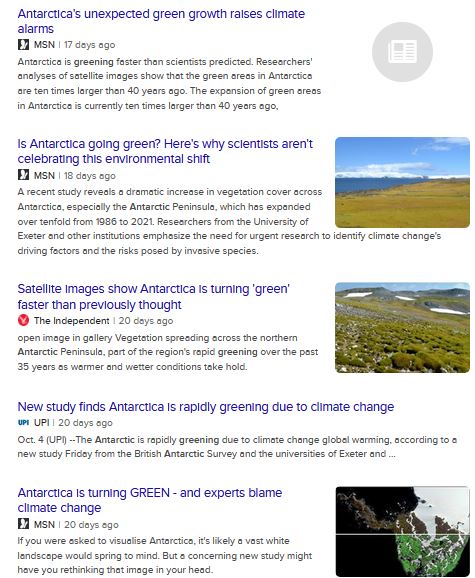
Most Cliscep readers will have heard this news story already. Sometimes otherwise innocuous papers make the news because there is a “worse than we thought” climate change angle, and quite often, there are a range of reactions, from sage nods from the catastrophists to howls of derision from the sceptics.

So it was with “Sustained greening of the Antarctic Peninsula observed from satellites” by Roland et al in Nature Geoscience.

The apparent greening of the Antarctic Peninsula reported by Roland et al has been covered by WUWT and Jo Nova. What attracted me to it? Well, the trigger was just one word in the Nature News report’s title and subhead that I found discombobulating. Which one? Take a guess:

Believe it or not, this lush landscape is Antarctica

Vegetation is spreading at an alarming rate in a place where temperatures are soaring.

Well, it was:

…alarming…

[Although “lush” is a ludicrous adjective, it must be said. Does the author even know the meaning of the word?]

Is vegetation spreading over bare ground ever alarming, wherever it is? Who prefers the ground to be sterile? Does anyone prefer change in the other direction, from green to bare? Of course not (and partly this is our allergy to change of any sort, and our insistence that everything has to stay exactly how it is. Except when it comes to anything other than the natural world? Maybe).

The spread of vegetation is not alarming. The next question is, is it happening? The question after that is, is it because of climate change? And somewhere down the line we might wonder whether tis the direct effect of CO2 fertilisation that is causing the increase, or the temperature rise.

Landsat Flies By

The first land imaging satellites were Landsats. From Landsat 4 in the mid 80s the satellites had an MSS: a multispectral sensor, which can see light beyond the visible light that mere humans experience in the day to day. Here’s what happens. Light from the Big Yellow Thing hits the ground and bounces back up. A bit of that light passes into the satellite’s sensor, and makes a picture. From the 80s till now new Landsats have been launched, but the sensor is the same-ish, and the only difference is the memory and download bandwidth. So it’s easy to see that you just consult the public archive of Landsat pictures, and see how much green there is at place X in each year, and you’ve got an indisputably greening Antarctic.

I said the word “green” there, but that isn’t actually the colour that matters. Think of it like this: snow is green. Yes it is. By which I mean, it reflects green light (and red and blue). So measuring the quantity of green hitting the sensor, by itself, is no good. Instead you use NDVI, which is a measure of greenness, obtained by using the values of two kinds of red light: the visible and invisible (infra-red). The NDVI score for a pixel goes up as the vegetation grows, and so, a higher NDVI equals more plants on the Antarctic Peninsula.

So, the archive is public, the processing is relatively easy, and so it’s a wonder that we had to wait until 2024 for this piece of work. Isn’t it?

I strongly suspect others considered it years ago, but after a moment’s thought, said: “Nah. It’s just a giant mess.”

And if you asked me to do it, I’d say: “It’s possible, but it’s a giant mess.”

And several people may even have peeped at the data and concluded: “It’s an even bigger mess than we thought. It’s just not worth it.”

Why is the Landsat archive such a mess? Well, it’s because of where it is. The Antarctic Peninsula is usually cloudy. It’s also quite snowy, even in the middle of the Austral summer. Snow melts and falls and blows around. The chances of Landsat flying over and getting a good series of shots with its MSS is low. Then there are other issues, including shadows (if no incident light hits a location, it will of course appear black to the sensor). The sun is often low at high latitudes, and shadows are long. Seemingly the co-registration of image pixels is difficult (needed to record the value of two pixels at the same location but at different times). So the data is a giant mess.

Having done the best they could with it, Roland et al duly found an increasing NDVI, and alarmists found it alarming, as they are wont to do. Is the trend real?

Well, maybe. But I don’t think this paper proves as much. But Jit. The later pictures had more green, or higher NDVI, than the early pictures. Greening is the only answer. Maybe. However, I suspect that there may be a contribution from the satellites themselves. The newer Landsats take more pictures. Their sensors are similar to the older satellites, but they have more on-board memory, and can send more data down to the base stations. That being so, you have a higher chance of getting a good cloudless image in later years… and more chance of picking up green areas.

Looking at Roland et al’s Figure 2, there seems to be some evidence of greater image coverage in later years. Without co-registered pixels, we don’t actually know whether some areas begin grey and become green: just that we recorded more green in later years.

Figure 2 from Roland et al

There’s something else a tad concerning about Figure 2 as well. Look at the inter-annual variation. Does this bespeak a slow incremental greening to you? The moss banks of the Antarctic Peninsula are often rather old (>4000 years old). They grow very slowly at very low temperatures. The cushion-moss communities that develop on better-drained soils also develop very slowly. But here, we have sudden leaps up in the area classified as plant-covered. And more tellingly, we have sudden drops. Consider the change from 2004 to 2005. The plant cover plummets to a fraction of its former value, but the image coverage is higher. What happened in 2017? Why the drop in apparent vegetation here? Again, there was more coverage than the previous year.

The suspicion is, that image quality is determining the quantity of plants detected, rather than the detected quantity actually representing what is going on on the ground.

[A long technical section on the merits of Roland et al’s methods used to go here, but I’ve excised it: I strongly doubt whether the general reader would have been interested in it.]

We’ve mentioned that vegetation is developing, if at all, at glacial pace, and that the year-to-year variations don’t conform to that. I would also argue that the initial values are too small. The bryologist Ryszard Ochyra described the moss communities of King George Island (South Shetlands) in 1998 from his work there from the late 1970s onwards. His descriptions of the island do not square with the very low early values of vegetation reported by Roland et al. In 1982, Furmanczyk and Ochyra mapped about 10 hectares of vegetation in a small area by the Polish research station in one bay on one island off the Antarctic Peninsula (Admiralty Bay, King George Island). It is not credible to say that if 0.1 km2 were mapped in this restricted area (albeit the moss-richest) in 1982, that all the vegetation of the entire Antarctic Peninsula covered less than 1 km2 total at that time. Or that Ochyra would write an epic monograph about the mosses of King George, comprising 60 species, and undertaking collections in a hundred locations about the island in 1979-1980… if the entire vegetation of the entire Antarctic Peninsula covered less than 1 km2 at that time.

Ochyra presents some photographs of vegetation on King George in 1980 (see the link at bottom for photo credits). And the total vegetation in the entire Antarctic Peninsula is supposedly below 1km2 at this time? Not credible.

All that said, the vegetation may well have expanded in the past 40 years. This paper does not prove that, but that does not constitute proof that it hasn’t happened. If it has, was it rednecks driving Ford F-150s that did it?

Sceptics have pointed to CO2 fertilisation. Maybe. But this has a strong effect in dry places. And while the centre of Antarctica is dry, its fringes are not. A lot of these moss communities are fed by meltwater and kept damp. So water loss through stomata is maybe not an issue. Of course, when life is marginal, making photosynthesis easier would certainly help. What about temperature? I have not seen the temperature trends of King George and its surrounds. It’s still very cold in the summer. And to invoke temperature, we would have to explain how:

Climate was suitable in a small part of the island of King George in 1980, and a larger part today.

Since temperatures are highly correlated over large distances, does this make any sense? How could places a few metres apart be warm enough for growth and too cold for growth?* It’s worth noting here that the bases of moss banks on King George have been dated as >4000 years old. The vegetation has not just sprung up ex nihilo. [Ochyra notes that shelter from prevailing westerlies has a role in determining the presence of plants. Has climate change the power to alter this?]

ASTERISK: there are microclimate difference across distances of metres. But not on flat ground, or gently sloping ground.

Another possible explanation for vegetation growth on King George relates to the numerous research stations that have been established there. Disturbance from these sites, and from increasingly abundant tourists, may well have caused penguin colonies to relocate. Such places are no longer subject to toxic levels of phosphorus by manuring (but are still nutrient-rich). Highly-trampled areas are trampled no more. Added together, these factors could increase vegetation growth (a point that Roland et al acknowledge).

Areas [on King George Island] that have been abandoned by penguins are rapidly colonized by complex plant formations, facilitated by both the considerable nutrient resources and the cessation of trampling by the birds.

Zwolicki et al, 2015

I’ve gone on too long, haven’t I? Let me just summarise by saying, there is plenty of room for doubt surrounding this story, and as you might guess, doubt is not something that the primitive minds who spoonfeed us our proper opinions are going to place in prominent position.

References
Furmanczyk and Ochyra’s 1982 map of the vegetation of their bit of Admiralty Bay

Ochyra’s monumental work on the mosses of King George Island (1998).

Roland et al 2024

Soliman 2024 (Nature News report on the paper).

Zwolicki et al 2015, Seabird colony effects on soil properties and vegetation zonation patterns on King George Island

via Climate Scepticism

https://ift.tt/3ckTROo

October 24, 2024 at 01:57PM

UN Grants Earth A 100 Year Reprieve

In 1989, the UN said the climate catastrophe would arrive by the year 2000. Now they say it will arrive by the year 2100.

AP News

About Tony Heller

Just having fun

This entry was posted in Uncategorized. Bookmark the permalink.

via Real Climate Science

https://ift.tt/Ohw7z05

October 24, 2024 at 12:27PM