Net Zero is Losing the Battle of Ideas

From THE DAILY SCEPTIC

by David Turver

At the weekend I attended the Battle of Ideas Festival in London. It is a fascinating event, with interesting debates taking place across a wide variety of topics like free speech, culture wars, the economy, education and women’s freedom.

I was there primarily for the energy discussions. Unfortunately, I missed the book launch on nuclear power on the Saturday, but I did attend the two energy debates that took place in the scientific dilemmas section on Sunday.

First up was a lunchtime debate entitled “Is nuclear the future of energy… again?” Unfortunately, the speaker who was supposed to speak for this position had some sort of transportation nightmare and could not attend. I did not catch the name of the man who replaced her, but he did put up a valiant effort considering he was drafted in at the last minute. Speaking against the idea of a nuclear renaissance was Robert Reid, policy development officer for the Alba Party who was in mourning for the late Alec Salmond. We can therefore forgive him somewhat for advancing the hoary old chestnut that offshore wind is cheap: he claimed £41/MWh without citing any sources. Of course, the existing CfD funded offshore wind farms have cost us over £150/MWh so far this financial year and the new projects awarded in AR6 will cost us over £82/MWh in today’s money, more than twice Robert’s claim. Emma Bateman, who is an environmental campaigner and founding member of Together Against Sizewell C, unsurprisingly spoke against the idea of nuclear power and made some spurious claims about safety that if nuclear power were a person would have resulted in the libel lawyers being called on Monday morning. The gist of her substantive argument was that nuclear is too expensive and takes too long so we should therefore spend more on wind and solar.

In the ensuing debate, I managed to correct Robert Reid’s ‘facts’ and make the point that if your primary concern is the environment, then you should be an advocate of nuclear power because it has the smallest overall environmental footprint of all energy sources because it doesn’t take up much land and has very low mineral intensity. I also made the point about the chocolate teapot fallacy. Arguing for wind and solar in place of nuclear power is akin to arguing in favour of chocolate teapots because you cannot wait for a ceramic one. No matter how many chocolate teapots you buy, you can never make tea; just like no matter how many wind turbines and solar panels you install you can never run a modern economy on intermittent electricity.

The physics of nuclear power are far superior to any other energy source because of its extremely high energy return on energy invested, meaning we get far more energy out than we expend building the power plants, and the output is reliable. There are even designs on the drawing board and beginning to be built that will allow nuclear power plants to follow fluctuations in demand. The barriers to nuclear power are all political: the West over-regulates nuclear power and it is unsurprising that it takes so long because of all the paperwork that must be produced before a new reactor can be built. We can fix man-made political and regulatory problems, but mere mortals cannot change the faulty physics of intermittent renewables, just like you can never make tea in a chocolate teapot.

We would be far better off committing to a significant nuclear power programme so we can deliver reliable electricity. If we fix the regulations, invest in rebuilding the skills base and supply chains and choose the right reactor design, we can even have cheap, reliable energy with only a small impact on the environment. This is what the French did in the 1970s and 1980s and now they produce around 70% of their electricity from nuclear.

The next debate was on the “Great British Energy Crisis”. It was encouraging to see that three of the five panellists are subscribers to this Substack (you know who you are and thank you). Two of the speakers, James Woudhuysen and Lord David Frost both made eloquent attacks on Net Zero and its consequences. Professor Michaela Kendall who is the U.K. Hydrogen Champion for Mission Innovation suggested we needed more facts to inform the debate on energy, but managed to skirt around the fact that the Government agreed contracts for green hydrogen at £241/MWh, which is about seven times the current cost of U.K. natural gas, which in turn costs more than five times U.S. gas.

Dr. Shahrar Ali is a former spokesperson for the Green Party who has recently won a discrimination court case against the Greens because they sacked him for his gender critical beliefs. It is a shame Dr. Ali cannot apply his critical thinking skills to Net Zero. The gist of his argument was the world is warming, it is going to be a catastrophe, it is all our fault, so build more windmills.

I managed to take him to task in the ensuing debate by pointing out that even if you believe CO2 causes warming, then it is a big leap to conclude that building windmills will change the weather. This is the so-called mitigation strategy that can only work if 1) CO2 is the only climate control knob (we know this to be untrue from paleo-climate records) and 2) everyone else follows the strategy (you only need to look at charts of global greenhouse gas emissions to see this is also untrue). A far better strategy is one of adaptation which has the advantages of being cheaper and will work regardless of the actions of others and regardless of the causes of global warming. The mitigation strategy we are pursuing is one of unilateral economic impoverishment and the Net Zero “cure” is far worse than the alleged climate change “disease”.

It is encouraging that my intervention drew an enthusiastic round of applause which is testament to the growing scepticism about Net Zero among the general public. It appears to me that cracks are appearing in the cosy green consensus in Westminster and if we get our arguments right, we can win this debate.

All in all, the Battle of Ideas is a thoroughly enjoyable event and I highly recommend everyone to attend next year, whatever your beliefs. It is only through free and open debate that we can get to the truth.

David Turver writes the Eigen Values Substack, where this article first appeared.

via Watts Up With That?

https://ift.tt/NvF30cW

October 23, 2024 at 12:05AM

“Electric fire truck burns down brand new German fire station”

“An electric fire truck ‘containing lithium-ion batteries’ started a fire that consumed a German fire station

The Feuerwehr station in Stadtallendorf is new. Really new. In fact, the new fire station opened its bay doors less than one year ago. The station could accommodate 10 fire engines and many firefighters. However, a tragic fire destroyed the station, despite its firefighting purposes.”

Electric fire truck burns down brand new German fire station

h/t Steve Milloy

About Tony Heller

Just having fun

This entry was posted in Uncategorized. Bookmark the permalink.

via Real Climate Science

https://ift.tt/EDTiR9Y

October 22, 2024 at 09:21PM

New Paper: Methane Concentration Increase Not Related to Fossil Fuels

A new paper just published in the PNAS identifies different culprits.

Abstract

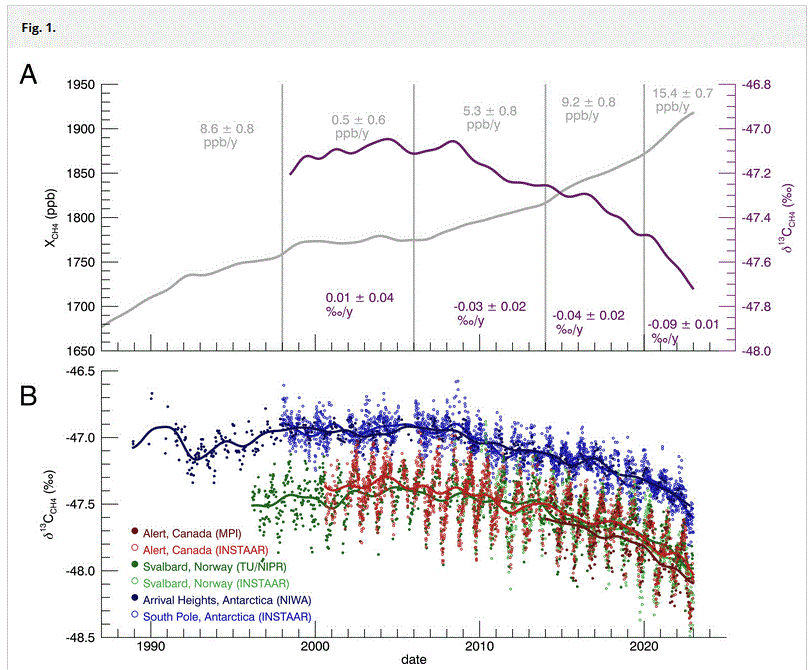
The growth rate of the atmospheric abundance of methane (CH4) reached a record high of 15.4 ppb yr−1 between 2020 and 2022, but the mechanisms driving the accelerated CH4 growth have so far been unclear. In this work, we use measurements of the 13C:12C ratio of CH4 (expressed as δ13CCH4) from NOAA’s Global Greenhouse Gas Reference Network and a box model to investigate potential drivers for the rapid CH4 growth. These measurements show that the record-high CH4 growth in 2020–2022 was accompanied by a sharp decline in δ13CCH4, indicating that the increase in CH4 abundance was mainly driven by increased emissions from microbial sources such as wetlands, waste, and agriculture. We use our box model to reject increasing fossil fuel emissions or decreasing hydroxyl radical sink as the dominant driver for increasing global methane abundance.
https://www.pnas.org/doi/10.1073/pnas.2411212121

Methane (CH4) is the second-most abundant anthropogenic greenhouse gas and has global warming potential (GWP) of 28 over 100 y (1); as a result, CH4 has consequential near-term radiative effects and is a prominent target for mitigation (2). Following a short pause in growth from 1999 to 2006, both the abundance and growth rate of atmospheric methane have been increasing (3). During 2020–2022, the observed CH4 growth rate reached a record high since NOAA measurements began in 1983, averaging 15.4 ± 0.6 ppb yr−1 (4). Understanding the mechanisms driving this accelerated growth is essential for predicting its future climate impact and providing scientific support for climate mitigation strategies (2).

The carbon isotopic composition of atmospheric CH4 (δ13CCH4) is a powerful tool for tracking the sources and sinks of atmospheric CH4. Different CH4 sources have distinctive δ13CCH4 values: Microbial CH4 emissions (wetlands, livestock, landfills, etc.) have lower δ13CCH4 values (global mean of –62‰) than pyrogenic (biomass and biofuel burning, global mean of –24‰) and fossil fuel CH4 emissions (global mean of –45‰) (5). Various sinks of atmospheric CH4 also have distinctive isotopic effects. Therefore, combined observations of atmospheric CH4 mole fraction and δ13CCH4 can provide unique constraints on the changes of global CH4 sources and sinks during the post-2006 rapid CH4 growth.

The National Oceanic and Atmospheric Administration’s Global Monitoring Laboratory (NOAA/GML) has been carefully monitoring the global CH4 burden through the Global Greenhouse Gas Reference Network (GGGRN) for over four decades. The collaboration between NOAA/GML and the Institute of Arctic and Alpine Research (INSTAAR) at the University of Colorado Boulder has enabled δ13CCH4 measurements from the GGGRN since 1998, currently measuring weekly or biweekly from 22 globally distributed background sites (6). The dataset has been widely used for studying the evolution of global CH4 sources and sinks (7–9). Here, we report our most recent observations of atmospheric CH4 mole fractions and δ13CCH4 values through the end of 2022 and then use a box model to examine and quantify the contributions of potential drivers of the record-high CH4 growth rate.

The rest of the paper can be found here.

This is unlikely to mollify climate zealots as agriculture is listed among the potential causes. With biological activity exploding across the world, due to CO2 fertilization, I personally wonder how much of this is increasing wetland productivity as well as flourishing soil microbes.

H/T Steve Milloy.

via Watts Up With That?

https://ift.tt/J8Ozfnk

October 22, 2024 at 08:02PM

Methane False Alarm, Microbes Are to Blame

Home fireplace burning Nat Gas, which is 75% methane (CH4).

Jo Nova explains at her blog Mysterious record methane surge since 2020 was not fossil fuels but “90% due to microbes”.  Excerpts in italics with my bolds and added images.

Nobody checked the carbon-13 ratios!

Wouldn’t you know it — 150 nations signed the Global Methane Pledge without even bothering to check if the methane was man-made.

Methane — the second most hated Greenhouse gas — spiked to record historic levels in the last few years, over 1,900 parts per billion.  In 2019, even the WEF scientists admitted they couldn’t explain the baffling rise, and then in 2020, the world of methane went into the twilight zone.  We shut down the modern world due to the pandemic, and methane levels rose even faster.

It seems many have been blaming fossil fuels for the global
surge in emissions, but forgot to check the C13 isotopes.

Somehow we spend millions on breathalysing cows, measuring their burps, and feeding them seaweed, but didn’t think to do the basic chemistry. How could that be, you might wonder… 158 nations agreed to cut methane emissions by 30% by 2030, but none of them audited the science even though very strange things were happening. (The point was obviously the “pledge”, the junkets, the captive industries and subsidies, anything but the science).

Methane from fossil fuels has a higher carbon-13 ratio, but even though fossil fuel use was rising, the carbon-13 levels of atmospheric methane was rolling down a hill. Indeed this new study shows it’s been falling for 17 years.

It’s not like this snuck up on us….  any inquiring mind should have seen this coming a decade ago. The lab has been recording C13 in methane since 1998 and gets air samples from 22 sites around the world every week or two.

From the press release:

Microbes in environment drove methane emissions more than fossil fuels between 2020 and 2022, analysis finds

They found that between 2020 and 2022, the drastic increase in atmospheric methane was driven almost entirely by microbial sources. Since 2007, scientists have observed microbes playing a significant role in methane emissions, but their contribution has surged to over 90% starting in 2020.

“Some prior studies have suggested that human activities, especially fossil fuels, were the primary source of methane growth in recent years,” said Xin (Lindsay) Lan…

“These studies failed to look at the isotope profile of methane…

They go on to mention that in a warmer world, bacteria have a higher metabolism, which means they are happier and work faster. Thus, like CO2, if the world warms for any reason at all, methane will rise — and there is nothing we can do about it.

The one last straw they could clutch is that maybe the microbes were “man-made” :  It remains unclear whether the increased microbial emissions came from natural sources like wetlands or human-driven sources, such as landfills and agriculture. The team plans to delve deeper to identify the exact source of methane.

As if somehow there was a surge in landfill, rice paddies
or cows in the last few years that no one had noticed.

This is a pretty big deal — methane has supposedly caused about 30% of our current temperature rise (says the broken climate models) yet 90% of that recent rise was microbes. It’s yet another slice of the climate we aren’t controlling, but we’re still designing burgers with mealworms and bacon from fungus, in the hope of reducing methane emissions and controlling the weather.  Then it turns out every swamp and square meter of soil is working against us.

Methane concentrations in the air have almost tripled since the 1700s, but that was the Little Ice Age.  It’s easy to believe that as the world warmed up, the planet’s wetlands and soil microbes have just been returning to normal business for the last 300 years.

We skeptics told the experts long ago it was mostly not man-made, Tom Quirk showed that methane rises and falls in time with El Ninos, and was thus largely a natural phenomenon. Willie Soon also pointed out that one of Saturn’s moons has more methane than all the oil and gas deposits on Earth, but has no dinosaurs, cows or leaky wells.

REFERENCE

Michel, Sylvia Englund, et al (2024) Rapid shift in methane carbon isotopes suggests microbial emissions drove record high atmospheric methane growth in 2020–2022, Proceedings of the National Academy of Sciences. DOI: 10.1073/pnas.2411212121

Give Daisy a Break!


via Science Matters

https://ift.tt/lDOq4vc

October 22, 2024 at 05:54PM