Hurricane Milton is heading towards Florida, bringing "potentially catastrophic" winds, storm surges and heavy rainfall, American forecasters have warned.
The storm is due to hit the heavily-populated city of Tampa Bay less than two weeks after the state was badly hit by Hurricane Helene.
Milton is the ninth hurricane of the 2024 Atlantic season, which continues until the end of November.
Being the BBC though, they just could not resist the usual disinformation:
This is what the IPCC actually say:
In other words, there is no evidence of trends either in the frequency or intensity of hurricanes.
The IPCC also state:
It is generally accepted that Atlantic hurricanes tend to be weaker during the cold phase of the AMO, which ran from the 1970s to 90s. But clearly the longer term data, which extends back to the 19thC, trumps any shorter term data, particularly given the known ocean cycles.
Yet there is no mention of the longer term trends by the BBC. Nor is there mention of this very clear statement from NOAA regarding both US and Atlantic hurricanes:
To cap it all, the BBC even include this deliberately deceitful chart:
.
The apparent increase in major Atlantic hurricanes since 1920 is due to the fact that we now have satellites to observe them in mid-ocean. This is why there is a step change in the 1990s.
A glance at US landfalling hurricanes shows there is clearly no long term increase in the strongest hurricanes:
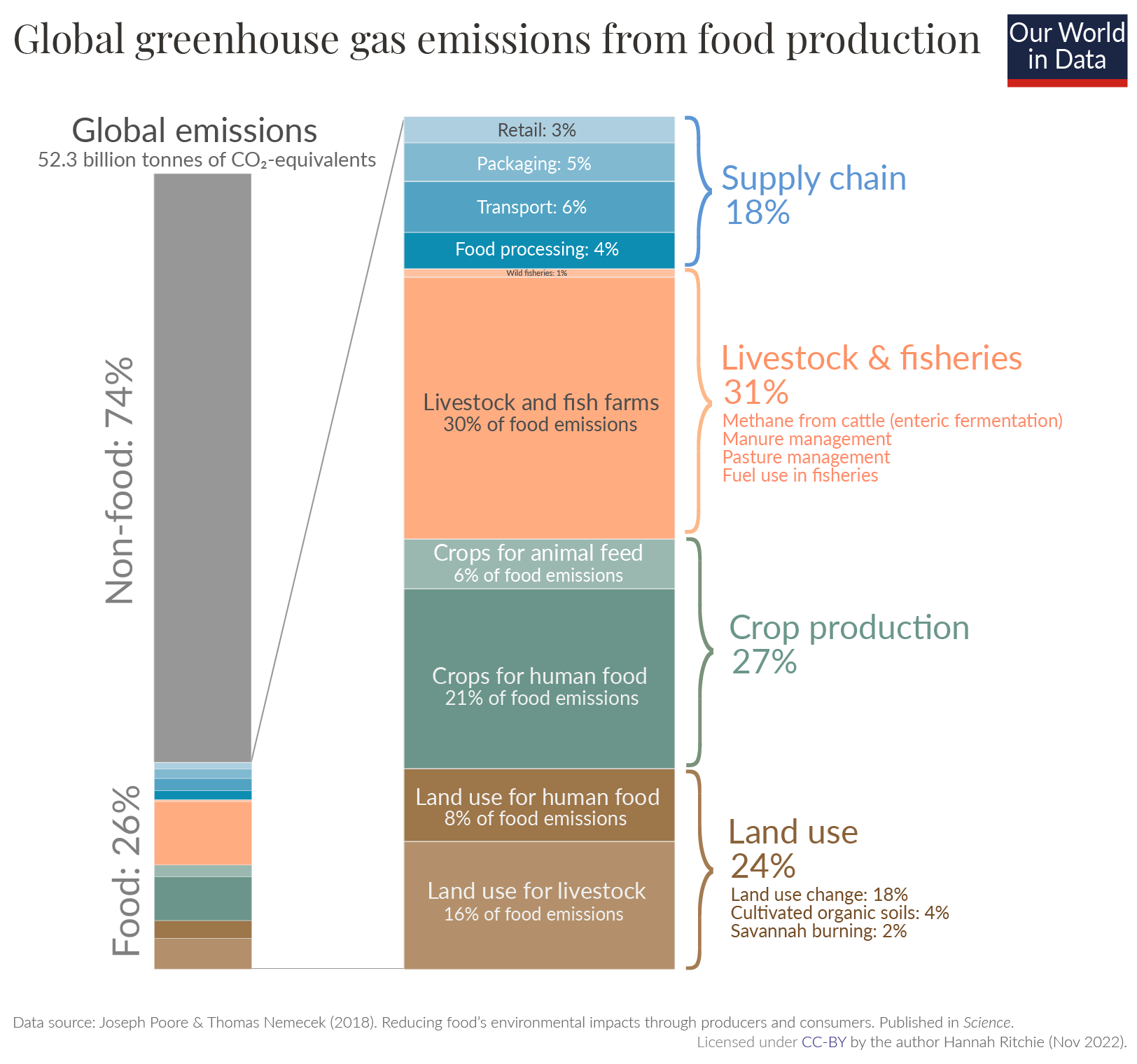
When it comes to tackling climate change, the focus tends to be on ‘clean energy’ solutions – the deployment of renewable or nuclear energy; improvements in energy efficiency; or transition to low-carbon transport. Indeed, energy, whether in the form of electricity, heat, transport or industrial processes, account for the majority – 76% – of greenhouse gas (GHG) emissions.1
But the global food system, which encompasses production, and post-farm process such as processing, and distribution is also a key contributor to emissions. And it’s a problem for which we don’t yet have viable technological solutions.
The most worrying thing about this is that they are even wanting to quantify emissions from farming.
If there is anything that should be excluded from the Net Zero madness, it is agriculture. Nothing can be more important to the world than food, no matter how much GHGs are emitted.
Exeter No 2 50.73717 -3.40580 Met Office Assessed CIMO Class 4 & Satisfactory Installed 3/11/2009
The main Met Office CIMO assessed weather station in Exeter is now Exeter No 2 pictured above. Tim Channon reviewed this site and was somewhat scathing about such a modern station with a poor location. I am not an aviator but I believe Tim was experienced in this area, however, when I read terms like “jet blast area” I start to question site locations.
Firstly, as Tim conjectured, if use of the airport increased and larger aircraft were used then taxiing to the main “long” runway could become an issue. Aside from Covid periods, the number of longer range flights has indeed increased with substantially more flights to the Canary and Balearic Islands. These use Airbus A320 size aircraft operating over the full 6,811 feet runway length.
The right turn from the taxiway onto the east end of the full runway length will inevitably direct the engines exhaust onto the Stevenson screen similar to the effect demonstrated at Dyce (Aberdeen Airport). The Met Office never seems overly concerned about such issues and simply assess the site as a lowly Class 4 – inaccuracy by siting of 2°C – Class 5 seems more appropriate given the likely regular engine exhaust induced distortions. A wider view image, including all taxiways and runways, better shows the implications.
Exeter No 2 though is not the only weather station in the locality, the original Exeter Airport site still operates. Its data does not contribute to the historic record and is used solely for aviation purposes. Many airport sites are correctly not used for climate recording purposes e.g Lakenheath, Mildenhall, Biggin Hill etc. It would probably be more realistic if the Exeter No 2 site was similarly discounted.
But it obviously does not end there with Exeter, after all a certain meteorological organisation has its Headquarters there. Other weather “sites” also exist in the City such as at the University, Weather Centre and even the interesting concept of the “SurfaceNet”
Clearly the presence of the Met Office has a strong influence on Exeter but surely not the entire county of Devon? Whilst Devon is, by area, the third largest English county just behind sizewise the original border areas of Lincolnshire and barely half the original county bounds of Yorkshire, it retains a surprisingly high number of weather stations as well as a number of quite new ones.
Contrast these 17 stations to just 8 in the larger old boundary area of Lincolnshire, 7 in the meteorological important county of Kent for south easterly continental air flows, and a mere 3 in the strategically important county of Fife. As was demonstrated in the case of the preponderance of sites to the west quadrant of London (en-route to Reading?) there are 11 stations in one compressed area that do not readily appear to be essential to keep even area representation for the historic climate record.
None of this quantity of Devon stations achieve Class 1 status and the only Class 2 site (at North Wyke) is courtesy of the quality diligence of Rothamsted research who runs the site. Several sites are in very close proximity to each other notably the new Stoodleigh being just a few kilometres from Huntsham, Hemyock is just a short distance from Dunkeswell and both Lapford and Okehampton do not seem to offer anything that North Wyke (between the two) does not already do much better.
I personally have no problem with multiple weather station sites providing they are of good quality and in representative locations. I suggest the abundance of Devon sites does not reflect good quality representation and is only likely to distort the historic temperature record.
A radical new plan to reduce international air travel from Europe to minimal levels over the next few years has been proposed by a group of Net Zero fanatics led by the New Economics Foundation (NEF). Massive charges under a ‘frequent flyer levy’ are proposed, the effect of which could quickly destroy large sections of the international air transportation industry. Some of the money raised – or not as the case may be – will be sent abroad as ‘climate aid’ to less developed countries forced to stay poor by mandated restrictions on their use of hydrocarbons. Needless to say, the work is the product of what Ben Pile recently termed “bog-standard Green Blob fronts”. Writing and promoting the NEF publication involved a number of operations heavily funded by the usual suspects including the European Climate Foundation (ECF) and ClimateWorks.
The fantasy plan calls for large European surcharges to be added to ticket prices for multiple annual trips. Financial details are not provided in the press release but the report suggests €50 for a medium distance trip and additional levies of €100 for long and “comfort” classes. This would appear to suggest an extra €250 charge for long-distance business and first class travel. George Monbiot of the Guardian boasts of the report having been shared exclusively with his newspaper and writes that the €100 levy on both distance and class will rise with each trip. It is hoped the surcharges will raise €64 billion, a sum said to be equivalent to 30% of the entire EU annual budget. This would be spent, at least until the golden goose is killed stone dead, on accelerating Europe to a “fairer, greener economy”. More virtuous bungs can be sent to countries to stop them using hydrocarbons and recompense them for the non-existent climate crisis.
Although the report talks of reducing travel by around 25%, the blow will be much worse in financial terms. Many airlines rely on premium travel to keep economy tickets low and severe reductions would affect the economics of aviation, both in the air and on the ground. Reducing passenger traffic by a suggested 25% and very likely much more, would require massive restructuring across the board including air traffic control, baggage handling, security and border activities and airport management. Yet more lost jobs to be added to the increasing pile of Net Zero casualties.
Not that this is the end of the attack. Air travel has enabled countless millions to travel for pleasure, holidays, education, business and to connect with family over the last few decades. In pursuit of ther mad Net Zero policies, the eco-zealots tell us, further restrictions “would therefore be necessary”. These would include caps on the number of flights, airport slots, night flights, private jets and “limits on the more damaging comfort classes of travel”.
Want to know what is being planned by the Net Zero fanatics – look at what their Blob-funded puppets are writing. In this case, forget about flying within just a few short years.
The New Economics Foundation has been around for a few years pumping out Left wing propaganda. It is no surprise that the hard Left’s favourite money tree the Rowntree Trust has funnelled in cash, although much larger amounts have been supplied by the Laudes Foundation and the ECF. As Ben Pile noted recently in the Daily Sceptic, most of the organisations active in the climate domain in the U.K. are funded by the ECF directly, or by one of the half dozen or so of the ECF’s grantor philanthropic foundations. As Pile also observes, the “hapless consumer” is ensnared by the phantom institutions that represent the green-ideology-addled British Establishment.
The NEF report is co-written by the Stay Grounded Network which, perhaps to nobody’s surprise, is funded by the ECF. The aviation campaigner at this outfit, Magdalena Heuwieser, says that the single trip flyer is paying the same tax as a traveller making 10 trips. Except that the more frequent flyer is actually paying 10 times more tax. Designed to fit a political narrative, Left wing sums often diverge from reality. In his article, Monbiot notes that air travel, heavily taxed as most passengers are aware, is “heavily subsidised” since the fuel is exempt from duties. In Monbiot’s world, a lack of a specific tax is often seen as a ‘subsidy’, while an actual £12 billion annual subsidy loaded onto U.K. electricity consumers to pay for unreliable renewable power is passed off as an ‘investment’. One reason fuel duty is not levied on aviation is that mobile jet aircraft will ‘tanker up’ at cheaper locations.
Monbiot reports on the view of Marlene Engelhorn who states that the “mile-high club of private planet combustion, where wealthy people like me can ferment in our comfort zones, needs to close it doors”. Easy to say of course when you are a wealthy heiress who has inherited a fortune from the BASF chemical operation. Other people who work for a living and need holidays and some modest comfort as they travel to drum up business might take a different view.
According to Monbiot, the International Council on Clean Transportation (ICCT) reviewed an early draft of the NEF report. Another Green Blob-funded operation of course, mostly it seems through ClimateWorks. This large operation channels considerable flows of money from other billionaire foundations such as Hewlett and Packard. These two latter operations are also direct funders of ICCT. Flying less is obviously the most effective solution to cutting emissions, states Sola Zhang, described by Monbiot as an aviation “expert”. Another operation quoted by Monbiot, More in Common, found that rich people would be most affected by a frequent flyer levy because they fly more. Again such value, such insight – funders ECF, the George Soros Open Society Foundation and Hewlett must be very pleased.
Chris Morrison is the Daily Sceptic’s Environment Editor.