
The Western Solar Plan, spearheaded by the Interior Department’s Bureau of Land Management, would expand industrial-scale solar power development on 31 million acres of federal land in 11 Western states.
via CFACT
October 16, 2024 at 03:38AM
The Western Solar Plan, spearheaded by the Interior Department’s Bureau of Land Management, would expand industrial-scale solar power development on 31 million acres of federal land in 11 Western states.
via CFACT
October 16, 2024 at 03:38AM
Get ready to pay for every mile you drive on Britain’s roads. That is certain to come according to senior government advisors. Big brother will be watching us all and recording every mile we drive.
Pay-Per-Mile Road Pricing is "Inevitable", Drivers Warned – The Daily Sceptic
via climate science
October 16, 2024 at 01:35AM

As the wind and solar industries destroy the scenery from coast to coast, wipeout pristine forests and flatten whole mountain ranges, there’s even more to be said for new-age nuclear.
A nuclear plant that pumps out 1,000MW around-the-clock takes up an area no bigger than a city block.
Whereas giant industrial wind turbines and endless seas of solar panels are spreading like an ugly cancer across the countryside. Wrecking everything in their path.
Only deranged members of the wind and sun cult think it has any kind of aesthetic appeal. But, rational folk know ugly when they see it.
Not only is the modern nuclear power plant self-contained, safe and highly efficient, the best of them feature architectural designs worthy of a power generation system that will last for multiple generations.
It’s a point well made by Dr Kelvin Kemm, a nuclear physicist and Past Chairman of the South African Nuclear Energy Corporation (Necsa).
Kevin is currently Chairman of Stratek Global, based in Pretoria, South Africa. Kevin and his team are working towards building an HTMR-100 nuclear reactor in Pretoria. And, as he explains below, they are taking the opportunity to make power generation not only safe and reliable, but to look good, too.
Nuclear power stations can be a beautiful part of the environment
Watts Up With That?
Kelvin Kemm
17 September 2024
Over the past 25 years, the world electricity demand doubled. All indications are that it will double again over the next 25 years. In fact, the time span is likely to be much shorter. The emergence of more electricity-intensive consuming technologies such as data centres is causing electricity demand to rise more steeply. Then one must add the rising demand of developing countries in which. People are moving from cooking dinner over an open fire outdoors to acquiring an electrical stove and fridge.
The image of electricity demand is a large boulder rolling down a hill, it is not stopping or slowing. In fact it is rolling faster and faster.
Without doubt fossil fuels will continue to be the backbone of world electricity generation for decades to come. But equally certain is that nuclear power is making a rapid advance across the globe. That means not only for the traditional large, industrialised countries, but also for the less developed, or much smaller countries. Rapid development of Small Modular Reactor technology is also accelerating the options for the adoption of nuclear power on a large scale. South Africa was the first country in the world to start developing a commercial Small Modular Reactor, and has continued with the work for over 30 years.
Some years ago, South Africa announced its intention to add an additional 2500 MW of new nuclear to its existing nuclear base. Early in 2024, the energy minister confirmed the acceleration of this goal. The intention, from inception, was to build a new 2400 MW coastal nuclear plant, but also to dedicate 100 MW to the development of SMR’s for inland use. In September 2024, the energy minister gave a public address in which he stated that we must go ahead on the basis of science and facts, and not be ‘fighting in the mud’ with activists who rely more on emotion than reality.
South Africa is forging ahead with a new nuclear build. This is excellent news. The current initiative is for an additional 2500 MW of nuclear, composed of a 2400 MW new large nuclear power station on the coast, plus 100 MW dedicated to Small Modular Reactor (SMR) development.
The announcement of the continuation of the project was greeted with applause by many, but as always, the anti-nuclear lobby were frothing at the mouth about all the imagined problems associated with nuclear power.
But let us digress for a moment, to consider the macro-implications of this initiative.
Building a large nuclear plant is essentially following in the footsteps of the traditional route, that being; placing a large plant on the coastline at an ideal site. The resulting power is then transmitted over some distance to consumers.
But what of SMR’s? The crucial difference with a gas-cooled SMR, which does not need a large body of water for cooling purposes, is that you can take the reactor to the consumer. You can place the rector anywhere you like. This reality enables planners to embrace. Embark on a highly flexible. Nuclear solution across the entire country.
Think about it!
Let us now make a comparison with a cell phone system. Prior to the advent of cell phones, a telephone network consisted of major exchanges, interconnected by means of long-range connections. Then cell phones arrived. The cells are something like the honeycomb of a beehive, and each cell has its own main base station antenna. Each cell handles calls within the cell.
The emergence of Small Modular Reactor (SMR) systems onto the modern scene, essentially makes a nuclear cell system a reality. One can now place a gas-cooled SMR anywhere, and it can serve its own ‘cell.’ This ‘cell’ could be a mining complex, a municipality, a collection of factories, or an agricultural area encompassing the farm, proceeding to processing, packaging, and transport. Such a ‘cell’ does not even need to be connected to the National Grid, and can be owned by a Province, Municipality, or private company.
The SMR revolution effectively means that the fundamental planning options available for the distribution of electricity have changed significantly.
A gas-cooled SMR, such as the South African HTMR-100 is walk-away-safe. The fuel cannot suffer a meltdown under any circumstances. Such an SMR emits absolutely nothing during normal operations, no solids, no liquids, no gases. The fuel is in the form of balls, the size of a tennis ball, and each ball lasts between two and three years in the reactor. So, the amount of refuelling required is extremely small, in comparison to coal, gas, or oil plants. So no continuous refuelling structure is required, such as a conveyor belt, pipeline, or railway line.
What all this means is that small nuclear plants can be safely and effectively placed in industrial areas or agricultural areas, or near an idyllic town. One of the accusations of the extremist anti-nuclear lobby has always been that nuclear reactors are ugly industrial structures which spoil beautiful scenic coastlines
With modern SMR’s we can totally remove that accusation. Since then is a bomb, it’s nothing during operation. And what’s more? Is totally silent. It can be integrated into the Vista of any setting. With this in mind, the developers of the HTMR-100 range of reactors approached Johann Koch of Johann Koch Design Architects (JKDA) with a proposal to work together to develop SMRe complexes for a range of customers.
Stratek Global originally developed the HTMR-100 for a classic industrial setting in South Africa, such as a gold-mining complex, far inland, and far away from any large water body. However, Stratek Global has been approached by potential customers from around the world, including the Middle East, Australia, a number of African countries, and also island states.
Furthermore, site factors such as the altitude, have varied from sea level to high altitude. The prevailing weather conditions have varied from hot and dry, to cold and wet, including snow.
As a result, Stratek Global is in a position to offer any type of nuclear power complex which can be designed to fit, not only any site but which can also be skilfully designed to match the scenery or cultural nature of the people and area.
Since nuclear is completely clean and green, emitting no gasses, liquids, or anything else, during normal operations, there is no reason why nuclear power stations must be viewed as ugly industrial buildings. They can be made as attractive as a hotel complex or holiday resort.
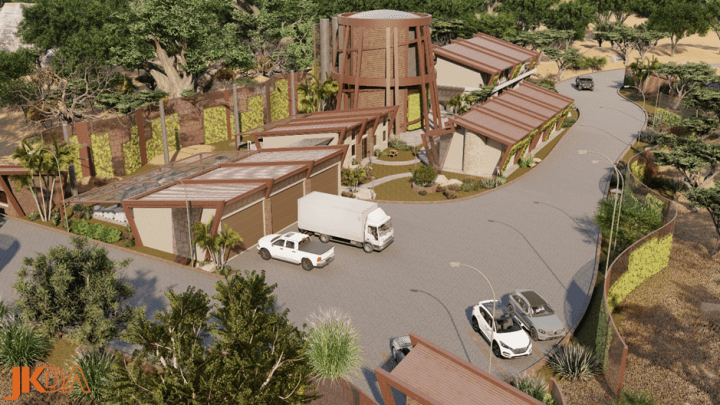
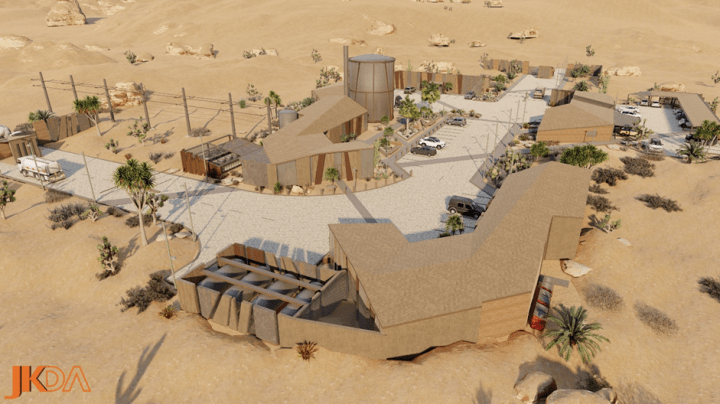
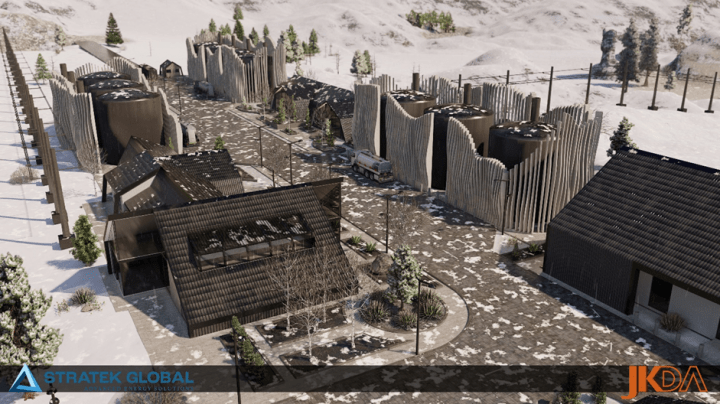
Illustrated here or four of the designs developed as a result of customer requests. They are named; the Impala Design, Kudu Design, Oryx Design, and Sable Design.
The Kudu Design was developed for an African savanna setting. It is shown here with a single reactor of 100 MW thermal output, or 35 MW electrical output.
A most useful aspect of the. HTMR-100 is that an SMR complex can be designed to take up to ten reactors. All ten can be run from a single control room. Obviously, building more reactors per site reduces the unit cost, because you don’t have to duplicate the administration building, the workshops, or a variety of other facilities. Furthermore, if a site is designed for, say, ten reactors they do not all have to be constructed at the same time. An owner can add reactors, in later years, as the demand rises, or as finances become available, thereby allowing for immense planning flexibility.
The Oryx Design was developed as a result of a request from the Middle East. It also features a single reactor, but can easily be adapted for more reactors.
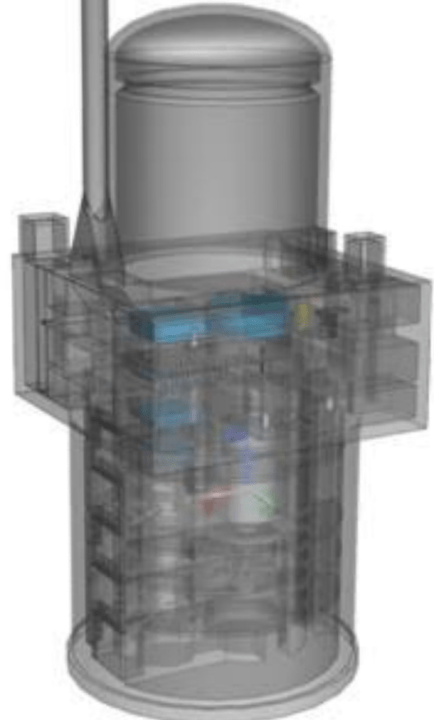
Computer graphic showing the interior arrangement of the reactor building. Approximately 60% of the reactor is underground. Ground-level is at the bottom of the ventilation stack.
The single reactor Impala Design is a workhorse design for an industrial setting such as a South African gold mining complex. This design was developed to fit into any existing industrial complex. It illustrates that other than the actual nuclear reactor itself, in the cylindrical concrete containment vessel, the rest of the power station consists of perfectly normal industrial buildings.
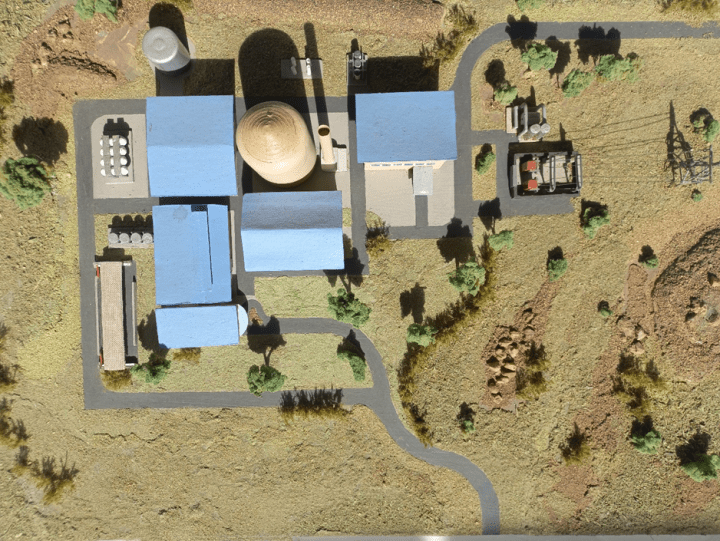
The Sable Design was developed as a result of a request from a country which experiences snow conditions. The request was for a ten-reactor complex. The reactors can be added, over a period of some years, as the customer sees fit.

via STOP THESE THINGS
October 16, 2024 at 01:31AM
“’I’m a businessman. I’ll take the [government green] money, that’s all I care about… I will move heaven and earth to get projects done over here’.” – James Quigley, quoted in Politico ‘s “Power Switch” (below)
In the mid-19th century, Claude-Frédéric Bastiat, a political economist, wrote:
Government is the great fiction through which everyone endeavors to live at the expense of everyone else. Every one is, more or less, for profiting by the labors of others. No one would dare to express such a sentiment; he even hides it from himself.
The Frenchman added:
When plunder becomes a way of life for a group of men in a society, over the course of time they create for themselves a legal system that authorizes it and a moral code that glorifies it.
Correct. Government does not create wealth; it redistributes it (after a large cut). Who wins and loses? The winners are government, the lobbyists, and the rent-seekers, with concentrated benefits to them and diffused costs for the rest of us. Plunder, Bastiat would say.
—————-
I was reminded of this by a news item reported in Politico‘s “Power Switch” newsletter.(August 16, 2023).
“Not all Republicans want to repeal the climate law that turns 1 today,” reported Josh Siegel. “In fact, my colleague Kelsey Tamborrino and I spoke to dozens of people from all corners of the country and discovered that many GOP officials in rural areas are welcoming the billions of dollars in clean energy incentives coming from President Joe Biden’s signature legislation.”
So do you think they found Republicans that feared “climate change” and welcomed “green” energy as cheaper and better? No, the interviewed were financially captured rent-seekers, enjoying a wealth transfer from taxpayers (via Biden) to their pockets. Here is the rest of the story.
In Rogers County, Okla., Republican Commissioner Ron Burrows looks at the Inflation Reduction Act and sees jobs — 1,000 of them to be exact. At least once the Italian giant Enel opens its $1 billion solar manufacturing plant there in 2025.
Burrows is not alone. Other political and economic leaders in Oklahoma, including Republican Gov. Kevin Stitt, are glad to receive the major investments they say they’d never have attracted without the climate law.
“You can imagine being in a small rural community and trying to get economic development to come — it’s a challenge,” said Rosalie Griffith, a board member of the Rural Economic Development of Inola. “But unless you develop, you’re going to die.”
Burrows said Enel’s decision to locate in his tiny town east of Tulsa — population 1,500 — would not have happened without local buy-in. “I just don’t see a company making that sort of investment without some level of comfort that it’s not adversarial, it’s not split,” he said.
By contrast, his local member of Congress — GOP Rep. Josh Brecheen — views the Inflation Reduction Act through the prism of most national Republicans. Brecheen told me he opposes the use of “taxpayer subsidization” to bolster Democrats’ favored green industries and is seeking to repeal the law.
Kelsey and I found that same disconnect between state and local GOP officials in rural areas and their federal representatives across the country.
There’s even a similar, but less dramatic, dynamic unfolding in upstate New York. GOP Rep. Marc Molinaro voted to repeal the Inflation Reduction Act’s clean energy incentives, and that’s made him a top target of Democrats in the 2024 election. His district is one of 18 that voted for Biden but are held by Republicans.
Inflation Reduction Act money catalyzed Canadian company Zinc8 Energy Solutions’ decision to locate a planned battery factory in Molinaro’s purple district. The project is expected to bring up to 500 new jobs to a Hudson Valley region still suffering from the loss of its manufacturing base in the 1990s. That’s exciting James Quigley, a Republican who drives a Tesla and is the supervisor for the town of Ulster, where Zinc8 plans to locate.
“I’m a businessman. I’ll take the money, that’s all I care about,” Quigley said. “I will move heaven and earth to get projects done over here.”
Final Comment
Gosh Josh, what did you really find our here? Are you proud of this? Did you and Kelsey Tamborrino ask the same parties if they liked the federal deficit and inflation? The present level of taxation? The wisdom of the few over the energy verdicts of the masses?
The Wall Street Journal‘s “Bidenomics and the New Political-Subsidy Economy” spoke to this issue:
Money for these subsidies has to come from somewhere, and that means the private economy in higher taxes and more government borrowing…. The IRA [Inflation Reduction Act] is the heart of Bidenomics, which is about creating a new political-subsidy economy. Perhaps all of this will effloresce into a brilliant green future. More likely hundreds of billions in misallocated investment will reduce future productivity gains and translate into slower economic and income growth. Let’s hope President Biden’s subsidies don’t boomerang like pandemic transfer payments, leaving all Americans poorer.
What a waste, what a shame. The next President needs to issue an emergency declaration that the U.S. is out of money and cease all subsidies of the Inflation Reduction Act in order to pause wind, solar, and battery subsidies. Ratepayers and taxpayers will be thankful.
The post “Green” Energy: It’s Just a Bribe appeared first on Master Resource.
via Master Resource
October 16, 2024 at 01:04AM

