The Case Against Net Zero – A Seventh Update

In October 2008, Parliament passed the Climate Change Act requiring the UK Government to ensure that by 2050 ‘the net UK carbon account’ was reduced to a level at least 80% lower than that of 1990; ‘carbon account’ refers to CO2 and ‘other targeted greenhouse gas emissions’. Only five MPs voted against it. Then in 2019, by secondary legislation and without serious debate, Parliament increased the 80% reduction requirement to 100% – thereby creating the Net Zero policy.i

Unfortunately, it’s a policy that’s unachievable, potentially disastrous and in any case pointless. And that’s true whether or not humanity’s greenhouse gas emissions are contributing to increased global temperatures.

1. It’s unachievable.

A modern, advanced economy depends on fossil fuels; something that’s unlikely to change for a long time.ii Examples fall into two categories: (i) vehicles and machines such as those used in agriculture, mining, mineral processing, building, heavy transportation, commercial shipping, commercial aviation, the military and emergency services and (ii) products such as nitrogen fertilisers, cement and concrete, primary steel, plastics, insecticides, pharmaceuticals, anaesthetics, lubricants, solvents, paints, adhesives, insulation, tyres and asphalt. All the above require either the combustion of fossil fuels or are made from oil derivatives: easily deployable, commercially viable alternatives have yet to be developed.iii

Although wind is the most effective source of renewable electricity in the U.K. – because of its latitude, solar power contributes only a small percentage of the UK’s electricity – it has significant problems: (i) the substantial and increasing costs of building, operating and maintaining the huge numbers of turbines needed for Net Zero; (ii) the complex engineering and cost challenges of establishing a stable, reliable, comprehensive non-fossil fuel grid by 2030 as planned by the Government; (iii) the vast scale of what’s involved (a multitude of enormous wind turbines, immense amounts of space iv and large quantities of increasingly unavailable and expensive raw materials); and (iv) the intermittency of renewable energy (see 2 below).v This means that the UK may be unable to generate sufficient electricity by 2030 for current needs let alone for the mandated EVs (electric vehicles) and heat pumps and for the energy requirements of industry and of the huge new data centres being developed to support the rapid growth of AI (artificial intelligence).

In any case, the UK doesn’t have enough skilled technical managers, electrical, heating and other engineers, electricians, plumbers, welders, mechanics and other skilled tradespeople required to do the multitude of tasks essential to achieve Net Zero – a problem worsened by the Government’s plans for massively increased house building.vi

2. It would be socially and economically disastrous.

The Government aims for 100% renewable electricity by 2030 but has yet to publish a fully costed engineering plan for the provision of comprehensive grid-scale back-up when there’s little or no wind or sun; a problem that’s complicated by the imminent retirement of elderly nuclear and fossil fuel power plants. The Government has indicated that back-up may be provided by new gas-fired power plants vii but it has yet to publish any detail. That of course would not be a ‘clean’ solution and it seems the Government’s answer is to fit them with carbon capture and underground storage (CCS) systems: a ‘solution’ that’s very expensive, controversial and commercially unproven at scale.viii This issue is desperately important: without full back-up, electricity blackouts would be inevitable – potentially ruining many businesses and causing dreadful problems for millions of people, including serious health consequences threatening everyone and in particular the poor and vulnerable.ix

Net Zero’s major problem however is its overall cost and the impact of that on the economy. Because there’s no coherent plan for the project’s delivery, little attention has been given to overall cost; but with several trillion pounds seeming likely to be a correct estimate it would almost certainly be unaffordable.x The borrowing and taxes required for costs at this scale could destroy Britain’s credit standing and put an impossible burden on millions of households and businesses. It could quite possibly mean that the UK would face economic collapse.

But Net Zero is already causing one serious economic problem: because of renewable subsidies, carbon taxes, grid balancing costs and capacity market costs, the UK has the highest industrial and domestic electricity prices in the developed world.xi The additional costs referred to elsewhere in this essay – for example the costs of establishing a comprehensive non-fossil grid and of providing gas-fired power plants fitted with CCS as back-up – can only make this worse. Unless urgent remedial action is taken, the government is most unlikely to be able to achieve its principal mission of increased economic growth.

Net Zero would have two other dire consequences:

(i) As China essentially controls the supply of key materials (for example, lithium, cobalt, aluminium, processed graphite, nickel, copper and so-called rare earths) without which renewables cannot be manufactured, the UK would greatly increase its already damaging dependence on it, putting its energy and overall national security at most serious risk.xii It would also mean that, while impoverishing Britain, Net Zero would be enriching China.xiii

(ii) The vast mining and mineral processing operations required for renewables are already causing appalling environmental damage and dreadful human suffering throughout the world, affecting in particular fragile, unspoilt ecosystems and many of the world’s poorest and most vulnerable people; the continued pursuit of Net Zero would make all this far worse.xiv

3. In any case it’s pointless.

For two reasons:

(i) It’s absurd to regard the closure of greenhouse gas (GHG) emitting plants in the UK and their ‘export’ mainly to SE Asian countries, commonly with poor environmental regulation and often powered by coal-fired electricity – thereby increasing global emissions – as a positive step towards Net Zero. Yet efforts to ‘decarbonise’ the UK mean that’s what’s happening: it’s why we no longer produce many key chemicals and, by closing our few remaining blast furnaces, will soon be unable to produce commercially viable primary steel (see endnote iii).xv

(ii) Most major non-Western countries – the source of over 70% of GHG emissions and home to 84% of humanity – don’t regard emission reduction as a priority and, either exempt (by international agreement) from or ignoring any obligation to reduce their emissions, are focused instead on economic and social development, poverty eradication and energy security.xvi As a result, global emissions are increasing (by 62% since 1990) and are set to continue to increase for the foreseeable future. As the UK is the source of just 0.72% of global emissions any further emission reduction it may achieve would essentially have no impact on the global position.xvii

In other words, Net Zero means the UK is legally obliged to pursue an unachievable, potentially disastrous and pointless policy – a policy that could result in Britain’s economic destruction.

Robin Guenier October 2024

Guenier is a retired, writer, speaker and business consultant. He has a degree in law from Oxford, is qualified as a barrister and for twenty years was chief executive of various high-tech companies, including the Central Computing and Telecommunications Agency reporting to the UK Cabinet Office. A Freeman of the City of London, he was Executive Director of Taskforce 2000, founder chair of the medical online research company MedixGlobal and a regular contributor to TV and radio.

End notes:

ihttp://www.legislation.gov.uk/ukpga/2008/27/part/1/crossheading/the-target-for-2050

ii See Vaclav Smil’s important book, How the World Really Works: https://time.com/6175734/reliance-on-fossil-fuels/

iii Regarding steel for example see the penultimate paragraph of this article: https://www.construction-physics.com/p/the-blast-furnace-800-years-of-technology.

iv See Andrews & Jelley, “Energy Science”, 3rd ed., Oxford, page 16: http://tiny.cc/4jhezz

v For a view of wind power’s many problems, see this: https://watt-logic.com/2023/06/14/wind-farm-costs/ This is also relevant: https://davidturver.substack.com/p/debunking-cheap-renewables-myth

vi A detailed Government report: https://assets.publishing.service.gov.uk/media/65855506fc07f3000d8d46bd/Employer_skills_survey_2022_research_report.pdf See also pages 10 and 11 of the Royal Academy of Engineering report (Note 6 below).

vii See this report by the Royal Academy of Engineering: https://nepc.raeng.org.uk/media/uoqclnri/electricity-decarbonisation-report.pdf (Go to section 2.4.3 on page 22.) This interesting report contains a lot of valuable information.

viii This International Institute for Sustainable Development report on CCS is informative: https://www.iisd.org/articles/insight/unpacking-carbon-capture-storage-technology And see the second and third paragraphs here: https://www.theguardian.com/commentisfree/2024/sep/12/fossil-fuel-companies-environment-greenwashing (the rest of the article is also interesting).

ix This article shows how more renewables could result in blackouts: http://tiny.cc/lnhezz

x The National Grid (now the Energy System Operator (ESO)) has said net zero will cost £3 trillion: https://www.current-news.co.uk/reaching-net-zero-to-cost-3bn-says-national-grid-eso/. And in this presentation Michael Kelly, Emeritus Professor of Technology at Cambridge, shows how the cost would amount to several trillion pounds: https://www.youtube.com/watch?v=NkImqOxMqvU

xi The facts, an explanation of why Net Zero is responsible and a proposed solution are cogently set out here: https://davidturver.substack.com/p/uk-electricity-prices-highest-in-world.

xiihttps://www.dw.com/en/the-eus-risky-dependency-on-critical-chinese-metals/a-61462687

xiii Discussed here: https://dailysceptic.org/2024/07/24/net-zero-is-impoverishing-the-west-and-enriching-china/

xiv See this for example: http://tiny.cc/3lhezz. Arguably however the most compelling and harrowing evidence is found in Siddharth Kara’s book Cobalt Red – about the horrors of cobalt mining in the Congo: https://us.macmillan.com/books/9781250284297/cobaltred

xv A current example: https://www.bbc.co.uk/news/articles/c70zxjldqnxo

xvi This essay shows how developing countries have taken control of climate negotiations: https://ipccreport.wordpress.com/wp-content/uploads/2020/07/the-west-vs-the-rest-2.1.1.pdf (Nothing that’s happened since 2020 changes the conclusion: for example see the ‘Dubai Stocktake’ agreed at COP28 in 2023 of which item 38 unambiguously confirms developing countries’ exemption from any emission reduction obligation.)

xvii This comprehensive analysis, based on an EU Commission database, provides – re global greenhouse gas (GHG) and CO2 emissions – detailed information by country from 1990 to 2023: https://edgar.jrc.ec.europa.eu/report_2024?vis=ghgtot#emissions_table

via Climate Scepticism

https://ift.tt/yc6RC34

October 14, 2024 at 02:01PM

Brown Bears Lived In The 73°N Siberian Arctic 3500 Years Ago…Today Their Northern Boundary Is 65°N

A new study provides still more evidence the Arctic was warmer than it is today as recently as a few thousand years ago.

In 2020 the well-preserved carcass of a Yakutian brown bear (Ursus arctos) was discovered buried in permafrost on the terrain of the treeless tundra Bolshoy Lyakhovsky Island in the Arctic Ocean, 73°N.

The Yakutian brown bear currently occupies only the forested regions of Eurasia, with a northern limit of northern Yakutia (Republic of Sakha), 65°N.

The female bear’s age has been dated to approximately 3500 years ago, during the Middle to Late Holocene. At that time the Arctic was warm enough at that latitude to support vegetation (grasses, shrubs) that only persist in the northern Yakutia region today.

The authors suggest brown bears may have been permanent residents of the Siberian Arctic’s islands from about 5000 years ago until a few thousand years ago, when, as today, the Arctic became too cold for the vegetation production requisite for their sustenance.

Image Source: Cheprasov et al., 2024

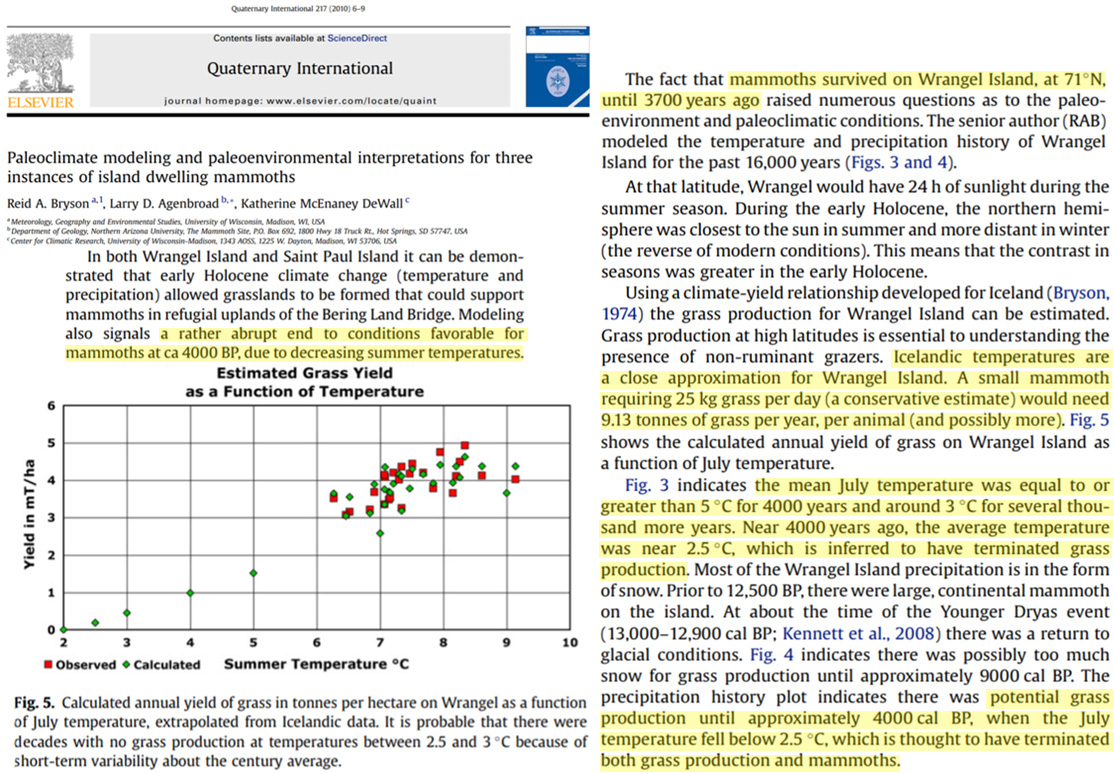
In the same vein, the Arctic’s Wrangel Island (71°N) is home to extensive mammoth remains. Radiocarbon dating indicates the woolly mammoth continued living on this island until 3700 years ago, or until the Arctic climate became too cold to provide enough grass year-round to sustain them (Bryson et al., 2010, Arppe et al., 2019).

A small mammoth is modeled to have conservatively required 25 kg of grass per day to survive. Mean July temperatures decreased from above 5°C during the Early Holocene to below 2.5°C – the threshold for grass production – by about 4000 years ago. Consequently, without enough year-round grass to feed on, the woolly mammoth died out (Bryson et al., 2010).

Image Source: Bryson et al., 2010

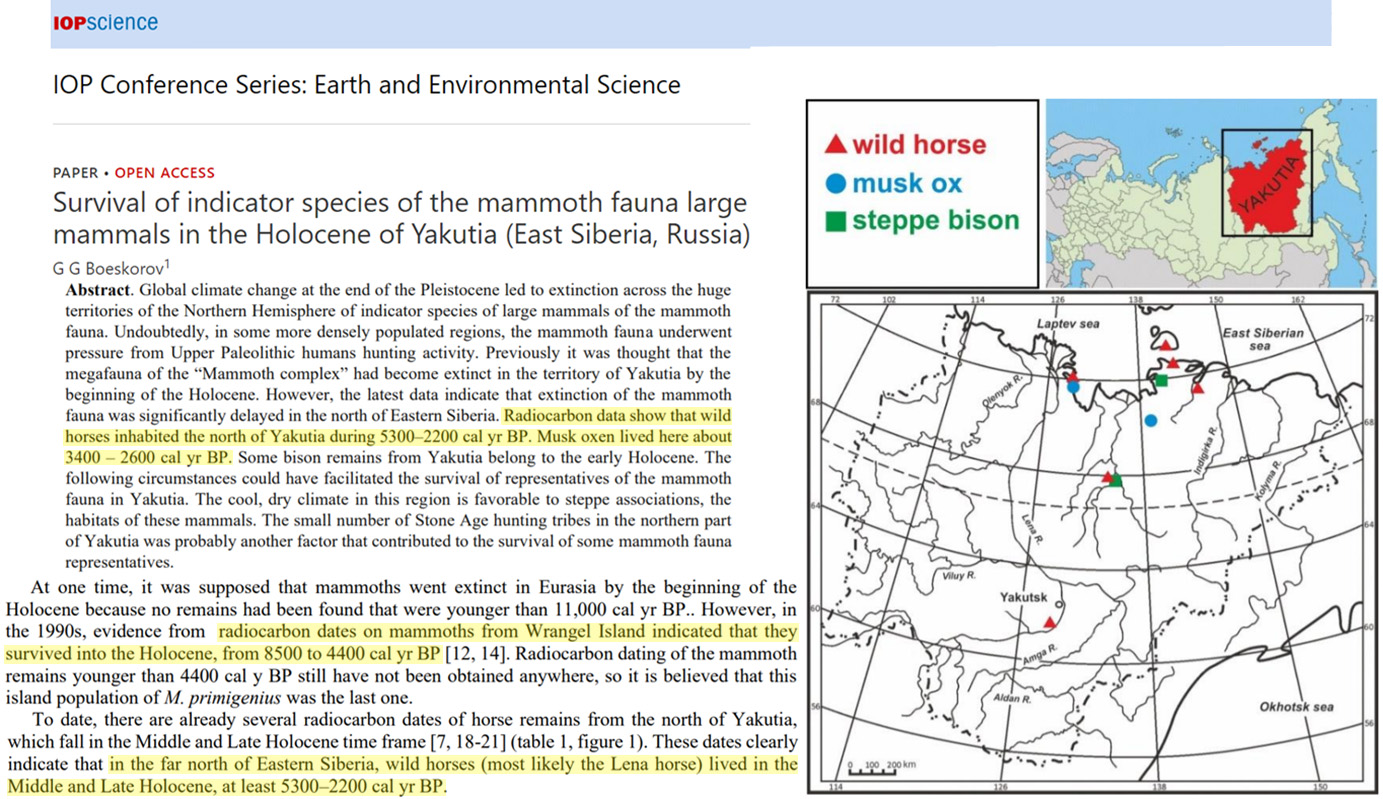
Other research (Boeskorov, 2020) has provided further evidence the Arctic climate was hospitable to grass-eating megafauna until as recently as a few thousand years ago.

The remains of wild horses, musk ox, and bison have been located north of the Arctic circle in the East Siberian Sea (Arctic Ocean) dating to 5300 to 2200 calibrated years before present. The northernmost Siberian climate is far too cold to sustain these large mammals with enough food year-round today.

Image Source: Boeskorov, 2020

via NoTricksZone

https://ift.tt/SqBjyKY

October 14, 2024 at 12:24PM

New Antarctic Greening Study Wilfully Blind to CO2 Fertilization

The study published in Nature Geoscience, titled “Sustained Greening of the Antarctic Peninsula Observed from Satellites,” focuses on the observed increase in vegetation, particularly moss-dominated ecosystems, on the Antarctic Peninsula (AP). While it attributes this “greening” to recent regional warming trends, the paper conspicuously neglects the broader global phenomenon known as carbon dioxide (CO2) fertilization or global greening, which has been documented worldwide. Instead, it takes a rather narrow and selective approach, focusing on the correlation between temperature rise and greening in this specific cold-climate ecosystem, largely ignoring the established role of CO2 in enhancing plant growth globally.

Abstract

The Antarctic Peninsula has experienced considerable anthropogenic warming in recent decades. While cryospheric responses are well defined, the responses of moss-dominated terrestrial ecosystems have not been quantified. Analysis of Landsat archives (1986–2021) using a Google Earth Engine cloud-processing workflow suggest widespread greening across the Antarctic Peninsula. The area of likely vegetation cover increased from 0.863 km2 in 1986 to 11.947 km2 in 2021, with an accelerated rate of change in recent years (2016–2021: 0.424 km2 yr−1) relative to the study period (1986–2021: 0.317 km2 yr−1). This trend echoes a wider pattern of greening in cold-climate ecosystems in response to recent warming, suggesting future widespread changes in the Antarctic Peninsula’s terrestrial ecosystems and their long-term functioning.

https://www.nature.com/articles/s41561-024-01564-5

This omission is significant because the greening of cold regions like the Antarctic Peninsula could easily be explained as part of the broader CO2-driven global greening trend, which has been observed across a variety of ecosystems, from tropical forests to temperate and boreal regions. Global greening is not just limited to cold-climate ecosystems; rather, it’s a pervasive effect driven by increased atmospheric CO2, which enhances plant growth efficiency through a process known as carbon fertilization. Yet, the authors of this study appear to cherry-pick data and studies focusing almost exclusively on temperature as the driver of this greening, while downplaying or ignoring the impact of CO2 enrichment, a factor that has been widely accepted in the scientific community.

The Premise of the Study and Its Narrow Focus on Temperature

The core premise of the study is that the observed greening of the Antarctic Peninsula over recent decades is primarily the result of warming driven by anthropogenic climate change. The authors reference warming trends over the past 60 years, particularly on the West Antarctic and Antarctic Peninsula, regions that have experienced some of the fastest temperature increases globally. They highlight that despite a pause in warming between 1999 and 2014 due to natural variability, the long-term warming trend is projected to continue at 0.34°C per decade until 2100​.

The study uses satellite data from 1986 to 2021, applying normalized difference vegetation index (NDVI) and Tasseled Cap Greenness (TCG) as proxies for vegetation cover. Their analysis suggests a significant increase in moss-dominated ecosystems, with vegetation cover expanding from 0.863 km² in 1986 to 11.947 km² in 2021, and an accelerated rate of change in recent years (2016–2021) compared to the overall study period​.

The authors link this greening primarily to temperature increases, citing the lengthening of growing seasons, warmer conditions, and increased moisture availability due to reductions in sea ice extent. However, they make only cursory mention of the larger, well-established phenomenon of CO2 fertilization and its role in global plant productivity increases.

Ignoring the Evidence for Global CO2 Fertilization

One of the major shortcomings of this study is its failure to consider or adequately address the global impact of increased atmospheric CO2 concentrations, which are well known to enhance plant growth across a wide range of ecosystems. The phenomenon of CO2 fertilization has been extensively documented in studies like the one by Zhu et al. (2016), which found that global leaf area increased by over 10% in the past two decades, largely driven by CO2 enrichment​.

The Antarctic Peninsula, though a unique and cold ecosystem, is not immune to the effects of global processes. The rise in atmospheric CO2 concentrations has been shown to enhance photosynthesis and water-use efficiency in plants, enabling them to thrive even in areas where water or temperature might otherwise be limiting factors. This is particularly relevant in cold, high-latitude ecosystems where the growing season is short, and any enhancement in plant productivity due to higher CO2 levels could have an outsized impact on vegetation cover.

The fact that the authors of this study chose to ignore this well-documented global trend raises questions about the selectivity of their analysis. While they acknowledge that warming temperatures may play a role in greening, they fail to adequately explore how increased CO2 levels could be contributing to the observed changes in vegetation cover on the Antarctic Peninsula. By focusing almost exclusively on temperature as the driver of greening, they present an incomplete picture of the underlying processes.

Cherry-Picking Temperature Data

Another issue with the study is the apparent cherry-picking of temperature data to support the claim that warming is the primary driver of greening. The authors note a “recent pause in warming” between 1999 and 2014 but argue that the overall trend is one of continued warming. However, this “pause” is more than a minor footnote—it suggests that temperature is not the only or even the primary factor driving changes in vegetation cover.

In fact, the recent slowdown in warming across the Antarctic Peninsula, linked to natural variability, challenges the notion that temperature alone is responsible for the observed greening. If warming had paused or even reversed during this period, one would expect a corresponding slowdown in greening. Yet, the study finds that the rate of greening has accelerated in recent years, suggesting that factors other than temperature are at play.

This brings us back to CO2 fertilization. Even during periods of stable or declining temperatures, plants can continue to thrive and expand their ranges due to increased atmospheric CO2, which enhances their photosynthetic capacity and water-use efficiency. The failure to consider this factor in the analysis is a glaring omission, especially when the authors attempt to attribute all observed greening to temperature increases.

The Global Context of Greening

To better understand the limitations of this study, it’s useful to place the findings in the context of global greening trends. The Earth’s land surface has been “greening” for several decades, with large increases in leaf area across tropical forests, savannas, and boreal regions​. This greening has been driven by a combination of factors, including CO2 fertilization, nitrogen deposition, and land-use changes, with CO2 enrichment being the dominant factor.

Even in high-latitude regions, such as the Arctic and Antarctic, where temperatures have risen faster than the global average, CO2 fertilization plays a critical role. In these cold environments, the growing season is short, and any increase in photosynthetic efficiency can have a significant impact on vegetation cover. For example, in the Arctic, researchers have documented a similar greening trend, which has been attributed to both warming temperatures and increased CO2 availability​.

The failure of the authors to engage with this broader body of literature on global greening and CO2 fertilization creates a skewed narrative. By attributing the greening of the Antarctic Peninsula almost exclusively to temperature increases, they overlook the more comprehensive explanation provided by global trends in plant productivity and atmospheric CO2 concentrations.

Conclusions: A Narrow View of a Global Phenomenon

The study of the Antarctic Peninsula’s greening presents an interesting case of vegetation expansion in one of the planet’s coldest regions, but it suffers from a narrow and selective approach to explaining the phenomenon. By focusing almost exclusively on temperature as the driver of greening, the authors ignore the well-established global impact of CO2 fertilization, which has been shown to enhance plant growth across a wide range of ecosystems.

This selective focus on temperature is problematic for several reasons. First, it overlooks the fact that CO2 fertilization can drive plant productivity even in the absence of significant temperature increases. Second, it downplays the global context of greening, which has been observed in ecosystems ranging from tropical forests to Arctic tundra. Finally, by cherry-picking temperature data and ignoring periods of warming “pauses,” the authors present an incomplete picture of the factors driving vegetation change in the Antarctic Peninsula.

Ultimately, this study reflects a broader trend in climate science, where researchers often focus on temperature as the primary driver of environmental change while neglecting the significant role of CO2. While temperature undoubtedly plays a role in shaping ecosystems, it is only part of the story. The global greening phenomenon, driven by increased atmospheric CO2, is a critical factor that must be considered in any comprehensive analysis of vegetation change, whether in the Antarctic or elsewhere. It’s difficult to believe the level of myopia demonstrated by these experienced researchers was not intentional.

via Watts Up With That?

https://ift.tt/tkTJLDn

October 14, 2024 at 12:02PM

Miliband Fiddles While Britain Faces Blackouts

By Paul Homewood

h/t Philip Bratby


This is insane!


 image

A backstop system designed to prevent blackouts was mobilised for the first time in two years as Britain’s power grid battles low winds and nuclear outages.

The surprise notice for the capacity market, which issues a warning to Britain’s electricity generators, was issued by the National Energy System Operator (Neso) just after midday on Monday.

It told generators to be ready for when demand spikes at 4:30pm, amid fears the amount of spare power capacity had grown unacceptably small compared to demand.

However, the notice was withdrawn just after 2pm.

A spokesman for the Neso insisted it was “confident that electricity margins are sufficient for this evening” and stressed the triggering of the original notice was automatic.

The warning was the first of its kind since November 2022, when a similar notice was issued but later withdrawn as low wind speeds and nuclear power outages piled stress on the electricity system.

Kathryn Porter, an independent energy analyst at Watt Logic, said the likely causes this time around were lower-than-expected wind output, as well as greater-than-expected demand for electricity.

At the same time, publicly available data showed the grid was expecting power to be flowing out to Europe via interconnectors on Monday evening, suggesting the Neso might have had to intervene to ensure power flows into the UK instead, she added. 

The warning also comes after the Sizewell B nuclear power station, in Suffolk, was temporarily shut down for refuelling on Friday.

The 1.2 gigawatt site is not expected to return to full capacity until December, according to owner EDF.

https://www.telegraph.co.uk/business/2024/10/14/blackout-prevention-plan-activated-britain/

OK, there was never any chance of a blackout. The purpose of the warning is to get sufficient back up capacity in place in time.

But this is still only October, and there is still a lot more wind power than we would get in a real wind drought in midwinter. Note that wind dropped to 800 MW on Sunday evening

Today wind power has fallen to 2 GW, about 7% of capacity, while demand has peaked at 35 GW – in winter that could easily rise to 45 GW or more.

image

https://bmrs.elexon.co.uk/generation-by-fuel-type

Interconnectors have been bringing in 4 GW, but the backbone has been 20 GW of CCGT and 4 GW of nuclear. But we already know that all the nuclear bar Sizewell B will be gone by 2028.

Even supposing Miliband gets to triple wind power by 2030, that would still only give us 6 GW, at a time when demand will probably have gone up by that much as well.

Add to that 5 GW of biomass and other bits and pieces, and we will still be potentially 40 GW short in midwinter.

Meanwhile crazy Ed Miliband plays a ukulele next to a wind mill!

via NOT A LOT OF PEOPLE KNOW THAT

https://ift.tt/Un7FZq0

October 14, 2024 at 11:49AM