British Blackout System Mobilised After Wind Dropped on a Cold Day

Essay by Eric Worrall

The alert was withdrawn after 2 hours. An energy spokesman insists there is no cause for alarm.

Blackout prevention system mobilised as Britain battles low winds

First capacity warning in two years later withdrawn

Matt Oliver Industry Editor
14 October 2024 3:03pm BST

A backstop system designed to prevent blackouts was mobilised for the first time in two years as Britain’s power grid battles low winds and nuclear outages.

The surprise notice for the capacity market, which issues a warning to Britain’s electricity generators, was issued by the National Energy System Operator (Neso) just after midday on Monday.

It told generators to be ready for when demand spikes at 4:30pm, amid fears the amount of spare power capacity had grown unacceptably small compared to demand.

However, the notice was withdrawn just after 2pm.

A spokesman for the Neso insisted it was “confident that electricity margins are sufficient for this evening” and stressed the triggering of the original notice was automatic.

…

But Tom Greatrex, chief executive of the Nuclear Industry Association, warned that the notices risked becoming more commonplace as Britain’s ageing nuclear power stations were switched off this decade.

…

Read more: https://www.telegraph.co.uk/business/2024/10/14/blackout-prevention-plan-activated-britain/

Thankfully your genius Minister for Net Zero Energy Security has a plan to keep British energy supplies secure.

Anger at UK’s ‘bonkers’ plan to reach net zero by importing fuel from North Korea

Government criticised over list of potential countries for sourcing biomass, which also includes Afghanistan

Isabella Kaminski
Wed 9 Oct 2024 20.37 AEDT

A plan by the British government to burn biomass imported from countries including North Korea and Afghanistan has been described as “bonkers”, with critics saying it undermines the credibility of the UK’s climate strategy.

A bioenergy resource model, published in late summer, calculates that only a big expansion in the import of energy crops and wood from a surprising list of nations would satisfy the UK’s plan to meet net zero.

In a strategy document published last year and since seemingly adopted by the new Labour government, the Sunak government said it wanted biomass to play a “significant role” in decarbonising all sectors of the economy in the years leading up to 2050. Previous administrations have provided more than £20bn to businesses using it in the power and heat sectors over the past two decades.

…

Read more: https://www.theguardian.com/environment/2024/oct/09/anger-uk-plan-net-zero-import-biomass-fuel-north-korea

Of course, the North Korean firewood will only be needed to keep the lights on if the flywheels run out of spin.

My suggestion, if even The Guardian is calling your Net Zero plan “bonkers”, it might be time for a rethink. Or possibly a new energy minister.

via Watts Up With That?

https://ift.tt/epKAMGV

October 15, 2024 at 12:04AM

Thanks, CBS News, For Presenting the Truth About When the Deadliest Hurricanes in U.S. History Occurred

From ClimateREALISM

By Linnea Lueken

A recent post by CBS News, titled “Top 10 deadliest hurricanes in U.S. history,” presents a factual discussion of the 10 deadliest hurricanes that made landfall in the United States. Refreshingly, CBS did not attempt to attribute the deadly hurricanes to climate change.

The post begins by quoting the Colorado State University Tropical Meteorology Project prediction that this season would be “well above average” for major hurricanes making landfall in the United States and Caribbean. While some media outlets, including CBS in other posts (covered by Climate Realism here), do try to cram a human-caused climate change narrative into stories covering this hurricane season, this one does not. Instead, it merely lists the top ten storms with the highest death tolls, and the post itself actually serves to undermine climate alarmist claims about the “unprecedented” nature of recent storms.

Of the ten storms listed:

  • 4 happened before the year 1900;
  • The Great Galveston hurricane of 1900 killed the most people of all at up to 12,000 people;
  • Only Katrina (1,200 dead in Louisiana, 2005) and Maria (2,975 dead in Puerto Rico, 2017) occurred within the last three decades.

It is an open question, however, whether Maria should actually make the list since the death toll from the hurricane itself was 64. The 2,975 number comes from an counterfactual attribution study, the kind Climate Realism has critiqued previously here and here, for example, in which the authors looked at historical death patterns in and around the time of the hurricane, and attributed any excess deaths to the hurricane – an “estimate how many people would have died had Hurricane Maria not hit the island.” Had attribution studies been conducted for each and every hurricane on the list, it is likely their death tolls would have been much higher as well.

Helene has a current death toll of 238, according to the report, but that number is likely to climb as more wreckage is combed through and missing persons are identified. At the time of writing, no death statistics are available for Milton.

There is no clear pattern to this data, for two major reasons.

First is that there is no pattern of increasingly severe storms. The available hurricane and tropical cyclone data simply do not show that hurricanes are getting more intense, severe or frequent over time. Climate Realism has covered the data, sometimes at the state-specific level, dozens of times. Even the Intergovernmental Panel on Climate Change (IPCC) agrees, stating in their 2021 AR6 Working Group report that identifying past trends in tropical storm metrics is a “challenge.”

Since the beginning of more accurate data collection in the 1970s, there is no trend whatsoever for global tropical cyclone frequency, or global accumulated cyclone energy (ACE). (See figures below)

Figure 1: Chart and data collection by Ryan N. Maue, “Global Tropical Cyclone Activity,” Climate Atlas, accessed October 10, 2024, https://ift.tt/pyzgt0s
Figure 2: Last 50-years+ of Global and Northern Hemisphere Accumulated Cyclone Energy: 24 month running sums. Note that the year indicated represents the value of ACE through the previous 24-months for the Northern Hemisphere (bottom line/gray boxes) and the entire global (top line/blue boxes). The area in between represents the Southern Hemisphere total ACE. Source: Ryan N. Maue, “Global Tropical Cyclone Activity,” Climate Atlas, accessed October 10, 2024 https://ift.tt/WCeDYXB

Despite a much larger population in the Hurricane bullseye zone on the coasts now than in the past, most of top ten deadliest hurricanes occurred in the more distant past. Why? Because of improved early warning systems resulting in evacuations and infrastructure in the United States having been hardened against severe weather due stronger building standards and technology. Also, many deaths due to exposure to the elements have been prevented by modern generators and the speed with which emergency personnel can get into communities and power is restored. These improvements would not have been possible without fossil fuels and their byproducts, which climate alarmists seek to eliminate.

Every deadly storm is a tragedy, and it is just as much of a mistake to downplay the danger and damage from tropical cyclones as it is to hype them up and try to connect them to climate change. In this instance, CBS gave a simple, factual account detailing the somber history of severe hurricane landfalls in the United States and its territories. Bravo, CBS. See if you can follow this up by sticking the facts about severe weather in the future.

via Watts Up With That?

https://ift.tt/r4RCmIY

October 14, 2024 at 08:01PM

Buy Woke, Go Broke: The Failure of ESG Investing

From THE DAILY SCEPTIC

by Tilak Doshi

Terrence Keeley is a long-time ESG practitioner who until recently headed the official institutions group in the world’s largest asset manager BlackRock advising sovereign wealth funds, central banks, finance ministries, and public pension funds. He claimed in 2022 that “ESG investing could well be the biggest thing in finance since the Dutch East India company issued shares in 1602…ESG’s success or failure could literally impact every living creature on Earth.”

Mr. Keeley’s boss, Larry Fink, chief executive of BlackRock, was equally hyperbolic in his annual letter to CEOs in early 2020:

We believe that sustainability should be our new standard for investing…all investors – and particularly the millions of our clients who are saving for long-term goals like retirement – must seriously consider sustainability in their investments…I believe we are on the edge of a fundamental reshaping of finance.

Alas, the ESG and sustainability movement, a financial juggernaut in its heyday, has performed poorly in the past two years.

This poor performance has been a result of a combination of factors including the boomeranging impact of Western sanctions on Russia energy exports, the collapse of “clean” energy stocks, the rise in interest rates, and the widespread backlash against ‘woke capitalism’ and climate change regulations in Europe and the U.S.

ESG investment momentum has slowed on both sides of the Atlantic since 2022. In 2022, for the first time in more than a decade, investors pulled more money from funds marketed as “sustainable” than they added. In the first half of 2024, the U.S. ESG market experienced net outflows of over $13 billion, on the heels of a $9 billion outflow in 2023. Morningstar, a financial research firm, found nearly 2,500 fewer sustainable funds globally in 2023 relative to the prior year and 2024 is on track for an even steeper plunge.

According to Torsten Lichtenau, Bain and Company’s global carbon transition practice lead, “When you look at the importance of [environmental, social and corporate-governance efforts], you can clearly see a huge peak in 2021 to 2022 where there was also a lot of action off the back of the Glasgow COP26 climate conference in 2021. Now it’s dropped back to 2019 levels.”

Competitive Sustainability

Enter “competitive sustainability”, a buzz phrase of choice of its most vociferous proponents. The European Commission’s 2022 Annual Sustainable Growth Survey (ASGS) presented a “competitive sustainability” agenda for the EU covering four dimensions: productivity, environment, fairness, and stability. In a word salad worthy of Brussel’s unelected bureaucrats, it describes the agenda as one where “a fair, just, green and digital transition which requires sustainable social conditions, will serve as a foundation for future prosperity and resilience. Well-designed labour market policies and social protection systems are the basis for resilience and inclusive growth.”

In offering a Panglossian world where all good things go together – high productivity, environmental sustainability, fairness and stability – “competitive sustainability” is now the battle cry for the Cambridge Institute of Sustainable Leadership (CISL). It is mom’s venerable apple pie, something no reasonable person could object to. There are no difficult trade-offs to be made since “competitive sustainability” ensures both economic growth and environmental sustainability, not to mention equity and stability.

In an article published in the Financial Times last month, the interim CEO of CISL Lindsay Hooper begins by saying: “The business case for sustainability is clear: companies cannot thrive on a planet suffering from cascading crises and unmanageable risks. Yet, despite decades of corporate commitments, businesses continue to damage the planet, carbon emissions to rise and fossil fuel companies to chase growth.”

Ms. Hooper asserts that “It is time to confront the uncomfortable truth: ESG as it stands – grounded in disclosures and voluntary market action – will not deliver the necessary change. The solution is a radical shift towards ‘competitive sustainability’.”

What does this “radical shift” entail? To deliver change, Ms. Hooper says we must “redesign” penalties and incentives which “will require a critical mass of businesses to push for government action”. Evidently, market decision-making in the context of disclosure rules and voluntary action by company executives is not enough. She finds it imperative that governments “create conditions that make it economically compelling to phase out damaging activities. Otherwise businesses that voluntarily transition will be undermined by those that don’t.”

There we have it, straight from the hallowed halls of academe. Governments – presumably advised by sustainability-congruent academics – must replace markets by diktats that determine which industries are pursuing “damaging activities” and need to be proscribed, and which are not. An extreme case of governments picking winners.

The familiar trope of market myopia is trotted out by Ms. Hooper: “As long as the market rewards short-term gains over long-term resilience, businesses will harm the planet, and markets will destroy the foundations on which they depend.” Evidently, Mr. Hooper seems not to be too concerned about the “short-termism” of governments bound by electoral cycles.

Meanwhile, in the Real World…

Firms favoured by ESG investment metrics – the “non-damaging activities” as per Ms. Hooper – such as wind and solar system providers, electric vehicle manufacturers, “green” hydrogen producers, and other such “sustainable” entities have been having a hard time after initial enthusiasm and high IPO values.

The Renewable Energy Industrial Index (RENIXX) is a global stock capitalisation index of the 30 largest renewable energy industrial companies in the world including First Solar, Gamesa, Orsted, Plug Power, Solarcity, Tesla, and Vestas. Established on May 1, 2006, with an initial value of 1,000 points, the index stood at 1,013 points on September 25th, essentially registering zero value growth over the last 18 years. In comparison, the S&P 500 Index more than quadrupled over the same period. The RENIXX is down three years in a row from 2021, losing half its value. It should be noted that that this performance would have been far worse if the outperforming Tesla stock was removed from the index.

The iShares Global Clean Energy ETF aims to “target access to clean energy stocks around the world”. Last year its value fell by 26.1% and from its inception in 2008 it has lost about 60% of an initial investment of $10,000.

Perhaps the best example of ESG-inspired debacles is provided by bp, the hitherto “woke” oil company that has used lower-case letters for its name and logo since 2000. In the high road of the climate crusade, marked by corporate brochures extolling social responsibility and environmental sustainability, the company was first among its peers. Its then-CEO John Browne – now Lord Browne – declared in a 2020 speech at Stanford University: “We need to reinvent the energy business. We need to go beyond petroleum.”

According to an article in the Telegraph published on Monday, bp has abandoned its target to cut oil and gas production by 2030 “as its new chief executive scales back a switch to green energy to boost its share price”. Its new CEO Murray Auchincloss plans to focus on investments in oil and gas projects in the Middle East and the Gulf of Mexico to boost output. Quite unsurprisingly, in the real world where money matters, the company’s shares rose as much as 1.3% after the story was first reported by Reuters. Perhaps rather late in the day, the company’s senior management has decided that its fiduciary duties to maximize shareholder profits trump its devotion to “sustainability”.

Them Weasel Words

The question about the ethically appropriate role of business firms in societies in which they operate is as old as the business firm itself. Adam Smith, a keen observer of businesses – he authored An Inquiry into the Nature and Causes of the Wealth of Nations after all – was not at all uncertain in his response to this question in 1776: it is from the appeal to the self-interest of the butcher, the brewer and the baker that we expect our dinner, not to their benevolence. He had also “never known much good done by those who affected to trade for the public good”.

Almost two centuries later, Smith’s most famous acolyte Milton Friedman was just as clear: “There is one and only one social responsibility of business – to use its resources and engage in activities designed to increase its profits so long as it stays within the rules of the game, which is to say, engages in open and free competition without deception or fraud.”

He too was distrustful of businessmen who talk of promoting desirable social ends, for they are “unwitting puppets of the intellectual forces that have been undermining the basis of a free society these past decades”.

In the battle of the greatest weasel words of recent years, “ESG” and “competitive sustainability”, along with their corollaries such as “energy transition” and “net zero by 2050”, surely come out at the top.

It is not capitalist free markets but those that seek to replace them that threaten to destroy the foundations of modern civilization.

Dr. Tilak K. Doshi is an economist, a former contributor to Forbes, and a member of the CO2 Coalition.

via Watts Up With That?

https://ift.tt/bQghUzC

October 14, 2024 at 04:08PM

An Australian local council calls for suspension of all mRNA vaccines due to DNA contamination

Media pollution

…

Port Hedland Council had a special meeting on Friday Oct 11, where they voted to call for the immediate suspension of Moderna and Pfizer COVID vaccines and to send letters about this to the Prime Minister, the State’s Premier, and  to every other council in Australia telling them why they should do it too.

The motion was carried 5:2. Port Hedland is the largest iron ore export port in the world, in the far north west Pilbara area of Western Australia.

The motion, based on a recent report by Canadian virologist David Speicher and letters from MP Russell Broadbent to Anthony Albanese, calls on council to send a letter to the Prime Minister supporting Mr Broadbent’s call for the immediate suspension of Pfizer and Moderna COVID-19 vaccines.

Deputy mayor Ash Christensen, who once described fighting against COVID vaccine mandates as akin to the ANZAC’s battle at Gallipoli, voted for the motion alongside councillors Adrian McRae, Camilo Blanco, Sven Arentz and Lorraine Butson.

There was resounding community support for the motion, with more than 10 residents delivering speeches at public statement time, referencing a range of COVID vaccine conspiracy theories.

The man who moved the motion, Councillor Adrian McRae, said that national vaccine policy was not the councils job, but said that the state and federal governments had failed the community. The council has “grave concerns about the health impacts that could arise from contamination, including genomic instability, cancers and potential effects on future generations.”  (Annexure 1)

ABC, Public Broadcaster, news, media, alternate logo, Australia

The council shared a video made by Professor Angus Dalgleish for the Australian audience.  The English oncologist had seen a dramatic shift in inexplicable cancers among some of his long time patients who had vaccine boosters.  He pointed out that a Canadian virologist, David Speicher, had studied vials of Australian vaccines and found levels of DNA contamination 145 times the permissible limit. Dalgleish also talked about recent results from Japan, The Czech Republic and Italy which showed the number of boosters was associated with an increase in cancer. He described the risks of giving children contaminated vaccines en mass as a “disaster” worse than thalidomide.

The Australian ABC didn’t think this extraordinary meeting, contaminated medicine, or the possible deaths of Australian children was noteworthy enough to report on, even though they practically charter a plane to report on Councils that want to change the global climate. Those councils that lead the way in soaking up subsidies and wasting ratepayers money on grandiose schemes to cool the world are treated like stars. If a far flung council runs a personality test on their residents to prepare for a Hydrogen Boom fantasy, the ABC will be there. If our government agencies turn out to be corrupt clubs funded by the perfidious industries they are supposed to regulate, who cares?

The story only became newsworthy when the State Premier came out with petty insults, saying the council had “gone off the rails” and telling them to “stick to their knitting”. We look forward to the day Roger Cook, with a BA in Public Administration,  meets Professor Dalgleish, of St Georges University of London, to talk about their slip stitch. Dalgleish has published 495 medical papers and been cited 21,000 times.

The council is raising laboratory results that show we may be harming the gene pool of Australia, and the Premier (and ABC) offer childish ridicule in return? It’s a “let them eat cake” moment. Why isn’t the TGA (Australia’s “FDA”) even keeping track of cancer cases in people who have had 1 – 4 booster shots?

It’s just another misinformation sausage from the Butcher of news — our ABC.

The ABC writers (not naming any names, Charlie McLean and Jessica Shackleton) de facto declared the studies raised by the Canadian virologist and the Oncology Prof “conspiracy theories”.  They didn’t bother to interview either of them, (or read the studies) they just implied the DNA argument was an old one, and said it had been discredited by “international bodies” they couldn’t be bothered naming, and the “Australian Department of Health and Aged Care.” To show how little they cared about making sense, they quoted an irrelevant paragraph from the Department’s website about how DNA is in the nucleus of our cells, and mRNA can’t get in there, or affect or combine with our DNA. Since the council was talking about DNA contamination of the mRNA vaccines, this was wholly superfluous misdirection.

This is the kind of research taxpayers are forced to pay for to cover up government failures. But the more they censor the more we can use it against them. Don’t forget to mention to friends and family about things like this and Elon catching the largest rocket that ever flew yesterday.  Your mission, should you choose to accept it, is to undermine the authority of our inept parasitic public news service, every chance you get.

The letter the Council is sending to the PM and all the other councils contains very specific details about the reasons the TGA has failed to detect the DNA contaminants in the vaccines.

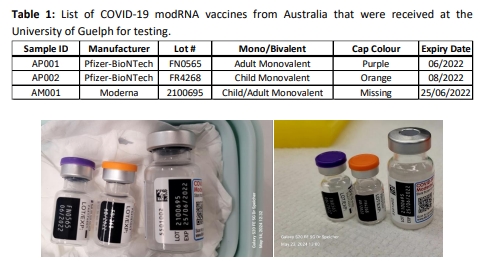
Vaccine vials for testing. Australian mRNA. DNA contamination.


My rough notes from the speech by Professor Angus Dalgleish:

Canadian virologist, David Speiker has found synthetic DNA contamination, in Australian vials of mRNA vaccines. The sheer level of contaminants detected — up to 145 times the permissable limit —  means  the vaccines are a form of gene therapy.

Professor Angus Dalgleish reports that we are already seeing effects of this in real patients. “Patients who had been cancer free for many years, were suddenly showing rapid progression”. They had been completely stable for 5, 8, 10, or 18 years. “I am used to seeing people progress when they face severe depression, for example during divorce, bereavement, debt etc, but all these patients had only one thing in common. (3:20)  They had been forced to have a booster vaccine.”

It is not an isolated issue. His own research shows the boosters suppress the T Cell response and switch the antibody response to tolerizing [the kind of antibodies that reduce the immune response rather than ramp it up]. That means it’s the perfect example where we have part of the immune system turning off the policing of foreign invaders and cancer.

Australia has administered more than 60 million vaccines, but the Australian public health agencies are not tracking cancers in patients.

The Dept of Health and the TGA have chosen not to monitor the cancer incidence in people post vaccination.

It is troubling that the Dept of Health has not made data on cancer trends publicly available.

Each booster increases the chances of cancer across the board. Studies from the Office of National Statistics of Japan, and Checkoslovakia and Italy, and in all these countries shows an increase in all cancers across the board and they are associated with the number of boosters.

The contamination of this vaccine with DNA should have been picked up before they were administered. But the first thing we should do is stop all doses of the vaccines at the moment. This could be an unmitigated disaster, that would make the thalidomide disaster, previously, look very small beer in comparison.

REFERENCES and LINKS

For anyone dealing with cancer now, or vaccine injuries, my deepest sympathies. There is a lot you can do. In addition to discussing it with your own doctors, study the FLCCC site for their cancer treatment protocol and their Covid and vaccine recovery protocols. The FLCCC are a team of top specialist doctors in the US like Paul Marik (currently touring Australia) and Pierre Cory. They explain and list the drugs and vitamins they recommend with reasons and all the references.  These are excellent resources.


0 out of 10 based on 0 rating

via JoNova

https://ift.tt/mcbpgQw

October 14, 2024 at 03:55PM