On approach of autumn the Floridian quakes with apprehension. It is the dreaded season of hurricanes. Tearing through the West Indies, they often strike the coast with deadly effect. With scarcely a note of warning, houses are overthrown, sailboats blown from the water, and orange groves swept bare of leaves and fruit. Some of the old settlers say that they can detect signs of the storm a day before it breaks upon them. “You feel it in the air long before it comes,” says one. This is, however, an indefinite sign. The devastation lingering in its track certainly proves that “you feel it in the air when it comes.” One of these typhoons visits the coast every year.”
The researchers at the Potsdam Institute for Climate Impact Research PIK are among the world leaders of the Church of Global Warming and are responsible for various stylistic fantasies such as the “tipping points”.
Stefan Rahmstorf in particular, known since the 2000s for his rabidness (more here), hardly misses an opportunity to spread catastrophic news that is, however, quite easy to refute.
His earlier statement: “We are losing control of the climate system” from 2019 is legendary. When has humanity ever had control over the Earth’s climate?
According to the familiar pattern…
“Too warm – climate catastrophe
Too cold – climate catastrophe
Too dry – climate catastrophe
Too wet – climate disaster
All good – still a climate catastrophe”
…the mass media and their purveyors of doom are currently constructing the apocalyptic climate riders from the Atlantic hurricanes off North America, announcing the imminent end.
In order to activate the viewer’s conformist instinct, the “news” programs like to present luminaries of climate science – currently Stefan Rahmstorf on ZDF German public television, who presents the Milton storm as exceptional and unprecedented. The reason for the weather conditions: industrial carbon dioxide, of course, which is inexorably heating the earth.
But is Rahmstorf’s prediction true?
EIKE Vice President Michael Limburg thinks as follows:
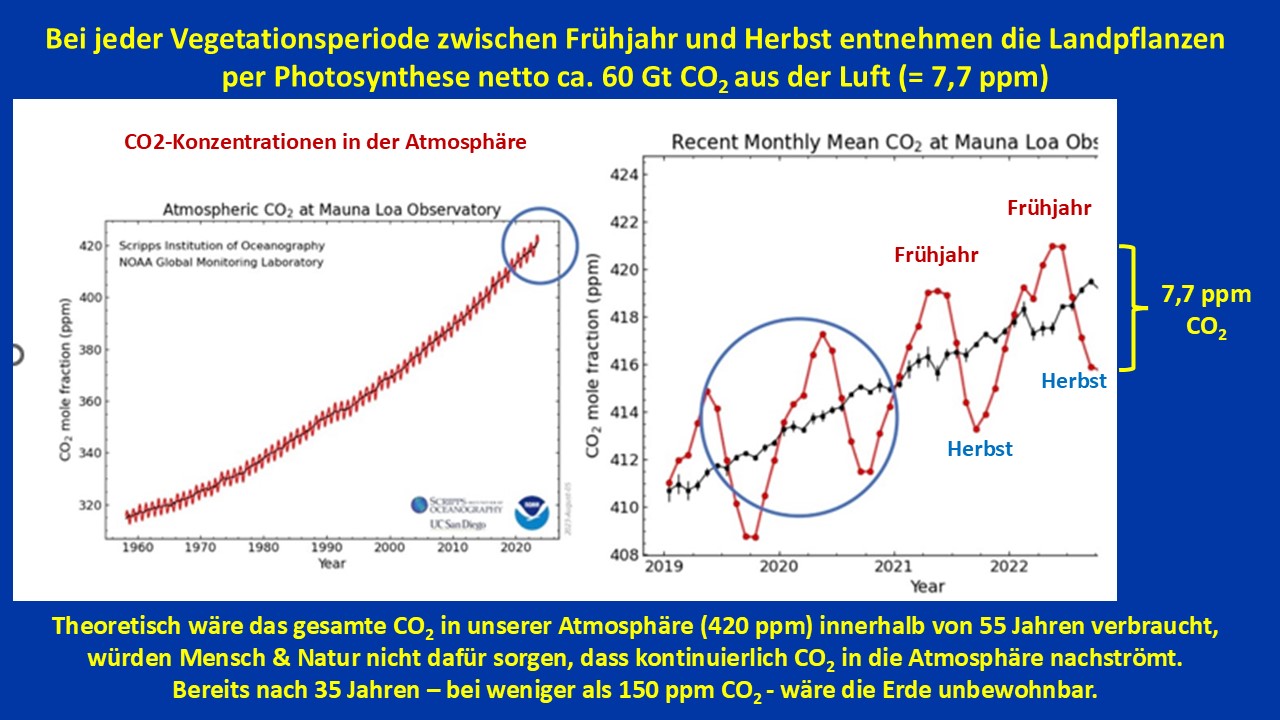
What Rahmstorf is saying is unbelievable. CO2 would remain in the air for 1,000s of years. The correct answer would be a few to a few tens of years. For example, Tom Segalstadt, a geologist from the University of Oslo, has shown in his paper “Carbon cycle modelling and the residence time of natural and anthropogenic atmospheric CO2: on the construction of the ‘Greenhouse Effect Global Warming’ dogma” that the residence time is about 5 years. Ganteför also shows in this video that because of the C14, which rose sharply due to above-ground A-bomb tests after WW2, after a test ban from 1963, the C14 value (allusion to CO14 O2) through the sinks almost fell back to the natural value after approx. 50 years. And the easily accessible data on CO2 concentration on a global scale not only shows the average value, but also the increase and decrease due to plant growth at an annual rate. This difference is about 6-7 ppm, and the duration is 1 year. If the residence time were a thousand or more years, a drop would not even have to show up. Prof. Klaus D. Döhler has also drawn attention to this. See fogure.
Mauna Loa; CO2 in the atmosphere with plant growth
EIKE contributor Josef Kowatsch seconds:
Beginning at the 6: 0 min mark on ‘heute journal’, it starts with the PIK professor’s panicky eyes, hard to believe what Mr. Rahmstorf claimed, CO2 is staying in the air ‘for decades’. Yes, Rahmstorf actually claimed this lie. All he had to do was look at the zig-zag curve of atmospheric CO2 values, the international comparative standard measured at Mauna Loa. Then he would have noticed (or maybe not?) that during each vegetation period from spring to autumn, around 6 ppm of CO2 is removed from the air and metabolized by plants into biomass. If no new CO2 were added, then – from a purely mathematical point of view – all the CO2 in the air on our planet would be metabolized into biomass in just 70 years.
What did he demand? Answer: Immediate zero emissions of CO2 so that the current situation does not get worse. This is alarmist science like in the Middle Ages with the sale of sins that people invented themselves and from which they could buy themselves out. Otherwise there was the threat of a hellish purgatory after death.
How much longer will we put up with this?”
EIKE reader Gerald Pesch writes
Hurricane “Milton” was the prime example of a climate doomsday story gone completely wrong. Heralded by the media as the ultimate storm, the punishment of Gaia for sinful humans, the fastest moving hurricane from Cat 1 to Cat 5 in living memory.
The meteorologists on state television showed graphics with the water temperatures in the Gulf (temperatures that were of course caused by humans…) as an explanation for the imminent apocalyptic event and then, Thursday morning, nothing… I couldn’t believe my eyes, “Welt online” reported shortly before 9:00 a.m. that the all-destroying monster storm had been downgraded to Cat. 1!
The System Media frantically searched for images of the devastation in order to at least be able to provide a retraction battle, then there was silence, other panic topics were sought, Milton was forgotten faster than its fastest gust of wind…
The next storm is sure to come and then they’ll all be back, the “climate experts” from politics and the system media, proclaiming Gaia’s punishment to the sinful people.
What a crazy climate circus is taking place.”
Mike interviews Dr. Judith Curry, a prominent climate scientist, about her views on climate change, the politicization of climate science, and the challenges of transitioning to renewable energy.
Dr. Curry discusses the importance of acknowledging uncertainty in climate science, critiques the behavior of activist scientists, and emphasizes the need for a balanced approach to energy solutions that includes fossil fuels and nuclear power.
She also highlights the ethical implications of energy access for developing nations and advocates for a bottom-up approach to climate solutions.
Transcript
Dr. Curry: uh yeah there’s two issues. One was this issue was very narrowly framed by the United Nations, focused on dangerous human-caused climate change. They ignored natural climate variability that was marginalized, and they assumed warming was dangerous without considering any benefits of increased CO2 or increased warming, or considering the regional variability of impacts. You know, Northern climates would generally benefit from more warmth, for example. So it was framed very narrowly in an inappropriate way to support a particular political agenda.
Okay, with that context then, you know, scientists quickly realized that their path to fame and fortune was to embellish this narrative, you know, by cherry-picking the science, the data, and everything else—all to support this particular narrative. So yes, a lot of overconfidence, neglect of uncertainty, and in general just weak justification of many of their arguments.
Mike: the best part about doing Money Talks is I get the opportunity to talk to people like Judith Curry. By the way, her latest book is called Climate Uncertainty and Risk: Rethinking Our Response—a must-read. Dr. Curry, by the way, a climate scientist, is the author of 180 peer-reviewed articles. She is also the former chair of the School of Earth and Atmospheric Sciences at Georgia Institute of Technology and a former member of the National Research Council Climate Research Committee. She served on the National Oceanic and Atmospheric Administration Climate Working Group for five years and was a member of the National Academy of Climate Research Group from 2003 to 2006. I mean, her career has included being awarded things like the Presidential Young Investigators Award from the National Science Foundation and the Henry G. Houghton Research Award. The list is long as you can tell.
And why is that noteworthy? Because after a lifetime of accolades and accomplishments, what is she best known for? Well, she’s been called a climate denier—although she doesn’t question that man has an impact on climate. No, she’s called a denier because she dares to question the political science climate establishment. I mean, it’s an incredible story.
I welcome her now; I’m very pleased to have you with us, Dr. Curry.
Dr. Curry: Thanks for inviting me; it’s always a pleasure. And that’s a heck of a list, by the way—that’s three lifetimes of accomplishments! You know this is such a difficult subject because I personally off the top of my head can’t think of anything that’s been more bastardized or thoroughly politicized by interest groups. You know—you of course know University of Colorado Professor Roger Pielke summed it up well when he said: “Can you think of any area of science with a larger difference between what everyone knows for sure—like media politicians activists—and what is actually so?” The data peer-reviewed research—but pointing those kinds of differences out has made you unpopular for well over a few decades.
Yeah, it’s been a crazy ride. My biggest sin has actually been criticizing the behavior of some activist scientists who have been behaving unprofessionally in my opinion. And that was my biggest sin; it’s not so much about my criticism of the science or talking about uncertainty and natural climate variability—it’s my criticism of the establishment such as the IPCC and organizations that support professional science and the behavior of certain activist climate scientists. That was the sin sort of—I broke the fwa by sort of criticizing these people.
Mike: Is there a consensus?
Dr. Curry: No! They throw that word around as we both know—the 97% consensus—which was an absurdity by the way as if science is consensus! It’s not! But you know they throw that around—what do scientists generally agree on though? Which part? Okay well they agree that overall global temperatures have increased since the middle 1800s; they agree that humans have been emitting carbon dioxide and other gases into the atmosphere; they agree that so-called greenhouse gases have an infrared emission spectra—which is the physical property that enables them sort of to heat the planet.
Okay—that’s what people agree on; those are the so-called facts. But the most consequential issues—like what has caused the warming over the last hundred years? How much will it warm in 2100? Is warming dangerous? Is elimination of fossil fuels going to support human well-being in the 21st century and beyond? These are the most consequential issues and there’s a great deal of disagreement and uncertainty on all those.
I mean, in Canada they talk about a carbon tax etc.—I’m not going to debate the method but the impact—I mean if we reduce—you know if I stop driving—is that going to have an impact on extreme weather? For example? No! Even in the worst incarnation of projected warming—the so-called 8.5 extreme emission scenarios—there’s still very little evidence that warming worsens extreme weather events other than heat waves! It makes cold outbreaks less likely—and an order of magnitude more people die from extreme cold than they do from extreme heat! So it seems that overall warming would be beneficial in terms of storms like hurricanes and tornadoes and hailstorms and things like that.
There’s no evidence of an increase; there’s hypotheses but there’s no observational evidence! And the climate models really aren’t fit for purpose for even simulating these extreme events in our current climate let alone making credible projections for future scenarios.
So there’s apart from heat waves—there’s very little support for thinking that warming worsens extreme weather events—and yet there’s an agenda! I mean you were there firsthand watching the politicization of this agenda that continues to this moment.
Mike: The other side of it that you just alluded to—besides the fact that they don’t even examine whether heating a planet or warming up would be beneficial in more areas—but it’s also this incredible use of resources to fight this particular scenario that should be open to a heck of a lot more questioning!
Dr. Curry: Um—you know this idea that we can prevent bad weather by eliminating fossil fuel emissions is just a fairy tale! That said it makes some sense to transition our energy systems over the course of the 21st century to move away from fossil fuels—which have their issues—and will become increasingly expensive and difficult to extract over time.
So I think even if the climate issue wasn’t on the table we would be seeing a transition in energy infrastructure over the course of this century now what this whole climate movement has done through their claims of urgency and code red existential threat—all these artificial deadlines—people say “Oh my gosh we have to do this quickly!” The only thing we can quickly do is wind and solar—but wind and solar—I mean they’re niche solutions but they can’t—you know once you get beyond like 30%—you cause great difficulties to your electric grid infrastructure!
Even with adequate storage there are asynchronicity issues—all sorts of problems—and it requires huge transmission lines huge land use footprints that just aren’t sellable in a country like Canada! You’ve got so much open space maybe it’s not a problem—but even in the US which has a fair amount open space—there’s still big pushback against every new transmission line every new wind farm proposal etc.
So people don’t want that! So you know there’s clearly better solutions that we have on the table now like nuclear power—and next generation nuclear technology—the so-called Generation 4—is extremely exciting! Advanced geothermal is also being developed—and I think this would be a good solution for many regions in Canada as well.
But bottom line is—you know we’re going to need fossil fuels for a while—and you know we just need to let this transition sort of happen driven by rapidly increasing power needs! I mean—the rate of increase for electricity demand is huge with artificial intelligence data centers blockchains things like that—and big tech companies are investing heavily in nuclear power to develop plants right near their big data centers!
So they’re leading the way—and some of these technologies just because they see them as sources for so much future demand for electricity! So if we let market forces and capitalism just have its way—we would see an orderly transition over this century towards more abundant more inexpensive cleaner energy sources!
But we’re interfering with that—you know by insisting on rapid deployment of wind and solar—which are just going to make things worse once you get beyond about 30% penetration into your grid—even with adequate storage it doesn’t help grid stability issues! So those technologies—they sound cheap—oh wind and solar radiation is free! Well it’s not—the generation may be inexpensive but it’s storage and transmission that get you into trouble!
And may I add on—is that I just can’t believe how much we ignore developing nations in all this—whether you’re talking about COP this COP that—I mean literally going so far as to say off top my head—I thought it was Glasgow Accord saying “You know we’re not going to help anybody in Africa develop with fossil fuels” which is another way saying we’d like them live in poverty!
You know—the list is long—I mean to ignore power needs in developing Africa parts South America China—you know—the list is long one—and it’s just been a blind spot!
Yeah there’s more than a billion people on this planet without access to grid electricity—in large majority are in Africa—and they still farm you know with wheelbarrows picks axes—you know without any machines or anything—it’s terrible state affairs! And there’s lots intelligent industrious people in these countries but they need electricity—and we need to give them a leg up!
You know it’s so bad they can’t even take out loans from European banks because they don’t want stigma loaning money help them develop natural gas resources—they’re very rich coal oil natural gas but can’t afford develop infrastructure use them on their continent!
And so Europe Asia are just sort effectively taking maybe purchasing—but they’re sort raping those countries fossil fuel resources support use Europe Asia—and that’s just about most unethical thing going on planet today in my opinion!
I’m with you on that—you wrote Climate Uncertainty and Risk released last year rethinking our response—and I’m looking inside book—it’s worthwhile because it frames challenges there—but you’re alluding one here—that even if you go into North American marketplace want do wind for example you’ve got huge opposition—you know well not in my backyard kind approach—you’ve got huge grid problems—you know solar uncertainty intermittent power!
I’m just astounded—you know Germany for example—it’s as if they woke up one morning said “Gee you mean sun doesn’t shine every day?” You know—that wind doesn’t blow every day? And course huge vulnerability geopolitically because they were relying Russian gas—you know now they’re massive coal importers—I mean mess sort hazy thinking has really come home roost!
Dr. Curry: Oh yeah—it’s terrible! I mean Germany’s really destroyed its whole industrial base effectively over this crazy issue! So I think people are starting realize—not everybody—but some countries some states US realizing this bad idea pushing hard nuclear—which I think really good solution!
In US regulatory environment crazy so we can’t build anything—it takes more than decade build anything when should only take two or three years just because regulatory environment needs be addressed—but nuclear great solution!
Personally I’m very excited about advanced geothermal—that’s really good solution US West many parts Canada—I’m optimistic about one! And I still think rooftop solar good solution because put energy where need it—with batteries have pretty good solution gives household company whatever energy security if grid goes down—not as great having own local nuclear power plant but think it’s very good solution households!
But issue you know net metering policies surrounding how electric utilities funded makes awkward—we need rethink all this economic infrastructures utilities terms how accommodate rooftop solar because think that’s solution—it doesn’t really hurt environment doesn’t take up additional land—it’s right your rooftop gives people autonomy security over their own energy supplies!
So I think rooftop solar around stay—the big solar farm that’s another story again huge land footprint huge ecosystem impacts—I can’t believe environmentalists buying one—you know Greenpeace got its start you know 70s save whales now with offshore wind turbines Mid-Atlantic Coast US killing all these whales—and Greenpeace doesn’t seem care—you know this whole climate issue trumps everything even real environmentalism—so common sense left room!
Mike: Your point though—that it trumps everything—is so apparent whether we’re talking amount money going into it—and no other priority—it doesn’t matter what there’s no other priority—even when look numbers western net zero haven’t costed note because couldn’t get accepted public—but been or nothing—and I think that’s where danger but—and other thing especially alarmism around we have do yesterday—that world going end if don’t do next week—which I think prevented practical solutions realistic solutions!
Dr. Curry: Okay—I mean it’s not just stupidity behind this—I mean there’s worldview political agenda sort neo-Malthusian view humans are blight planet—we’re overpopulated—we need destroy capitalism—all these kind things—we need go back nature how people lived 200 years ago—I don’t know what want—but it’s really antihuman worldview—to support all this we need world government through United Nations!
So there’s big worldview out there—you know—with its political embodiment being United Nations—that we’re up against! And so you know—the way forward is from bottom up I think—with individual countries individual state governments individual companies coming up solutions experimenting—we have all these mini laboratories all these different countries trying see works trying advance technologies!
And big tech company really pushing hard small modular nuclear reactors—and on goes—all experimentation by all these different groups going generate learning curves so figure out what works what doesn’t—we figure out how lower cost okay then we’re off running for 21st century energy transition which I think would almost be farther along at point if hadn’t been all these net zero mandates whatever because we do need more abundant more inexpensive cleaner energy everybody acknowledges!
So let’s unleash ingenuity economic tools government support some extent then let’s run with it get on with rather wasting all our energy over politics accusing people deniers misinformation so can litter environment with wind solar farms—it just makes no sense!
Mike: Well as I say there’s—as you mentioned—and I certainly agree—there’s other agendas work here besides climate—that have created opportunity much we can go into—but meantime want thank you taking time recommend book—I think people have responsibility opportunity get informed name book can get Amazon right now Climate Uncertainty and Risk: Rethinking Our Response Dr. Judith Curry thanks much finding time hope can visit again near future.
Dr. Curry: Okay thanks Mike—I enjoyed it!
This interview will be archived in WUWT Climate TV, a collection of over six hundred videos, featuring new interviews and analysis, and covering dozens of media sources discussing, debating and analyzing the latest in climate science, climate politics, and energy policy, including topics concerning temperature, sea level, polar bears, ocean acidification, extreme weather, censorship, wild fires, and more.
It all sounds tediously familiar so the post will be short. The usual wrangles drag on without much, if any, result as wealthier countries naturally defend their own interests instead of bowing to pressure from UN-led alarmists. Then it all gets staged again at the main event.
– – –
A key meeting ahead of the UN COP29 climate summit ended Friday in frustration with countries making little progress over how to fund a new finance deal for poorer nations, says AFP (via France24).
Delegates were urged to put aside differences and move negotiations forward during the two-day “pre-COP” in Azerbaijan, which is hosting the major climate talks in November.
Not all countries were represented so smaller gains, rather than concrete breakthroughs, were hoped for during the Baku meet.
But the gathering wrapped with nations no closer to resolving the same sticking points that have hindered the talks for months, attendees told AFP.
“Despite some hopeful talk of coming together, countries remain quite far apart,” said Iskander Erzini Vernoit, co-founder and director at the IMAL Initiative for Climate and Development, who was present in Baku.