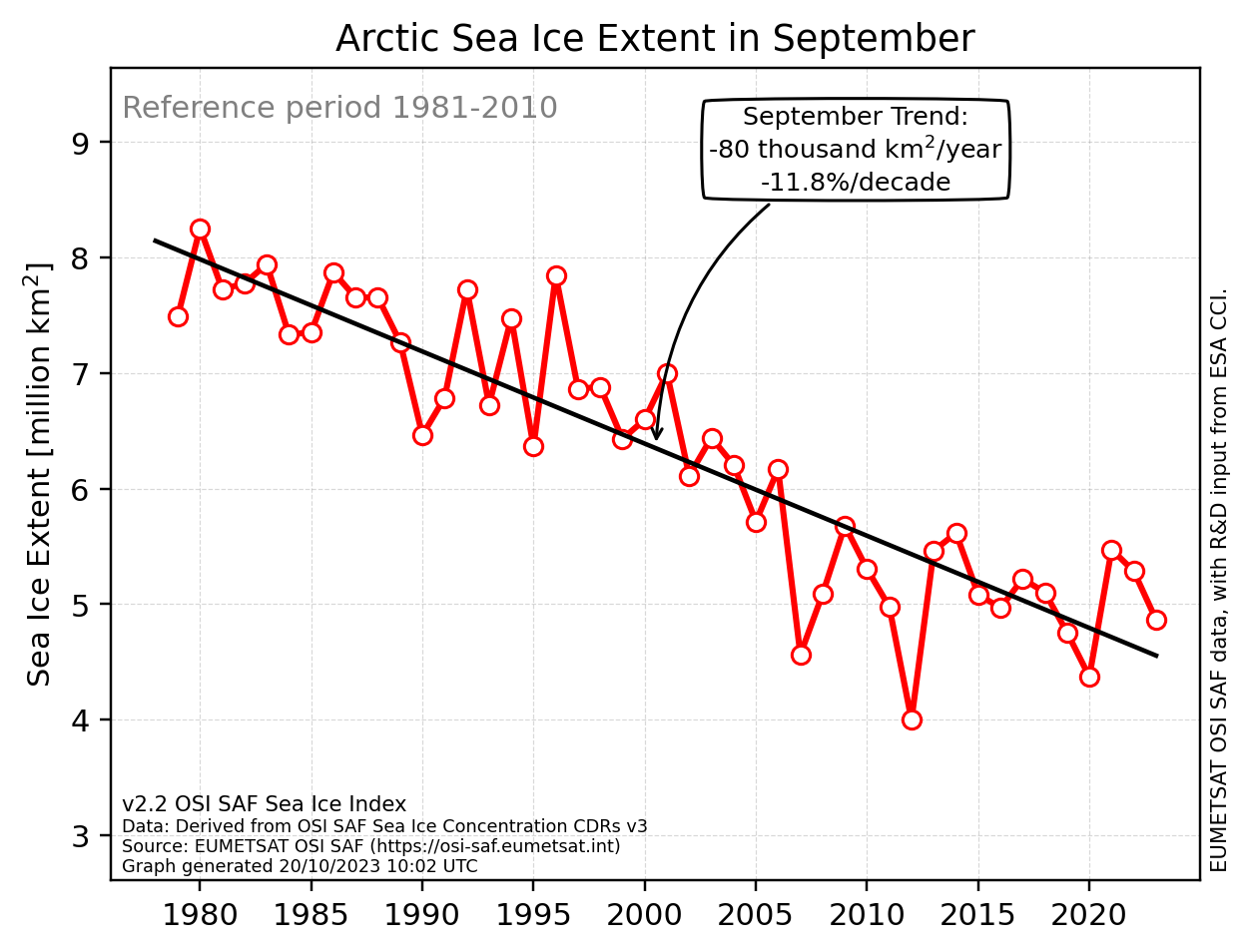
Ignore their misleading black trend line. It is now more apparent than ever that following the large ice loss in 2007, sea ice extent has remained remarkably stable.
54.014354 -2.775804 Met Office Assessed CIMO Class 4 Installed 1/1/1976
On the surface this site looks like a typically low grade Met Office climate reporting site. It is situated on the campus grounds of Lancaster University and surrounded by various other multifarious research projects liable to have only minor adverse effects on its temperature readings. Surely nothing too odd about this, after all what else could seriously affect this site? And then you look at the archives for “University of Lancaster Hazelrigg Weather Station” to read
“The University of Lancaster’s Hazelrigg Weather Station is situated amongst agricultural fields with nearby objects of a 100 m tall wind turbine 150 m WSW, meteorological mast 10 m NW, road and trees 30 m E.”
What? A 100 m tall wind turbine?
This is what the site used to look like in 2009. Not too good, not too bad.
But this is what it looks like now after a 2012 addition.
“The wind turbines themselves need to be around ‘5 rotor diameters’ apart so that they don’t affect each other with turbulence. For a 500 kW wind turbine this means 250 metres apart, and for a 2.5 MW wind turbine it is 410 metres.”…….so say reliable authorities.
The above wind turbine is a 2.5MW model with a 92.5m rotor length. This would require a distance of 410m from a neighbouring wind turbine to avoid adverse effects of turbulence. It is just 150 m from the Screen. It would need further investigation to ascertain what exact effect this proximity to the temperature sensors actually has on the 1.5m above ground level level screen, but just “gut feel” makes it extraordinarily hard to imagine that it would have no effect.
So what research has there been on the effects of wind turbines on surface temperatures – Lancaster University should be experts given their onsite research availability. Well it seems they opted to go to elsewhere to find out.
“Newly published research has shown that the action of wind turbines has a measurable effect on the local climate.
Researchers from Lancaster University, the Centre for Ecology & Hydrology, National Centre for Atmospheric Science, the University of Glasgow, and the University of Leeds placed a grid of more than 100 temperature and humidity sensors around wind turbines at ScottishPower Renewables’ Black Law Wind Farm in North Lanarkshire.”
Other research similarly indicates “Data from a meteorological field campaign show that such wind farms can significantly affect near-surface air temperatures.”
It is thus pretty certain, from empirical research, that wind turbines and wind farms alter surface temperatures. So why are we continuing to include known compromised modern readings into the historic temperature record from sites such as at Hazelrigg?