IF ONLY THE IPCC WOULD LINK EXTREME WEATHER TO CARBON EMISSIONS

If they did it would give credence to the claims of the media who continue to make these links based on extremely dodgy press releases.

It is probably only a matter of time before they change their minds, but at this moment in time they still do not claim that there is any clear evidence that increased CO2 has caused an increase in the quantity or severity of storms, droughts, or floods.

 Climate Activists Frustrated by IPCC’s Refusal to Link Extreme Weather With Carbon Emissions – The Daily Sceptic

Paul Burgess has made some videos on this:

The Met Office Exposed! What is the Agenda? (youtube.com) 

Debunking Weather Event Alarmism (youtube.com) 

via climate science

https://ift.tt/nF5HoUw

October 11, 2024 at 01:49AM

Grand Wind & Solar ‘Transition’ Built on Massive Subsidies and Even Bigger Lies

The wind and solar ‘industries’ were built on lies and run on subsidies. The electricity that the occasionally produce has no commercial value, simply because it can’t be delivered as and when power consumers need it. And because their output can’t be controlled, producers get paid a fortune to produce nothing at all to prevent the instability they generate from completely destroying the grid.

As wind and solar capacity increases, the story has had to shift to cover the ‘big intermittency’ problem.

Lies about wind and solar being perfect compliments, and about the wind always blowing somewhere, have been replaced with lies about giant batteries filling the gaps on calm nights – when wind and solar producing absolutely nothing at all.

In the piece below, David Gardner tackles the latter with some hard numbers.

Batteries not included
The Spectator
David Gardner
12 September 2024

‘The illusory truth effect (also known as the illusion of truth effect, validity effect, truth effect, or the reiteration effect) is the tendency to believe false information to be correct after repeated exposure.’ – Wikipedia, the free encyclopedia.

In plain English, if you repeat a lie often enough, most people will eventually accept it as the truth. Here are a few you may have heard.

‘Renewables are the cheapest form of energy.’ ‘Nuclear energy is up to six times more expensive than renewable energy.’

It is too difficult for the average voter to fact-check these statements, so they are accepted as truth with a bit of help from the media.

Recently, however, the media have begun to add the words ‘and batteries’ when reporting on new renewable energy developments. No fanfare, they just slip it in!

Battery storage units, which are used to maintain supply when the wind isn’t blowing or the sun isn’t shining, are a critical part of the renewable energy industry. They are used to balance the grid and cover the gaps during wind droughts, storms, hail damage, fire, cyclones, or mechanical failure.

There is a plan for OECD countries to cease all coal-fired electricity generation by 2030 or 2040 at the latest. The push to increase renewables seven-fold between 2023 and 2050 is on in spades.
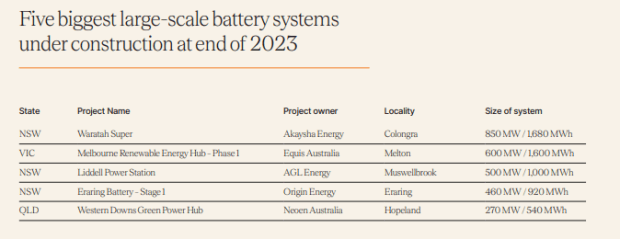
SOURCE – CLEAN ENERGY COUNCIL AUSTRALIA

Proponents of the ‘Climate Crisis’ have recently realised that the closure of coal and gas generation equipment is likely to lead to an unstable energy grid, intermittent power, and potential blackouts. To alleviate this problem, there is a concerted effort to encourage investment in ‘The Big Battery’. Within this battery world, there are currently around 30 projects in operation or under construction. These projects will, when completed, provide 5 Gigawatts of clean power for a total of two hours without a recharge.

Australia’s East Coast peak daily power consumption is currently around 65 Gigawatts.

Yes, 65 Gigawatts, not 5 Gigawatts…

Inferred, but not said, is the desire to aim for battery storage equal to 65 Gigawatts so that it can replace the current coal and gas-fired generators. The trouble is, the current predictions (with no gas or coal, and charging 15 million EVs) are for our power usage to increase to over 160 Gigawatts by 2050.

In February of this year, in Victoria, six high-voltage power line towers were brought down by a storm with 120 km/hour winds. 500,000 homes were left without power. This continued for many days. Once isolated, extra power was brought online to replace the loss. This extra power was mainly sourced from interstate gas and coal generators.

Consider these facts:

  • Commercial solar panels are less than 20 per cent efficient on an annual basis. Their usable lifespan is 20 years [Note to David: try half that, their efficiency and output diminishes rapidly after a decade in service].
  • A wind turbine (onshore) is around 30 per cent efficient on an annual basis. Their usable lifespan is 25 years [Note to David: try half that, after 12 years it often becomes uneconomic to repair them and they are completely replaced]. Wind tolerance of more than 12 km/hour and less than 90 km/hour. Ideal 60 km/hour.
  • A big battery capable of storing and supplying 700 Megawatts for two hours is currently costs around $1.1 billion to build with a lifespan of 15 years [Note to Dave: there is no evidence to support that. Large scale batteries have been in service for less than 8 years – the big battery in SA came into service in 2018, it is highly unlikely to be operating at the same level in 2033].
  • A big battery capable of grid supply for a day, or even longer (say 4-5 days) has not been invented yet.
  • A nuclear generator (Example – APR1400, four built in UAE) can produce 1,400 Megawatts of clean power 24 hours per day for over 80 years with an annual efficiency of over 95 per cent. The cost of this generator is $9.5 billion.
  • A big battery capable of storing/delivering 1,400 Megawatts of continuous power for five days is estimated to cost $168 billion – if it could be built!
  • To compete with a nuclear reactor, over an 80-year period wind and solar would be replaced four times for (solar) and three and a half times for (wind), at the then current day costs.

The batteries would need to be replaced every 15 years, which is over five times in the same period. This is the most expensive item of a green energy transition.

Compare a 1,400 Megawatt wind and solar system, and batteries, with a nuclear generator, over 20 years.

Total asset cost for renewables is $232.25 billion.

Total asset cost for nuclear is $2.375 billion.

When you take into account all these additional factors, renewables are a trillion dollar disaster.

In the commercial world, all assets are amortised over their expected life-span. No board of directors would approve the above costs (some unknown) without calling for an extensive cost/analysis together with a ‘return on investment’ projection.

If it was their money, rather than ours, the entire project would be thrown out as nothing more than an illusion.
The Spectator

via STOP THESE THINGS

https://ift.tt/mSYPIgt

October 11, 2024 at 01:37AM

Gas Power Prevented a Blackout Yesterday

From NOT A LOT OF PEOPLE KNOW THAT

By Paul Homewood

h/t Joe Public

I find this very worrisome:

https://twitter.com/AndrewOrlowski/status/1843669739287261351/photo/1

Thingvad is Trading Director at Hybrid Greentech, who specialise in Energy Storage Intelligence, so he is a reliable source.

The X Feed is from Andrew Orlowski, who writes for the Telegraph.

This incident highlights the foolhardiness of relying so much on imported electricity. At the moment, of course, we were able to plug the shortfall, presumably with gas.

The Elexon chart below shows how the NSL Interconnector collapsed instantaneously at 7.50am BST and was only back up running at full power at 9.25am.

https://bmrs.elexon.co.uk/generation-by-fuel-type

On this occasion, it was OCGT which was quickly ramped up to cope with the outage:

The more we rely on  I/C, the more we are vulnerable to these problems. And we won’t have gas power around to save us.

via Watts Up With That?

https://ift.tt/4dpe8vB

October 11, 2024 at 12:00AM

Democratic Platform 2024: Energy and Climate

From MasterResource

By Robert Bradley Jr.

“To tackle the climate crisis, lower energy costs, and secure energy independence….” (General Preamble)

Kamala “climate light” Harris as campaigner will not say that climate change is an “existential crisis” (much less yell it as the alarmists want). Harris refutes the notion that she would ban hydraulic fractionation with natural gas, reversing her previous pronunciations. She also states that electric cars (EVs) will not be mandated for drivers, backing away from a Biden Administration goal. Finally, Harris speaks little about the Green New Deal in general.

She is trying to get elected in the face of energy exceptionalism, which is the opposite of the Green New Deal. But her vagueness allows allows the major themes of ’24 Democratic Party Platform are controlling.

The energy/climate narrative in the 91-page document does not include energy in Chapter Three: Lowering Cost. But Chapter 4, “Tackling the Climate Crisis, Lowering Energy Costs & Security Energy Independence” (p. 30) starts with climate alarmism and continues with the villains Donald Trump and Big Oil:

Every year, the devastation caused by climate change grows more urgent. Across the country, Americans experience the dire impacts of climate change: Floods and storms wipe more homes off the map. Wildfire smoke spreads thousands of miles, forcing millions to shelter indoors. We’ve had the worst droughts in a thousand years, and the fastest sea-level rise in over a century. Last year was Earth’s hottest on record. Natural disasters and extreme weather have cost America over one trillion dollars in damages in just the last seven years.

… It’s a consequence of delay and destruction by people like Donald Trump and his friends in Big Oil, who still deny what we all see happening right before our eyes…. Now, Trump is set to do Big Oil’s and polluters’ bidding again.

It is all-good-things from the federally directed “energy transition,” which bribes consumers to buy the energies and energy-using appliances/vehicles that they would not naturally purchase. The term forced energy transformation applies, at the expense of consumers and taxpayers.

Now to the platform’s claims about lower energy costs, jobs, American Climate Corps, electric vehicles, and climate policy.

“Lower energy costs” revolves around “cheaper, cleaner energy and with tax credits to make home energy use more efficient and affordable.” Except that free market choices by consumers themselves–with their own money on the line–is not what the government wants. And special tax favors for some are paid by all. Classic misdirection….

Jobs? The claim that the “landmark” Inflation Reduction Act “has so far directly created over 300,000 jobs in communities nationwide” is the broken window fallacy as election propaganda. What would have the (taxpayer) resources done if not hijacked by the federal government? What cheaper, more reliable electric generation capacity would there be without DOE grants, the Production Tax Credit, and the Investment Tax Credit? What would the price of a new car be without the subsidies to electric vehicles. What would the price of new appliances such as stoves, refrigerators, washing machines be without the book of mandatory efficiency standards from DOE.

American Climate Corps. “Democrats launched the American Climate Corps, a new work force training and service initiative that will put more than 20,000 young Americans to work on clean energy, conservation, and climate resilience projects nationwide,” with a goal to triple its size by the start of 2030.” Ouch! And civil libertarians please stand up. The idea of a New Deal works program propagandizing youth is scary, Orwellian to the max.

Electric Vehicles. This one has turned into a campaign liability, so the Platform entire paragraph is worth reciting.

With tax credits, Democrats helped quadruple sales of electric vehicles, with the goal that 50 percent of all new passenger cars sold in the U.S. by 2030 be electric. We’re protecting American children from asthma-related diesel pollution by giving school districts rebates to buy thousands of electric school buses so kids don’t have to breathe polluted air. We’ll keep working to electrify the nation’s fleet of school buses, transit buses, and federal vehicles, including the U.S. Postal Service fleet. We’ll double funding to repair and expand active transportation and public transit, reducing pollution and traffic, and connecting people to jobs and opportunity. And we’ll work to electrify our ports and waterways, prioritizing progress towards a goal of zero-emissions freight.

So what are the cost and operational disadvantages of this forced transition. If electric vehicles, school buses, and port machinery were not already in service, why not? And where is the money coming from in the federal budget? Is a surplus being worked down? Or is the deficit/debt ballooning?

Climate Activism. No surprise here. “President Biden has restored America’s global climate leadership, once again making our nation the world’s pivotal force against climate change. The United States rejoined the Paris Climate Agreement on day one of his presidency, and President Biden set an ambitious goal to reach net-zero emissions by 2050, inline with climate science.” Continuing:

The Administration has rallied the world to commit for the first time to transitioning away from fossil fuels. It set a bold new goal for nations to triple renewable energy worldwide and to double energy efficiency by 2030; and it helped to launch a new global clean-energy supply chain partnership to make that happen…. As Democrats, we believe the United States has an indispensable role to play in solving the climate crisis, and we have an obligation to help other nations carry out this work.

The failure of climate mitigation policies, now in its fourth decade, speaks for itself. Oil, natural gas, and coal are each in a global growth mode despite governments madly spending money and increasing mandates at the expense of consumers and taxpayers. Social injustice at the expense of the average person–whatever happened to Democrats as the Party of the small and vulnerable?

Finally, the bogeyman of Big Oil returns in the heart of the document. “Throughout, we’ll keep standing up to Big Oil, as our clean energy boom breaks the industry’s monopoly hold on energy markets.”

Going forward, we’ll also eliminate tens of billions of dollars in other unfair oil and gas subsidies. When windfall profiteering causes prices to spike at the pump, we’ll release our own supplies to keep costs down for American families. And, when we hear of potential collusion or price-gouging, we’ll hold oil and gas executives accountable.

Maybe with electoral defeat, the Democratic Party can remake itself on energy and climate policy.

via Watts Up With That?

https://ift.tt/c2r3Las

October 10, 2024 at 08:05PM