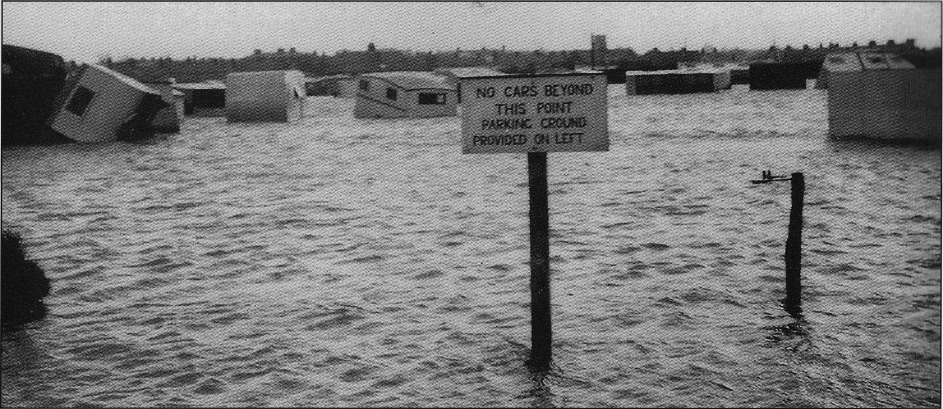
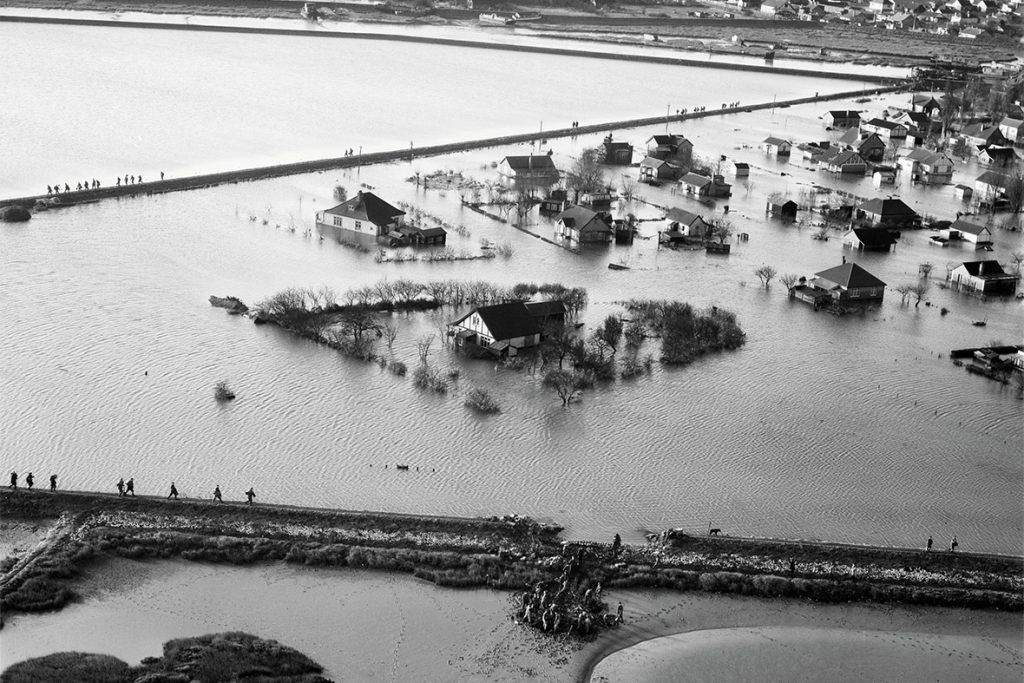
“Yes … definitely”

Google Gemini says high surface temperatures are responsible for large storm surges and intense storms, and then says the record storm surge in Britain during February 1953 was caused by an intense storm with low sea surface temperatures.

“However, with climate change increasing sea surface temperatures, future storms are likely to be more intense and generate higher surges, making events like the 1953 flood even more dangerous.”

About Tony Heller

Just having fun

This entry was posted in Uncategorized. Bookmark the permalink.

via Real Climate Science

https://ift.tt/7UhCrwg

October 10, 2024 at 01:16PM

“The Monster That Challenged the World”

Guest “When Sci-Fi predicted paleontology” by David Middleton

Anyone else out there remember this classically awful 1957 science fiction movie?

The Monster That Challenged the World

It scared the bejesus out of me when I was it in the late 1960’s when I was 9 or 10 years old.

Well guess what?

Largest ever millipede’s head revealed by 300-million-year-old fossils

By James Ashworth

First published 9 October 2024

Well-preserved fossils uncovered in France have revealed new insights into one of the biggest invertebrates to ever walk on Earth.

Arthropleura was a millipede-like animal which lived more than 300 million years ago during the Carboniferous Period, with some individuals reaching more than two metres long.

The head of one of history’s biggest arthropods has been revealed in detail for the first time.

Arthropleura is an arthropod, the group containing insects, crustaceans, arachnids and their relatives. For many years, only fossils of its body survived, which saw it placed among the earliest millipedes. Now, the discovery of the first complete head has revealed a surprising twist.

While the new fossils are not from fully grown Arthropleura, some of which reached 2.6 metres long, they reveal important characteristics. Most notably, the head has some features of early centipedes, suggesting millipedes and centipedes might be more closely related than previously accepted.

[…]

Natural History Museum

While Arthropleura wasn’t a mollusk, the first thing I thought of when I read the article was The Monster That Challenged the World.

INTRODUCTION

The iconic myriapod Arthropleura is a Carboniferous-Permian arthropod renowned for its record-breaking gigantism (1), inhabiting forest environments near the equatorial belt (2) from ~346 million to 290 million years ago (Ma) (Visean to Sakmarian) (1)

[…]

Lhéritier et al., 2024

Figure 1. “(color online) Impressive comparative size of Arthropleura armata, the up to 2.5 m long terrestrial millipede-like arthropod (modified after Schneider & Werneburg, 2010); scale bar is 1 m.” Pillola and Zoboli 2021
Figure 2. Good thing that they thick Arthropleura was a detritivore.

Don’t you love it when science imitates science fiction? (Sarcasm purely intentional). Of course, Arthropleura lived when Earth’s atmospheric oxygen concentration was at its highest level of the Phanerozoic Eon, enabling insects, arthropods, crustaceans and other creepy-crawlers to grow to 1950’s Sic-Fi sizes…

Berner_1999
Figure 3. Phanerozoic oxygen levels modeled from carbon and sulfur cycles (modified after Berner, 1999).

While The Monster That Challenged the World was just one of many giant “bugs” that only lived in classically bad 1950’s Sci-Fi movies.

References

Berner, Robert A.  Atmospheric oxygen over Phanerozoic time.  Proceedings of the National Academy of Sciences Sep 1999, 96 (20) 10955-10957; DOI: 10.1073/pnas.96.20.10955

Lhéritier, Mickaël  et al., Head anatomy and phylogenomics show the Carboniferous giant Arthropleura belonged to a millipede-centipede group. Sci. Adv. 10, eadp6362(2024). DOI:10.1126/sciadv.adp6362

Pillola, Gian & Zoboli, Daniel. (2021). First occurrence of Arthropleura armata (Myriapoda) in the Moscovian (Carboniferous) of SW Sardinia (Italy). Bollettino della Societa Paleontologica Italiana. 60. 49-54. 10.4435/BSPI.2021.01.

via Watts Up With That?

https://ift.tt/o9EtYDq

October 10, 2024 at 12:02PM

Hurricane Milton Update

By Paul Homewood

 image

Hurricane Milton made landfall 8.30EDT, just south of Tampa.

Here are the basic facts we have available from the National Hurricane Center:

.

image

image

https://www.nhc.noaa.gov/archive/2024/al14/al142024.update.10100030.shtml?

.

So, just as I predicted yesterday, Milton only hit Florida as a Cat 3 storm, and not the monster, record breaking, once in a century, historic storm which we were told it would be, and which is even now still being reported. (To recap, hurricanes are graded Cat 1 to 5, with 5s being the most powerful).

Just check some of the headlines:

.

image

Evening Standard – a day ago

image

image

image

image

.

Florida has been hit by 41 hurricanes of Cat 3 strength or greater since the start of records, and in the US as a whole Milton only ranks the 75th most intense hurricane, in terms of minimum pressure.

image

https://www.aoml.noaa.gov/hrd/hurdat/All_U.S._Hurricanes.html

Every hurricane can be potentially deadly, every hurricane brings damage and flooding, but there is no evidence that Milton is any more than just another run of the mill storm, either in terms of winds, rain or storm surge. Storm surge has been no more than 8ft, according to Sarasota’s mayor, which is consistent with a strong Cat 2.

As NHC notes, the highest sustained wind speeds measured were 78mph at Venice , which is on the coast only about 10 miles to the south of Siesta Key . Sarasota-Bradenton is a similar distance to the north and had only 40mph winds. They certainly cannot be called catastrophic.

image

.

This of course raises the question of why media reporting has consistently tried to portray Milton as something much worse than it actually was. As I reported yesterday, the official forecasts from the NHC have been predicting a weakening of the storm as it approached Florida for some days now.

And as is usually the case, warning intensities have been grossly overestimated in comparison with what the satellite data has been saying:

.

image

https://rammb-data.cira.colostate.edu/tc_realtime/products/storms/2024al14/dgtldvor/2024al14_dgtldvor_202410100600.gif

.

Hurricane forecaster naturally tend to guess on the top side, as they don’t want to be accused of underestimating a big storm.

But the media do not have that excuse. Partly this stems from the desire for scary headlines.

But there is definitely another motive at play here. By building up public expectations of a record, monster storm, the public then go on to believe that the film footage they see is confirmation of that.

They do not realise, and they are not told, that Florida sees hurricanes like this nearly every year.

If they want to know what exceptional really means, they should look back at hurricanes like 1926 one, which wiped Miami off the map. Or the 1928 Okeechobee one which killed 2500.

Or the most powerful US hurricane on record, 1935’s Labor Day storm, which hit the Florida Keys with winds of 185 mph and a 20ft storm surge, causing catastrophic damage there.

.

undefined

“Miami” Hurricane- – 1926

via NOT A LOT OF PEOPLE KNOW THAT

https://ift.tt/6MT1Fja

October 10, 2024 at 11:44AM

Friday

0 out of 10 based on 0 rating

via JoNova

https://ift.tt/OV7Bheb

October 10, 2024 at 09:42AM