The Real Cause of Weather-Related Deaths

By Vijay Jayaraj

Despite fearmongering about climate change supercharging natural disasters, weather-related deaths have declined dramatically.

According to the Emergency Event Database, the total global deaths per decade from climate-related disasters has fallen by more than 96% since the 1920s. Data show that between 1960 and 2020, there was an unprecedented decrease in climate-related deaths compared to the period between 1920 and 1959.

This decline is even more impressive considering that the global population has more than quadrupled during this period, from about 2 billion in 1920 to nearly 8 billion by 2020.

The dramatic reduction in fatalities is not just a statistic; it represents a fundamental improvement in our species’ ability to adapt and withstand the forces of nature. It’s a story of triumph over adversity and of innovation in the face of danger.

Why Deaths Have Dropped

For millennia, the whims of weather patterns dictated the rise and fall of civilizations, determined the success of harvests, and all too often, claimed countless lives. However, the 20th century marked a pivotal turning point in this age-old struggle.

One of the most significant factors in reducing deaths has been the dramatic strengthening of infrastructure, particularly in developing countries. The World Meteorological Organization’s “State of the Global Climate 2023” noted that improved early warning systems and disaster management have continued to reduce loss of life from extreme weather events.

Bangladesh, once notorious for cyclone-related deaths, has seen a dramatic reduction in casualties. In 1970, Cyclone Bhola killed an estimated 300,000-500,000 people. In contrast, Cyclone Amphan in 2020, though causing significant damage, resulted in fewer than 100 deaths in Bangladesh, thanks largely to early alerts and evacuation procedures.

The Netherlands, where much of the land lies below sea level, has been a pioneer in flood control. Its system of dikes, dams, and storm surge barriers, including the famous Maeslant structure near Rotterdam, has effectively protected the country from catastrophic flooding.

In the United States, the Mississippi River and Tributaries Project, initiated after the Great Mississippi Flood of 1927, has prevented billions of dollars in flood damages. Similar projects around the world, from China’s Three Gorges Dam to London’s Thames Barrier, have saved countless lives.

In hurricane-prone areas, buildings are now designed to withstand high winds and flying debris. The implementation of strict building codes in Florida after Hurricane Andrew in 1992 significantly reduced structural damage during subsequent storms.

Similarly, earthquake-resistant construction techniques have saved numerous lives in seismically-active regions. Japan’s stringent building codes, which require structures to withstand severe earthquakes, have dramatically reduced fatalities from seismic events.

Drought used to be one the of the deadliest climatic events, even ending the reign of famous empires. Today, advances in agricultural technology and practices have significantly reduced deaths from drought-induced famines. For instance, the development of drought-tolerant maize has benefited millions of farmers in Africa.

Misreporting Causes of Damage Fans Fear

However, despite the unprecedented decrease in fatalities from natural calamities, some argue that the economic costs of natural disasters have risen. It is true that monetary losses have increased, but this is partly due to a lack of planning that exposes increasingly valuable property to the risks of storm floods and winds.

A classic example of this is the Indian city of Chennai (formerly Madras), where floods have become a regular occurrence because of the dismal state of infrastructure. The city’s newest construction zones are in areas where water naturally accumulates, putting inhabitants at risk during heavy rains.

Living in the same city a while back, I found myself wading surreally in knee-deep water to reclaim my luggage from a car park where the flood rose to my hips.

A simple analysis revealed that Chennai’s heavy rains have occurred multiple times over many decades. Repeated flooding in this city, and others, is primarily from mismanagement, not climate change.

Where applied, human ingenuity has been spectacularly successful in countering nature’s threats. Humankind’s shortcoming in this story is its failure to apply appropriately its know-how rather than neglecting to control an uncontrollable climate.

This commentary was first published at American Thinker on September 29, 2024.

Vijay Jayaraj is a Science and Research Associate at the CO2 Coalition, Arlington, Virginia. He holds an M.S. in environmental sciences from the University of East Anglia and a postgraduate degree in energy management from Robert Gordon University, both in the U.K., and a bachelor’s in engineering from Anna University, India.

via Watts Up With That?

https://ift.tt/1yAajsV

October 4, 2024 at 04:02PM

NEW GOVERNMENT BLACK HOLE ANNOUNCED

Considering the new Labour Government claimed there was a £20 Billion black hole left by the previous government, it is a strange coincidence that they have managed to find £22 billion to spend on schemes to capture and store CO2. These are highly controversial schemes, as we know down here on the South coast in the New Forest, where a similar scheme proposed by Exxon has suddenly been dropped after attracting some opposition from local people, including the local Green party. What we are starting to see, is that there is now a debate on the effectiveness of the policies to reach net zero, even if there is still very little debate on whether there is a need to reach it in the first place. 

 Govt To Waste £22bn On Unproven Carbon Capture | NOT A LOT OF PEOPLE KNOW THAT (wordpress.com)

via climate science

https://ift.tt/EJUVl6Z

October 4, 2024 at 02:51PM

Steve McIntyre on the Real Lesson to be Learned from Hurricane Helene

actually, the lesson from Helene is the opposite from that being promoted.

In 1933, the Tennessee Valley Authority was given the mandate for flood control in the valley of the Tennessee River and its tributaries. Over the next 40 years, they built 49 dams, which, for the most part, accomplished their goal. Whereas floods in the Tennessee were once catastrophic, younger people are mostly unaware of them.

The French Broad River (Asheville) is an upstream tributary where flood control dams weren’t constructed due to local opposition.

Rather than the devastation of Hurricane Helene on Asheville illustrating the effect of climate change, the success of the flood control dams in other sectors of the Tennessee Valley illustrates the success of the TVA flood control program where it is implemented.

Hurricane Helene did not show the effect of climate change, but what happens to settlements in Tennessee Valley tributaries under “natural” flooding (i.e. where flood control dams have been rejected.)

https://x.com/ClimateAudit/status/1841514333274087862

I should add that, in its first 40 years, the TVA built 49 flood control dams, of which 29 were power-generating. In the subsequent 50 years, TVA built 0 flood control dams,
However, in the 1980s, they established the Carbon Dioxide Information Centre (CDIAC) under their nuclear division, which sponsored much influential climate research, including the CRU temperature data (Phil Jones) and Michael Mann’s fellowship from which Mann et al 1998 derived.

In 1990, the parents of Crowdstrike’s Dmitri Alperovich moved from Russia to Chattanooga, Tennessee, where his father was a TVA nuclear engineer. Dmitri moved to Tennessee a few years later.

One can’t help but wonder whether TVA’s original mandate for flood control got lost in the executive offices, attracted by more glamorous issues, such as climate change research.
If so, one could reasonably say that a factor in the seeming abandonment of TVA efforts to complete its original flood control mandate (e.g. to French Broad River which inundated Asheville) was partly attributable to diversion of TVA interest to climate change research, as opposed to its mandate of flood control.

https://x.com/ClimateAudit/status/1841532176866635907

another thought. As soon as the point is made, it is obvious that flood control dams have reduced flooding. Not just in Appalachia. I’ve looked at long data for water levels in Great Lakes and the amount of fluctuation (flooding) after dams installed is much reduced.

And yet my recollection of public reporting of climate is that weather extremes, including flooding, is getting worse. But in areas with flood control dams, it obviously //isn’t// getting worse than before. It’s better. Note to self: check IPCC reports for their specific findings on flooding.

https://x.com/ClimateAudit/status/1841544188623454419

Here is a diagram of the proposed system of dams and reservoirs proposed to provide flood control for Asheville – located in center of diagram (h/t reader Jack Brown). This was the project that was abandoned in the face of some local opposition. To be fair, it is my understanding that the wild rivers are very scenic, but the flood risk in the watershed was well known from the flood of 1916 and seemingly ignored by state and local governments.

@Revkin also cites NYT article on development in North Carolina zones known to be at risk

https://x.com/Revkin/status/1841850252061769963

https://x.com/ClimateAudit/status/1841868359971045829

Andy Revkin reports on fascinating 1960 report on
https://x.com/Revkin/status/1841936334891385070 entitled “Floods on French Broad and Swannanoa Rivers around Asheville,

Andy reported that the report stated that developments around Asheville “would cause these great floods of the past to be higher if they occurred again. Land fills and buildings in the flood plain and the many bcidges across the streams have seriously reduced flood flow capacity.” “On the French Broad River a flood of the same discharge as the 1916 flood would today be 3 to 4 feet;.higher between Pearson Bridge and West Asheville Viaduct than the actual flood elevation. On the Swannanoa River, a repetition of the 1916 flood would be up to 2. 5 feet higher today at Biltmore and up to 15 feet higher upstream from the Recreation Park dam.”

A corollary is that the contribution of site development to any modern “record” flood level has to be accounted for before comparing to past record levels.

https://twitter.com/ClimateAudit/status/1841956807474045082

via Watts Up With That?

https://ift.tt/c0LNdFj

October 4, 2024 at 01:06PM

Climatists’ War on Meat updated

Tyler Durden reports at Zerohedge Meat Substitutes Still A Tiny Sliver Of US Meat Market.  Excerpts in italics with my bolds and added images.

Over the past few years, plant-based meat substitutes have come closer and closer to mimicking the real thing, with brands like Beyond Meat having even sussed out how to create fake meat that “bleeds”.

But, as Statista’s Anna Fleck details below, after an initial boom, the company has rapidly come down from its peaks.

There are several reasons for the hype having died down, one of which being that many consumers decided to move away from buying the often more expensive items amid the cost of living crisis.

Another reason cited is that plant-based meats have become a part of the U.S.’s culture war, labeled as a symbol of left-wing politics and a binary to “real” meat.

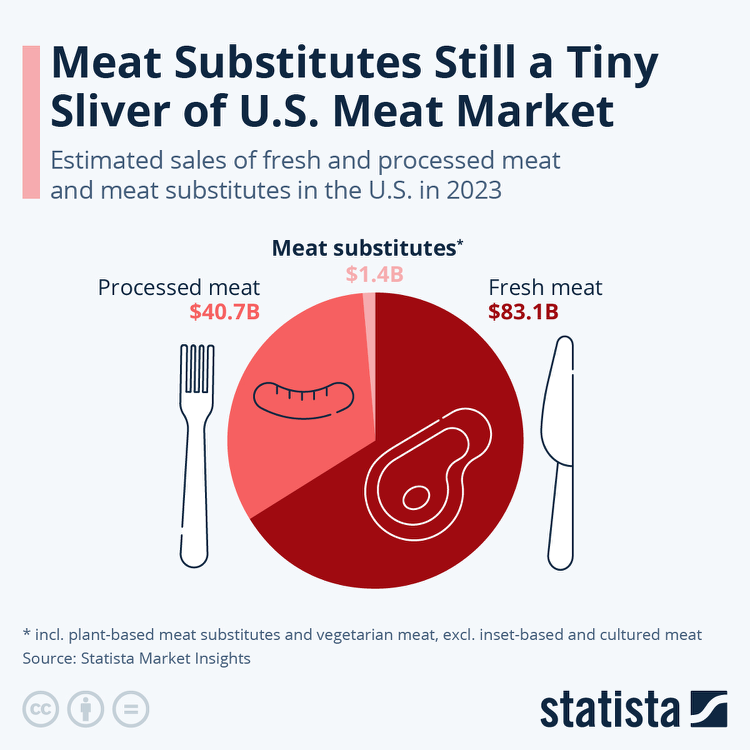
According to data from Statista’s Market Insights, plant-based meat substitutes accounted for a mere sliver of the U.S. meat market last year.

Not counting insect-based meat alternatives or cultured, i.e. lab-grown meat, meat substitute sales amounted to $1.4 billion in 2023, while sales of fresh and processed meat added up to almost $124 billion.

Outlook

  • Revenue in the Meat market amounts to US$131.60bn in 2024. The market is expected to grow annually by 4.22% (CAGR 2024-2029).
  • In global comparison, most revenue is generated in China (US$273bn in 2024).
  • In relation to total population figures, per person revenues of US$385.00 are generated in 2024.
  • In the Meat market, volume is expected to amount to 12.10bn kg by 2029. The Meat market is expected to show a volume growth of 1.9% in 2025.
  • The average volume per person in the Meat market is expected to amount to 32.4kg in 2024.

What’s Next?

Background Post: Coming Soon: Menu Climate Warnings

Baylen Linnekin writes at Reason Public Health Researchers Float Idea of Climate-Change Warnings on Menu Items.  Excerpts in italics with my bolds and added images.

Warning diners that red meat is bad for the environment is yet another attempt
to socially engineer food choices.

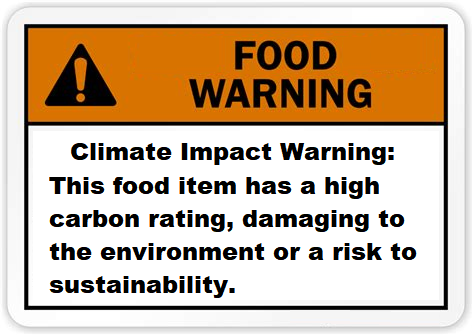
A study released last week suggests that fast-food menus that feature labels urging diners not to order red meat off those same menus due to the “climate impact” of those food items can help convince customers to swap out red meat for what the researchers argue are more climate-friendly foods—from fruits and vegetables to poultry and seafood. The study, published in Jama Network Open and led by researchers from Johns Hopkins University, concludes that “climate impact menu labels may be an effective strategy to promote more sustainable restaurant food choices and that labels highlighting high-climate impact items may be most effective.”

The study’s data comes from more than 5,000 Americans who took part in a nationwide online survey last year. Study participants were instructed to “imagine they were in a restaurant and about to order dinner” from an accurately priced sample menu containing a variety of choices, including hamburgers, chicken sandwiches, plant-based burgers, and salads.

The study asked participants to “order” different foods after viewing one of three types of sample menus online. Outside of a control group, the study presented web users with choices that either disparaged the sustainability of red-meat dishes or touted the sustainability of dishes not containing red meat. Based on the results, which showed people who were more likely to avoid red meat if it had a red warning label and more likely to order other menu items if they featured a green health halo, the authors conclude that “climate impact menu labels [a]re effective” and “that labeling red meat items with negatively framed, red high-climate impact labels was more effective at increasing sustainable selections than labeling non-red meat items with positively framed, green low-climate impact labels.”

The study has spurred some news outlets to suggest governments around the world
may—or should—operationalize its findings.

“Policymakers have been debating how to get people to make less carbon-heavy food choices,” the Guardian recounted in a recent report on the study, “In April, the Intergovernmental Panel on Climate Change (IPCC) report urged world leaders, especially those in developed countries, to support a transition to sustainable, healthy, low-emissions diets.”

“Unfortunately, consumers have been resistant to change and many wish to continue eating meat,” a Phys.org report on the study laments.

Worse still, though the study itself does not suggest that it should be used to form the basis of any government policies, its lead author, Prof. Julia Wolfson of the Johns Hopkins Bloomberg School of Public Health, told CNN last week that “legislation or regulation may be necessary” to force restaurants to add climate warnings to their menus.

Let’s pump the brakes—for a couple of reasons.

Data from the study itself and, more generally, on the effectiveness of government-mandated menu labeling suggests the authors may wish to dial down their perception of the effectiveness of the labels they tested. For example, after completing their respective orders, the survey asked participants if they “notice[d] any labels” on the menu. As the study data reveal, only around 4 out of every 10 participants even noticed any climate-related labeling. While that’s a low percentage, in the real world—in an actual fast-food restaurant setting rather than in an online survey—the percentage would likely be far lower. That’s because, as I’ve explained time and again, study after study has shown that few people pay attention to mandated menu labels (except to choose which food or foods to order), and even fewer use that information.

The premise of the study itself also may rest on shaky ground.

Some critics have pushed back against the notion that some chicken or seafood is more sustainable than all red meat. As the Guardian report on the study notes, “intensively produced chicken has been found to be damaging for the environment, as has some farmed and trawled fish.” Others disagree with the very notion that red meat is an inherently unsustainable food. While it’s become popular in recent years to argue that eating less red meat is better for the environment, that argument has received a good amount of pushback, with critics charging that swapping out meat for plants could be inefficient and ineffective, harm human health, and have unintended consequences for the developing world.

Even if I were to accept arguments that eating less meat is better for the environment, the choice to eat meat (or not) ultimately is and should be an individual’s to make. So it’s not “unfortunate” that consumers “wish to continue eating meat,” as Phys.org posits. And that wish isn’t a cry for government intervention, as Wolfson, the study’s lead author, argues. Rather, it’s a cry for freedom of choice.

If some restaurants competing in the marketplace care to attempt to skew their customers’ choices away from meat and towards vegetarian and/or vegan foods, by all means, they should do so. But the jury is out on whether that would improve the sustainability of those restaurants. What’s more, any restaurant that wants to make such a change should do so on its own accord, without the government’s prompting, backing, or mandate.

via Science Matters

https://ift.tt/qpyCai8

October 4, 2024 at 12:31PM