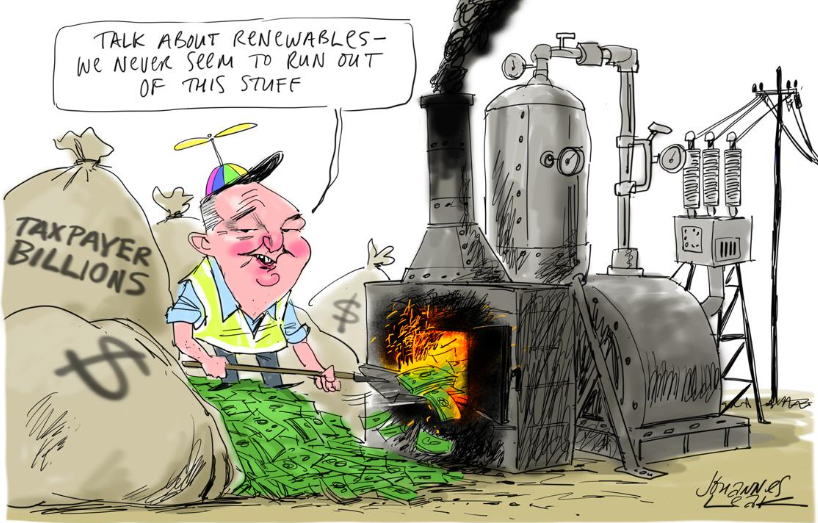
The combined cost of renewable energy certificates, tax credits, soft loans and other subsidies is staggering. The total cost of which always lands with the power consumer and/or taxpayer, with the wholly unjustified benefits pocketed by crony capitalists, carpetbaggers and rent-seekers.
The subsidised wind and solar scam has been running full throttle for more than 25 years, with no end in sight. The metric is quite simple: remove the subsidies, mandates and targets and so-called wind and solar ‘industries’ would disappear overnight.
In the piece below, Jonathan Lesser traces the history of wind and solar subsidies in the US and why every dollar shovelled into the occasional generation of electricity is a dollar wasted.
Do Green Energy Subsidies Work?
Real Clear Energy
Jonathan Lesser
3 September 2024
Like the Jeopardy! game show, green energy subsidies have been Congress’ answer to every energy policy question. The first OPEC oil embargo of 1973-74 catalyzed decades of energy policy, including the formation of the Department of Energy.
Wind, solar, and hydropower subsidies began in earnest with the Public Utilities Regulatory Policy Act of 1978. Similarly, subsidies for corn-based ethanol were enacted as part of the National Energy Conservation Policy Act of 1978. Both were designed to reduce the country’s dependence on Middle East oil.
The PURPA subsidies set off a race by independent developers to construct small generating plants whose output electric utilities were required to purchase at administratively set prices. In some cases, the subsidies were independent of how much electricity the plants actually produced, creating the moniker “PURPA machines,” because their real purpose was to extract subsidies; producing electricity was secondary.
The Energy Policy Act of 1992 modified those subsidies, creating a “temporary” production tax credit for wind power and certain types of biomass generation. Congress also enacted an Investment Tax Credit, initially for solar energy, but later extended to all renewables, which could choose between the ITC and the PTC. Although the PTC was supposed to expire in 1999, it has been repeatedly extended and expanded, most recently in the Inflation Reduction Act.
The PTC now includes all zero-emissions generation, including new nuclear plants. Under the IRA, the ITC has been increased, with qualifying green energy investments able to claim a credit of as much as 60% of their construction cost.
Moreover, the IRA extends the PTC and ITC until greenhouse gas emissions from electric generation fall to just 25% of their 2005 levels, after which they will be decreased gradually. According to the U.S. Energy Information Administration, the expected date for reaching that goal is 2048.
The IRA also provides subsidies for “green” hydrogen, that is, hydrogen produced from emissions-free electricity, battery storage facilities, and facilities that capture carbon and bury it underground.
Ethanol subsidies have similarly been extended and increased, with the government now subsidizing various types of biofuels and numerous states enacting clean fuel standards, which, like renewable portfolio standards, require increasing percentages of transportation fuels to be biofuels.
Congress has not been the only institution shoveling subsidies to green energy. Many states have provided their own subsidies, especially the mid-Atlantic states that are forcing ratepayers to purchase electricity from offshore wind projects at prices many times higher than the market. States have also enacted renewable portfolio standards forcing electric utilities to increasing percentages of electricity from renewable sources that would otherwise never be built.
This subsidy smorgasbord is supposed to reduce greenhouse gas emissions by promoting new clean energy technologies. It’s also supposed to accelerate economic growth by creating new “green” industries and high-paying jobs.
There is little evidence for the former. U.S. energy-related greenhouse gas emissions have decreased by almost 20% from 2005 levels primarily because natural gas has supplanted coal as the primary fuel for generating electricity.
Between 2005 and 2023, electricity generation from natural gas was six times greater than generation from wind and solar combined. In 2023 alone, electricity generated using natural gas was three times greater than wind and solar generation.
Moreover, growth in subsidized wind and solar generation has distorted wholesale electric markets, begetting the need for subsidies to ensure existing nuclear plants continue operating, lest their owners shutter them and eliminate thousands of high-paying jobs. Enacting subsidies required to offset the distortions caused by other subsidies is surely one definition of economic insanity.
As for spurring new industries and economic growth, today, the U.S. solar manufacturing industry is moribund, with almost 90% of the solar panels installed in this country now produced in China. All but one of the offshore wind projects under construction or slated to be built are owned by European companies that their respective governments control.
The economic costs of these subsidies are borne by taxpayers, who must finance the additional deficit spending; electric ratepayers who, despite claims that renewable energy resources are less costly than traditional generating resources, have seen their electric rates soar; and drivers, who pay more for gasoline and diesel fuel as refineries have closed or been modified to produce subsidized biofuels.
Those higher costs for electricity and transportation fuels raise the costs of producing and distributing almost everything else, which ripples through the entire economy, reducing economic growth and destroying jobs.
As for green energy subsidies spurring the development of new, lower-cost clean technologies, there is nothing new about wind and solar generation that receives the lion’s share of subsidies. After almost half a century, neither are cost-competitive, especially when the additional costs of addressing their inherent intermittency are included—costs that others must pay. And new technologies, such as direct air capture of carbon, will only be commercially viable if the U.S. imposes carbon taxes of several hundred dollars per ton, which few politicians will be willing to do.
The overwhelming majority of green energy subsidies reward politically powerful constituencies and businesses whose primary purpose is not to build better energy mousetraps but to build only ones that qualify for the largest subsidies.
The government could instead target subsidies solely on true research and development efforts of new clean energy technologies, such as advanced and small modular nuclear reactors.
With the country deeply in debt, wasting hundreds of billions of dollars on subsidies for green energy, as the Inflation Reduction Act calls for, is an idea whose time is long past. Green energy Jeopardy! may be a lucrative game for the lucky recipients, but eventually everyone loses.
Real Clear Energy