
No government has spent more money on their weather models than the U.S.
via CFACT
June 18, 2025 at 02:33AM
No government has spent more money on their weather models than the U.S.
via CFACT
June 18, 2025 at 02:33AM
Canadian Prime Minister Mark Carney said his government will start pushing legislation that would fast-track ambitious national projects to boost Canada’s economy, now faced with Donald Trump’s tariffs.
Carney said his plan is to narrow down a list of so-called “nation building” projects – like pipelines, nuclear reactors and trade corridors – and create a framework in which the projects would be approved in under two years’ time.
via climate science
June 18, 2025 at 01:30AM
“When relevant factors are properly considered, the most cost-effective appliances are usually the cheapest to buy and maintain. Super-efficient appliances are super expensive to buy and maintain.”
On June 9, 2025, Andrew Campbell, Executive Director of the Energy Institute at the Hass School of Business, University of California, Berkeley, published the above-named article. It is subtitled and summarized by the following: “If the DOE undoes minimum energy efficiency standards, which are decades old, consumer costs will likely rise.”
This statement is simultaneously vague, inaccurate and misleading. Where should I start debunking this fallacious statement? I suppose I should start with who I am to challenge Berkeley’s Energy Institute at Haas. I’m an engineer and energy policy analyst with decades of experience opposing DOE’s minimum energy efficiency standards. This can be easily validated by:
Cutting to the chase, in general, DOE’s Energy Efficiency and Renewable Energy Office (EERE), has long since harvested the low-hanging fruits of improved appliance minimum energy efficiency standards. Over the last two decades, EERE has increasingly resorted to analytical manipulation of “technical support documentation” (TSD) that are too heavy to lift, let alone read.
Typical EERE TSD’s easily exceed a thousand pages and are based upon “black box” models that virtually defy independent verification. Lawrence Berkeley National Laboratory (LBNL) is a major contractor to EERE (through its Energy Technologies Area (ETA) divisions) and who, in turn, manage an army of private contractors who generate EERE’s analyses. In short, this deep state bureaucracy has a lot of mouths to feed.
In recent years (i.e., the Biden Administration), the envision cornucopia for bureaucratic growth has been the “transition” to “clean” (renewable) energy through the increased regulation of carbon emissions. This bureaucratic growth potential is graphically summarized as follows:
“Transitioning” energy efficiency to carbon efficiency grows the regulation business
Source: “Electrification – What Does It Mean for Energy Efficiency?”
EERE and its technical support apparatus have been proven in court to manipulate its “cost effective” analyses to achieve it legislative hurdles. One case-in point is its self-serving misuse of “random assignments,” which effectively assumes that consumers purchase decisions are never influenced by the economic consequences of potential investments regardless of the economic stakes. These assumptions, buried “deep in the weeds” of EERE’s models, purposefully skew EERE’s analyses to force-fit predetermined cost-effectiveness objectives.[2]
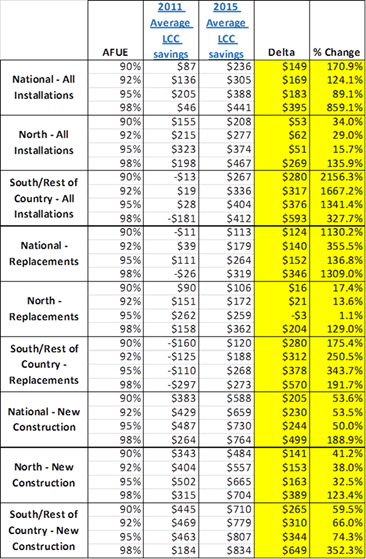
Another example of easy EERE scenario manipulation is the following comparison of 2011 and 2015 Life Cycle Cost (LCC) spreadsheet cost-saving calculations for non‐weatherized residential gas furnaces that EERE was determined to eliminate–at least for the non-condensing variety that most consumers have in their homes:
The most important observation of the above chart is the wild variation of percentage change between a few short years where gas prices were actually decreasing. Well over a thousand percent change in many cases. Let that sink in!
Getting back to the subtitle of Campbell’s article, “If the DOE undoes minimum energy efficiency standards, which are decades old, consumer costs will likely rise,” total life-cycle consumer costs effectiveness of EERE minimum appliance efficiencies” bear the brunt of bureaucratic empire building and mission creep.
Sure, EERE must collect public comments on all its minimum appliance energy efficiency “proposals,” but the division unilaterally determines what to do. At the end of the Day, EERE issues a “Final Rule” for a given proposed minimum appliance efficiency “improvement.”
Effectively challenging a “Final Rule” is definitely not for the faint of heart. Historically, EERE’s legal defense is effectively unlimited through representation through the US Department of Justice (DOJ) and the technical/analytical support of the aforementioned deep state bureaucracy, as well as the usual suspects of well-funded energy efficiency advocates) e.g., NRDC, ACEEE, etc.). The latter is pictorially summarized as follows:
The cosmology of energy codes & standards
Conclusion
When relevant factors are properly considered, the most cost-effective appliances are usually the cheapest to buy and maintain. Super-efficient appliances are super expensive to buy and maintain. In the real world, for example, one failed $0.50 capacitor in the computerized motherboard of a super-efficient furnace or whatever, can easily destroy any perceived/potential opportunity for consumer lifetime monetary savings. Given its repeated manipulative propensities, EERE has proven to be incapable of serving the best interests of consumers and deserves to be eliminated.
——————
Mark Krebs (markedwardkrebs@gmail.com), a mechanical engineer and energy policy consultant, has worked in energy efficiency design and program evaluation for well over thirty years. Mark has served as an expert witness and/or commenter in scores of State and Federal energy efficiency proceedings and has been an advisor to DOE. Mark, a Principal at MasterResource, has authored dozens of articles on natural gas vs. electricity and “Deep Decarbonization” policy. Recently retired from Spire Inc., Krebs has formed an energy policy consultancy, Gas Analytic & Advocacy Services (GAAS) with other veteran energy analysts.
[1] Filter by selecting “Energy Efficiency and Renewable Energy Office”
[2] For more information of the EERE’s “random assignment” analytical cheating, simply put the term “random assignment”:into the MasterResource” search box.
The post “The Freedom to Buy Inefficient Products”: A Rebuttal appeared first on Master Resource.
via Master Resource
June 18, 2025 at 01:10AM
Thousands of wind turbines and millions of solar panels generated a massive blackout
Paul Driessen
Updated Man of La Mancha lyrics could read: “To dream the impossible dream of clean, green, net-zero electricity, to fight the unbeatable foe of manmade climate cataclysms, we must run where the brave dare not go.”
Don Quixote saw windmills as malevolent and dangerous dragons. Spain’s governing classes view them from the Chinese perspective: benevolent and magical dragons.
They’ve erected over 22,000 gigantic windmills, to harness the wind and generate electricity. Portugal has nearly 3,000. Together, when conditions are perfect, they can generate almost 38 gigawatts.
Like Cervantes’ hero, the elites also want “to reach the unreachable star” – or at least capture the energy from one star: the sun. Spain and Portugal together also have 38 GW of photovoltaic solar panels.
However, the Iberian Peninsula neighbors have long ignored the dark sides of the forces they seek to commandeer.
Those wind turbines, solar panels and transmission lines sprawl across some 2,000,000 acres of Spanish and Portuguese vistas, habitats and croplands. That’s equal to Delaware and Rhode Island combined.
They kill eagles, bustards, vultures, and other raptors and birds. Building them requires mining, pollution and child labor on historically unprecedented scales. Solar panels are easily destroyed by storms.
Worst, they provide intermittent, weather-dependent electricity – necessitating expensive backup power and making the electrical grid unstable. Just how unstable was demonstrated recently, and dramatically.
On April 16, for the first time, for a few minutes, Spain generated 100% of its electricity with wind, solar and hydro power.
A fortnight later, on April 28, a prolonged blackout sent Iberia into chaos. Lights, televisions, refrigerators, cell phones and traffic lights went dark. Trains, subways and elevators trapped passengers. Airports canceled flights. Hospital backup power provided only basic and emergency services.
The outage even struck parts of France and Belgium. It was Europe’s biggest blackout ever. If France hadn’t shut off its connection to Spain’s cascading problems, all of Europe could have shut down.
Just a week later, another blackout hit Spain’s Canary Islands.
Power outages are nothing new. But the Spain-Portugal blackouts underscore fundamental problems with the supposedly “inevitable transition” from coal, oil, natural gas and nuclear electricity to wind, solar and battery power.
They show that the only inevitability will be more frequent and severe blackouts – because of our soaring reliance on electricity … political decisions to mothball or destroy reliable generating systems … and ideological commitments to “green” energy.
We’re effectively being told: You’ll have electricity when it’s available – not necessarily when you need it. In this modern technological era, that is absurd, outrageous, intolerable and dangerous.
One fundamental reality must override all other considerations: Modern industrialized societies require enormous quantities of steady, synchronous alternating current, 24/7 – at the precise frequency of 50 Hertz in Europe and 60 Hz in the United States. Without it, life shuts down, societies descend into chaos, and people die.
Frequencies outside 0.2 Hz above or below that frequency can trigger major emergencies. A mere ±0.5 Hz deviation can cause system-wide cascading blackouts.
In Spain’s case, with 80% of its power now coming from renewable sources, the country simply did not have enough reliable, dispatchable, instantly accessible power on hand to keep its grid from collapsing when a power generation glitch happened.
Rice University’s Baker Institute explained how a malfunction at two Spanish solar power plants triggered the widespread chaos.
“At approximately 12:30 pm local time in Spain – just minutes before the grid collapsed – renewable sources accounted for 78% of electricity generation in the Iberian system, with solar alone contributing nearly 60%. By contrast, conventional technologies, such as gas-fired and nuclear power plants, comprised only around 15% of the total generation mix….
“[Then] two consecutive generation loss events occurred in southwestern Spain, likely involving large solar installations…. Given the limited availability of conventional generation, these unexpected losses, combined with reduced support from neighboring systems – the instability triggered a disconnection from the French system – created a “perfect storm” for a massive power outage.
“In just five seconds, Spain lost approximately 15 GW of capacity, equivalent to 60% of its national electricity demand. The remaining generation was insufficient to meet demand, thus triggering a cascading failure across the entire grid. Various generating units were automatically disconnected to protect infrastructure, and nuclear plants were shut down in accordance with safety protocols.”
That’s all it took. In the blink of an eye, the Iberian Peninsula and beyond had a massive blackout.
Unless America’s Net Zero politicians and utility companies wake up to reality, multiple US states – and entire regions – face similar preventable (indeed virtually inevitable) disasters. The same nightmarish realities confront other countries worldwide.
First, because federal, state and local governments have pressured or ordered utility companies to shut down coal, gas, nuclear and even hydro power plants that still have years or decades of operational life. Other utilities have done so voluntarily, to showcase their climate and green energy bona fides.
Second, because the same governments also provide subsidies, loan guarantees, tax breaks, rapid permitting, and exemptions from endangered species and other environmental rules – to incentivize utilities to build more and more wind, solar and battery installations, instead of traditional power plants.
Third, because those same entities demand and often subsidize a steady conversion to electricity from gasoline and natural gas. Vehicles, home and apartment building heating systems, stoves and ovens, water heaters, lawn mowers, leaf blowers and more must be powered by electricity – to save the planet from manmade climate change – even as electricity generation and reliability dwindle.
This shortsighted, ideological, virtue-signaling government intrusion into what should be market-driven, reality-based, reliable-electricity-focused decisions puts our grid, our society and our lives at risk.
Abundant, reliable, affordable electricity is the lifeblood of twenty-first century civilization. Modern industrialized societies simply cannot function, or even survive, if they are forced to rely on land-hungry, expensive, insufficient, intermittent electricity.
And yet, largely because of misplaced climate fears (about human-induced droughts and a “thirstier atmosphere,” for example), $9 trillion has been spent globally over the past decade on wind and solar power, electric vehicles, energy storage, electrified heating and power grid adjustments.
Congress, state governors and legislatures, the Trump Administration, our courts and utility companies need to act quickly and decisively to end this wasteful spending and fix our fragile electricity generating system and grid. The news media and academia must stop parroting “climate crisis” and “renewable energy” talking points, and start presenting the complexities and realities of these issues.
Paul Driessen is senior policy advisor for the Committee For A Constructive Tomorrow (www.CFACT.org) and author of books and articles on energy, climate change, environmental protection and human rights.
Subscribe to get the latest posts sent to your email.
via Watts Up With That?
June 18, 2025 at 12:03AM
 Iowa Climate Science Education