The nuclear plant at Diablo Canyon uses far less land, produces far more power on a continuous basis, and is lasting multiple times as long as weather-dependent solar. Also, as the article below notes, ‘Diablo Canyon doesn’t have massive mirrors that work as bird death rays.’ But somehow climate miserablists see fit to oppose nuclear power, preferring uneconomic part-time alternatives.
H/T Washington Examiner
– – –
California politics are synonymous with many things, but failed energy policy might be the most relevant, says Climate Change Dispatch.
The Ivanpah solar power plant is on its way to being shut down, just 11 years after it opened. PG&E pulled out of its contract with the plant, leading to a planned closure of two of its three units by next year, while Southern California Edison is also working on buying out its contract.
The plant cost $2.2 billion to build, and the Department of Energy said taxpayers will receive a refund of an undisclosed amount for the $1.6 billion in department loans.
The contracts were supposed to take the plant through at least 2039.
In all, the energy from the plant costs too much money. It produced around 70% of what it was projected to produce annually.
The sea of mirrors that the plant relied on to produce the energy led to the plant catching on fire in 2016, after mirrors were wrongly positioned in relation to the sun.
The plant struggled with energy production due to weather, clouds, and jet streams, and was also pretty bad for the environment, what with the whole burning-birds-to-death thing.
Full article here.
– – – Image: Ivanpah solar, California [credit: Craig Butz @ Wikipedia]
Antarctica experienced record low temperatures in late 2023, particularly during late winter (July-August). These extreme cold events were observed across a wide area, impacting both East and West Antarctica, including the Ross Ice Shelf and the Antarctic Peninsula, according to The Watchers here.
The irony just couldn’t be greater, as all we hear in the fake media are stories about big icebergs breaking off somewhere, and everyone being (mis)led to believe the South Pole is melting when clearly as a whole it is not.
From New York to California, state renewable electrical power dreams are collapsing. Power demands soar, while the federal government cuts funding and support for wind, solar, and grid batteries. Renewables cannot provide enough power to support the artificial intelligence revolution. The Net Zero electricity transition is failing in the United States.
For the last two decades, state governments have embraced policies aimed at replacing coal and natural gas power plants with renewable sources. Twenty-three states enacted laws or executive orders to move to 100% Net Zero electricity by 2050. Onshore and offshore wind, utility-scale and rooftop solar, and grid-scale batteries were heavily promoted by states and most federal administrations.
The New York State Climate Action Scoping Plan of 2022 called for 70% renewable electricity by 2030 and 100% by 2040. But 49.7% of the state’s electricity came from gas in 2024, up from 47.7% in 2023. A January executive order issued by President Trump halted federal leases for construction of offshore wind systems. New York, nine other east coast states, and California were counting on offshore wind in efforts to get to 100% renewable electricity, but new offshore wind projects are now halted.
Wind and solar have benefited from federal tax credits, loans, and outright grants since 1992. But the Trump administration is now working to slash federal government support for these technologies. The One Big Beautiful Bill Act (OBBB) passed the House of Representatives on May 22. The bill eliminates Production Tax Credits and Investment Tax Credits for renewable systems that begin construction later than 60 days after passage of the bill or for projects that do not complete construction by year end 2028. The bill also halts the sale of tax credits from renewable projects. If the Senate passes the bill, these measures will choke off green energy projects that have relied on federal funding for decades.
Wind and solar advocates attack the OBBB, warning that the bill would create a “nightmare scenario” for US clean energy. These same advocates claim that wind and solar are the lowest-cost generators of electricity but also demand that huge federal subsidies must continue.
Along with federal cutbacks, the artificial intelligence (AI) revolution now drives the nation’s power system, interrupting the renewable electricity transition. Microsoft, Meta, Google, Amazon, and other giant firms are building new data centers and upgrading existing data centers to power AI. AI processors run 24-hours a day for months to enable computers to think like humans. When servers are upgraded to support AI, they consume 6 to 10 times more power than when used for cloud storage and the internet. Data centers consumed 4% of US electricity at the start of 2024 but are projected to consume 20% within the next decade.
Artificial intelligence drives a massive increase in electricity demand. For years, state legislators forced grid operators to close coal and natural gas power plants as part of a transition to renewables. More than 200 coal-fired power plants were closed. But now, many states face a shortage of generating capacity. Virginia has the highest concentration of data centers in the world, with power consumption forecasted to triple by 2040. The Electric Reliability Council of Texas estimates that Texas electricity demand will soar from a record 85.5 gigawatts in 2023 to 218 GW by 2031.
In December, the North American Electric Reliability Corporation concluded that that over half of North America risks power shortfalls in the next decade from surging demand and coal and gas plant retirements. Grid operators are now stepping back from the transition to wind and solar. Coal-fired power plant closures have been postponed in Georgia, Indiana, Illinois, Tennessee, Utah, West Virginia, and other states. Nuclear plants are being restarted in Michigan and Pennsylvania. But the big winner will be natural gas.
More than 200 gas plants are planned or under construction. Gas facilities can be brought online in about three years, compared to ten years for nuclear plants. Gas plants can be built near cities, often on former power plant sites, and require fewer new transmission lines than needed by wind and solar systems.
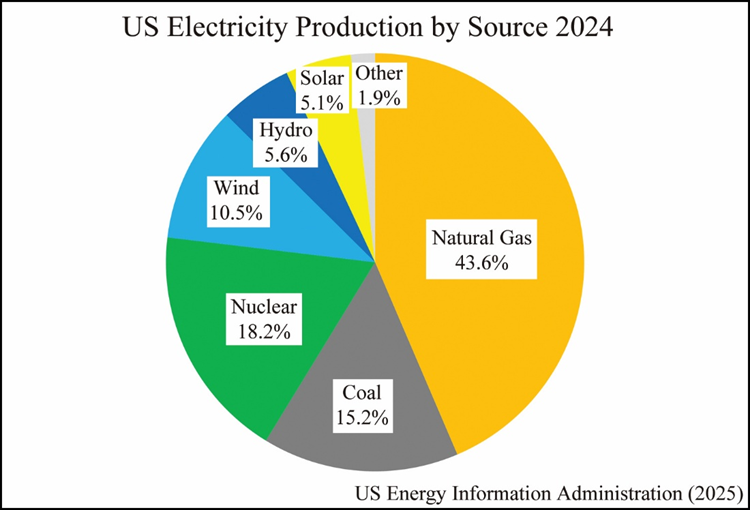
The latest trend is BYOP (bring your own power). AI firms are building their own gas plants to power data centers. Gas turbine manufacturer capacity is now sold out for years. The gas share of electricity production will rise from 43.6% of US consumption in 2024 to much higher levels. The AI power demand and the push for gas are destroying state plans for a transition to green electricity.
California, Massachusetts, Michigan, New York, Texas, and other states are installing grid-scale batteries to try to compensate for wind and solar intermittency. Huge lithium batteries are intended to store excess wind and solar output when the wind blows and the sun shines and then release electricity when wind and solar output is low. But lithium batteries are unproven technology that is prone to spontaneous ignition, creating huge fires that are difficult to extinguish and which endanger residents.
In the last two years, California suffered four grid battery fires, each at facilities less than five years old. The Otay Mesa storage facility near San Diego burned for more than a week and reignited three times. The Moss Landing battery facility, located south of Santa Cruz, caught fire in January. Forty percent of Moss Landing, one of the largest grid-scale battery facilities in the world, was destroyed in the fire. Residents have sued to prevent the restart of Moss Landing. New York also had three grid battery fires in the last 18 months. Battery fires release toxic gases, force evacuations and school closures, and disrupt communities.
In addition, grid batteries are very expensive. To back up a wind or solar facility for 24 hours requires batteries that cost about ten times as much as the wind or solar system itself. But without grid batteries, wind and solar cannot replace coal, gas, or nuclear generation and still provide reliable power.
The cost of wind, solar, and batteries is hurting the renewable electricity transition. Electricity rates in California, the epicenter of green energy, have risen 116% in the last 16 years, more than three times the national average increase of 33%. California’s residential electricity prices are now over 30 cents per kilowatt-hour, the second highest in the nation. Connecticut, Hawaii, Massachusetts, and Rhode Island complete the top five for the highest US power costs—all states with aggressive green electricity goals.
The Net Zero electricity transition, endorsed by many states for more than a decade, is failing in the United States. Wind, solar, and batteries suffer from the offshore wind cancellation, federal subsidy cuts, inability to meet the demand of the artificial intelligence revolution, grid battery fires, and high cost. A green energy breakdown is underway. States will be forced to return to sensible energy policy.
———————
Steve Goreham is a speaker on energy, the environment, and public policy and author of the bestselling bookGreen Breakdown: The Coming Renewable Energy Failure. His prior posts at MasterResource are here.
£2.6 billion over Phase 2 (2026/27 to 2029/30) for decarbonising transport
£2.3 billion for local transport “improvements”, including cycle lanes and bus lanes, again over Phase 2
£2.7 billion a year for sustainable farming and nature recovery.
The Renewable Heat Incentive at £1.3 billion a year.
In addition there is international climate aid, which will be funded out of the Official Development Assistance budget. This has been running at over £3 billion a year for this year and last.
Then there is revenue foregone by the refusal to make EV drivers pay their proper share of car tax. Fuel duties currently bring around £24 billion a year. Currently there are about 1.5 million BEVs on the road, 5% of the total; so the Treasury is already losing about £1 billion in revenue. By 2030, the number of electric cars could potentially rise to 7 million, leaving a blackhole of £5 million a year.
There are many other costs incurred which are simply impossible to quantify or remain hidden from public view. For instance:
The Affordable Homes Programme, which includes funding for energy efficient homes
Local Government Funding, some of which is channelled to decarbonisation initiative
Electric ambulances
£15.6 billion for local transport in cities
Decarbonisation of public buildings, paid for through the Public Sector Decarbonisation Scheme
Decarbonisation of defence
I have been alerted to one particular example of that last item, which I intend to explore more fully this week
At the Trooping of the Colours, the RAF apparently announced that the Red Arrows were using Sustainable Aviation Fuel (SAF) for the first time. We know SAF is considerably more expensive than conventional fuel, which begs the question of how much this will cost the MOD if it is rolled across the whole of the RAF.
The implication is that it could potentially cost billions.
This little story sadly is just the tip of the iceberg. Thousands of other examples could be found of how the government is throwing away taxpayer money on green virtue signalling.
This is not, of course, the full cost of Net Zero – it is just the amount spent by central government itself. Local Government is frittering more away, while the public and the business sector is faced with ever increasing punitive costs.
But even the quantifiable costs above add up to £24 billion a year, excluding Sizewell C. And this does include the cost of subsidising renewable energy, which is paid for via our electricity bills.
Discover more from Watts Up With That?
Subscribe to get the latest posts sent to your email.


 Iowa Climate Science Education