The Culture War on Climate Is Over—And the Left Lost It the Day They Started Lying About Everything

The Politico lament titled “‘We’ve lost the culture war on climate’” offers a rare moment of clarity from within the echo chamber of environmental orthodoxy.

“There’s no way around it,” admits Jody Freeman, former climate advisor to Barack Obama. “We’ve lost the culture war on climate, and we have to figure out a way for it to not be a niche leftist movement”.

https://www.politico.com/news/2025/06/11/trump-biden-obama-climate-regulations-legacy-00395857

But she—and the authors—never pause to ask why the war was lost. The answer isn’t about political maneuvering or industry lobbying. It’s much simpler: the left sacrificed the last of its credibility during COVID, and no amount of apocalyptic climate branding can bring it back.

COVID: The Bonfire of the Authorities

The same people who now ask Americans to trust sweeping climate rules are the ones who insisted lockdowns would “stop the spread,” that cloth masks were life-saving talismans, and that vaccines prevented transmission. They suppressed dissent, gaslit the public, and rewrote yesterday’s lies into today’s mandates.

During COVID, the American public witnessed a catastrophic failure of expertise—not in science per se, but in institutional honesty. Bureaucrats contradicted themselves weekly, all while pretending infallibility. “The science” was less about the evidence and more about control. And when people began asking why, they were called dangerous.

Now those same voices return with charts, forecasts, and pleas for regulation, insisting that failing to curb CO2 will be a disaster.

“Failing to curb power plants’ pollution, scientists say, means temperatures will continue to rise and bring more of the floods, heat waves, wildfires, supply chain disruptions, food shortages and other shocks that cost the U.S. hundreds of billions of dollars each year in property damage, illness, death and lost productivity.”.

https://www.politico.com/news/2025/06/11/trump-biden-obama-climate-regulations-legacy-00395857

Sound familiar?

That narrative structure—the breathless projection of catastrophe, the rigid insistence on compliance, the moral castigation of skeptics—is precisely what Americans no longer believe. Because they’ve seen the machinery behind it. And they’re not going back.

Market Reality, Not Mandates, Is Driving Change

Even Politico’s own article unwittingly undermines its narrative. It acknowledges that coal use has plummeted—from 48.5% of electricity in 2007 to just 15% in 2024—while emissions from power plants have dropped by 38%. These outcomes didn’t come from the Clean Power Plan, which never took effect. They came from natural gas abundance, fracking, and market evolution.

This makes Freeman’s despair particularly telling. It’s not that emissions aren’t falling. It’s that people no longer think we need the state to manage every molecule to make it happen.

Even the Supreme Court, hardly a bastion of climate denial, ruled in 2022 that agencies like the EPA can’t regulate major sectors of the economy without direct congressional authorization. That wasn’t climate skepticism. It was constitutional hygiene.

Likewise, the rollback of Biden’s power plant rules by Trump’s EPA isn’t radical. It’s the legal and political reality catching up to a skeptical public—one that now sees through the moral panic.

When Narrative Control Fails, the Spell Breaks

The left didn’t just lose the policy fight. They lost control of the frame. And part of that collapse came from an unexpected source: the decensorship of Twitter.

When Elon Musk took the reins of the world’s most influential digital square, he didn’t just fire a few moderators. He exposed a vast censorship regime—one in which government agencies, NGOs, and media gatekeepers worked to suppress dissent. This included not just COVID heresies but also climate skepticism, criticism of electric vehicle mandates, and questions about energy grid reliability.

Suddenly, voices long deemed “dangerous” were heard again. Questions that were once unspeakable became unignorable.

It wasn’t just about free speech for its own sake. It was about breaking the illusion of consensus. Musk didn’t create a movement; he let the light in on one that already existed, long denied by a rigged system. And once people saw it, they couldn’t unsee it.

Control Versus Trust

The Politico piece is filled with laments over lost tools of control. Court rulings. Congressional gridlock. Executive rollback. But the unspoken truth is this: those tools only worked when they were shielded by trust. And trust died not with a bang, but with a thousand flip-flops—on masks, on mandates, on lockdowns, on model projections.

Now, climate advocates find themselves in the same boat, still peddling apocalyptic certainty while the public shrugs. They’ve been told the end is nigh for decades. They’ve watched the goalposts move. They’ve endured every hot day being labeled a harbinger of doom—only to see emissions fall and prosperity continue.

They’ve also noticed that every “solution” somehow involves more regulation, less choice, and more power for the people who got it wrong last time.

You Can’t Guilt People Who No Longer Trust You

Politico’s article ends by framing the next four years as potentially “lost” on climate. But that assumes something essential: that the public still wants to be led by the same cast of characters. They don’t.

The war is over not because people deny that climate changes, or that humans play a role. It’s over because they deny the credibility of those claiming to solve it. The culture war wasn’t lost in a courtroom. It was lost in the empty supermarket aisles of lockdown-era America, and in the liberated feed of a post-censorship Twitter.

You can’t guilt people who no longer trust you. You can’t control a culture that no longer listens. And you can’t regulate your way out of a credibility crisis.

The only way forward is honesty, humility, and a firm end to the presumption that “the experts” always know best. Until then, the war is not just lost—it’s unwinnable.


Discover more from Watts Up With That?

Subscribe to get the latest posts sent to your email.

via Watts Up With That?

https://ift.tt/RBHwpuf

June 12, 2025 at 04:07PM
Who Ate All The Rice?

Whilst on a long car journey the other day, I was listening to BBC radio (I can’t remember now whether it was Radio 4 or the World Service, though I suspect it was the latter), when I heard a piece about a shortage of rice in Japan. I settled down to wait for the link to climate change, but it wasn’t forthcoming. What’s going on?

Having heard nothing more about it, I thought I would see if I could find out what the story is. It didn’t take me long to find an article that appeared on the Guardian’s website yesterday. The main headline seemed to fit the bill for what I regarded as the inevitable “climate crisis” angle: “Against the grain: as prices and temperatures rise, can Japan learn to love imported rice?”. However, the sub-title seemed to hint at a more nuanced story: “The political and cultural insulation of Japan’s beloved grain is falling apart, and experts warn the country’s relationship with the staple will have to adapt”.

Yes, the article does insert what is now an almost obligatory reference to adverse weather conditions (“Stockpiles, already depleted by record-breaking temperatures that affected the 2023 crop…”), but that’s just about all it has to say about weather or climate. It turns out that this is a story about protectionism, tight government control of rice stocks, soaring prices, pressure on household budgets, competition from abroad, panic buying in the wake of typhoon and earthquake warnings, and even demand from record numbers of tourists. There certainly doesn’t seem to be a shortage of rice globally, for suddenly Vietnam appears to be exporting four times as much rice to Japan as it did last year, South Korean rice is appearing on Japanese shelves, Taiwan’s exports to Japan are six times higher than in the first five months of 2024, and rice is even arriving in Japan from California. Stockpiled rice from harvests in 2020, 2021 and 2022 (which were presumably more than adequate) have also been released by the government.

Rice shortages in Japan, though, aren’t anything new. The article advises that there was a catastrophic crop failure in 1993. Wikipedia tells us that the 1993 rice shortage was due to a record setting cold summer that year, so they probably can’t blame it on climate change. Mind you, it does sound as though rice weather is like the porridge in Goldilocks and the Three Bears, and has to be just right – too cold in 1993, too hot last year, both years saw crop failures. Then again, was the heat really the problem last year? The same Wikipedia article suggests that “There was a heat wave in 1994 where the rice yields recovered and by the end of 1994, the situation had been resolved”. .

Another Guardian article last year again blamed the Japanese rice shortfall on hot weather last year and demand from tourists. That article inserted a new factor – changing diets that then changed back again, but after the agricultural damage had been done:

As diets in Japan become more westernised, demand for rice has fallen. Amid the country’s demographic crisis, lower rice prices have discouraged younger people from becoming farmers of the cereal, resulting in increasingly elderly growers and abandoned rice paddies giving way to nature and nearby wildlife, the Mainichi reports.

However, demand for rice rose to 7m tons between June 2023 and last month, up 100,000 tons from a year earlier and the first rise in 10 years. During the same period, foreign tourists more than doubled compared with a year earlier. Japan welcomed 17.78 million tourists in the first half of 2024, a million more than pre-pandemic levels, figures showed earlier this month.

And then I thought to myself that having first heard about the story on BBC Radio, there must also be an article somewhere on the BBC website. And it turns out that there is, from 21st May 2025. By and large it confirms the stories that appeared in the Guardian last year and this, but then, comfortingly, normal service was restored:

The cost of rice is also soaring in South East Asia, which accounts for almost 30% of global rice production – economic, political and climate pressures have resulted in shortages in recent years.

Of course, absolutely no attempt is made to provide context or to explain how and why climate pressures have been a contributory factor in shortages in recent years. Indeed, thanks to the internet, it doesn’t take long to find an article from Thailand with the headline “Global rice production forecast for 2024/25 raised to record high. We also learn:

Global rice production for the 2024/25 season has been revised upwards by 3.1 million tonnes to a record 535.8 million tonnes (milled basis), nearly 3% higher than last year.

According to the Rice Outlook: April 2025 report by the United States Department of Agriculture (USDA), global ending stocks for 2024/25 have been increased by 1.7 million tonnes from the previous forecast, reaching 183.2 million tonnes. These stock revisions are largely concentrated in Southeast Asia, with upward adjustments for Indonesia, Thailand and Vietnam.

India accounts for the bulk of the year-on-year increase in global ending stocks, with its reserves up by 1.5 million tonnes compared to the previous year. China’s ending stocks for 2024/25 are projected to remain unchanged at 103.5 million tonnes—the largest in the world—comprising 56% of total global rice stocks.

The report also highlights that global rice supplies for 2024/25 are projected to reach a record 715.3 million tonnes, an increase of 3.1 million tonnes from the previous forecast. This represents a year-on-year growth of 12.3 million tonnes and marks the second consecutive annual rise.

In other words, there is no climate change issue affecting rice growth, either globally or in south east Asia. For good measure, Our World in Data confirms that Japan’s issue is declining areas of land dedicated to rice cultivation, while rice yield per hectare in Japan has remained broadly constant over the last ten years.

I am perhaps being a little unfair, since apart from short (but apparently obligatory) references to climate change in articles produced by both the Guardian and the BBC, nobody is making a big deal about climate change in the context of this rather strange story. However, it’s worth making the point that economic, social, demographic, land use and other factors can often supply a more coherent story about issues such as this, with climate change trailing a long way behind (if it applies at all) as a factor. It certainly isn’t climate change “what done it”.

Footnote

The title to this article sprang to mind when I recalled my own visit to Japan, when I attended the football world cup there in 2002. At one England match a particularly (and by Japanese standards, unusually) portly security officer kept making an appearance on the terraces. Whenever he appeared, the England fans delighted in baiting him rather cruelly with a revised version of an old classic – “Who ate all the rice?”

via Climate Scepticism

https://ift.tt/KfWJjmX

June 12, 2025 at 02:44PM

Brize Norton WMO 03649 – Why Met Office claims about aviation sites do not ring true.

Antonov AN225 – The World’s largest cargo aircraft readying to take off at RAF Brize Norton 25th June 2021.

The Met Office claims its many aviation sites are acceptable to be used for historic climate temperature reporting purposes. The English, Scottish and Welsh all time record highest temperatures were all recorded at aviation sites of one form or another. In reviewing RAF Brize Norton I further examine whether these Met Office claims are reasonable or just an excuse to claim both records and routine regular readings out of direct public scrutiny.

In previous reports on airfield sites I have included Youtube clips of Typhoon power take offs at Coningsby and jet blast effects at St Maartens. I strongly recommend this BBC posted 36 second clip from RAF Brize Norton.

https://www.bbc.co.uk/news/av/uk-england-oxfordshire-57613090

Below is the map of the runway showing the marked section visible in the clip at metres from the fence that blew over. I estimate the aircraft engine exhausts to be a minimum of 250 metres/ 823 feet from those spectators.

Thus, when Met Office staff assure the public that aviation sites such as Dyce , St Athan, Hurn, and most notably Heathrow (amongst literally over 120 others) are unaffected by the airport activities, I find it impossible to accept their unsubstantiated opinion.

““Planes make a negligible difference,” says Professor Williams {Editors note: of Reading University}. “Every time you use energy – whether it’s from a plane’s engine, or even just switching on a light bulb or taking a shower – it’s eventually turned into heat. “But all of that is a minor influence compared to the effect of the urban heat island.”

The consequences of jet blast (that another BBC article was concerned whether there were any personal injuries to people more than 250 metres from the source) is conveniently hand waved away whilst simultaneously admitting that urban heat island effects are massive influences distorting temperature readings. Inconsistent messages seem to be the Met Office/BBC way of misrepresenting obvious facts. Anyone who has ever felt jet blast knows it can be very strong indeed and notably warm – only quite magical thinking can deny it would not affect temperature readings.

Looking at Brize Norton weather station in detail reveals a truly appalling site that even the Met office themselves struggle to justify.

51.75841 -1.57794 Met Office CIMO Assessed Class 4S Installed 1/1/1968

At first glance it is possibly a case of no aircraft in site so that is not an issue but more of that later. Firstly, on some Google Earth Pro historic images it is far too heavily shaded to even exactly discern the screen location. Quite how this addition of “S” does not render this site Class 5 rather baffles me. However, as the surrounding parked cars, hard standing and buildings are just over the prescribed distance away that seemingly makes them “okay”.

Just from the above standpoint this is a highly undesirable site by the Met Office’s own defined standards even ignoring the lowly WMO CIMO rating, but widening out the image indicates further problems.

How do those very large military jets get into these various and ever changing positions? Nine aircraft on parking bays to the north, south and east is the norm – I chose this image for clarity only, in some others there are many more. They may move around under low power, but “low” is a relative term given the size of some of the world’s largest aircraft that are regularly housed here. Even low power can represent up to 10% (typically 6-8%) of maximum thrust capability.

I defy anyone, meteorologist or otherwise, to claim this type of site could ever provide readings that reflect the wider natural environment and climate of the UK. It is simply not a credible site for climate reporting, even its forecasting benefits are likely limited and, of course, the RAF themselves do NOT use Met Office stations for their purposes as they are not nearly good enough. Even GROK recognises that!

“RAF Brize Norton has its own weather and temperature sensors separate from the Met Office station. The base, as a military airfield, maintains independent meteorological equipment to support aviation operations, which require real-time, precise, and localised weather data. These sensors provide critical information for flight planning and safety, including temperature, wind speed, humidity, and visibility, and are distinct from the Met Office’s synoptic and climate station (WMO ID 03649) located at the site, which focuses on broader weather observations for the UK network.”

Finally for those into large scale aviation (and to further demonstrate the unsuitability of so many Met Office aviation sites for climate reporting) here is a longer Youtube clip of Brize Norton to enjoy.

via Tallbloke’s Talkshop

https://ift.tt/0Fda4Yn

June 12, 2025 at 02:24PM

NH and Tropics Lead UAH Temps Lower May 2025

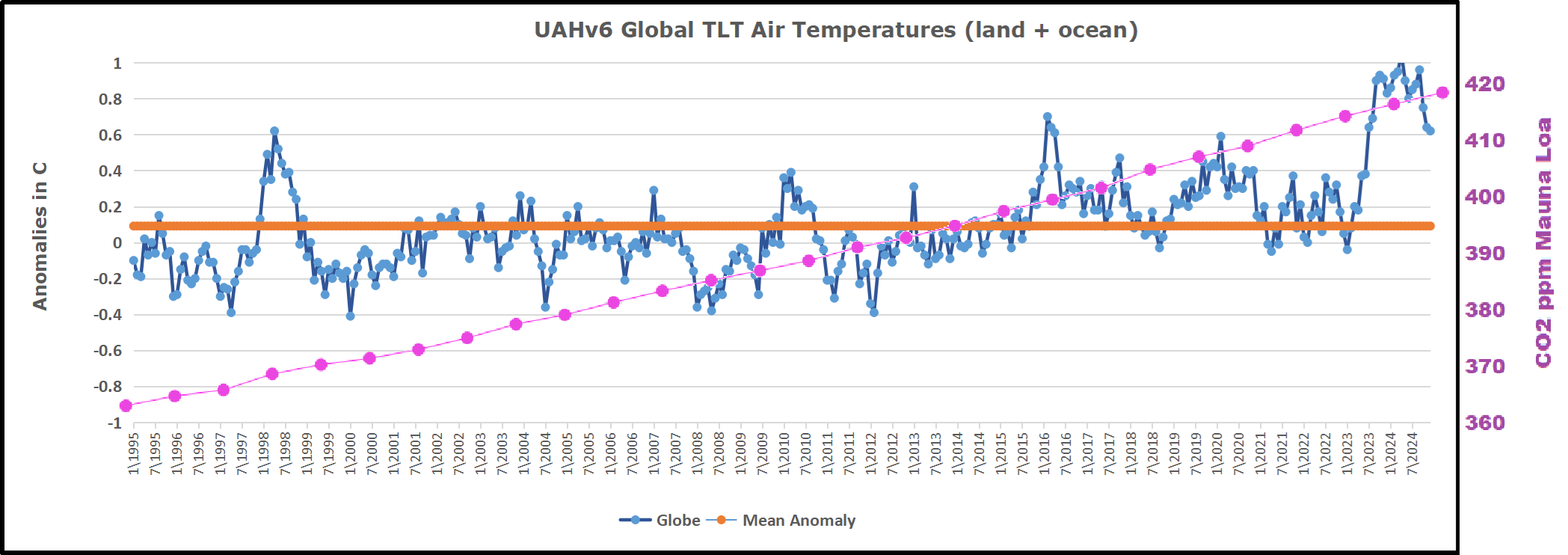
The post below updates the UAH record of air temperatures over land and ocean. Each month and year exposes again the growing disconnect between the real world and the Zero Carbon zealots.  It is as though the anti-hydrocarbon band wagon hopes to drown out the data contradicting their justification for the Great Energy Transition.  Yes, there was warming from an El Nino buildup coincidental with North Atlantic warming, but no basis to blame it on CO2.

As an overview consider how recent rapid cooling  completely overcame the warming from the last 3 El Ninos (1998, 2010 and 2016).  The UAH record shows that the effects of the last one were gone as of April 2021, again in November 2021, and in February and June 2022  At year end 2022 and continuing into 2023 global temp anomaly matched or went lower than average since 1995, an ENSO neutral year. (UAH baseline is now 1991-2020). Then there was an usual El Nino warming spike of uncertain cause, unrelated to steadily rising CO2 and now dropping steadily.

For reference I added an overlay of CO2 annual concentrations as measured at Mauna Loa.  While temperatures fluctuated up and down ending flat, CO2 went up steadily by ~60 ppm, a 15% increase.

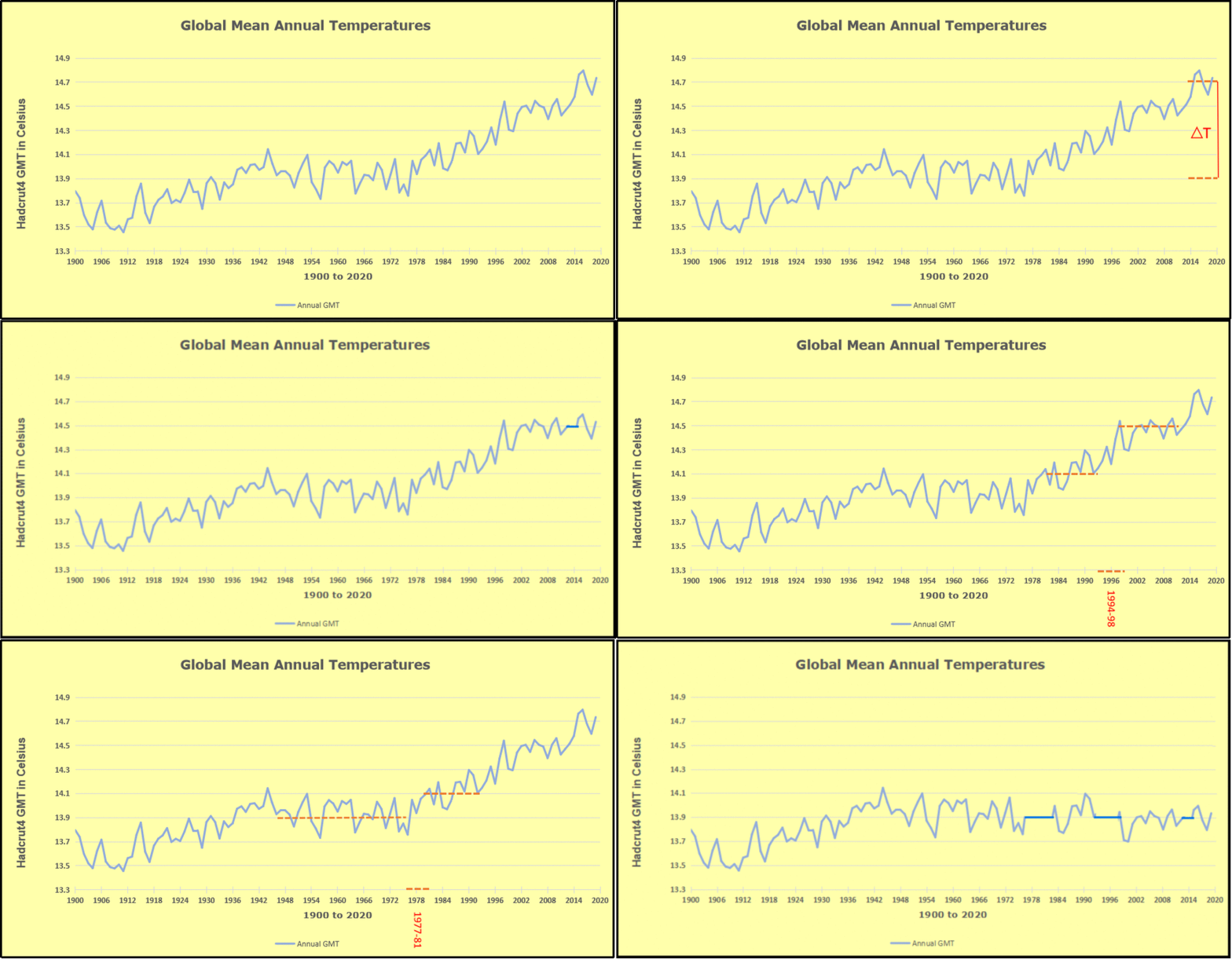
Furthermore, going back to previous warmings prior to the satellite record shows that the entire rise of 0.8C since 1947 is due to oceanic, not human activity.

gmt-warming-events

The animation is an update of a previous analysis from Dr. Murry Salby.  These graphs use Hadcrut4 and include the 2016 El Nino warming event.  The exhibit shows since 1947 GMT warmed by 0.8 C, from 13.9 to 14.7, as estimated by Hadcrut4.  This resulted from three natural warming events involving ocean cycles. The most recent rise 2013-16 lifted temperatures by 0.2C.  Previously the 1997-98 El Nino produced a plateau increase of 0.4C.  Before that, a rise from 1977-81 added 0.2C to start the warming since 1947.

Importantly, the theory of human-caused global warming asserts that increasing CO2 in the atmosphere changes the baseline and causes systemic warming in our climate.  On the contrary, all of the warming since 1947 was episodic, coming from three brief events associated with oceanic cycles. And in 2024 we saw an amazing episode with a temperature spike driven by ocean air warming in all regions, along with rising NH land temperatures, now dropping below its peak.

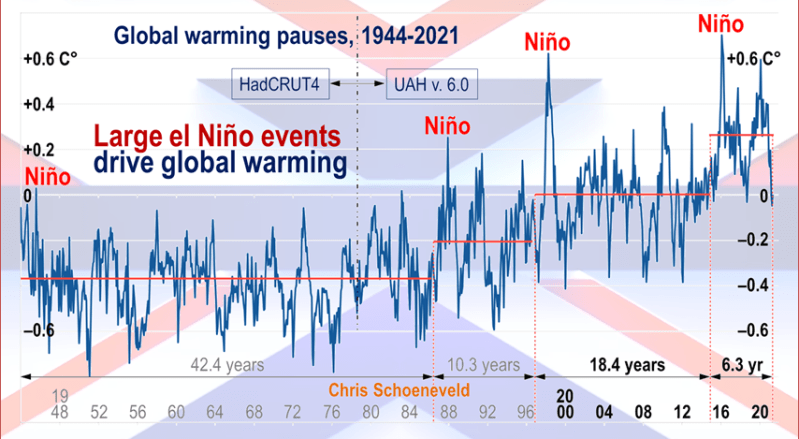
Chris Schoeneveld has produced a similar graph to the animation above, with a temperature series combining HadCRUT4 and UAH6. H/T WUWT

image-8

See Also Worst Threat: Greenhouse Gas or Quiet Sun?

May 2025 NH and Tropics Lead UAH Temps Lower banner-blog

With apologies to Paul Revere, this post is on the lookout for cooler weather with an eye on both the Land and the Sea.  While you heard a lot about 2020-21 temperatures matching 2016 as the highest ever, that spin ignores how fast the cooling set in.  The UAH data analyzed below shows that warming from the last El Nino had fully dissipated with chilly temperatures in all regions. After a warming blip in 2022, land and ocean temps dropped again with 2023 starting below the mean since 1995.  Spring and Summer 2023 saw a series of warmings, continuing into 2024 peaking in April, then cooling off to the present.

UAH has updated their TLT (temperatures in lower troposphere) dataset for May 2025. Due to one satellite drifting more than can be corrected, the dataset has been recalibrated and retitled as version 6.1 Graphs here contain this updated 6.1 data.  Posts on their reading of ocean air temps this month are ahead of the update from HadSST4.  I posted recently on SSTs April 2025 Two Years Ocean Warming Gone These posts have a separate graph of land air temps because the comparisons and contrasts are interesting as we contemplate possible cooling in coming months and years.

Sometimes air temps over land diverge from ocean air changes. In July 2024 all oceans were unchanged except for Tropical warming, while all land regions rose slightly. In August we saw a warming leap in SH land, slight Land cooling elsewhere, a dip in Tropical Ocean temp and slightly elsewhere.  September showed a dramatic drop in SH land, overcome by a greater NH land increase. 2025 has shown a sharp contrast between land and sea, first with ocean air temps falling in January recovering in February.  Then land air temps, especially NH, dropped in February and recovered in March. Now in May both land and sea temps are down in NH and Tropics, overwhelming slight rises of both in SH.

Note:  UAH has shifted their baseline from 1981-2010 to 1991-2020 beginning with January 2021.   v6.1 data was recalibrated also starting with 2021. In the charts below, the trends and fluctuations remain the same but the anomaly values changed with the baseline reference shift.

Presently sea surface temperatures (SST) are the best available indicator of heat content gained or lost from earth’s climate system.  Enthalpy is the thermodynamic term for total heat content in a system, and humidity differences in air parcels affect enthalpy.  Measuring water temperature directly avoids distorted impressions from air measurements.  In addition, ocean covers 71% of the planet surface and thus dominates surface temperature estimates.  Eventually we will likely have reliable means of recording water temperatures at depth.

Recently, Dr. Ole Humlum reported from his research that air temperatures lag 2-3 months behind changes in SST.  Thus cooling oceans portend cooling land air temperatures to follow.  He also observed that changes in CO2 atmospheric concentrations lag behind SST by 11-12 months.  This latter point is addressed in a previous post Who to Blame for Rising CO2?

After a change in priorities, updates are now exclusive to HadSST4.  For comparison we can also look at lower troposphere temperatures (TLT) from UAHv6.1 which are now posted for April 2025.  The temperature record is derived from microwave sounding units (MSU) on board satellites like the one pictured above. Recently there was a change in UAH processing of satellite drift corrections, including dropping one platform which can no longer be corrected. The graphs below are taken from the revised and current dataset.

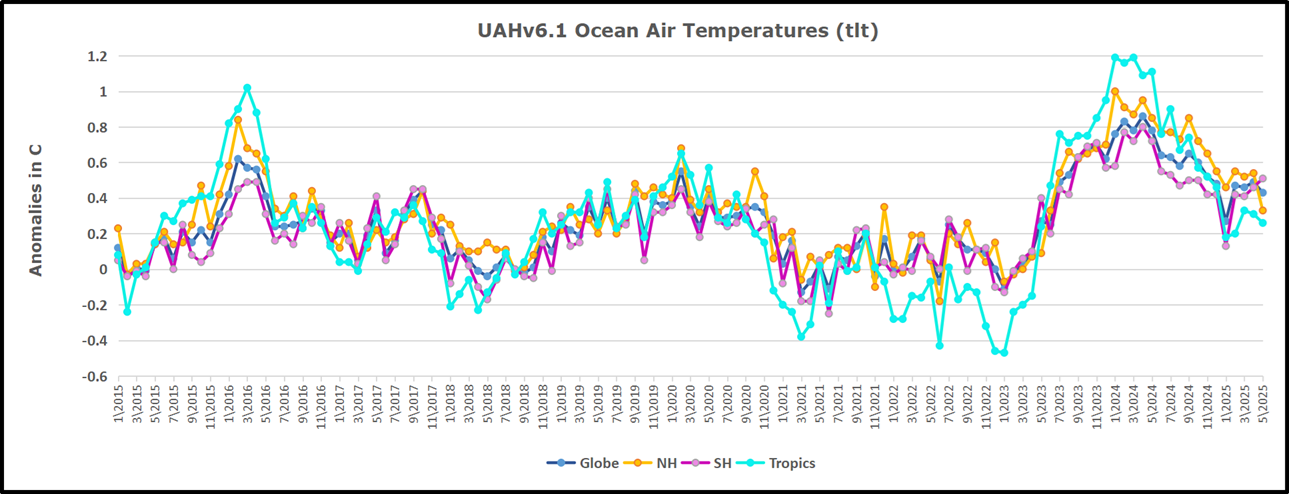
The UAH dataset includes temperature results for air above the oceans, and thus should be most comparable to the SSTs. There is the additional feature that ocean air temps avoid Urban Heat Islands (UHI).  The graph below shows monthly anomalies for ocean air temps since January 2015.

In 2021-22, SH and NH showed spikes up and down while the Tropics cooled dramatically, with some ups and downs, but hitting a new low in January 2023. At that point all regions were more or less in negative territory.

After sharp cooling everywhere in January 2023, there was a remarkable spiking of Tropical ocean temps from -0.5C up to + 1.2C in January 2024.  The rise was matched by other regions in 2024, such that the Global anomaly peaked at 0.86C in April. Since then all regions have cooled down sharply to a low of 0.27C in January.  In February 2025, SH rose from 0.1C to 0.4C pulling the Global ocean air anomaly up to 0.47C, where it stayed in March and April. Now in May drops in NH and Tropics pulled the air temps over oceans down despite an uptick in SH. At 0.43C, ocean air temps are similar to May 2020, albeit with higher SH anomalies.

Land Air Temperatures Tracking in Seesaw Pattern

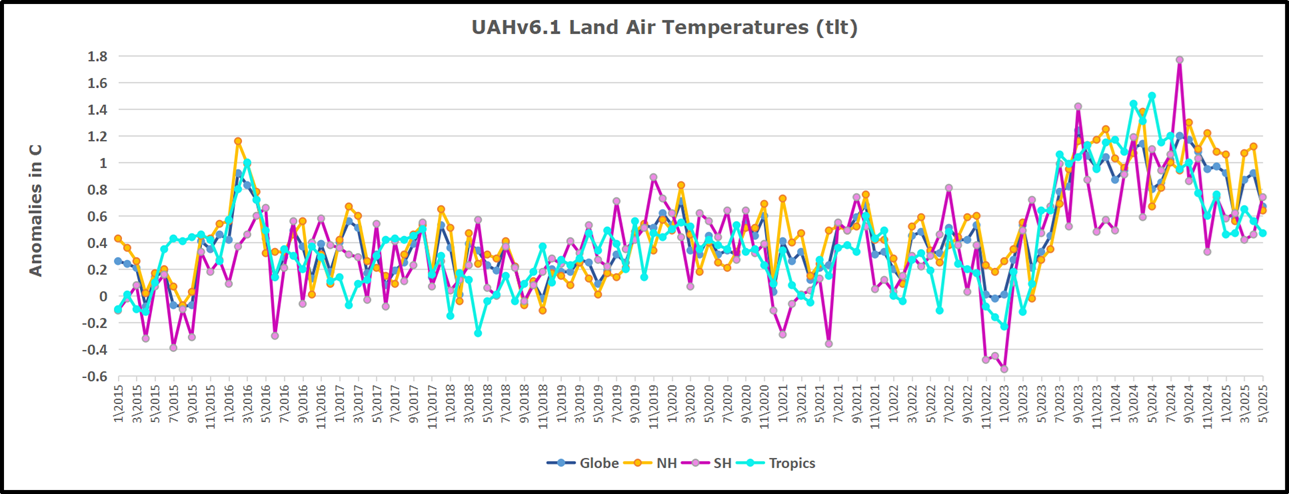
We sometimes overlook that in climate temperature records, while the oceans are measured directly with SSTs, land temps are measured only indirectly.  The land temperature records at surface stations sample air temps at 2 meters above ground.  UAH gives tlt anomalies for air over land separately from ocean air temps.  The graph updated for May is below.

 Here we have fresh evidence of the greater volatility of the Land temperatures, along with extraordinary departures by SH land.  The seesaw pattern in Land temps is similar to ocean temps 2021-22, except that SH is the outlier, hitting bottom in January 2023. Then exceptionally SH goes from -0.6C up to 1.4C in September 2023 and 1.8C in  August 2024, with a large drop in between.  In November, SH and the Tropics pulled the Global Land anomaly further down despite a bump in NH land temps. February showed a sharp drop in NH land air temps from 1.07C down to 0.56C, pulling the Global land anomaly downward from 0.9C to 0.6C. In March that drop reversed with both NH and Global land back to January values, holding there in April.  Now in May, sharp drops in NH and Tropics land air temps pulled the Global land air temps back down close to February value.

The Bigger Picture UAH Global Since 1980

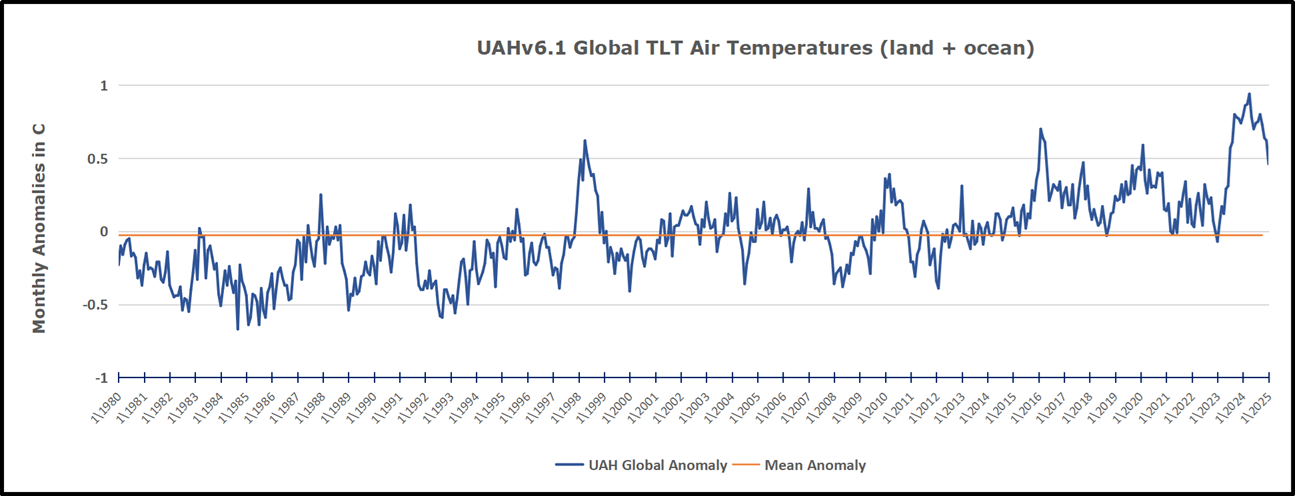
The chart shows monthly Global Land and Ocean anomalies starting 01/1980 to present.  The average monthly anomaly is -0.03, for this period of more than four decades.  The graph shows the 1998 El Nino after which the mean resumed, and again after the smaller 2010 event. The 2016 El Nino matched 1998 peak and in addition NH after effects lasted longer, followed by the NH warming 2019-20.   An upward bump in 2021 was reversed with temps having returned close to the mean as of 2/2022.  March and April brought warmer Global temps, later reversed

With the sharp drops in Nov., Dec. and January 2023 temps, there was no increase over 1980. Then in 2023 the buildup to the October/November peak exceeded the sharp April peak of the El Nino 1998 event. It also surpassed the February peak in 2016. In 2024 March and April took the Global anomaly to a new peak of 0.94C.  The cool down started with May dropping to 0.9C, and in June a further decline to 0.8C.  October went down to 0.7C,  November and December dropped to 0.6C. February went down to 0.5C, then back up to 0.6C in March and April driven by the bounce in NH land air temps, followed by May’s return to 0.5C.

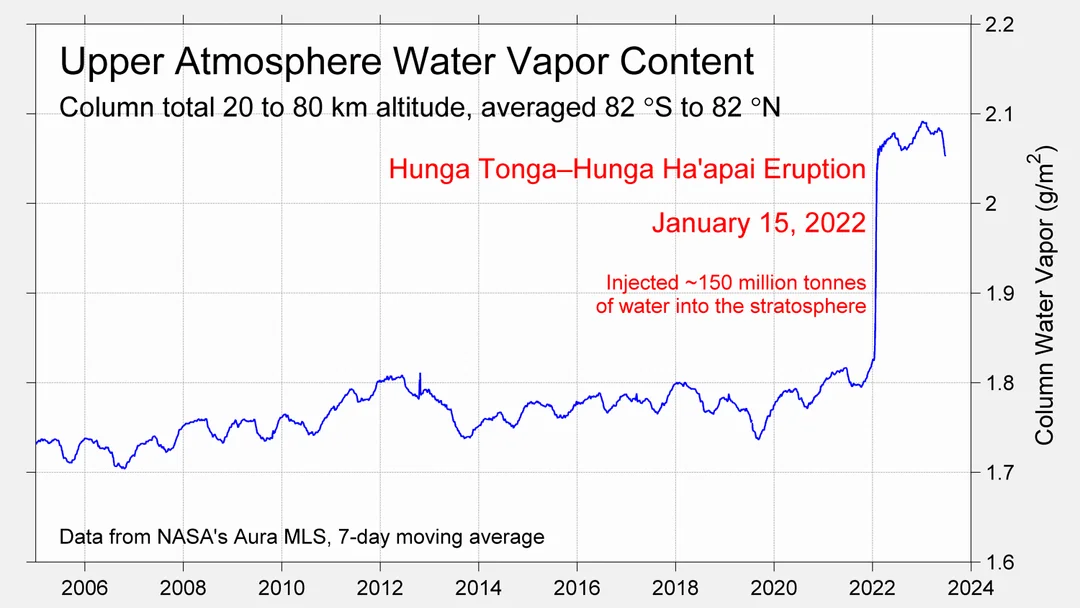
The graph reminds of another chart showing the abrupt ejection of humid air from Hunga Tonga eruption.

Note on Ocean Cooling Not Yet Fully Appearing in UAH Dataset

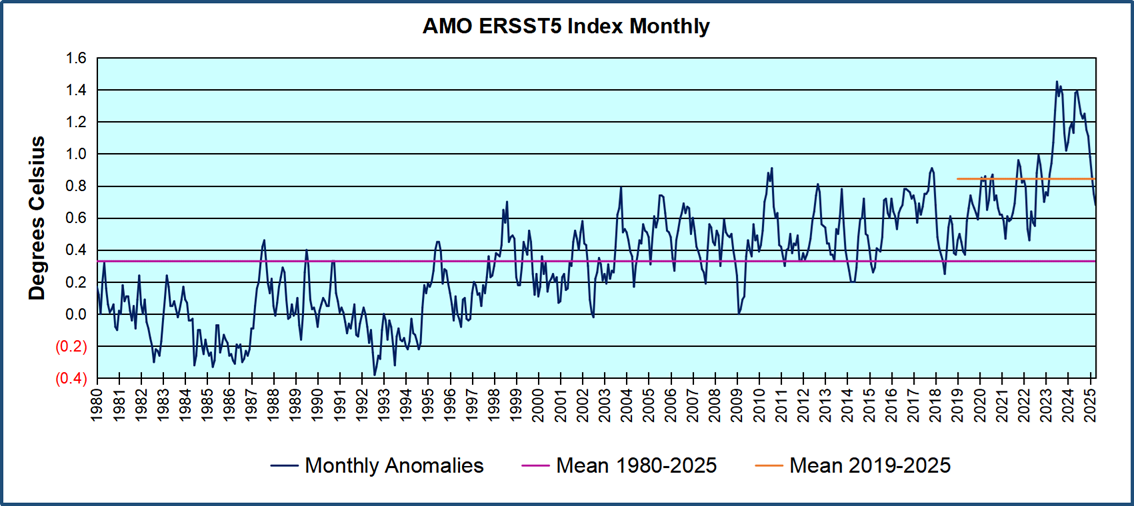
The above chart shows sea surface temperature anomalies (SSTA)  in the North Atlantic 0 to 60N.  The index is derived from ERSSTv.5 by subtracting the global anomalies from the North Atlantic anomalies, the differences as shown in the chart. The baseline of  0.0C is the average for the years 1951 to 1980.  The mean anomaly since 1980 is in purple at 0.33C, and persisted throughout up to 2018. The orange line is the average anomaly in the the last six years, 2019 to 04/2025 inclusive, at 0.84C. The remarkable spikes in 2023 and 2024 drove that rise to exceed 1.4C, which has been cut in half over the last 10 months.  As Dr. Humlum observed, such oceanic changes usually portend air temperature changes later on.

TLTs include mixing above the oceans and probably some influence from nearby more volatile land temps.  Clearly NH and Global land temps have been dropping in a seesaw pattern, nearly 1C lower than the 2016 peak.  Since the ocean has 1000 times the heat capacity as the atmosphere, that cooling is a significant driving force.  TLT measures started the recent cooling later than SSTs from HadSST4, but are now showing the same pattern. Despite the three El Ninos, their warming had not persisted prior to 2023, and without them it would probably have cooled since 1995.  Of course, the future has not yet been written.

via Science Matters

https://ift.tt/gUqs28n

June 12, 2025 at 01:48PM