Politico say ‘We’ve lost the culture war on climate’ (they mean “we lost the Science War”)

By Jo Nova

Politico doesn’t even know what “Culture” is (or Science)

They were paid millions by the USAID Blob as a fake news outlet, but even Politico has finally been dragged by its fingernails to admit something, anything, is not quite working for them in climate politics.

But make no mistake, this is not a mea culpa, it is just damage control, years after they really lost the culture war. After all, two years ago in March 2023, fully 60% of American voters already thought Climate science was more like a religion. And in any case, Donald Trump called climate change a hoax in 2016, and American voters elected him President.

But here the Blob Media are, trying to sell themselves as the firemen hosing down the global inferno.

h/t to Climate Depot

As if they give a damn about “Culture”:

“‘We’ve lost the culture war on climate” they say, but in the article they say nothing at all about culture and everything about federal regulators, funding for junkets, tax breaks and incentives. Culture is apparently just about The Money, The Rules, The Blob.

The big news here is not that Politico is reporting something meaningful, it’s that […]

via JoNova

https://ift.tt/RY1yvQL

June 12, 2025 at 01:17PM

Another Study Indicates China Was 7°C Warmer Than Today Throughout Much Of The Holocene

The evidence for a much warmer Mid-Holocene keeps accumulating.

According to a recent paleoclimate study, today’s Gahai Lake (China) reconstructed surface sediment warm season temperature is 9.4°C. This is similar to the region’s documented meteorological station temperatures (8.8°C, May-September).

The reconstruction’s average Gahai Lake sediment warm season temperatures dating to 8000 to 3500 years ago was determined to be 16.5°C. This means the region was more than 7°C warmer than recent decades during those millennia.

Image Source: Hou et al., 2024

Another new study from the Gulf of Thailand provides robust evidence sea levels were 1.8 – 2.3 m higher than today from 8600 to 6100 years ago. Sea levels were higher because less water was locked up on land as ice throughout the much warmer Mid-Holocene.

Image Source: Leknettip et al., 2025

via NoTricksZone

https://ift.tt/VTQSZhR

June 12, 2025 at 12:21PM

Top Ten Reasons to Shut Down NASA’s Climate Change Shop Known as GISS

For decades, the NASA Goddard Institute for Space Studies (GISS) has projected itself as a sentinel of Earth’s climate future. But its transformation from a space science institute into a climate policy echo chamber represents a textbook example of mission drift. Founded for planetary studies, GISS has long since abandoned its original purpose and embraced speculative climate modeling and media-driven narratives—often built on data more adjusted than measured.

It’s time to be honest: GISS should be closed.

Here are ten good reasons why.


1. GISS Abandoned Its Original Mission

GISS was established in 1961 to support NASA’s planetary science efforts—specifically analyzing satellite data and studying planetary atmospheres. This made sense during the era of Apollo and planetary exploration. But today, GISS has become a climate modeling hub pushing speculative scenarios about Earth’s future, often far removed from observational reality. The pivot from space to climate was not a logical expansion—it was bureaucratic repurposing to fit political trends, and perhaps to save the organization from lack of relevancy and funding cuts once the Apollo missions were over..

2. Duplication of Effort and Bureaucratic Bloat

The U.S. and the world already have multiple agencies—NOAA, NCEI, HadCRUT, Berkeley Earth, UAH—dedicated to tracking Earth’s climate. GISS’s primary offering, the GISTEMP dataset, merely reprocesses NOAA’s Global Historical Climatology Network (GHCN) data. This is redundancy masquerading as innovation. There’s no compelling justification for maintaining a separate NASA-funded entity to do what other agencies already do—except perhaps to keep a particular narrative alive.

3. They Add a “Special Sauce” to NOAA’s Raw Data

GISS doesn’t collect its own raw temperature data—it relies on NOAA’s GHCN. But then it massages that data using its own proprietary adjustments. These adjustments frequently increase recent temperatures and decrease older temperatures, thereby inflating long-term warming trends. This isn’t transparency; it’s alchemy. When the same data goes through different filters and always comes out “hotter,” we should be asking tough questions.

4. GISS Uses an Old, Outdated Temperature Baseline to Juice the Alarm

One of the lesser-known tricks in GISS’s toolkit is its use of a 1951–1980 baseline to calculate temperature anomalies. This baseline includes some of the coldest decades of the 20th century, particularly the 1970s—a period marked by widespread cooling concerns. By anchoring temperature anomalies to this chilly benchmark, GISS makes today’s anomalies appear artificially warm.

Contrast this with NOAA and the University of Alabama in Huntsville (UAH), which use more recent baselines (like 1991–2020) that better reflect modern climatology. If GISS used the same baseline, their charts wouldn’t look nearly as alarming. Plus, they tend to use “hotter” colors in the global maps they produce. This is a visual sleight of hand—technically correct, but intentionally misleading. And it’s exactly the kind of misrepresentation that undermines public trust in climate science.

5. Opaque Adjustment Processes

The so-called “homogenization” process at GISS is more like a magic black box than method. While the code is open source, the how, why, and where data is adjusted is poorly documented and has not been replicated elsewhere by science. Stations with long, reliable temperature histories are frequently “corrected” in ways that flatten past warmth and enhance recent trends. This isn’t merely correcting data—it’s rewriting it.

6. Contaminated Data from NOAA’s Station Network

GISS uses NOAA’s surface station data, but that data has systemic flaws. My 2009 and 2022 studies of the nations’ weather stations, demonstrated that over 90% of NOAA’s weather stations fail their own siting standards, usually being too close to artificial heat sources like asphalt and air conditioner vents. GISS not only accepts this flawed input but compounds the problem by applying additional adjustments. The result? Garbage in, propaganda out.

7. From Science to Activism: GISS’s Politicized Leadership

Former director Dr. James Hansen infamously turned GISS into a platform for climate activism. His 1988 Senate testimony is often credited with launching the modern climate scare, but even then, he and his sponsor had to amp-up the alarm with some heated stagecraft in the Senate hearing room—and his models have missed the mark ever since. Under his tenure and beyond, GISS has increasingly acted as an advocacy shop, with researchers stepping into media roles, climate protests, and policy debates rather than quietly letting data speak for itself.

8. Alarmism Masquerading as Science

NASA GISS leads the charge every year announcing the “hottest year ever,” often based on differences so small they fall within the margin of error. Other datasets—like UAH’s satellite record—don’t always agree, but that doesn’t stop the press releases. What matters to GISS is the headline, not the nuance. That’s not science; that’s marketing. Meanwhile, they remain “baffled” by the heat for 2023, and don’t delve into finding the cause. They suffer from confirmation bias.

9. Dysfunction, Low Morale, and Disconnection from NASA’s Core Mission

According to a recent CNN report, GISS is in “absolute sh*tshow” mode, with demoralized staff and no clear direction following proposed budget cuts. Even NASA admits it plans to end GISS as a standalone entity. When the agency itself is phasing you out, maybe it’s time to pack up the models and go home.

Meanwhile, space exploration missions are being shelved while GISS continues to siphon off funding. This is a betrayal of NASA’s original charter. The agency should be launching missions to Mars and beyond—not fiddling with spreadsheets to make the 1930s look cooler.

10. The Climate Community Doesn’t Need GISS Anymore

With multiple datasets available—satellite-based, balloon based, ground-based, international and private—GISS is no longer indispensable. Its role as a check-and-balance in climate science is compromised by its activism, questionable methods, and redundancy. The scientific community would benefit from one less politicized voice distorting the record.

Conclusion: End the Era of GISS Distortion

Shutting down GISS isn’t anti-science. It’s pro-accountability. Even the Inspector General’s office agrees, when they identified questionable ‘$1.63 million of GISS’ expenditures since 2012’.

It’s time to retire this Cold War-era artifact of climate modeling. GISS has become a monument to adjustment-driven narrative building. Its adherence to outdated baselines, inscrutable processes, and a relentless pursuit of alarming outcomes betrays its scientific mandate.

NASA should archive the GISS data and then return to what it does best: exploring other worlds, not endlessly reinterpreting data from this one. We need clarity, not overcooked temperatures.  If GISTemp is so important, set up an automated process that ingests GHCN data and continues outputting the result to a NOAA webpage. The code is available, and it runs on Python. What can now be replaced by a single high-power desktop PC does not require an entire government department.

It’s time to close GISS.


Discover more from Watts Up With That?

Subscribe to get the latest posts sent to your email.

via Watts Up With That?

https://ift.tt/a7qn8t5

June 12, 2025 at 11:59AM

Climate Policies to What End?

Oren Cass writes at Commonplace Who Is Climate Policy For?  Not workers. Excerpts in italics with my bolds and added images.

I mostly stopped writing about climate change in 2018, when actual analysis lost all relevance to the increasingly unmoored claims of climate activists. The frequently cited estimates of catastrophic cost, I showed in published reports and congressional testimony, were simply nonsensical. One prominent model relied upon by the EPA predicted that heat deaths in northern cities in the year 2100 would be 50 times higher than they had been in southern cities in the year 2000, despite the northern cities never reaching the temperatures that the southern cities were already experiencing. Another study, published in Nature, predicted that warming would boost Mongolia’s GDP per capita to more than four times America’s. But no one cared; no one was held accountable.

When subsequent research flipped the claims on their head, no one even flinched. Here’s the New York Times, four years apart:
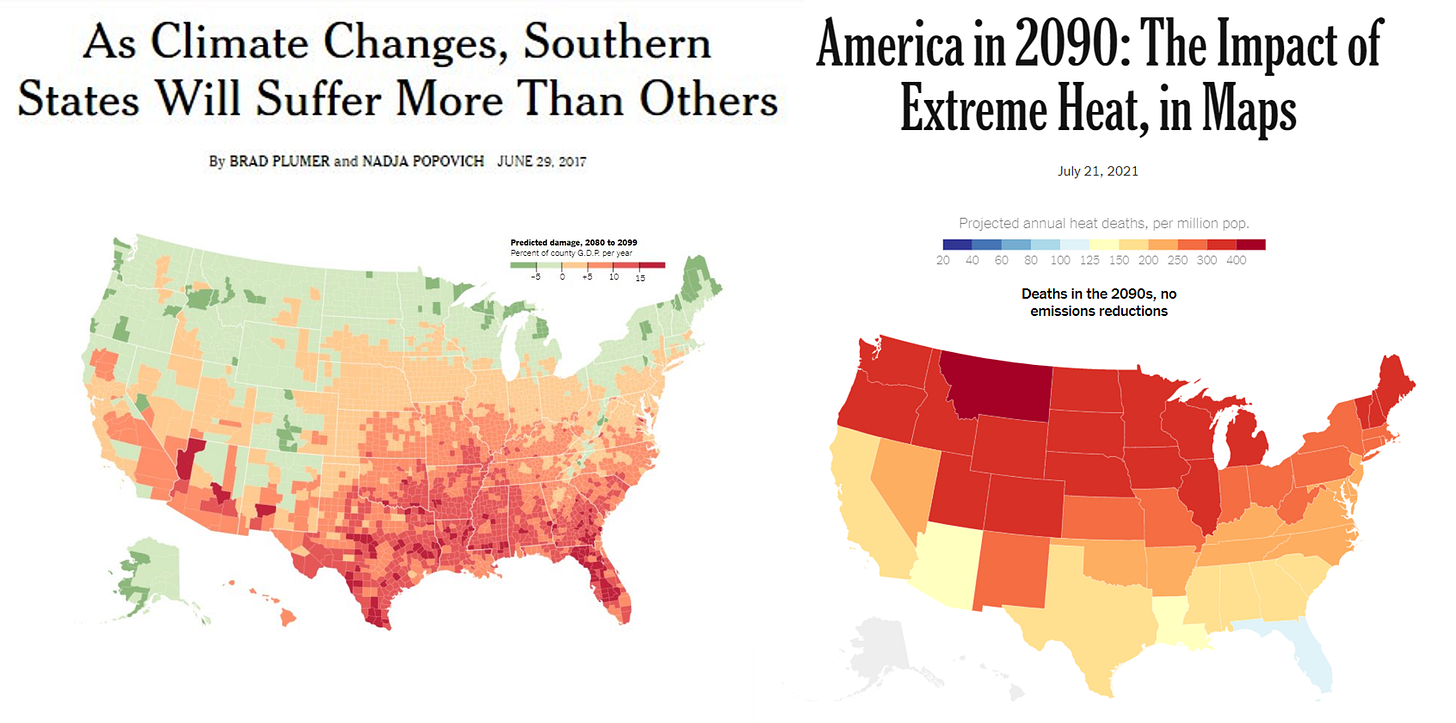
(Technically, the first chart is GDP loss, while the second is heat deaths. But as the Times explained, the main driver of GDP loss in that first chart is heat deaths: “The greatest economic impact would come from a projected increase in heat wave deaths as temperatures soared, which is why states like Alabama and Georgia would face higher risks while the cooler Northeast would not.”) [Note:  Observations actually show a “warming hole” in Southeast US, perhaps due in part to reforestation efforts.]

Discussion of solutions, meanwhile, became entirely performative. So many climate agreements were signed, none had the prospect of substantially shifting the trajectory of global emissions, which is driven overwhelmingly by growth in the developing world. The Biden administration spent four years trumpeting unprecedented investment in fighting climate change. Try to find a comment linking that action to a downward shift in future temperatures or a reduction in any of the purportedly existential harms repeated ad nauseum as the basis for the action. I’ll wait.

The climate lectures had become the equivalent of the parent telling his children to eat their vegetables, because children in Africa are starving.

So now I encounter climate change mostly in the context of discussions about how best to build a policy agenda that serves the interests of American workers, and the working class broadly. Along with the refusal to enforce immigration law and the passion for shoveling hundreds of billions of dollars into a higher education system that fails most young people, the obsession with fighting climate change is a quintessential tradeoff preferred by progressives that they are of course welcome to make, but that cannot be squared with a commitment to working-class interests.

Progressives tend not to appreciate this observation,
or the cognitive dissonance that it triggers.

As I wrote in The Once and Future Worker, “People know how they want society ordered and wish desperately for that same thing to be good for everyone else.” Our 20-year-old texter feels this strongly. Fighting the climate crisis and providing for working families are not mutually exclusive. But the belief in a mythological crisis goes forever unsubstantiated. What is the ongoing devastation of communities that Biden-style policy action will mitigate?

To be clear, when I say mythological crisis, I don’t mean that climate change is a myth. I think climate change is a very serious challenge with which the United States, and the world, must find ways to cope. I’d also like to see us pursuing aggressive public investment in next-generation nuclear technology, and in the industrial precursors to strong electric vehicle supply chains—both of which are smart industrial policy regardless of climate implications.

But in the broader scheme of a century of economic, technological,
and geopolitical changes and challenges, the gradual increase
in global temperatures does not rank high.

This is not my opinion, it is the conclusion of the climate models, the UN’s Intergovernmental Panel on Climate Change, and the analyses that attempt to translate these forecasts into economic impacts. Climate change is not one of the top challenges facing working families in America. Solving it, if we could, which we can’t, would do little to move the needle in helping them achieve middle-class security.
But what about the “Green New Deal”? It has “New Deal” right in the title, suggesting a clear commitment to improving economic opportunity! That’s true, as far as it goes. Indeed, we could launch a “Purple New Deal” dedicated to knocking down all buildings that are not purple and replacing them with purple ones, which would also have many jobs associated with it.  Unfortunately, that’s not good economic policy.

What the Green New Deal—and climate policy, generally—attempts to do is shut down the existing energy industry and much of the industrial economy that relies on cheap and reliable energy, and replace it all with new “green” jobs. This should not require saying, but apparently does: Supplanting an existing, robust energy sector and industrial economy that provides a lot of very good jobs outside of our knowledge economy and superstar cities, with a new set of industries that hopes to do the same, does not in fact deliver economic gains.

The stated goal of climate policy is to replace things we already have. Anything new it creates is an attempt to climb back out of a hole it has dug itself. And unfortunately, the new tends to be less good, economically speaking, than the old. That reality in the auto industry is what drove the UAW strike last year.

The best way to understand all this is with a simple hypothetical: Let’s say we didn’t have to worry about climate change. A neat little box sucked greenhouse gases out of the atmosphere for free; problem solved. Would anyone still propose the Green New Deal? No climate change to worry about, you need to propose an agenda to support working families, how high on the list is “spend trillions of dollars shutting down the industrial economy and attempting to replace it with a set of less efficient and unproven technologies in which the United States has a much weaker position”?

It’s nowhere on the list.
Because climate policy does not help the working class.

For whatever reason, the project of decarbonizing the economy captures the progressive mind like no other. Ezra Klein and Derek Thompson’s Abundanceopens with a paragraph about waking up in the year 2050 in a cool bedroom powered by clean energy sources—a bedroom no cooler than the one you would wake up in today. Their abundant future is, first and foremost, not a more abundant one at all—merely one whose energy system they have transformed. Discussing scarcities, they start with, “We say that we want to save the planet from climate change.” When they enthuse that “new technologies create new possibilities and allow us to solve once-impossible problems,” they are thinking first of greenhouse gas emissions. “We worry,” first, “over climate change.” And “this book is motivated in no small part by our belief that we need to decarbonize the global economy.”

In my podcast with Klein, I asked him whether combatting climate change might represent a tradeoff in his agenda, rather than item one for bringing abundance to America. “For most, certainly, liberals who think about this and have studied this,” he responded, “the decarbonization is just central to the idea of what it would mean for our descendants to live a flourishing life.” Pitched this way, it fits perfectly the ideological template of most neoliberal missteps of the past 30 years: a purported win-win that serves the priorities of highly educated, high-income elites, who then instruct everyone else that the same thing should be their priority too. Like globalization, and unrestricted immigration, and free college.

Fool me once… Climate policy imposes massive costs, and damages the industrial economy, in pursuit of a specific goal: reducing carbon dioxide emissions. And if that’s your goal, that’s fine. Fight for it! Make the case for the tradeoff. But don’t pretend there’s no tradeoff, and certainly don’t tell the people you’re trading off that you’re really doing it for them.


via Science Matters

https://ift.tt/l7nE2K4

June 12, 2025 at 11:03AM