Why Regulate Electricity? Two Exchanges (Giberson, Borlick)

The intellectual and practical case for separating government and electricity is strong. The historical record offers little support for “market failure”–quite the opposite. The laws of physics do not preclude private ownership and control of assets in this area unless you assume mandatory open access–Lynne Kiesling’s Ostrom trick–to make private operation of control areas problematic. [1]

So I labor against faux classical liberals/think tanks that offer suggestion after suggestion to try to make government planned ISO/RTO’s work. But the fix is in with the guilty who refuse to seriously consider a free market in electricity.

Two exchanges with my critics follow. One is with Michael Giberson, a “Right” central planner; the other with Robert Borlick, a Progressive Left central planner.

Michael Giberson Exchange

Giberson posted on his regulatory filing:

The DOJ Anticompetitive Regulations Task Force requested comments on how state and federal regulations act to impair competition. In R Street’s comments we describe how regulations granting monopoly rights to electric utilities can be abused to raise rates and slow innovation. We advocate deep reconsideration of the grounds for state-protection of monopoly in the electric power industry, and using that reconsideration to restrict monopoly grants to the degree supportable by evidence and then quarantining the monopoly to allow competition to flourish in other industry sectors.

He continues:

Much of the regulatory framework governing the electric power industry in the United States remains founded on thinking that is now over a century old. It might [not?] be the case that the old ways still work best for consumers. Plenty of evidence–ranging from peer-reviewed economic analysis to legal decisions to news reports–suggest that monopoly electric utilities use their protections in ways harmful to the public interest. We discuss this evidence and offer recommendations for reform.

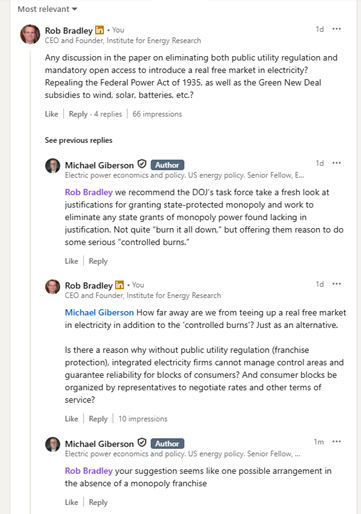
I asked: “Any discussion in the paper on eliminating both public utility regulation and mandatory open access to introduce a real free market in electricity? Repealing the Federal Power Act of 1935, as well as the Green New Deal subsidies to wind, solar, batteries, etc.?”

Giberson: “We recommend the DOJ’s task force take a fresh look at justifications for granting state-protected monopoly and work to eliminate any state grants of monopoly power found lacking in justification. Not quite “burn it all down,” but offering them reason to do some serious “controlled burns.”

Bradley: “How far away are we from teeing up a real free market in electricity in addition to the ‘controlled burns’? Just as an alternative. Is there a reason why without public utility regulation (franchise protection), integrated electricity firms cannot manage control areas and guarantee reliability for blocks of consumers? And consumer blocks be organized by representatives to negotiate rates and other terms of service?”

Giberson: “Your suggestion seems like one possible arrangement in the absence of a monopoly franchise.”

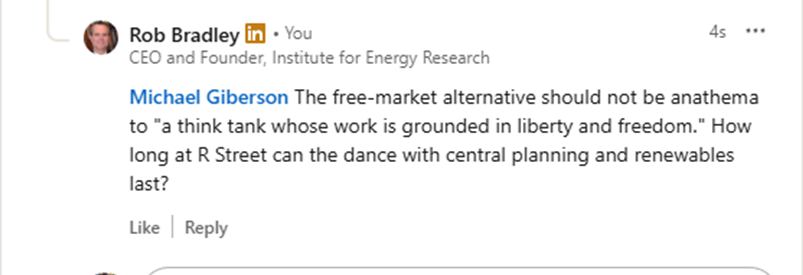
Bradley: “The free-market alternative should not be anathema to ‘a think tank whose work is grounded in liberty and freedom.’ How long at R Street can the dance with central planning and renewables last?”

Final Comment

And he disappeared, as usual….

There can be no straight answer. R Street and Michael Giberson are wed to electricity statism in the centrally planned ISO/RTO market. They do not offer a North Start of a real free market in electricity in the face of withering criticism that free markets never failed in this huge sector. Note that Giberson’s extensive footnotes do not mention my electricity piece, which he refuses to try to refute, much less acknowledge. Oh well, the future will be kinder to me than to him, as is the case for many areas of statism versus free markets.

Robert Borlick Exchange

The exchange began with Borlick’s social media post:

Why should the general public subsidize Big Tech’s need for electric power? These companies are largely owned by billionaire oligarchs. We don’t need more welfare for corporations. Big Tech should provide for their own power needs.

He referred to an article “Big tech must stop passing the cost of its spiking energy needs onto the public.”

I commented: “An end to public utility regulation could address this.”

Borlick: “Rob, you keep saying this without addressing how to control the market power of natural monopoly. If utilities faced competition there would be little need for price regulation. When small scale generation gets cheap enough to make self generation economically feasible, utility regulation will no longer be needed, nor will it be capable of even ensuring cost recovery for the utilities. I submit that day is not far off.”

Bradley: “My argument has long been (and it is in the paper I have shared with you) that 1) the natural monopoly theory is missing in action, as in the pre-PUR of the industry and 2) a ‘monopolist’ utility rate can be countered by monopsony, organized consumers via lawyers/experts. Low transaction costs make the latter possible, and civil society (public opinion, media, etc.) will no doubt be part of the process, if it were to get to that.

But can you or anyone else provide a clear example of a natural monopoly doing bad things in a free market setting (w/o franchise protection)?

Third, as Pigou stated in 1920, ‘It is not sufficient to contrast the imperfect adjustments of unfettered private enterprise with the best adjustment that economists in their studies can imagine. For we cannot expect that any State authority will attain, or will even whole-heartedly seek, that ideal’ (1920, 296).”

Bradley: “Regarding off-grid distributed generation, central station thermal with transmission and end users exhibits scale economies–and in all three areas. Insull first discovered this, and it has not changed despite all the government intervention to penalize vertical/horizontal integration and to subsidize dilute, intermittent inferiors….”

Final Comment

And Borlick disappeared….

[1] Kiesling uses the mandatory open access trick to argue:

I don’t know that we need to reopen the utility regulation debate. I strongly think we need to reframe it in Ostromian terms. Yes, electric networks require central physical control, but 1. there are different institutional ways of implementing that and 2. the more we think of grid management and physical control as Ostrom-eqsue institutions for defining and enforcing use rights in a common-pool resource, the better a job we’ll do of allowing a resilient, decentralized, heterogenous network of resources to emerge through innovation.

Wrong! The regulatory approach has been, is, and will be a case study of technocratic second-best, at best.

—————————————
The post Why Regulate Electricity? Two Exchanges (Giberson, Borlick) appeared first on Master Resource.

via Master Resource

https://ift.tt/kuoCBMl

June 3, 2025 at 01:07AM

The Scorching Hot German Summer of 1911

From the NoTricksZone

By P Gosselin

1911 in Germany saw a hot, dry summer that lasted from spring until well into September

German blog site lokalgeschichte here looks at the German summer of 1911, which was exceptionally hot, dry and sunny. It disproves the previously widespread idea that Central Europe’s heat waves are something new and due to more CO2 in the atmosphere.

Germany saw extreme heat from spring until September in 1911. Symbol image, produced by Grok

Although temperatures in the summer of 1911 were very high in places (up to 40 C in Chemnitz), no new records were broken. The year 1892 had similar or even higher values (41.5C in Reichenhall). The most remarkable feature of the summer of 1911 was not the absolute maximum temperature, but the duration of the hot spell and the persistent tendency towards dry and warm high-pressure weather, which lasted from spring until well into September.

In 1911, Germany saw extreme drought, particularly in western and central Germany. In Berlin, for example, only about half of the normal precipitation fell between April and July, and only a seventh in August. Such an event occurring today would have climates alarmists blaming CO2. But, as 1911 shows, weather extremes are nothing new.

According to the article, the cause of such weather is a persistent shift of high-pressure areas over continental Europe. However, the fundamental forces that control these atmospheric currents are not yet fully understood. Although the outflow of heated air from the tropics to the poles influences the climate of the temperate zones and the conditions in higher atmospheric layers could play a role, there are still no reliable laws for accurate forecasting.

Meteorological observations over almost two centuries show that cool and warm summers occur in bunches. Examples of this are eight consecutive cool summers from 1881 to 1888 and 18 cool summers from 1730 to 1747, as well as 15 warm summers from 1756 to 1770. The climate balances itself out over longer periods of time. It’s naturally occurring.


Discover more from Watts Up With That?

Subscribe to get the latest posts sent to your email.

via Watts Up With That?

https://ift.tt/G1oQ2k5

June 3, 2025 at 12:05AM

New Study: North American Fires Were Four Times More Prevalent From 1600-1880 Than 1984-2022

“Based on the historical fire-scar record, NAFSN [North American tree-ring fire-scar network] sites collectively would be expected to have burned 4346 times from 1984–2022, yet they burned 989 times, or only 23% of what would be expected under the historical fire regime.”  — Parks et al., 2025

According to the prevailing alarmist narrative, the recent decades of “unprecedented” warming across North America was supposed to have been the driver of the continent’s contemporary “record-breaking” fires and burned area.

However, a new study using tree ring fire-scar records dating to the “historical period” of 1600-1880 has determined these colder Little Ice Age centuries had far higher burn rates than recent decades.

“Many studies have reported increases in area burned associated with a warming climate over the last few decades across much of North America. Our evidence indicates that, even under a warming climate, the rate at which NAFSN sites burned in recent decades has been much lower than historical rates [1600-1880] across most of the continent.”

“Our study of 1851 tree-ring fire-scar sites and contemporary fire perimeters across the United States and Canada reveals a substantial, persistent fire deficit from 1984-2022 in many forest and woodland ecosystems, despite recent increases in burning. Contemporary fire occurrence is still far below historical (1600-1880) levels at NAFSN sites despite multiple large and ‘record-breaking’ recent fire years, such as 2020 in the western United States.”

Astonishingly, the non-fire years at the 1,851 tree-ring fire-scar sites were more than one hundred times less frequent during the Little Ice Age centuries (1600-1880) than in the last four decades.

“The prevalence of non-fire years at the NAFSN sites in the contemporary time period [1984-2022] was >100 times more prevalent compared to the historical period…”

Overall, the North American tree-ring fire-scar record indicates the historical (1600-1880) period’s burn rate was more than four times greater than it was from 1984-2022, as modern fire burning was “only 23% of what would be expected under the historical fire regime.”

Image Source: Parks et al., 2025

via NoTricksZone

https://ift.tt/Mt83PmW

June 2, 2025 at 11:17PM

The Faux Science of Outlawing Fossil Fuels

By Dr. Bruce Everett and Gordon Tomb

The recent Nature article, “Carbon Majors and the Scientific Case for Climate Liability,” tries to further the alarmists’ dream of pinning alleged harms of “extreme” weather on the world’s largest producers of fossil fuels.

Christopher W. Callahan and Justin S. Mankin, both at Dartmouth College when their article was prepared, accept – without substantiation – climate activists’ position that industrial emissions of carbon dioxide cause catastrophic warming and perpetuate the demonization of oil and gas companies as global villains.  Instead of casting light on the climate issue, the authors attempt to provide a blueprint for a “‘coming wave of climate legal action’ for which courts are woefully unprepared.”

“More than 100 climate-related lawsuits have been filed annually since 2017,” report the authors. “And as extreme events intensify and losses accumulate … more people are turning to the legal system for relief.”

The authors, however, fail to provide a sound foundation for such lawsuits. Their claim that Chevron Corp. is liable for nearly $2 trillion in “climate damages” has no basis in science, fact or common sense. Moreover, in making the case, they violate important tenets of scientific inquiry.

The Nature article uses the words “science” and “scientific” 44 times, but the writers disregard the scientific method, a centuries-old system of inquiry that relies on testing by empirical observation. Repeated are fallacies of popular climate research such as trusting computer models that have failed validation by real-world data.

The research is bestowed with the supposed credibility of “peer review” – a term that once described a dispassionate assessment by third parties but long ago was corrupted into a seal of approval for ideological purity. At best, the authors attempt to cover their conclusions with a patina of authority by using faddish jargon and opinions that are more political than scientific.

The authors claim to establish the liability of oil and gas companies for climate damage through a four-step process:

First, relying on discredited analytical models, they find that Chevron’s emissions of carbon dioxide are responsible for 0.025 degrees Celsius of warming since 1920, or less than 0.01% of the Earth’s average temperature. Attributing this level of precision to crude computer analysis makes no sense.

Dr. Richard Lindzen, professor emeritus of physics at the Massachusetts Institute of Technology, has declared such analysis the basis of “a quasi-religious movement predicated on an absurd ‘scientific’ narrative.” Suffice it to say that the many parameters influencing climate are too poorly understood to construct a useful predictive model. Among those factors are changes in Earth’s orbit, fluctuations in solar energy, volcanic emissions, changes in ocean currents and cloud formation.

Second, the authors purport to show that heat waves induced by increasing atmospheric carbon dioxide are becoming more severe and frequent without showing a connection between hot weather and CO2 and without having a baseline to establish a trend of greater severity and frequency.

How could they? Earth has been in a beneficial warm period for nearly 12,000 years, but satellite data to track heat waves cover only the last half century and scattered thermometer readings a mere 150 years. The trend for U.S. heat waves has been flat since at least 1890 except for the Dust Bowl period of the 1930s.

The third and fourth steps assume connections – with little or no empirical backup – between changes in global surface temperatures and extreme heat at a regional level and between unusually hot days and per capita income.

The least rigorous of the researchers’ analyses is that of weather’s influence on income. For centuries, economists have tried to understand why per capita income varies from country to country, region to region, year to year and month to month.

Individual income is influenced by culture, geography, demographics, normal weather variations, government policy, war, civil strife, crime, natural disasters of all types, trade, influences from friendly or hostile neighbors, world commodity prices, exchange rates, interest rates and consumer sentiment – to name just some variables.  To assert that the effect of several hot days on income can be screened from all manner of influences – natural or otherwise – is well beyond any reasonable interpretation of data.

In summary, the authors use unvalidated computer models, opinions and assumptions and specious economic correlations to calculate down to two decimal places a climate liability for Chevron of $1.98 trillion – more than eight times the company’s market capitalization.

The authors ignore the direct benefits of increasing CO2 – mainly an overall greening of Earth and record crop production from the gas’s fertilization effect. Although they note that fossil fuels have “produced immense prosperity,” even that is an understatement. After all, coal, oil and natural gas are largely responsible for sustaining 8 billion people – tenfold the population prior to the Industrial Revolution.

Such facts, hopefully, would be considered should the faux science of Messrs. Callahan and Mankin ever be introduced to a judge and jury.

This commentary was first published at The Daily Signal on June 2, 2025.

The authors are with the CO2 Coalition, Fairfax, Virginia – Bruce Everett as a member of the board of directors and Gordon Tomb as a senior advisor. Dr. Everett has published a paper on the research of Callahan and Mankin.


Discover more from Watts Up With That?

Subscribe to get the latest posts sent to your email.

via Watts Up With That?

https://ift.tt/3A0oTdK

June 2, 2025 at 08:02PM