Augusta Chronicle’s Climate Myth: Invasive Species in Georgia Not Driven by Warming

From ClimateREALISM

By H. Sterling Burnett

The August Chronicle published an article claiming climate change was causing the spread of invasive plant species. This is false. Data from Georgia does not show climactic changes, whether in temperatures or extreme weather, that would make the state more suitable than it already is for invasive plant species, which have, in fact, long been established there.

The author of the August Chronicle story, “Symptoms of climate change in Southeast fuel increase in invasive plant species,” Erica Van Buren writes:

Symptoms of climate change include extreme heat, drought, and extreme weather, all of which can significantly impact plant species.

“It’s kind of hard to pin it down, because climate change is so complicated,” said Eamonn Leonard, senior wildlife biologist for the Georgia Department of Natural Resources, Wildlife Resources Division. “It changes so many different things. From storm frequency to moisture to drought in general. I think invasives are able to sort of capitalize on changes that our native plant species aren’t able to.”

There are multiple problems with this claim. First, contra Leonard, the “expert,” Van Buren quotes in her story there is no reason whatsoever to believe that invasive species which thrive in present conditions in Georgia will be any more adaptable or able to thrive there if those conditions change than native species will be. Invasive species, that is species from other regions or foreign countries that are introduced either intentionally or accidentally and cause unintended harms, thrive because the climate conditions where they are introduced are suitable for their flourishing. When they outcompete native species, it is not due to climate conditions but rather because the insects, plants, species, management practices, and conditions that keep them in check in their native lands don’t exist here. More or less rainfall, fewer or increased storms, won’t disadvantage native species in competition with invasive species.

More importantly, weather and temperature trends in Georgia show no discernable “symptoms of climate change.” Temperatures have not increased significantly, or become more extreme, and neither droughts nor other types or extreme weather have increased in Georgia. There is no way invasive species can be benefitted in competition with native species from a changing climate if it is not, in fact, changing that much

Concerning temperatures, the Georgia state summary from the U.S. National Centers for Environmental Information (NCEI) shows that the temperatures in Georgia have risen just 0.8℉ since 1900, half the average rise measured across the nation. As a result, present temperatures and the temperature trend do not advantage invasive species in competition with native species. The has been no increase in extreme temperatures in Georgia, according to the NCEI, which reports that “The highest number of extremely hot days occurred during the late 1920s, early 1930s, and early 1950s; however, since 1955, the number of these days has generally been near or below average.” (See the graph, below)

Nor, the NCEI reports, have precipitation trends changed substantially during the recent century and a half of modern warming.

The U.S. Geological Survey has recorded extended, sometimes severe droughts across different regions of Georgia since it began recording and reporting such data in the 1890s. There is no evidence that droughts have increased in number or severity in Georgia in recent decades, with data indicating droughts in the early part of the 20th century when temperatures were modestly cooler, were as severe, widespread, and frequent then as they are now. Streamflow has fallen in some areas in recent years beyond what might have been expected previously due to similar drought conditions but that is because the demands for water in Georgia have increased dramatically to supply intensive agriculture and to supply water for various uses to fast growing urban populations.

Hurricanes are a problem in for Georgia but not as big a problem as in other Atlantic and Gulf coast states, due, in part to a smaller coastline.

“The last system to make landfall in the state at hurricane intensity was Hurricane David in 1979,” Wikipedia reports. “Further, only three major hurricanes have struck Georgia, the most recent of which being in 1898.”

There has been no observable increase in the number or severity of hurricanes and tropical storms striking or passing through Georgia in recent decades during the period of slight warming.

So, since neither temperature, precipitation, drought, nor hurricane trends have changed much in Georgia, contrary to the Augusta Chronicle’s slant a “changing climate” can’t be behind any perceived or observed increase in the spread of invasive species. To the extent that invasive species are thriving or spreading, it is due entirely to same conditions or factors that made their growth here possible in the first place, human introduction, plant and pest management, and landscape modifications that have favored invasives compared to native species. Climate change is not an identifiable factor. No amount of spin or fearmongering from the Augusta Chronicle can change this one basic fact.

H. Sterling Burnett

H. Sterling Burnett, Ph.D., is the Director of the Arthur B. Robinson Center on Climate and Environmental Policy and the managing editor of Environment & Climate News. In addition to directing The Heartland Institute’s Arthur B. Robinson Center on Climate and Environmental Policy, Burnett puts Environment & Climate News together, is the editor of Heartland’s Climate Change Weekly email, and the host of the Environment & Climate News Podcast.


Discover more from Watts Up With That?

Subscribe to get the latest posts sent to your email.

via Watts Up With That?

https://ift.tt/4OFi3nt

June 2, 2025 at 04:07PM

Lingwood:Strumpshaw Hill DCNN 3000 – A very poor site that stands head and shoulders above its comparative neighbours.

52.61080 1.48318 Met Office CIMO Assessed Class 5 Temperature records from 1/4/2009

This is my 250th post since re-starting the Surface Stations Project on the 24th August 2024. That I have still not covered all the Class 5 stations yet surprises even me but there are still 31 more of these effectively unregulated ones I have yet to review! Lingwood:Strumpshaw Hill may not be the worst sited of them all but it comes very close. Amazingly, it is infinitely better than any of its near “neighbours”.

I have deliberately used a wide angle view in the headline image to include the thick belt of woodland to the south and the ever-changing agricultural land to all other compass points surrounding this highly enclosed domestic rear garden site. To give more context below is an image of the entrance driveway to the property from the aptly named “Wood Lane” to the south.

Viewing from the Buckenham Road trackway leading to the property from north it is just about possible from one older streetview image to discern a vague white blob indicating the screen – under the trees and surrounded by shrubbery.

I really feel delineating the proximity with radius circles is a pointless exercise as this site can have no credibility whatsoever for contributing any data to the national historic temperature record – but it does as shown here. {Worth remembering this listing for later reference}

Clearly the site is not going to represent anywhere other than the tiny micro-climate of the rear garden it sits in. I defy any meteorologist to claim this site offers any climate reporting benefits so why on earth is it included in the above listing and its data even considered? Answer: because it is infinitely better than all those comparative Met Office “Weather Stations” in the area……..the UNDEAD strike again!

I use the term “infinitely better” simply because NONE OF THE ABOVE SITES EVEN EXIST. Check out that “List of all the synoptic and climate stations” and they are not there. Regular readers will know well about the absurdity of Lowestoft still reporting monthly averages here despite closure 15 years ago as well as the proof of an afterlife at Scole. Coltishall died 19 years ago, Morley St Botolph died 20 years ago and Hemsby died nearly 25 years ago.

Lingwood weather station sits just 9 miles from the fully operational Norwich Airport site and 11 miles from the University of East Anglia Climatic Research Unit (CRU). Are we really to believe that the Airport site cannot be used or that the CRU does not have a weather station? Seems someone is missing a “Trick

via Tallbloke’s Talkshop

https://ift.tt/SENyA0M

June 2, 2025 at 03:04PM

Morano: How White House staff used autopen to sign climate orders without Biden’s knowledge


Beyond a joke barely covers it. What were they thinking?
– – –
Link to news video via Climate Depot – here.

[NB Screenshot above is not the video link]

via Tallbloke’s Talkshop

https://ift.tt/GjVhDY6

June 2, 2025 at 02:00PM

MPs from Left and Right in France vote to ditch “low emission zones” and bans on old cars

By Jo Nova

Good news — there is one less hyper-complex, pointless, car-hate program in the world

It all flipped so quickly: Only six months ago President Macron was hurling France into a climate changing roadmap of the Octopus kind. The people of France were going to have to buy EVs, work from home, swap the filet mignon for tofu, and take fewer flights overseas. Even large screen televisions were going to have to shrink, to save electrons. And some bureaucrats were enthusiastically even dreaming that they would reach into homes and set the thermostats to max out at 66F in winter and to only cool to 78F in summer.

To beat French car owners around the head, the National government legislated car zoning incentives to make life hard for anyone who wanted to drive an old car. The low emission zones started in 2019 and had already spread like a municipal leprosy to every town larger than 150,000 people.

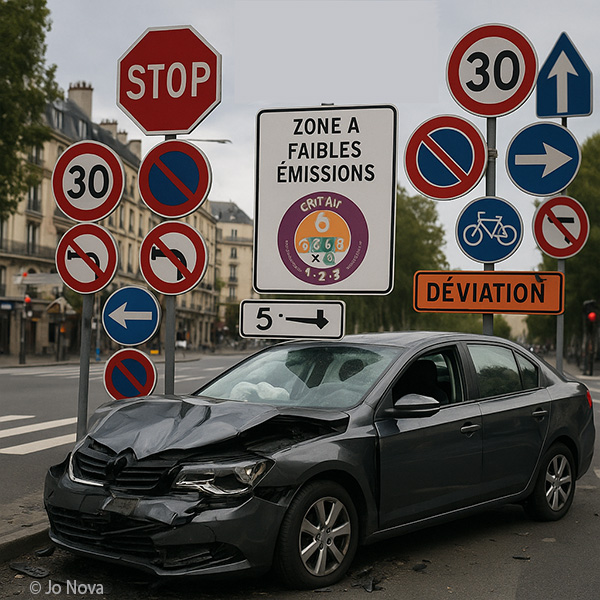
In these ZFEs (zones à faibles émissions), cars were ranked and given a sticker. Crit’Air 0  were the cleanest and Crit’Air 5 were the most “polluting” vehicles. Different rules applied to each sticker class in each town with a soul sapping complexity. In Paris for example, Crit’Air 3 cars (basically diesel cars older than 2011, and petrol cars before 2006) were banned on weekdays. Fines varied from €68  to €750. It was a case of — if you like your car, you can keep it — (locked in the garage) right?

But cars older than  1997 were seen as such baby killers they were not allowed to have a Crit’Air Sticker at all, so their drivers would be fined if they were caught on any weekday between 8am and 8pm. Obviously, the bans hurt the poor and the rural workers — who drove older cars. They also hurt the tradies, and small businesses that used a van.

The low emission zones were so unpopular, as the BBC even admits, they “turned into something of a lightening rod for Macron’s supporters”. (The wonder is that it took five years?)

Last week the French National Assembly voted 98 to 51 to scrap the zones entirely. The government had tried to dilute the rules, and save the restrictions to Paris and Lyon, but MP’s were having none of it.  Evidently, many politicians were afraid of word getting back to voters that they didn’t vote down the low emissions zones. (Go, democracy).

Interestingly, these car zones were so awful that even some members on the far left of French politics, joined the centre right to get rid of them.

Finally, there are hints of life on the far left:

“Green policies should not be imposed on the backs of the working classes” — Clémence Guetté. 

Guetté is described in the Wall Street Journal as being “to the left of Bernie Sanders”. The Greens and Socialists though, still voted for the car sticker program to change the weather. They probably like having stickers on their cars to tell everyone how smugly clever they are.

BBC

A handful of MPs from Macron’s party joined opposition parties from the right and far right in voting 98-51 to scrap the zones, which have gradually been extended across French cities since 2019.

But it was a personal victory for writer Alexandre Jardin who set up a movement called Les #Gueux (Beggars), arguing that “ecology has turned into a sport for the rich”.

The low-emission zones began with 15 of France’s most polluted cities in 2019 and by the start of this year had been extended to every urban area with a population of more than 150,000, with a ban on cars registered before 1997.

Marine Le Pen condemned the ZFEs as “no-rights zones” during her presidential campaign for National Rally in 2022, and her Communist counterpart warned of a “social bomb”.

The head of the right-wing Republicans in the Assembly, Laurent Wauquiez, talked of “freeing the French from stifling, punitive ecology”, and on the far left, Clémence Guetté said green policies should not be imposed “on the backs of the working classes”.

Green Senator Anne Souyris told BFMTV that “killing [the ZFEs] also means killing hundreds of thousands of people” …

The legislation still has to go through the upper house, though it is expected to. And it doesn’t stop tyrant-municipalities from imposing their own small tourist-deterrent zones. But spread the word in case any of our politicians think this idea is not radioactively awful. They need to know it’s been tried and failed so we don’t have to repeat the experiment.


See also  France, Yes Even France, Rethinks Low-Emissions Zones, Wall Street Journal

Car and signs picture created with AI.

0 out of 10 based on 0 rating

via JoNova

https://ift.tt/K1F3Sus

June 2, 2025 at 01:56PM