“Let the lesson be clear. Avoid political bribes intended to get a company to do what consumers do not want done. Respect taxpayer neutrality. Value economic freedom. Pursue good profit, not bad.”
Political capitalism is risky business. And Big Oil, as renewable companies (PPL Corp., Ørsted), is paying the price. Eating at the table of the Climate Industrial Complex, rather than proudly concentrating on its core business of serving consumer demand, has resulted in many federal loan cancellations. Think Exxon Mobil.
Turning to Big Gas, two Calpine grants for carbon capture and storage took a hit: 550-MW gas-fired Sutter power plant in Yuba City, California and 810-MW Baytown power plant in Baytown, Texas.
As reported in a press release last week from the U.S. Department of Energy:
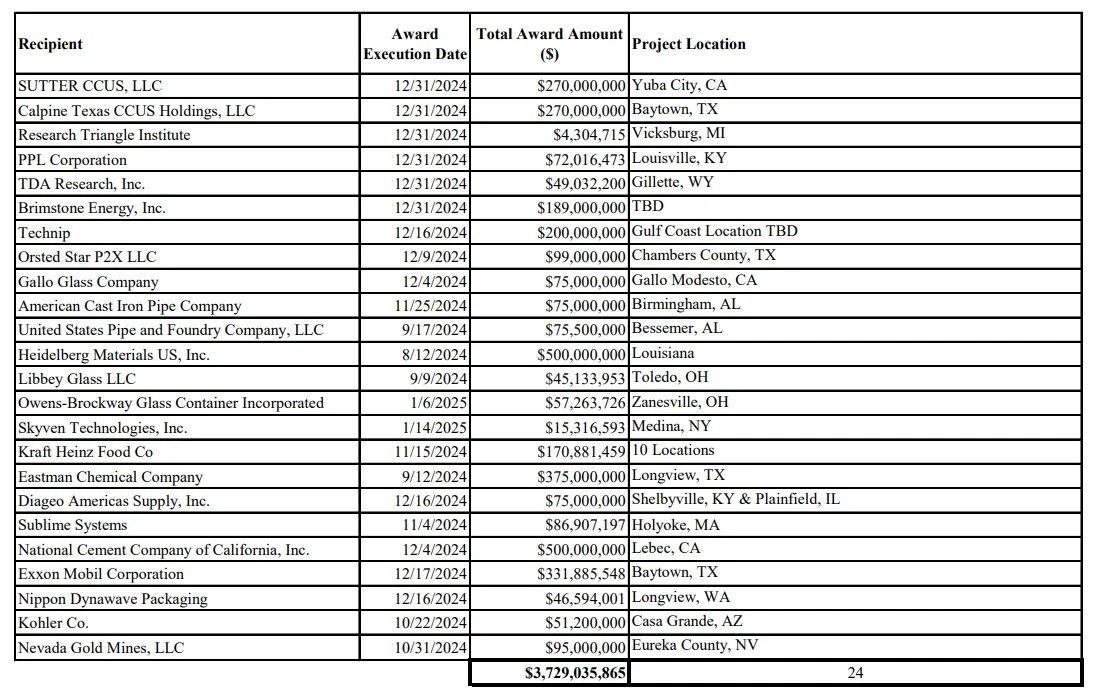
U.S. Secretary of Energy Chris Wright today announced the termination of 24 awards issued by the Office of Clean Energy Demonstrations (OCED) totaling over $3.7 billion in taxpayer-funded financial assistance. After a thorough and individualized financial review of each award, DOE found that these projects failed to advance the energy needs of the American people, were not economically viable and would not generate a positive return on investment of taxpayer dollars.
Of the 24 awards cancelled, nearly 70% (16 of the 24 projects) were signed between Election Day and January 20th. The projects primarily include funding for carbon capture and sequestration (CCS) and decarbonization initiatives. By terminating these awards, DOE is generating an immediate $3.6 billion in savings for the American people.
Flawed, rushed gold-bars-off-the-Titanic was mentioned in the press release.
“While the previous administration failed to conduct a thorough financial review before signing away billions of taxpayer dollars, the Trump administration is doing our due diligence to ensure we are utilizing taxpayer dollars to strengthen our national security, bolster affordable, reliable energy sources and advance projects that generate the highest possible return on investment,” said Secretary Wright. “Today, we are acting in the best interest of the American people by cancelling these 24 awards.”
Some background was provided:
Earlier this month, DOE issued a Secretarial Memorandum entitled, “Ensuring Responsibility for Financial Assistance,” which outlined DOE’s policy for evaluating financial assistance on a case-by-case basis to identity waste of taxpayer dollars, protect America’s national security and advance President Trump’s commitment to unleash affordable, reliable and secure energy for the American people. DOE utilized this review process to evaluate each of these 24 awards and determined that they did not meet the economic, national security or energy security standards necessary to sustain DOE’s investment.
The list from Utility Dive involves 24 rent-seeking, crony companies:
Let the lesson be clear. Avoid political bribes intended to get a company to do what consumers do not want done. Respect taxpayer neutrality. Value economic freedom. Pursue good profit, not bad.
I don’t know how it’s been in other countries so far this year, but in Germany it seems a number of German weathermen have been getting acutely aroused every time a model sees a heat wave in the pipeline 2 weeks out. The media make headlines out of them.
Image generated by Grok
Of all people, you’d think meteorologists would know the huge uncertainties these models have beyond 7 days. But, when you’re desperate for attention, you might succumb to the temptation to take them as being real enough and have yourself quoted in the press.
Germany has seen an unusually dry spring this year. This has likely raised hopes of a hot summer. The DWD German national Weather Service reports that spring 2025 in Germany was 0.9°C warmer than the 1991-2020 reference period. One reason for the warmth was unusually sunny weather. Spring 2025 in Germany saw 695 hours of sunshine, around 33% more than the reference period 1991-2020 (522 hours) mean.
The plentiful sunshine meant lower precipitation. Spring 2025 in Germany was the third driest on record. Only 96 liters of rain fell per square meters.
Spring has aroused forecasters
The warm dry weather has definitely aroused many of Germany’s weathermen, who are now caught up in full blown record-heatwave summertime fantasies. Lost from memory are the months of heavy rainfall seen from late 2023 to the end of 2024.
Over at German Weather Channel here, Jan Schenk suddenly warned of “a 100-year summer” with temps soaring to 40°C in Germany. “One of the hottest summers ever is in the cards at 70 to 100%.”… “The previous summer of the century in 2003 could soon be replaced.” … “Over the course of the summer, a heat dome will form over south-eastern Europe, which will also spread to Germany. This means that we can expect a lot of high pressure and sunshine – and little rain. The highs will not stop at 30 or 35 degrees. We can already assume that the 40 degree mark will be exceeded several times in the summer of 2025. And the first heatwave in Germany will already appear in June.”
It’s important to point out that many weathermen today no longer forecast the weather, but instead simply report spectacular scenarios that models invariably churn out.
20°C could mean 40°C!
Over at Wetter.net, meteorologist Dominik Jung said the European Weather Model (ECMWF) is showing a“massive high altitude heat” for June 9, “Down on the ground, that would mean more than 35 degrees, maybe 38, 39, maybe almost 40 degrees,” says Jung.
So far, however, the ECMWF model is showing no such heat for early June. We can only speculate that Jung’s forecast has its origins in overly active fantasies.
So what will become of Germany’s summer? A hot one of course cannot be excluded. But to claim a near record hot summer is 70-100% sure is nothing but meteorological attention seeking and headline-grabbing.
Discover more from Watts Up With That?
Subscribe to get the latest posts sent to your email.
A nonprofit organization bankrolled by numerous Chinese Communist Party (CCP)-linked entities advocated for a New York law that authorizes the state to charge energy companies billions for their roles in climate change.
The Chinese-American Planning Council (CPC) is a New York nonprofit that has received over $1.4 million in taxpayer funds since 2022, in addition to significant funding from Chinese government-linked sources in recent years, as the Daily Caller News Foundation previously reported. The CPC supports New York’s climate superfund law, which would require energy companies to cough up $75 billion combined over time to fund green initiatives, in addition to a number of other bills and programs favored by Democrats, according to its website.
“The Chinese-American Planning Council (CPC) is not just another advocacy group, it’s a conduit for CCP-linked money and influence in the heart of our country. When you read ‘CPC,’ you should think ‘CCP,’” founder and CEO of State Armor Michael Lucci told the DCNF. “CPC has a long record of supporting malicious policies that run contrary to our interests. It should come as no surprise that the CPC supports New York’s massive climate slush fund, which would jack up energy costs while weakening America’s energy security.” (RELATED: New York Rolls Out ‘Shakedown’ Law Forcing Companies To Atone For Climate Change With Cash)
“This isn’t just bad policy — it’s Beijing’s playbook, operating through a range of front groups, proxies, and influence operations to undermine our sovereignty,” Lucci continued. “Every lawmaker who backs this scheme is playing into the hands of the CCP’s geopolitical strategy. If we’re serious about protecting national security and energy independence, we must treat CPC–backed initiatives as CCP-backed initiatives, which are always malicious influence operations against America.”
The CPC submitted written testimony for a January 2024 joint legislative public hearing on New York’s budget proposal advocating for the superfund law, and the group also characterized the bill’s failure to make it into the budget in April 2024 as a “shortcoming.”
Since 2018, the CPC has received up to $445,969 in donations from sources linked to the Chinese government, according to financial records previously reviewed by the DCNF. State-run corporations — including the Industrial and Commercial Bank of China (ICBC) and the Bank of China — have financially supported the CPC in recent years, records show.
The ICBC donated almost $20,000 to the nonprofit across 2018, 2019 and 2023, according to the CPC’s annual reports, and the Beijing-based and state-owned Bank of China gave as much as $9,999 in 2020 and up to that same amount in 2024 to the CPC, the nonprofit’s annual reports show.
The CPC has accepted funds from multiple other organizations that have ties to the CCP, the DCNF previously reported.
Democratic New York Gov. Kathy Hochul signed the climate bill in December 2024, enacting a law that will require energy companies to pay billions to the state over 25 years to atone for their supposed roles in causing climate change. The new law rests on shaky legal foundations and functions as a state revenue grab that, if fully implemented, is likely to increase consumer costs, energy and legal experts previously told the DCNF.
Hochul’s office says that the state will use the funds extracted from energy companies under the law to pay for projects that will enhance the state’s “resiliency to dangerous climate impacts.” Some of the projects to be funded by the law include upgrades to drainage systems, refashioning buildings to be more green and developing “green spaces” in urban environments, according to the law’s text.
Upon signing the bill, Hochul’s office proclaimed that the new superfund law will “[shift] the cost of climate adaptation from everyday New Yorkers to the fossil fuel companies most responsible for the pollution.” If the law is fully implemented, the financial burden on energy companies will ultimately lead to increased costs for the consumers, critics told the DCNF at the time of the bill’s enactment.
The CPC has also backed other policies that hinder domestic energy production in addition to purportedly advising illegal migrants on how to defy immigration laws.
“There is an urgent need to invest in our community well-being and safety through building climate resilient infrastructures and systems,” the CPC’s website reads.
It continues to argue for the passage of the Climate, Jobs, and Justice Package for the sake of “marginalized communities,” which includes the superfund law as well as the NY Home Energy Affordable Transition Act and the Just Energy Transition Act. The NY Home Energy Affordable Transition Act seeks to “[align] utility regulation with state climate justice and emission reduction targets” and the Just Energy Transition Act would “provide a blueprint to guide the replacement and redevelopment of New York State’s fossil fuel facilities and their sites by 2030,” according to the bill text.
The CPC supports efforts to “decarbonize New York and transition into renewable energy that will allow all New Yorkers to live in a safe and healthy environment,” the nonprofit’s website states. New York has historically supported green energy mandates that threaten the reliability of its power grid, several grid experts previously told the DCNF.
The nonprofit’s site goes on to list support for increasing taxes on corporations to fund left-leaning social programs, universal health care and shelling out $500 million in taxpayer funds on a program for illegal migrants.
The CPC, the Chinese Embassy, Hochul’s office, the ICBC and the Bank of China did not respond to the DCNF’s requests for comment.
All content created by the Daily Caller News Foundation, an independent and nonpartisan newswire service, is available without charge to any legitimate news publisher that can provide a large audience. All republished articles must include our logo, our reporter’s byline and their DCNF affiliation. For any questions about our guidelines or partnering with us, please contact licensing@dailycallernewsfoundation.org.
Discover more from Watts Up With That?
Subscribe to get the latest posts sent to your email.
In a rare but resounding act of judicial sanity, the Supreme Court of the United States has delivered an 8-0 ruling that reins in one of the most abused weapons in the bureaucratic arsenal: environmental obstructionism. The case, Seven County Infrastructure Coalition v. Eagle County, stemmed from a challenge to a planned railway in Utah, a project that environmentalists attempted to kneecap through endless litigation under the National Environmental Policy Act (NEPA). In a time when green tape has been weaponized to stall or cancel everything from pipelines to housing, this decision marks a turning point—and it’s worth celebrating.
Let’s start with the heart of the ruling. Writing for the majority, Justice Brett Kavanaugh emphasized that,
“NEPA does not allow courts, ‘under the guise of judicial review’ of agency compliance with NEPA, to delay or block agency projects based on the environmental effects of other projects separate from the project at hand”.
Translation: judges can’t play fortune teller and block infrastructure because of speculative “ripple effects” on theoretical future projects. In other words, environmental lawfare just hit a serious snag.
But the Court decisively said no. Agencies aren’t expected to possess clairvoyant powers. As Kavanaugh clarified,
“The fact that the project might foreseeably lead to the construction or increased use of a separate project does not mean the agency must consider that separate project’s environmental effects”.
It’s worth pausing to appreciate the magnitude of this decision. The ruling wasn’t 5-4. It wasn’t even 6-3. It was 8-0, with Justice Neil Gorsuch recusing himself. That means even Justices Sotomayor, Kagan, and Jackson—all of whom joined a concurring opinion—recognized the madness of allowing environmental review to be expanded into an all-purpose tool for litigation and delay.
Predictably, the Chicken Littles of climate alarmism are already wailing. Rep. Diana DeGette (D-Colo.) declared,
“This decision lays the groundwork for an environmental catastrophe. As the harsh impacts of the climate crisis increase the vulnerability of the Colorado River, the risk of an oil spill along this train route is unacceptable.
Increasing fracking levels and transporting them across the country would not only harm the communities through which the train travels, including those in Denver, but it would further devastate the communities surrounding the facilities where this oil would burn.”
and fretted over the hypothetical risk of oil spills along the train route. But this sort of fear-mongering is precisely what the Court’s decision seeks to restrain. If every project can be blocked based on what might happen in an alternate timeline, then no project would ever move forward.
And make no mistake: that’s the goal for many green activists. NEPA, once a procedural statute meant to inform agencies, has become a cudgel to halt development. Environmental impact statements now stretch to thousands of pages, often taking years—and millions of dollars—to complete. These reviews are less about stewardship than obstruction, used by opponents of any development as a bureaucratic chokehold.
As Justice Kavanaugh rightly stated, courts are not meant to
“micromanage those agency choices so long as they fall within a broad zone of reasonableness”.
This ruling reinforces that principle and restores a shred of common sense to environmental regulation.
This decision also arrives at a time when the American economy is gasping for infrastructure upgrades—bridges, pipelines, rail, transmission lines. All of it. Yet too often, federal judges acting as philosopher kings have halted projects based on the flimsiest environmental pretexts. In recent years, judicial overreach has been the favored tactic of climate warriors who couldn’t get their agenda passed through Congress.
With this ruling, it has taken a welcome stand against the activist judiciary and the technocratic delusion that every consequence of human progress must be mitigated in advance.
Now, let’s be clear: this isn’t about ignoring real environmental issues. But it is about proportionality, reason, and the rule of law. No society can function—much less thrive—under a regime where every project is presumed guilty until proven environmentally pure by a thousand bureaucrats. NEPA was never intended to be a veto power for anti-development zealots.
The Supreme Court’s decision in Seven County Infrastructure Coalition v. Eagle County represents a triumph of logic over litigious lunacy. It affirms that federal agencies—not judges and not activist groups—are responsible for environmental assessments, and that their discretion should be respected unless they act irrationally.
For too long, infrastructure has been hostage to hypotheticals, paralyzed by process. This ruling loosens those chains. And that’s a victory not just for Utah’s railway, but for every American who still believes in building things.
Here’s to the rare sound of a gavel striking in favor of progress.
Discover more from Watts Up With That?
Subscribe to get the latest posts sent to your email.


 Iowa Climate Science Education